I Asked ChatGPT vs I Logged Into My Local Mycelial Network
Why is this AI ML meme funny?
Level 1: Fancy Computer vs Friendly Mushroom
Imagine you have a big question or problem, and you can either ask a super smart computer or ask Mother Nature. In this meme, one person uses the super smart computer – kind of like using Google or Siri – to get an answer (that’s what asking ChatGPT is like). The other person does something totally unexpected: they go into the garden and consult a giant friendly mushroom as if the mushroom is a computer that can talk. 😊 It’s a bit like one kid bragging, “I got a robot to do my homework,” and another kid replying, “Oh yeah? I got the magical forest to do mine!” This is funny because, of course, mushrooms (and snails and forests) don’t actually solve math problems or answer questions for you in real life. The joke is in the absurd comparison: a high-tech solution versus a whimsical nature solution. It’s as if someone said their pet snail and mushroom are smarter than a whole internet full of computers – a silly idea that makes us laugh. The feeling of the meme is playful and imaginative: it reminds us of a child pretending that fairies or talking trees help them with chores, while another child might use a fancy gadget. In the end, it’s humorous because it mixes something very modern and fast (an AI on the internet) with something very natural and slow (a mushroom in the ground) and pretends the natural one is better. It’s like saying the old, magical way beats the new fancy way, just for giggles. Even a kid can sense how goofy that is – and that’s why it’s amusing!
Level 2: Mushrooms vs Machines
Let’s break down what’s happening in this meme in more straightforward terms. On one side, we have ChatGPT, which is a very advanced AI language model (think of it as a super-smart chatbot) usually running on powerful computers in the cloud. Cloud just means those computers aren’t in your house – they’re in big data centers accessible via the internet. When someone says “I asked ChatGPT,” they mean they typed a question or task into this AI and got an answer, as if consulting a digital expert. By 2025, ChatGPT (and similar AI) has become super popular in tech – people use it to get code suggestions, troubleshoot problems, or even generate jokes. It’s part of the whole AI buzz that’s everywhere (AI_ML hype). So, in the meme text, one person says: “i asked chatgpt”, implying they went to this trendy AI for help or information.
Now, the punchline: the other person responds, “ok well i logged into my local mycelial network.” This sounds like a perfectly normal tech response until those last two words: mycelial network. Let’s clarify that term. Mycelium is the term for the thread-like part of a fungus (the stuff a mushroom grows from). If you’ve ever seen white stringy fibers under a rotting log or in soil – that’s mycelium. It’s essentially the roots of a mushroom, and these threads can spread out huge distances, connecting with other mycelium threads. In forests, mycelium from fungi actually links plant roots in what scientists nicknamed the “wood wide web,” because it behaves a bit like an underground network connecting trees and mushrooms. Nutrients and chemical signals pass through it (for instance, a tree that gets more sun might share extra sugars via the fungus to a shaded tree, or a plant under bug attack might send a warning through these fungal connections). So in literal terms, a mycelial network is a natural network of fungus threads in the ground. It’s a real biological thing, but it’s not a computer network you can normally log into with a keyboard! That’s where the humor is – the meme treats it as if it were just another IT system. Saying “I logged into my local mycelial network” is constructed like a technical statement (similar to “logged into my local network server”), which catches us off guard because nobody logs into a fungus. It’s mixing tech-speak with biology in a deadpan way.
So why would someone even joke about a fungus network instead of using an AI? It helps to understand how this meme is poking fun at current trends. AIHypeVsReality is a tag that hints at what’s going on: there’s a lot of hype around AI like ChatGPT, and sometimes reality doesn’t live up to it or it gets a bit over-the-top. The meme humorously suggests an alternative that is even more hyped and out-there as a way to satirize the situation. In simpler words, it’s like they’re saying, “Everyone’s so obsessed with this fancy AI, but look, I’ve got something even crazier and more natural – a bunch of mushrooms wired up to answer my questions!” It’s not actually true, of course; nobody literally has a mushroom answer machine. The joke exaggerates to make a point about how every new tech trend (in this case, AI) can seem a bit ridiculous, so we double down with something purposely ridiculous to laugh about it. It falls under AIHumor/TechHumor because it’s using our familiarity with AI and mixing it with an outlandish concept (organic computing) for comedic effect.
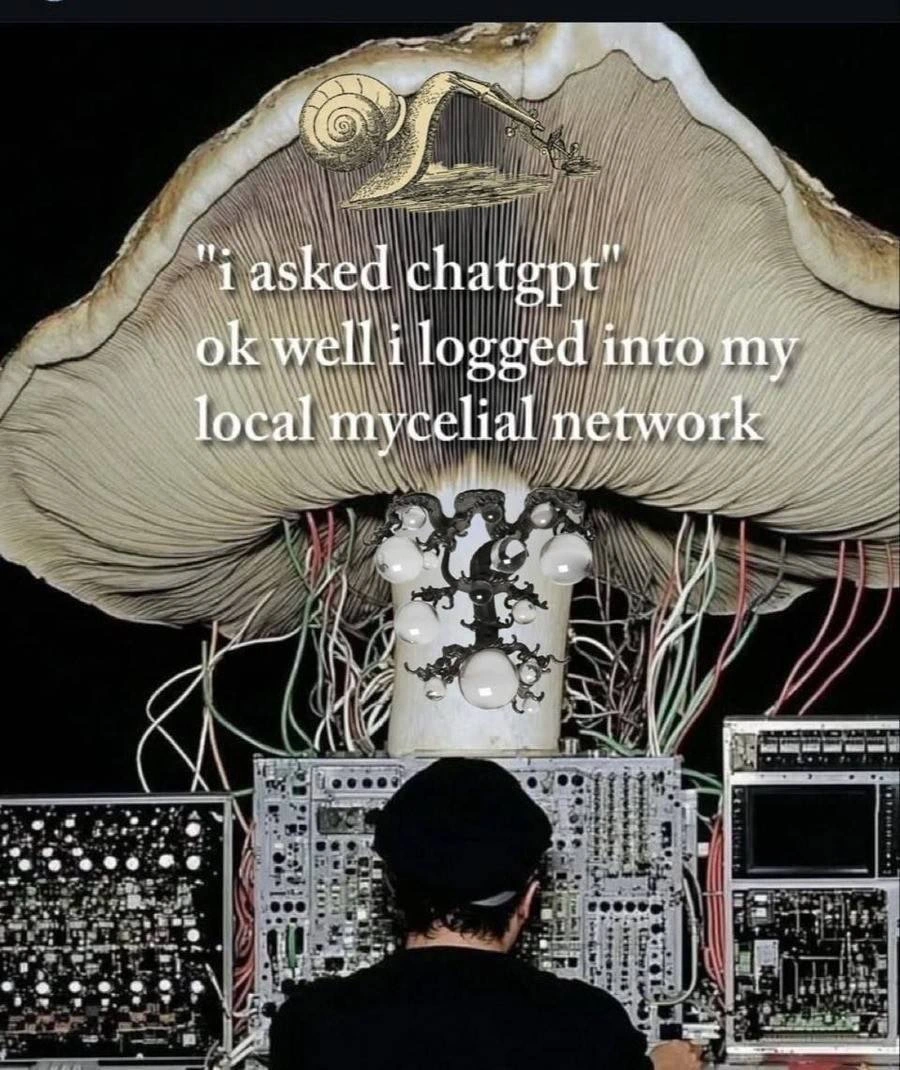
Now look at the image details described: We have an engineer sitting in front of old-fashioned electronic equipment with analog patch panels and cables everywhere. Those panels full of knobs, sockets, and wires – think of an old telephone switchboard or a synthesizer with all the cables. In early computing and electronics, to direct signals or “program” the system, you had to literally plug wires from one circuit to another. It’s like a manual control center. Here, they’ve taken that aesthetic to depict the guy manually connecting to a mushroom. The curly multicolored cables from the gear go up into the stem of a gigantic mushroom overhead. The top of the image is the underside of the mushroom’s cap, with all the gills (the frilly part under a mushroom cap) visible. Interestingly, those gills along with the cables look similar – as if the cables are just continuing up and becoming fungal mycelium. Visually, it says “we have merged the machine with the mushroom.” The text on the image – “i asked chatgpt” / “ok well i logged into my local mycelial network” – is placed right on that mushroom cap, making it clear that the mushroom is the network being talked about. The whole scene is surreal: normally, data centers (the facilities that run cloud services like ChatGPT) are rows of servers with blinking lights. Here, the “data center” is portrayed as a living organism (hence the post title joking about a fungal data center). It’s like nature’s version of a server farm (pun intended, since mushrooms can be farmed!).
The small snail illustration near the top adds an extra layer to the joke. Snails are famously slow, so in tech jokes, we often use the snail to symbolize slowness or outdated methods (for example, calling physical mail “snail mail” because it’s much slower than email). By placing a snail on this “mycelial network,” the meme hints: This is cool and all, but it probably runs very slowly! It’s a self-aware joke: ChatGPT on the cloud can respond in seconds, while a mushroom network, if it were real, would be painfully slow (imagine waiting hours for your fungus to “compute” an answer – the snail is essentially saying “don’t hold your breath”). The snail image is drawn in a Victorian engraving style, which also gives the meme a quirky vintage feel, like an old science fiction illustration. That feeds into the contrast: ChatGPT represents cutting-edge 2020s technology, whereas a snail and analog electronics evoke centuries-old or decades-old tech. It’s nature vs. technology and also old vs. new, all jumbled together intentionally.
Let’s clarify some of the tags and context terms in plain language:
- ChatGPT / LLM (Large Language Model): ChatGPT is an AI program that understands and generates human-like text. It’s called a large language model because it was trained on tons of text data. So think of it as a very sophisticated autocomplete that can answer questions, write essays, or help with coding, running on huge computer servers.
- Cloud vs. Local: Cloud computing means you’re using someone else’s computers over the internet (like renting computing power from Google, Amazon, or OpenAI’s servers). Local means on your own machine or network. In the meme, “local mycelial network” humorously implies this person has their own private setup (the mushroom in his vicinity) rather than using the remote cloud. It’s like saying “I’m not using a public service; I have my own homemade version right here.”
- Mycelial network / organic_distributed_systems: We explained mycelial network as fungus fibers connecting organisms. Calling it a distributed system is borrowing computing language to describe it: a distributed system is multiple computers working together on a problem. So an organic distributed system would be multiple living things acting together like a computer. It’s not a common term you’ll find in textbooks, more a playful concept, but here it fits the joke: the mushroom and its mycelium are acting like a cluster of computers on a network.
- Mushroom_computing / nature_vs_ai / alt_intelligence: These tags reflect the theme: using nature (mushrooms) as an alternative form of intelligence or computing. “Alt intelligence” meaning alternative intelligence – the meme imagines the fungus as another kind of intelligent network versus the artificial intelligence of ChatGPT. It’s a sci-fi-ish idea. In real life, people do study intelligence in nature (like how ant colonies solve problems or how slime molds navigate), and once in a while you hear of experimental “biocomputers.” But nothing like a giant mushroom that can replace your laptop – that’s purely humor… for now!
- IndustryTrends_Hype: This refers to how in the tech industry, certain trends get massively hyped. AI is one of those trends. Everyone starts talking like it’s the solution to everything. The meme is teasing that phenomenon by introducing an even more hyped-sounding “trend” (mushroom networks!) ironically.
For a newer developer or someone early in their tech journey, the imagery and lingo might seem bewildering, so it helps to analogize: It’s basically saying “You used a fancy online AI? Well, I used a super-natural organic computer I grew myself!” It’s akin to someone bragging about using the latest iPhone, and you respond by pulling out two tin cans connected by a string and saying, “I have my own device, thank you.” It’s absurd and funny because clearly the two things are not on the same level. The person claiming the local mycelial network is “beating” the cloud is purposely overstating – that’s the sarcasm. In everyday terms, it’s like:
- ChatGPT/cloud solution: Using a huge library or Google to find an answer quickly.
- Mycelial network solution: Going into your garden and consulting nature (like asking a tree or mushroom) for the answer.
One is real and efficient, the other is imaginative and would be incredibly slow (if it worked at all). The meme makes them sound comparable just to be funny.
To illustrate the differences clearly, let’s do a side-by-side comparison in a light-hearted way:
| ChatGPT Cloud (AI on the Internet) | “Mycelial Network” (Mushroom setup) |
|---|---|
| Runs on thousands of powerful silicon chips in data centers worldwide. ⚡️ | “Runs” on thousands of fungal threads (hyphae) spread through soil. 🌱 |
| Responds in seconds with text answers or code suggestions. ⏱️ | Would respond super slowly (hours, days?) via subtle biological signals. 🐌 |
| Relies on electricity, binary data, and well-defined algorithms. 🔌 | Relies on chemistry, growth patterns, and Mother Nature’s unpredictability. 🍄 |
| High-tech, current trend – everyone’s talking about it. 🤖 | Fantastical, not a real tech trend (a playful idea merging biology and tech). 🧚♂️ |
| Example: “I used ChatGPT to debug my code.” ✅ | Example: “I hooked electrodes to my garden mushroom for advice.” (Definitely a joke!) 😂 |
As you can see, the two columns are ridiculously different! The table makes it obvious that using a mushroom as a computer is not something you’d actually do to beat an AI – and that’s exactly the point of the meme’s humor. It’s highlighting the absurdity by treating the mushroom network like it’s on par with a cloud supercomputer, which it isn’t (in reality, it’s not even a thing).
One more element: the text says “mycelial network beats ChatGPT cloud.” Of course, this isn’t literally true in performance; it’s a sarcastic flex. It’s like claiming your pet snail is faster than a sports car just to be funny. The meme is the developer jokingly bragging that his weird, personal setup (some imaginary fungal network) outshines the massively funded AI. This taps into a sort of developer humor about hacking together quirky solutions. Sometimes, developers do create clever homemade alternatives (for example, someone might rig up a Raspberry Pi to monitor their plants instead of buying a fancy device). Here it’s just taken to a comical extreme.
Finally, it’s worth noting that while no one is actually replacing cloud AI with mushrooms, the meme does hint at real “nature-inspired computing” ideas. Scientists have indeed experimented with things like biological circuits (using living cells to compute), DNA computing (using DNA strands to solve math problems), and using living organisms like slime mold to find optimal paths (since slime molds naturally find efficient routes to food sources). These are niche research topics, but they fire the imagination. A junior dev might not have heard of these, but it’s a fascinating crossover of biology and tech. If nothing else, this meme might prompt you to Google “slime mold computer” for some cool science tidbits! But keep in mind, those are experimental – we won’t be coding on mushrooms in our day jobs anytime soon. The meme’s scenario is firmly in the realm of humor and science fiction.
In summary, at this level: The meme contrasts ChatGPT, an advanced AI tool running on cloud servers, with a mycelial network, a network of mushroom fibers, as a comedic alternative computing platform. It uses lots of visual and verbal puns (mushroom as data center, snail indicating slowness) to poke fun at the current AI craze. Even if you’re new to tech, you can appreciate the silliness – it’s basically saying, “Instead of using a fancy new technology that everyone is hyped about, I used something totally old-school and natural… and it’s superior! (wink wink).” It’s a joke about tech trends, dressed up in a very imaginative picture. If you understand that, you get the heart of the meme. And hey, you also learned a quirky fact about fungi networks along the way! 🌱🤖
Level 3: The Wood Wide Web
At a more tangible level, this meme brilliantly spoofs the current AI hype cycle by imagining a developer who has decided to go even more cutting-edge (or off the edge) than everyone using ChatGPT. The setup is a classic one-upmanship gag: Friend 1: “I asked ChatGPT,” Friend 2: “Oh that’s cute, I logged into my local mycelial network instead.” It’s the kind of deadpan absurd claim that makes seasoned engineers smirk. After months (or years) of hearing “ChatGPT this, ChatGPT that” as the solution to everything, the meme’s protagonist pretends to trump it with something even more exotic – a fungal data center in his own backyard. The humor lands because it exaggerates the tech trend to the point of surrealism. It’s as if someone responded to “I use the cloud” with “Well, I use literal clouds harnessed by rainforest shamans to run my code.” Here it’s mushrooms instead of cumulonimbus, but the idea is the same: lampooning the AI_ML craze by positing an “even cooler” alternative that’s completely outlandish.
For context, ChatGPT (an AI chatbot from OpenAI) became the poster child of tech hype in the 2020s. Everyone from CEOs to newbies was touting how Large Language Models would revolutionize coding, writing, you-name-it. In developer circles, saying “I asked ChatGPT to help with this bug” became commonplace. Some developers embrace it, others roll their eyes at the over-reliance. This meme speaks to that fatigue: it jokes, “Forget asking the fancy cloud AI, I’m plugging into something more down-to-earth – literally, the earth (via fungus)!” It’s a playful jab at how ridiculous the hype can feel. An experienced dev might chuckle, thinking, “Ha, given how some people treat ChatGPT like an oracle, we might as well consult a mushroom oracle next.” The phrase “logged into my local mycelial network” is written in perfect tech lingo, which makes it hilarious – nobody expects the words “login” and “mycelial network” in the same sentence during a serious discussion. Logging into a network usually means SSH-ing into a server or joining a Wi-Fi. Here it sounds like this engineer opens a terminal and types something like ssh [email protected] to access his mushroom-powered server. The absurd image of a command-line interface for a giant mushroom is precisely the kind of geek humor that hits home for those of us who work with servers and networks. It’s combining two worlds that never meet: sysadmin meet shaman.
The visual composition amplifies this joke with rich details. The engineer in the foreground, wearing a black beret, sits before banks of dense analog equipment – it looks like a cross between a 1970s telephone switchboard and a modular synthesizer. To seasoned eyes, those patch-panels and knobs are nostalgic tech. They hark back to an era when computing and signal processing meant manually routing cables – think of early telephone operators or the ENIAC computer where human “operators” literally moved wires to reprogram it. Or in music, a Moog synth where you patch cords to shape sounds. This analog retro-tech aesthetic contrasts sharply with today’s sleek, invisible cloud computing. Seeing those cables run up and vanish into the gills of a colossal mushroom is a visual punchline: it’s as if the fungus has become the motherboard, and its mycelium strands are the new network cables. A senior dev might half-jokingly think, “Did we just revert from server racks to spore racks?” The image screams steampunk meets cyberpunk: Victorian snail engravings and chandeliers fused onto a biologically augmented mainframe. That snail at the top is no random clipart – it’s an old-timey illustration that adds a dash of antiquity and hints at snail mail. In tech slang, snail mail is the opposite of email – regular postal mail, notoriously slow. By slipping a snail into the “data center,” the meme winks: this might be high-tech nature, but it’s probably slow as a snail. It’s a cheeky visual pun on latency. An experienced viewer catches that and appreciates the multi-layered pun: cloud vs. snail mail, modern vs. vintage, fast vs. slow. (Perhaps the snail is also a nod that this system uses a shell – quite literally a snail shell 🐌 – as its UI! The idea of a snail providing a command shell for a mushroom OS is the kind of absurd detail that causes a double-take and a groan-laugh from the Unix-savvy.)
Beyond the puns, why does this resonate specifically with developers and industry folks? It’s partially because we recognize the hype-and-backlash pattern. We’ve seen waves of “This new tech will solve everything!” before – from Big Data to Blockchain to Cloud – and each time, contrarians or satirists respond with humor. ChatGPT and AI are amazing, yes, but they’re also a bit over-sold as magical. So here comes the tongue-in-cheek response: “Oh you have AI? I’ve got BI – Biological Intelligence as a Service.” It’s poking fun at our tendency to treat new tech almost like mysticism. The meme basically says, “You think a neural network in a data center is cool? Hold my beer, I’m about to hot-plug into Mother Nature’s neural network.” For a battle-scarred engineer who’s survived NoSQL vs SQL debates and Cloud vs On-Prem wars, this is peak parody. It satirizes the notion that the solution to every problem must be something new and trendy – by picking something so new-and-trendy-seeming (mushroom computing?!) that it’s obviously ridiculous. Yet, it’s delivered with a straight face, which is comedic perfection.
There’s also an element of DIY ethos and independence that senior devs appreciate. In the meme, the developer isn’t relying on OpenAI’s cloud or any corporate service; he’s literally built his own “organic cluster” at home. This feels like the ultimate self-hosted project taken to a crazy extreme. Many developers have a streak of wanting to control their own tech stack (“I run my own servers instead of using the big cloud providers,” or “I forked that library to have my custom version”). Here, our meme hero has taken that to the point of parody: he’s not just self-hosting software, he’s self-growing hardware! It’s a fun exaggeration of the hacker spirit – why buy a supercomputer when you can grow one in your garden shed? It also subtly mocks the idea of trusting something as complex as ChatGPT: maybe this dev is implying, “I trust my open-source mushroom more than a closed-source AI.” It’s absurd, but it echoes real concerns about relying on big tech. Some of us have joked, “I’d rather use two cans and a string than trust that new proprietary API,” and here we have essentially two cans and a mycelial string. The fact that it’s “local” (emphasized by local mycelial network) implies it’s under his control, not some remote cloud. That wording tickles anyone who’s set up a Local Area Network (LAN) – it’s a classic tech phrase, subverted by swapping in “mycelial.” It almost sounds plausible for a split second (“local mycelial network” has the cadence of a real tech term) until you actually parse it. That delayed realization – wait, did he just say mycelial? – is what triggers the laugh.
The IndustryTrends_Hype angle is strong here. We’re at a point where every conference talk, every product, wants to sprinkle in “AI” for relevance. There’s a bit of fatigue and healthy skepticism brewing. This meme captures that sentiment by ironically suggesting the next wave after AI might as well be “organic computing”. Why not? We’ve done cloud, edge, maybe the next buzzword is mushroom computing! It’s funny because it feels like something a satire site would actually write: “Silicon Valley startup announces fungal neural network – raises $50M.” In fact, a grizzled dev might recall outlandish real headlines, like using DNA for data storage or potato-powered servers. The snail and Victorian touches even evoke the cyclical nature of trends – like we’ve gone full circle back to nature and old-school tech to find inspiration. The tech historian inside many senior engineers remembers that computing wasn’t always about microchips: there were mechanical computers, analog computers, even biological experiments (NASA in the ’80s did studies on slime mold computing!). So the meme has this extra layer of enjoyment: it’s absurd, but not completely alien to the history of computing ideas. An engineer who knows about the experiments to implement # logic gates in Petri dishes or the Star Trek spore drive chuckles at the thought: “Heh, maybe in an alternate timeline, we did end up with mushroom mainframes.”
Let’s not overlook the Victorian-era snail illustration and ornate lamp-like fixtures on the mushroom’s stem. These contribute to the meme’s vibe, which seasoned nerds appreciate as carefully crafted. The snail, as mentioned, screams “snail mail” – hinting the network’s speed. It also gives the whole scene a Monty Python-esque absurdity, as if this could be a panel from an old science fiction fantasy comic. The ornate chandelier pieces attached to the mushroom’s stalk add to the steampunk fantasy: perhaps they’re hinting at a “mushroom supercomputer powered by gaslight”. For an older dev or someone who’s into retro-futurism, these details are delightful easter eggs. They set a tone that this is a jest mixing eras and genres. It’s part AIHumor, part pure imaginative art. The snail might also be a sly reference to how data was once physically carried (you’ve heard the joke about bandwidth measured in “how many trucks of tapes per day” or the RFC about using pigeons to carry data packets?). If pigeons can deliver internet (yes, IP over carrier pigeon is a real joke-turned-experiment), why not snails delivering compute cycles? A veteran might recall those stories and grin at the snail subtly endorsing “biological protocols”.
From a shared developer experience perspective, there’s also the familiar trope of solving problems by stepping away from the problem – sometimes literally going outside. Every experienced coder knows the magic of the “walk in the woods” or “rubber duck debugging”. In rubber-duck debugging, you explain your code problem to a rubber duck on your desk, and often in the process, you figure out the solution yourself. This meme plays with that idea: the engineer isn’t asking an AI or even another human; he’s effectively consulting an unconventional listener – a mushroom (and a snail) – to work through the problem. It’s as if he took rubber-duck debugging and said, “Forget the duck, I’m going to wire up an entire fungus and see if that helps!” In a way, that’s a hilarious metaphor for going back to nature to find clarity, versus relying on the hottest new digital tool. A senior developer who’s pulled an all-nighter might jokingly relate: “Yeah, at 3 AM when Stack Overflow and ChatGPT failed me, I probably would have tried communing with a houseplant if I thought it’d help fix the bug.” That absurd desperation is part of the comedic relatability. It’s the “I’ve tried nothing and I’m all out of ideas, time to try black magic” meme, but here the black magic is mushroom-sorcery.
In summary, the meme’s genius at this level is how it mixes tech metaphors and metaphysics to poke fun at industry trends. It’s simultaneously a commentary (“AI isn’t the only weird thing out there”), a parody of tech jargon (co-opting terms like network, login, data center for fungi), and a feast of nerdy references (from the Wood Wide Web science to snail mail to analog synths). For an audience steeped in tech culture, it hits multiple pleasure points. We laugh because it’s absurd, but we also nod at the underlying context: After all, today’s cutting-edge tech was yesterday’s crazy idea. Who’s to say that in some distant future, someone won’t actually harness a mycelial network for computing? The meme gives a knowing wink: we’ve seen crazier things happen in tech. Until then, when someone brags about their AI-powered app, we can jokingly retort, “Sure, but does your solution involve mushroom load-balancing? Didn’t think so.” It’s a jest that reminds us not to take the hype too seriously – and that sometimes the most refreshing perspective is found by flipping the script entirely, boldly and bizarrely, just as this meme does.
Level 4: Turing-Complete Toadstool?
At the most theoretical level, this meme hints at the wild possibility of computing with fungus. It playfully asks: could a giant mushroom network function like a cloud of GPUs powering an AI? In computer science terms, we might wonder if a mycelial network could be Turing-complete – capable of performing any computation given the right conditions. This isn’t entirely whimsical: researchers in unconventional computing have experimented with living substrates (famously, slime molds and even soldier crabs) to implement basic logic gates. If crabs moving in unison can simulate an OR gate, and slime molds can solve mazes by finding shortest paths, why not imagine a toadstool supercomputer? The meme’s giant fungus with cables could be seen as an organic analog to a massively parallel processor. Each fungal thread (hypha) might carry signals, akin to wires carrying currents. In theory, a sufficiently large and configurable network of fungus might be coached to do computations – for example, using chemical signals to represent data and growth patterns as memory. It’s a fanciful echo of neural networks: after all, both brains and mycelium are networks of interconnected fibers. Could this mushroom be running some bio-optimized algorithm in its gills? The question brings a geeky grin, because it weds a serious concept (computing substrate) with an absurd medium (a literal fungus).
In practice, of course, a mycelial network differs drastically from silicon hardware. Digital computers like those running ChatGPT operate on electricity through transistors switching billions of times per second. A fungal network operates on electrochemical pulses and growth signals that are orders of magnitude slower – we’re talking snail-mail latency (fitting, given that snail on the mushroom). Signals in plant/fungal systems propagate in the realm of millimeters per hour or slow chemical diffusion, not the near-light-speed switching of cloud datacenters. Imagine trying to do matrix multiplication when each operation travels at a snail’s pace 🐌 through living tissue – your backpropagation might finish sometime next spring! This fundamental speed limit is grounded in physics and biology: electrons zip, but ions ooze. The meme implicitly acknowledges this with the Victorian snail engraving perched atop the mushroom cap, a tongue-in-cheek nod that this organic cluster operates under a different clock cycle entirely. It’s a comical contrast between the blazing-fast parallelism of GPU cores and the glacial, analog parallelism of growing hyphae. Where a GPU cloud achieves parallelism by having thousands of cores working in tandem, a mushroom achieves it by literally extending thousands of threads through soil. Both are massively parallel systems, but one’s clock is measured in gigahertz and the other in growth rings.
Yet, there is a kernel of scientific truth: fungal mycelium can encode and transmit information in surprising ways. Advanced readers might recall the term “Wood Wide Web”, the real-life underground network where mycorrhizal fungi connect tree roots across a forest, allowing trees to swap nutrients and chemical “messages.” In distributed systems terms, it’s like a decentralized gossip network or a very slow peer-to-peer database where each tree (node) eventually syncs information (like warnings of pests or drought) via fungal links. This natural network even has rudimentary error correction – if one link is damaged, the mycelium finds new paths, much like rerouting in a mesh network. It’s fun to draw parallels: the forest’s fungal network achieves a form of eventual consistency (all parts eventually get the memo), similar to how distributed databases propagate updates. And nature’s network is fault-tolerant: break one path and information finds another route, not unlike packets on the internet re-routing around damage. Of course, comparing this to the engineered precision of cloud protocols is where the humor lies – the meme exaggerates a whisper of similarity into a full-blown alternative “data center.” Still, the analogy tickles the brain: in theory, if you could program the state of the mycelium (perhaps by applying stimuli or nutrients as inputs, and reading electrical responses as outputs), you might coax it to perform computations. The question “Turing-Complete Toadstool?” playfully asks if this mushroom could handle the same kind of universal computing tasks that a digital computer can. The honest answer: not in any practical sense. The fungal network isn’t going to be training GPT-4 on your codebase anytime soon. But conceptually, one could imagine encoding bits in the presence or absence of certain chemical signals and using fungal intersections as logic gates. It’s the stuff of experimental bio-computation research – fascinating, extremely slow, and absurdly complex to implement.
Ultimately, this level of analysis reveals why the meme’s scenario is so fantastically tongue-in-cheek. It flirts with deep ideas about computation beyond silicon. We’re reminded that intelligence and processing might not belong solely to electronics – brains prove that, and some even dub mycelium the “Earth’s natural neural network.” But beating ChatGPT’s cloud? Our mushroom mainframe would face insurmountable engineering challenges: latency measured in days, very low data rates (maybe a few bits per hour?), and difficulty in reliability and readout. The meme wears that impossibility as part of the joke – by positing an organic network that magically “outperforms” a state-of-the-art AI cloud, it highlights the almost magical thinking behind tech hype itself. It’s a nerdy reminder that for all the mathematical universality of computing (Turing completeness means you can, in theory, compute anything given time and resources), the practical constraints of real-world substrates mean not all “computers” are equal. A fungus might be theoretically capable of some computation given unlimited time (and a lot of patience with the snail-based I/O), but it’s certainly not going to generate a Python script on demand. This contrast between theoretical possibility and practical reality is exactly what makes the meme hilariously geeky at its core – it’s a collision of high tech and organic nature under the strict laws of physics, with the poor snail overseeing this impossible marriage. And for those of us who love both CS theory and a good laugh, that collision is pure gold.
Description
A surreal, psychedelic collage meme featuring a large mushroom with a snail on top, made from vintage scientific illustrations and photographs. The text reads: '"i asked chatgpt" ok well i logged into my local mycelial network'. Below, a person sits at a desk surrounded by vintage electronic equipment, circuit boards, and tangled wires that merge with the mushroom's mycelial network of roots and cables. The meme contrasts mainstream ChatGPT usage with a hipster/counterculture alternative of communing with a biological neural network, satirizing both AI hype and the pretentiousness of people who reject mainstream tech in favor of obscure alternatives
Comments
8Comment deleted
While you were fine-tuning transformers on GPUs, I was fine-tuning spores on decomposing logs. My mycelial network runs on zero electricity, has zero hallucinations, and the only thing it produces is shiitake -- which is still more useful than most ChatGPT outputs
ChatGPT is just a wrapper for the Mycelial API, but the documentation is all spores and the latency is measured in seasons
Sure, your LLM scales across Kubernetes - mine self-heals, does zero-trust via penicillin, and literally grows capacity overnight
When you ask ChatGPT for distributed systems advice and it takes 'eventual consistency' to mean achieving enlightenment through fungal spore propagation across your Kubernetes cluster
When your AI assistant starts talking about 'distributed consensus protocols' and you realize it's been reading papers on fungal networks - suddenly that O(log n) lookup time makes sense when you're literally traversing a biological graph database with millions of years of evolutionary optimization. Who needs Kubernetes when you have kilometers of hyphae handling fault tolerance?
Mycelium: the original gossip protocol, fault-tolerant across decaying nodes
My on‑prem wetware cluster is air‑gapped, avoids egress fees with spore‑based replication, and even passes CAP: Consistency, Availability, and a literal mushroom cap
My on‑prem mycelial mesh is eventually consistent, partition‑tolerant, and occasionally delicious - horizontal scaling is just adding mulch