Skip to content
DevMeme
6581 of 7435
Twitter Troll Promises Sora Codes Then Blocks Everyone Who Replies
DevCommunities Post #7214, on Oct 4, 2025 in TG

Twitter Troll Promises Sora Codes Then Blocks Everyone Who Replies

Why is this DevCommunities meme funny?

Level 1: Bait and Block

Imagine you’re at school and a classmate shouts, “I have extra cupcakes! Anyone who asks me can have one for free!” You and some friends are excited, because who doesn’t love a free cupcake? One friend goes up and very nicely says, “Hey, can I have a cupcake?” But instead of giving away a cupcake, the classmate frowns and says, “No, and you’re not allowed to ask me again!” and then turns his back on your friend. Another kid just waves hello to ask for a cupcake, and the classmate immediately shouts, “No, go away!” to that kid too.

It turns out the classmate never actually planned to share the cupcakes at all. He was just tricking everyone into coming over so he could refuse and push them away. One by one, each hopeful kid gets told off and blocked from even talking to him. It’s mean and unexpected – the opposite of what he promised. This is exactly what’s happening in the meme, but instead of cupcakes, it’s special access codes for a tech toy called “Sora,” and instead of saying “No, go away,” the person says “Blocked.” It’s funny in a silly way: someone promised a gift to anyone who asks, but then they just slam the door on every single person who tries. The surprise and exaggeration make it a joke, showing how a “free giveaway” can suddenly turn into no one gets anything.

Level 2: API Keys and Locks

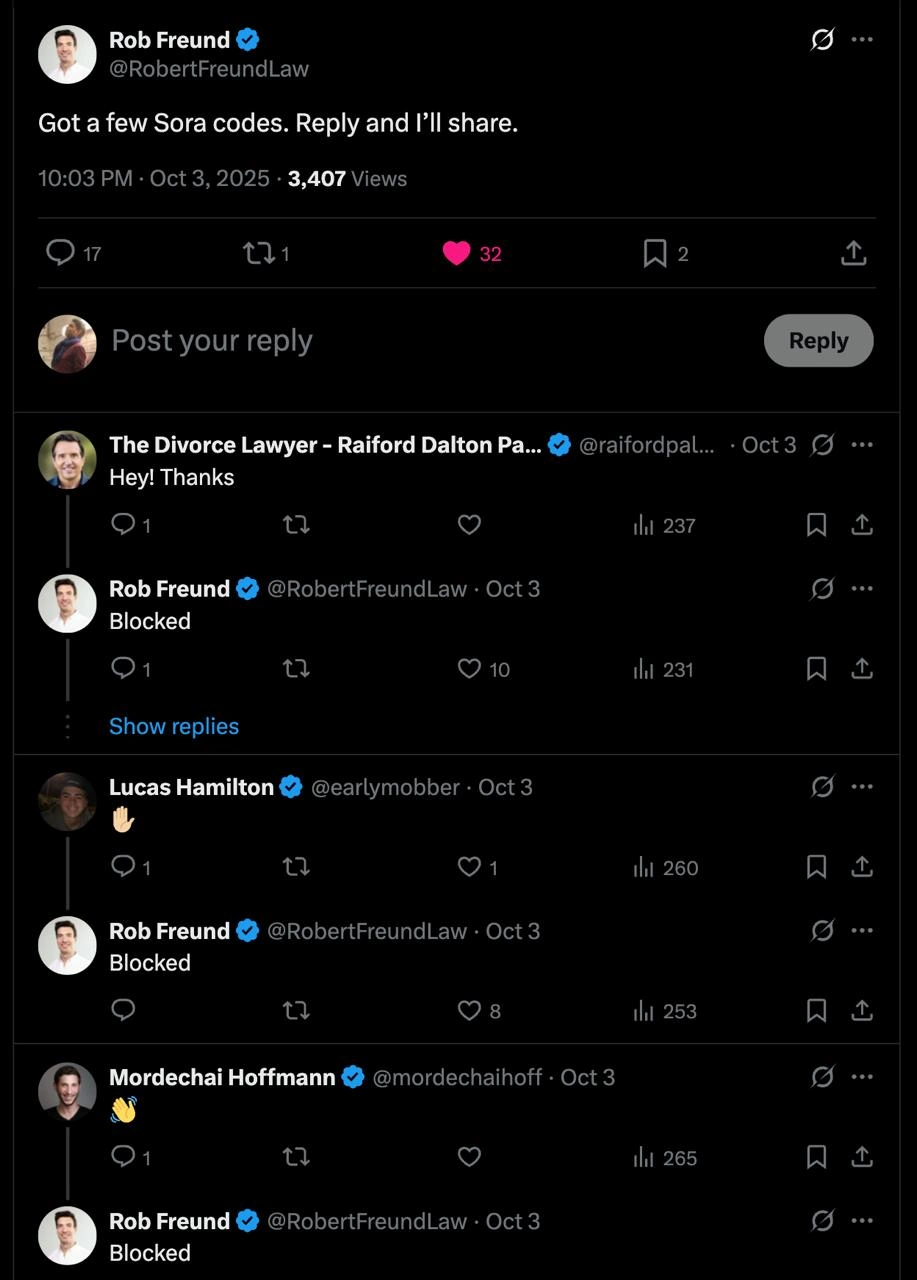
Let’s break down what’s happening in this meme in simpler terms. We have a screenshot of a Twitter (now X) thread. The first tweet is from a person saying: “Got a few Sora codes. Reply and I’ll share.” In plain English, they’re claiming: “I have some invite codes for Sora, and I’m willing to give them out. Just ask me!” Now, Sora in this context is likely a new or exclusive tech service or API that not everyone can access. Often, new developer tools or platforms release a limited number of invite codes or API keys so that only a few people can try them early. This creates excitement because everyone wants to be part of the beta and not miss out (that’s the developer FOMO, or Fear of Missing Out, kicking in).

So naturally, several people replied to that tweet, basically raising their hand to get a code. You can see their responses: one person says “Hey! Thanks” (politely showing interest), another just sends a friendly waving hand emoji 👋 (meaning “Hi, I’d like one!”). These folks are doing exactly what was asked: replying so they might receive a code. In a normal scenario, the original poster would then send them a direct message with the Sora invite or reply with a code. That’s how an API giveaway or code giveaway is supposed to work – you ask, and if you’re lucky, you get the key.

But here’s the twist: in this meme, the original poster responds to each eager reply with a single word: “Blocked.” On Twitter, blocking someone means that person can no longer follow you, see your tweets, or interact with you. It’s like slamming a door in someone’s face online. So instead of rewarding them, he’s punishing them just for asking! It’s unexpected and really harsh in a comedic way. Visually, the thread shows a pattern: each hopeful reply from a user is immediately met with “Blocked” from the original poster. It’s the same word every time, almost like an automated script or a robotic response.

Now, how does this relate to APIs and the number 403? In web development, when you try to access an API (Application Programming Interface) or a web resource, the server will give you an HTTP status code to tell you what happened with your request. HTTP 403 is a status code meaning “Forbidden” – in other words, “I see your request, but I refuse to give you what you want.” It’s what you get when you don’t have permission to access something. For example, if you try to fetch data from an API without the proper API key or token, the server might respond with a 403 Forbidden, basically saying “You’re not allowed to do that.”

So, the meme’s title “open access API giveaways turn into instant 403 responses” is comparing the Twitter scenario to a tech scenario: There’s an “open access” claim – which implies anyone should be able to get in – but in reality every attempt gets shut down immediately. Each “Blocked” reply is just like an API returning a 403 error as soon as you call it. Imagine a developer finds a new web service that says “no authentication required, feel free to use our data”, but every time they make a request, the response is 403 Forbidden. It’d be confusing and frustrating, right? That’s exactly the feeling this meme is going for, but in a social context.

Let’s define a few terms and concepts to make sure it’s all clear:

  • API (Application Programming Interface): This is like a door or interface that allows different software components to talk to each other. For example, Twitter has an API that lets developers fetch tweets or post tweets from their own apps. Usually, you need an API key (a sort of secret password) to use an API. When the tweet says “Sora codes”, think of those like API keys or invite codes that let you access the Sora service.

  • Open Access API: This would mean an API that’s open for anyone to use, possibly without needing special permission or limited invites. It suggests no strict lock-and-key – anyone can call it and get data. But sometimes companies say “open” and still enforce rate limits or require sign-ups. In the meme, “open access” is in quotes to hint that it’s not really open.

  • Invite-only beta / invite codes: When a product is in beta (testing phase) or just launching, they might not want everyone flooding in at once. So they give out a limited number of invite codes. Only people with a code can join or use the service. This creates exclusivity. Sora codes implies Sora is in this phase – you can’t use Sora unless you have a code from an insider.

  • Gatekeeping in Tech: This refers to when knowledge or access is controlled by a few and they only let certain people through the “gate”. In communities, a gatekeeper might be an expert who refuses to share knowledge, making newcomers feel unwelcome. In this meme, the original poster is acting as a gatekeeper for Sora access – but an extreme one who isn’t letting anyone through.

  • Fear of Missing Out (FOMO): Developers often experience FOMO when a hot new technology or API comes out. If only a few can get in early, everyone else worries they’ll fall behind or miss something big. That’s why people jump on giveaways and invite offers so quickly – they don’t want to be left out.

Now, the comedic effect becomes clearer: You have a bunch of developers eagerly responding to get access (they don’t want to miss out on Sora, whatever cool thing Sora is). They do what they’re told: “Reply and I’ll share.” But instead of sharing the codes, the poster effectively locks them out. Each “Blocked” is like saying “Not only will you not get a code, but I’m also banning you from even seeing my future tweets about it.” It’s an exaggerated form of gatekeeping.

For a new developer or someone early in their career, this scene might also be a little warning about the culture on tech Twitter and in dev communities. Sometimes, things that sound too good to be true (like free access for everyone!) are indeed not true. And occasionally, people will pull pranks or power moves like this just for laughs or attention. It’s a reminder that while there are very generous folks and genuinely open APIs out there, there are also trolls and very restricted APIs that say “open” but quickly rate-limit or reject you.

In real, less jokey terms, an “instant 403 response” from an API might happen if:

  • You call an endpoint that requires an API key and you didn’t provide one (or provided the wrong one).
  • The API key has expired or been revoked.
  • You exceeded some limit (and the server now forbids further calls).
  • The resource is only available to certain users or during certain times.

It’s always a bit startling to get a 403 because it feels like a door was slammed on your request. In the meme, the “Blocked” replies are exactly that sensation – door slammed, repeatedly and without hesitation, on each person who asked nicely. It’s both cringeworthy and funny, because none of us would want to be those reply guys, yet many of us have been in their shoes virtually when dealing with closed-off systems.

So, in summary for this level: The meme compares a cheeky social media stunt to the experience of trying to access something in tech that’s supposed to be open but isn’t. We covered what API keys and invite codes are (our “keys to the kingdom”), and how a 403 Forbidden status is essentially a big “NO” from a server, akin to being blocked. The humor is that the guy in the tweet turned an “open giveaway” into a series of “Nope, you’re blocked” – the exact opposite of what was advertised. For anyone who’s struggled with a “friendly” developer platform that ends up denying them access, this hits home in a comical way.

Level 3: Gatekeeping as a Service

This meme nails a classic tech community bait-and-switch. A verified user on X (Twitter) teases “Got a few Sora codes. Reply and I’ll share.” In developer terms, that’s like an API claiming to be open access – anyone can use it – if you just send the right request. Eager followers (the clients) reply with polite requests ("Hey! Thanks" 🙌 or a simple 👋), expecting to receive an invite code payload. But instead of the promised data, the “API” (original poster) returns the equivalent of an HTTP 403 Forbidden every time. Literally, he replies “Blocked.” One word, delivered instantly, to each hopeful reply. It’s a comedic visualization of an API that always responds with “Access denied.”

Seasoned engineers recognize this pattern from painful experience. It’s reminiscent of those invite-only betas and API key lotteries in dev communities that generate huge hype and then shut the door in your face. Think about the times you’ve raced to grab a limited access token for some new service, only to find out all the keys were gone or never actually given out. Here the gatekeeping is overt: the person dangled “Sora codes” as bait to drive engagement (just like companies dangle “open APIs” to lure developers), then gleefully blocked everyone who took the bait. The humor has a dark truth: in tech circles, “open access” often comes with invisible caveats or catches.

Consider how HTTP status codes work for web APIs: a 200 OK means success, 404 means not found, and 403 means “I see what you want, but no – you’re not allowed.” A lot of senior devs have hit a 403 when calling an API that was supposed to be public. Maybe the API was advertised as free or open, but all your requests returned “Forbidden” until you provided some elusive key or paid account. The meme captures that exact frustration. Each “Blocked” reply is the social media analog of a 403 Forbidden HTTP response to a hopeful client request. It’s both ridiculously literal and technically on-point:

> GET /sora-invite?reply=please
< HTTP/1.1 403 Forbidden
< Content-Type: text/plain

Blocked

Above is essentially what happened in the thread. Instead of a nice JSON with an invite code, the “server” responds with plain “Blocked”. As a senior developer, you can’t help but smirk – we’ve all dealt with gatekeeping in tech. Maybe you remember the days of Gmail invites (back in 2004 you needed a friend’s invite to sign up for Gmail) or more recently the scramble for early API access tokens for AI platforms. Those who had connections or quick reflexes got in; everyone else got errors or silence. The tweet’s author is spoofing that scenario, acting as the ultimate gatekeeper: every request is denied.

This resonates in the dev world because it highlights a mix of FOMO (Fear of Missing Out) and frustration that so many of us know. A new API or dev tool drops and says “sign up, open for all!”, but then you discover it’s actually an exclusive club. Maybe the documentation says “open beta” but the response is {"error": "InviteRequired"} – effectively a 403. Or a company’s devrel tweets “We’ve got free credits for whoever wants!” and by the time you reply, they’re all gone (or it was a stunt to gain followers). The relatable humor here is in that instant reversal of expectations: the dev community is primed to expect either genuine sharing or maybe a slow response, but immediate blanket blocking is so over-the-top that it parodies all the less-obvious forms of gatekeeping.

From an industry perspective, this also pokes fun at how social media “giveaways” sometimes serve the giver more than the receivers. Companies and influencers promise open access or freebies to get engagement metrics (replies, retweets, likes) – basically free marketing. But the participants often walk away empty-handed, or in this case, worse than empty-handed (imagine being literally blocked from the conversation). It’s a cynical commentary: the house always wins. Here the original poster got what they wanted (attention, clout, maybe a laugh) and the reply guys got nothing but the boot. Senior devs chuckle because it’s an exaggeration of what we suspect anyway: those “reply and I’ll share” posts can feel rigged or insincere. This meme just strips away the pretense and shows an API giveaway where the only response code is 403.

In practice, real-world scenarios have felt this cruel (if less explicit). For example, consider a developer conference that advertises a “community ticket giveaway”, then quietly gives them all to insiders – everyone else who applied just gets a form rejection. Or the time an online API promised “open access to our data” but as soon as devs signed up, they hit a wall of “upgrade your plan to actually use this endpoint.” It’s not literally a block, but it feels like one. The meme condenses that feeling into a single visual thread of repeated rejection. The repetitive pattern of hopeful request -> immediate block stacked down the timeline is both absurd and too real. It’s absurd in the cartoonish, cruel consistency; it’s “too real” in that devs have been on the receiving end of such consistent rejections (perhaps not as a direct “Blocked” message on Twitter, but through consistently denied access).

There’s also an implied community lesson here that senior devs appreciate: be wary of gatekeepers. The ones shouting the loudest about “open access” might be the first to shut you out. Whether it’s an API with hidden rate limits or a community leader who promises mentorship but ignores newcomers, the gatekeeping vibe is familiar. In the meme, the gatekeeper didn’t even pretend beyond the initial tweet – it was a trap from the start. That exaggeration makes the joke land hard. It’s a bit like an inside joke among burned-out engineers: “Open API” often belongs in quotes, because you’ll get a 403 faster than you can hit enter.

In summary, at the deepest level this meme merges tech protocol humor (the 403 Forbidden code), developer community culture (invite-code FOMO, social media clout-chasing), and a healthy dose of cynicism. It’s funny because it’s a dramatized reflection of real experiences: the times we chased that early access golden ticket, only to end up empty-handed (or outright blocked). And as cynical veterans, we laugh to keep from crying — after all, we’ve probably been “Blocked” by both APIs and people in our quest for that next cool tech.

Description

A screenshot from X (formerly Twitter) showing user Rob Freund (@RobertFreundLaw) posting 'Got a few Sora codes. Reply and I'll share.' at 10:03 PM Oct 3, 2025 with 3,407 views, 17 comments, 1 retweet, and 32 likes. The replies section shows multiple users responding: The Divorce Lawyer (@raifordpal...) says 'Hey! Thanks' -- Rob replies 'Blocked'. Lucas Hamilton (@earlymobber) posts a raised hand emoji -- Rob replies 'Blocked'. Mordechai Hoffmann (@mordechaihoff) waves -- Rob replies 'Blocked'. Every single reply gets blocked, making it an engagement-bait troll post where the punchline is blocking everyone who falls for it

Comments

19
Anonymous ★ Top Pick The most efficient spam filter ever built: promise Sora access codes, collect replies, then run block() on every respondent. O(n) time complexity, O(1) codes distributed, O(infinity) engagement ratio
  1. Anonymous ★ Top Pick

    The most efficient spam filter ever built: promise Sora access codes, collect replies, then run block() on every respondent. O(n) time complexity, O(1) codes distributed, O(infinity) engagement ratio

  2. Anonymous

    His block list is growing faster than Sora's waitlist. It's the most efficient social graph pruning algorithm I've seen

  3. Anonymous

    Feels like submitting a well-formed POST only to discover the API silently hard-codes “blocked” into every response - talk about a zero-length rate limit!

  4. Anonymous

    This is basically implementing rate limiting with a 429 status code, except instead of 'Too Many Requests' it's 'Any Request At All' - the most aggressive DDoS protection strategy since turning off the server entirely

  5. Anonymous

    When you've been in the industry long enough, you recognize this pattern: it's the distributed systems equivalent of a honeypot - promise eventual consistency of Sora codes, deliver immediate consistency of blocks. The CAP theorem strikes again: you can have Courtesy, Availability, or Promises kept, but apparently this guy chose 'none of the above.' At least the O(n) blocking algorithm scales linearly with reply count

  6. Anonymous

    Ultimate rate limiter: bait with beta codes, block all requesters - scales infinitely, zero false positives

  7. Anonymous

    “Reply and I’ll share” followed by “Blocked” is the growth team’s write-only API: onReply(user) { views++; block(user); } - FOMO optimized, throughput zero

  8. Anonymous

    Launch ops 101: announce “reply for Sora codes,” then enable a human WAF - block every inbound request; perfect rate limiting, terrible DX, and onboarding drops to zero so your SLA looks amazing

  9. @hedonistic_transhumanist 9mo

    He is sharing a Sora code with each, what's wrong?

    1. dev_meme 9mo

      He is blocking everyone who asks for a code

      1. @hedonistic_transhumanist 9mo

        Maybe "Blocked" is a code ;3

      2. @hedonistic_transhumanist 9mo

        I guess my silly joke went not-so-well, but thanks for explaining the image in case I didn't understand it.

      3. @roped 9mo

        maybe he cant share cuz of closed DM?

        1. @affirvega 9mo

          no because anyone who's hyped about sora will make ai slop and a bad person and should be blocked, i assume

  10. dev_meme 9mo

    It was great while it lasted So sad I was unavailable last few days to play before it got killied 😭

    1. @cyberoctopuss 9mo

      Wait, what did i miss? I also live under the rock for a last few days

      1. dev_meme 9mo

        Videos like this one about R&M but it was literally about anything with anything and quality of generation was top of the game leaving competitors behind

      2. dev_meme 9mo

        https://t.me/dev_meme/7192

    2. @affirvega 9mo

      damn :< now only uninteresting videos going forward

Use J and K for navigation