Skip to content
DevMeme
2726 of 7435
Central Dogma as a Unix Machine
CS Fundamentals Post #3011, on Apr 24, 2021 in TG

Central Dogma as a Unix Machine

Why is this CS Fundamentals meme funny?

Level 1: Recipe, Counter, Cooking

This is like keeping a cookbook safely on a shelf, copying one recipe onto the kitchen counter, and then using that copy to cook food. DNA is the cookbook, RNA is the recipe you are using right now, and proteins are the food or tools that actually do something. The funny part is that the meme explains life as if it were a computer starting up and running programs.

Level 2: DNA on Disk

DNA stores genetic instructions. It is long-term biological information that can be copied when cells divide. The meme compares it to /dev/sda, a Linux-style name for a storage device, because disks are where computers keep data that should survive after the machine powers off.

RNA is a molecule made from DNA instructions. One common kind, messenger RNA, helps carry instructions for making proteins. The meme compares RNA to RAM, which is a computer's working memory. RAM is where information is held while the computer is actively using it.

Proteins are molecules that do many jobs in living things. They can form structures, speed up chemical reactions, receive signals, and help cells respond to the world. That is why the slide says proteins "Sense and Do."

The humor comes from explaining biology like a system diagram. Instead of saying "DNA becomes RNA becomes proteins," the image says, "disk becomes memory becomes active work." For programmers, that makes cells sound like tiny Linux machines with very damp hardware.

Level 3: Wet Unix Architecture

The slide turns molecular biology into a tiny operating-systems lecture:

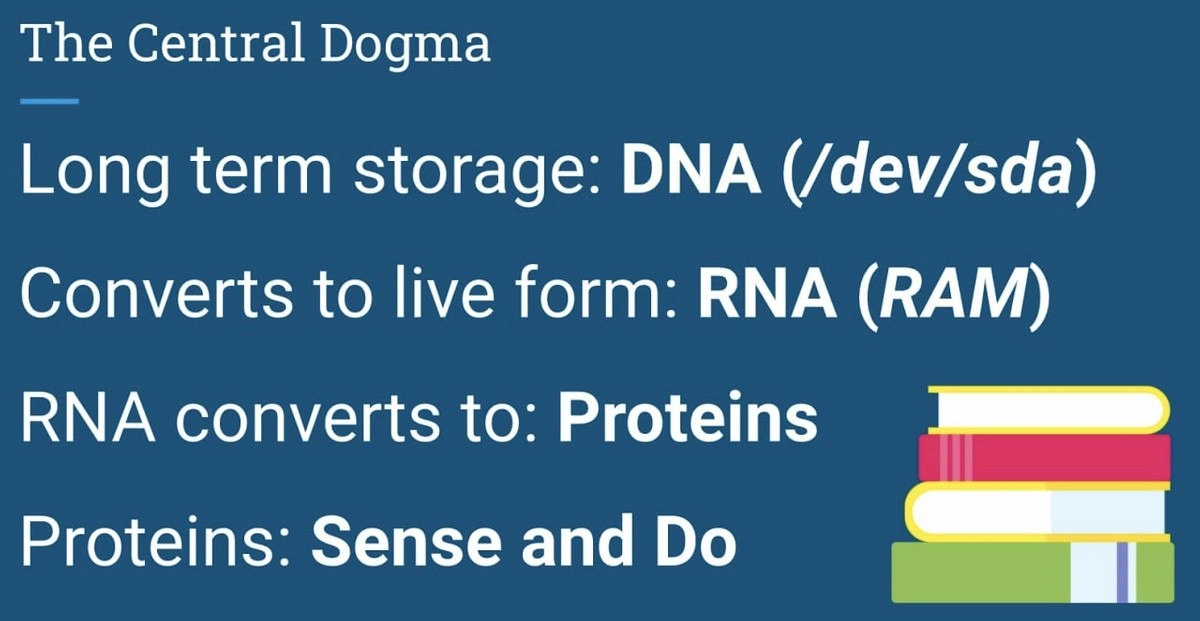
The Central Dogma Long term storage: DNA (/dev/sda) Converts to live form: RNA (RAM) RNA converts to: Proteins Proteins: Sense and Do

The joke works because the analogy is surprisingly serviceable. In biology, the central dogma is the flow of genetic information from DNA to RNA to protein. In the slide's computing metaphor, DNA is persistent storage, RNA is a working copy, and proteins are the running behavior of the system. That maps cleanly onto the mental model developers already use: durable data sits on disk, active data sits in memory, and executable behavior changes the world.

The /dev/sda detail makes it specifically Unix/Linux flavored. On many Linux systems, /dev/sda names a block storage device, traditionally the first SCSI/SATA-style disk exposed by the kernel. It is not a normal text file in the friendly "open a document" sense; it is a device node that represents storage at a low level. So calling DNA (/dev/sda) is a compact nerd joke: the genome becomes the organism's boot disk.

RNA (RAM) is the most playful compression. RNA is not literally random-access memory, but the analogy captures a useful idea: RNA is a more immediate, transient working form of information. Cells transcribe parts of DNA into RNA, and that RNA can be used to produce proteins. In computing terms, it is like loading only the needed instructions from long-term storage into a place where current work can happen.

The "Proteins: Sense and Do" line is the runtime layer. Proteins build structures, catalyze reactions, send signals, receive signals, move materials, and generally make cells behave like living systems rather than static archives. If DNA is configuration plus source material, proteins are the services, workers, handlers, and drivers actually doing things. Yes, the analogy is reductive; all good teaching analogies commit a few misdemeanors before breakfast. But it gives programmers a quick bridge from storage and memory to biological information flow.

Description

A blue slide-style graphic titled "The Central Dogma" presents a biology concept using computing metaphors. The visible text reads: "Long term storage: DNA (/dev/sda)", "Converts to live form: RNA (RAM)", "RNA converts to: Proteins", and "Proteins: Sense and Do," with a small stacked-books illustration on the right. The joke maps DNA to persistent block storage, RNA to working memory, and proteins to the active runtime behavior of the organism. The use of `/dev/sda` makes the analogy specifically Unix/Linux flavored, treating biology like a system architecture diagram.

Comments

1
Anonymous ★ Top Pick Life is just a boot process where the firmware is wet and the init system is proteins.
  1. Anonymous ★ Top Pick

    Life is just a boot process where the firmware is wet and the init system is proteins.

Use J and K for navigation