When a Developer Meets Their Own Legacy Code
Why is this TechDebt meme funny?
Level 1: Not Me!
Imagine you find a drawing in your family’s old scrapbook with your name scribbled in the corner. It’s a messy crayon sketch of a house that looks like it’s about to fall over. Your parents show it to you and say, “Did you draw this?” You stare at it, not remembering it at all, and quickly blurt out, “That’s not mine! I’ve never seen this picture in my life!” – even though your name is right there. It’s a funny, relatable moment: you don’t want to take credit for the crummy drawing, or you truly forgot you ever made it. That’s exactly what’s happening in this meme. The developer is basically that kid, and the code is the embarrassing drawing. The computer is telling them, “Hey, you made this, see? Your name’s on it,” and the developer is wide-eyed, going, “No way, not me!” It’s humorous because we all know the feeling of wanting to distance ourselves from something that turned out a bit ugly – whether it’s a childhood doodle or a wonky piece of code. The meme makes us laugh because it shows a programmer denying responsibility with the same energy a kid would use when caught with crayon on the wall: “I didn’t do it, I swear!”
Level 2: Who Wrote This?
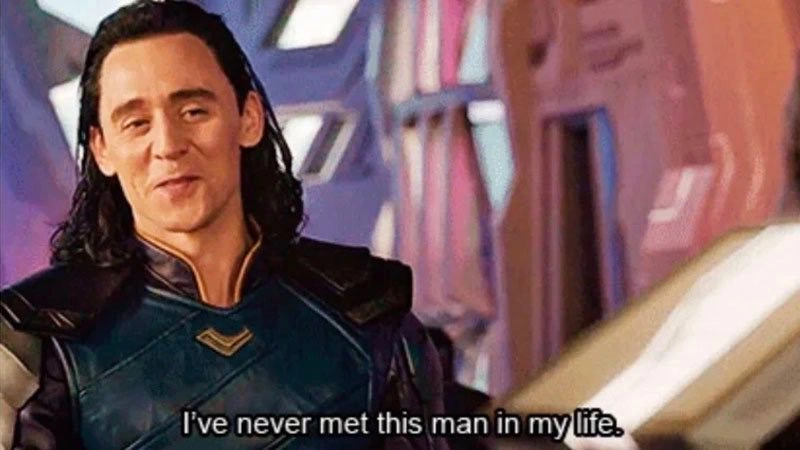
Let’s break down what’s happening in this meme. Git is a popular tool programmers use for tracking changes in code (a VersionControl system). One handy (or sometimes scary) command in Git is git blame. Despite its name, it isn’t about shaming your teammates; it simply shows you who last edited each line of a file and when. Developers often use git blame when a bug pops up in a certain line of code – it helps identify who might know more about that line. Now, imagine running git blame on a file that’s causing problems and seeing your own name as the last person who changed those lines. But you absolutely don’t remember touching that code at all! That’s exactly the situation this meme is poking fun at. The on-screen caption “I’ve never met this man in my life” is from a movie scene (featuring a trickster character, which is fitting). In our context, the developer is basically saying, “I don’t know this code, I definitely didn’t write it,” even though Git’s history suggests they did. It’s a case of git_blame_false_accusation – the feeling that Git must be falsely accusing you of a coding crime you didn’t commit.
Why would this happen? Often in software projects, there’s something called legacy code – that’s old code written in the past, sometimes by developers who have left, or by you when you were less experienced. Maybe the code has been moved around or reformatted, and your name got attached as the last editor (even if you only changed a comment or moved the file). Or maybe you genuinely wrote it a long time ago and have zero recollection – it happens, especially if you maintain a large codebase with many contributions. For newer developers, it’s important to know that git blame isn’t magic truth serum; it just follows the history. If the history is misleading (for example, one person copied a file from elsewhere or made a minor tweak), blame will still credit that person for the whole line. This can lead to funny moments where someone’s basically saying, “Git blames me, but I swear I didn’t do it!” In team culture, people joke about this a lot. Nobody likes being blamed for a bug, especially if it’s in a dusty corner of the code. You might hear a dev say, “According to Git, I wrote this function, but honestly, I’ve never seen it before.” They’re half-joking, half-serious – it’s a way to lighten the mood when dealing with a nasty bug. We’ve all experienced that slight panic or disbelief when a tool points a finger at us for something we don’t remember. This meme perfectly captures that mysterious_code_discovery moment, using a funny movie quote to echo a developer’s instinctive reaction: “Nope, not mine!”
On the visual side, the meme uses a frame from a superhero film where the character (pictured in armor, inside a spaceship) is denying knowing someone with a straight face. Developers repurposed that scene because it’s a clean, expressive way to say “I have nothing to do with this.” The background looks high-tech, and the caption is in that familiar white font – a style common in meme subtitles. Even if you don’t know the film, you can tell he’s disavowing all responsibility. In a programming context, this is like a dev looking at a piece of problematic code and raising their hands saying, “Don’t look at me!” It’s VersionControlHumor because it’s tied to the use of a version control tool (Git) and the shared experience of hunting through a project’s history. Especially with Bugs popping up, teams often scramble to find who wrote the failing code. The joke here is that sometimes the history points back to the very person who’s asking – leading to an awkward but comical situation. For a junior dev, it’s a lighthearted reminder: be prepared, one day you might encounter a strange function, run git blame out of curiosity, and find out your own name is attached to it. And trust us, your first reaction will probably be something meme-worthy too!
Level 3: The Blame Game
Git has a delightful little command called git blame that reveals, line-by-line, who last edited each part of a file. In theory, it’s a tool for accountability and tracing bugs; in practice, it often feels like a forensic investigation at a VersionControl crime scene. In this meme’s scenario, a developer discovers that some legacy code—ancient, mysterious logic lurking in the codebase—appears to have their name on it. The punchline? They channel the blurred superhero character on screen, flatly declaring “I’ve never met this man in my life.” Here, “this man” is the buggy code in question. It’s a tongue-in-cheek way of denying code ownership despite what the Git history says. Seasoned developers chuckle (or cringe) because we’ve all been there: an error surfaces in a LegacySystems module last touched ages ago, you run git blame to find the culprit, and surprise! the logs point to you.
From a senior engineer’s perspective, the humor comes from how GitBlame can mislead or cause drama. The git blame output is like a surveillance tape for your repository – immutable evidence of who last “handled” that line. But like any evidence, it can be misleading without context. Perhaps you innocently reformatted the code or moved it to a new file, and now Git thinks you “wrote” those 200 lines of legacy logic. (Thanks to how blame works, the last person to touch a line gets credit, even if they just added a space or moved the file.) A grizzled veteran knows to use git blame -M -C to find original moves or copies – otherwise you might end up blaming the wrong suspect. There’s a whole whodunit aspect to debugging legacy bugs: you play detective with the commit history, piecing together clues from years-old diffs and cryptic commit messages. It can feel like a legacy_commit_whodunit, with git log --follow as your magnifying glass. When the trail leads to your own commit from long ago, it’s equal parts horrifying and darkly funny. “Surely,” you think, “I didn’t create this monster… right?” But the repository’s fingerprint forensics say otherwise.
Why is this so funny (in a painful way) to experienced devs? Because it satirizes the common blame culture in software teams. The tool is literally named “blame,” after all. We joke about it, but there’s an underlying truth: when production is on fire due to a bug, everyone scrambles to find who wrote the offending line. It’s a quick way to assign responsibility (or find someone to fix it), but it also encourages a bit of finger-pointing. Imagine a 3 AM outage where an on-call engineer digs through git blame and slacks you: “Hey, you last touched this code in 2019… what does it do?” If you’re a battle-scarred dev, you know that sinking feeling. The meme captures the code_ownership_denial defense we’ve all wanted to invoke at least once. It’s the gallows humor of BugsInSoftware: “Production bug in a module I supposedly wrote? I plead innocent – never seen that code before, Your Honor.” This resonates because in real life, nobody wants to own up to the crazy legacy hacks in the system. They might have been written under duress, long forgotten, or heavily modified by others until it barely resembles your original work. In a large team or a decade-old project, source control history becomes a hall of ghosts. The blame_shift_meme hits home: we laugh, remembering times we too wanted to wash our hands of some crusty old function that git pinned on us.
Behind the sarcasm is a gentle nod to better practices. Good teams prefer a “blameless post-mortem” culture, focusing on fixing issues rather than hunting down a scapegoat. Yet here we are, with a tool that highlights a name next to each line of buggy code. It’s ironic: the VersionControlHumor is that even the best tool for collaboration (Git) has a feature that feels like tattling. In fact, GUI clients often rename blame to a nicer word like “annotate,” precisely because blame sounds so accusatory. But every senior dev knows the truth: when something breaks, the first question is often “Who touched this last?” And if that name turns out to be yours, well, cue the Loki meme: “I’ve never met this code in my life.” The absurd denial, especially coming from a veteran who probably did write it during a past caffeine-fueled marathon, is what makes it comedic gold. It’s a way of laughing at our own forgetfulness and the treachery of version control logs. After all, code can outlive memory. The meme perfectly encapsulates that senior-engineer mix of embarrassment and amusement when you realize the legacy mess you’re cursing was, in fact, your own creation – a long time ago, in a deployment far, far away.
Description
This meme features a screenshot of the character Loki from the Marvel movie 'Thor: Ragnarok,' portrayed by Tom Hiddleston. Loki has a slightly smug, dismissive expression. The image is subtitled with the quote: 'I've never met this man in my life.' In the context of software development, this meme is universally understood to represent a developer's reaction when they encounter a piece of their own old, poorly written, or confusing code. It humorously depicts the desire to disown past work, especially when it has caused a new bug or is difficult to understand. For experienced developers, it's a deeply relatable moment of combined embarrassment and amusement, reflecting on how their coding skills and standards have evolved over time, while conveniently forgetting the 'genius' solutions they implemented years, or even months, prior. The underlying joke is the tension between the developer's internal knowledge of their authorship and their outward denial, often just moments before a 'git blame' command reveals the truth
Comments
8Comment deleted
I've never met this man, but `git blame` is about to introduce me to the author. If the commit hash points to me, it was clearly a tactical decision made under duress to unblock the CI/CD pipeline
Git blame: “Author: you, 2006.” Me: “All I did was fix a trailing space during the SVN-to-Git migration; I’ve never met this COBOL-wrapped-in-Perl monstrosity in my life.”
When the git blame points to your username on that 'temporary workaround' from 2019 that's now load-bearing infrastructure supporting half the company's revenue stream
Every senior engineer's relationship with their code from 6 months ago: 'I've never met this man in my life.' Bonus points when git blame reveals you wrote it at 2 AM during a production incident, and the commit message is just 'fix stuff' with no ticket reference. The real Loki move is when you confidently suggest a complete rewrite because 'whoever wrote this clearly didn't understand the requirements' - while secretly hoping no one runs git log
20-YoE architect eyeing their pre-K8s monolith in prod: 'Never met this man who traded CAP for availability at all costs.'
Git blame fingers me for 18k lines because I ran svn2git in 2014; compliance asks who wrote it, and I’ve never met this man in my life
Runbook: “Ask the original author.” Git blame points to me (2015). On-call at 3am: I’ve never met this system in my life
Finale Comment deleted