The Five Nines of Malicious SLA Compliance
Why is this DevOps SRE meme funny?
Level 1: Broken Promises
Imagine your friend Alex promises to be there for you “almost all the time, 99.999% for sure!” That sounds like Alex will always show up when you need help – nearly perfect reliability. But in reality, whenever you call Alex, he’s hardly ever around. You might say, “Alex, you’re never here when I need you!” and Alex cheekily replies, “Oh, I meant I’m there 9.9999% of the time.” In other words, Alex promised to be as reliable as the sun, but actually he’s about as reliable as weather in a cartoon – usually a no-show. The joke here is just like that: someone bragged their service is almost never down, but it turns out it’s almost always down. It’s funny in the way it’s funny when a classmate boasts they’ll never, ever make a mistake, and then they keep goofing up – the big promise turned out to be an empty promise. The meme makes us laugh because we all know the feeling of counting on something (or someone) that says it’ll be perfect, and then finding out it fails almost every time. It’s a silly reminder that saying you’re “99.999% sure” means nothing if you don’t show up when it counts.
Level 2: Uptime Math 101
Let’s break down the technical terms and joke for those newer to DevOps and reliability engineering. First, SLA stands for Service Level Agreement. It’s basically a promise (often a formal contract) that a service will meet a certain level of performance or uptime. Uptime is usually measured as a percentage of time the service is available. For example, an SLA might guarantee 99.9% uptime (that's “three nines” in reliability lingo). Five nines (99.999%) is an even stricter promise: the service should be up almost 100% of the time. To grasp how extreme that is, let’s do a bit of uptime_math:
- 99.9% uptime (three nines) allows about 8.8 hours of total downtime per year.
- 99.99% uptime (four nines) allows roughly 52.6 minutes of downtime per year.
- 99.999% uptime (five nines) permits only about 5.3 minutes of downtime in an entire year!
In contrast, the meme’s punchline 9.9999% is a hilariously low uptime. 9.9999% uptime means the service is down most of the time. If a system only had 9.9999% uptime, it would be working for just about 36.5 days per year and non-functional for the other 328.5 days! That’s why the frustrated person in the meme says “this shit is always inaccessible” – with only ~10% uptime, it practically is always down. The joke is that the bragged “five nines” got a little decimal drift. Instead of 99.999% (very close to always up), it’s 9.9999% (very close to always down). It’s a sla_vs_reality punch in the gut: what was promised versus what users actually experience.
Now, why would someone claim five_nines uptime? Often, companies want to show they offer HighAvailability. High availability means designing systems so they almost never fail – using backups, redundant servers, multiple data centers, etc. A five-nines promise sets a very high bar, akin to saying “we’ll only be down for a few minutes per year, if at all.” In practice, even hitting four nines (99.99%) is challenging for many systems. Things break – hardware can fail, bugs can crash the service, network issues can occur. That’s where Observability and Monitoring come in: engineers set up dashboards, logs, and alerts to track uptime and get notified when something is wrong. Site Reliability Engineering (SRE) teams and DevOps folks use these tools to measure actual performance against the promises. They also use concepts like SLOs (Service Level Objectives), which are internal targets (e.g., “we aim for 99.9% uptime each quarter”). The SLA is what you promise customers (often tied to penalties if not met), while the SLO is what you realistically expect to achieve and monitor day-to-day.
In the meme, the conversation is formatted like a chat or text exchange. The Q&A style —
Q: "What is the SLA of your service?"
A: "Five nines!"
— sets up an expectation. A newcomer might think, “Wow, that service must hardly ever go down!” The next line flips that on its head:
"But this thing is always inaccessible!"
This is the user or maybe a fellow engineer saying, "Hey, you claim 99.999% uptime, but I can never reach it." Then the final retort:
"9.9999%!"
That’s basically someone (likely the tired engineer) joking that the only way to reconcile the advertised reliability with the actual experience is that maybe the real achieved uptime is 9.9999%, not 99.999%. It’s a sarcastic way to say, “Your claim is off by a factor of 10.”
For a junior developer or someone new to on-call life, here are some key concepts to understand in this context:
- Service Uptime: The percentage of time a service is operational and accessible. 100% would mean no downtime at all (very hard to achieve outside of theoretical models).
- Downtime: When the service is inaccessible or not functioning correctly. Downtime can be caused by crashes, bugs, maintenance, network outages, etc.
- Service Level Agreement (SLA): A formal promise, often to customers, usually expressed as a minimum uptime percentage (or maximum downtime). If an SLA is not met, the provider might have to give compensation (like service credits or refunds). For example, an SLA of 99.999% uptime means they promise less than 5.3 minutes of downtime per year.
- On-Call Duty: A rotation in engineering teams (especially DevOps/SRE) where someone is responsible for responding to ProductionIssues whenever they occur, even at 2 AM on a Sunday. If the service goes down, the on-call engineer’s phone (or pager) gets an alert and they must jump in to fix it.
- Observability & Monitoring: Systems that track the health of services. They record metrics like uptime, response times, error rates, etc. If a service promises five nines, the monitoring system is what actually tells you if you’re meeting that goal or not. Dashboards might show uptime percentages, and if you see 9.9999% on there, you know something is horribly wrong!
- SRE Humor: SREs and ops engineers often cope with high stress using humor. Jokes about uptime math or “it’s always DNS” (blaming the Domain Name System for outages) are common in this community. This meme is a tongue-in-cheek way to say, “Our official numbers are a joke, and we all know it.” It’s an sre_joke born from real frustration.
In a real-world scenario for a junior dev: imagine you just joined a team and you hear your manager boasting to stakeholders that your product will be available 99.999% of the time. That sounds great! But then you start working on the system and realize the database crashes every other week, there’s only one server (no backup), and no one set up proper load balancing. Soon, you’re the one carrying the on-call phone, and you get paged a lot. You’d probably think back to that “five nines” promise and go, “Yeah right… we’re lucky if we hit 90% uptime!” This meme captures that exact feeling. The dark_mode_tweet format (white text on black background) even gives it a late-night, moody vibe – as if the conversation is happening at 3 AM when another outage alert has hit. It’s both funny and a little painful because it’s a situation many of us encounter early in our careers: learning that what was promised to users isn’t always what we, as engineers, struggle with behind the scenes.
Level 3: The Five Nines Farce
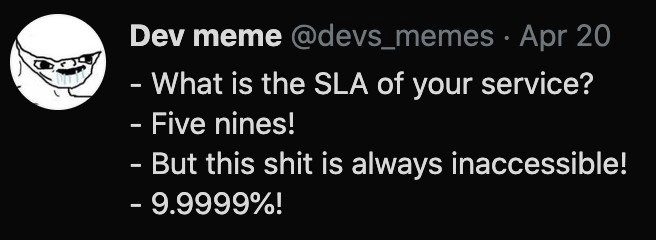
This meme satirizes the absurd gap between lofty availability claims and harsh production reality. In the dark-mode tweet screenshot, someone asks “What is the SLA of your service?” and gets the proud answer “Five nines!” (meaning 99.999% uptime). But the disgruntled reply “But this shit is always inaccessible!” is met with a snarky “9.9999%!” – shifting the decimal point to reveal the cruel truth. Every seasoned DevOps/SRE engineer reading this can practically hear the pager buzzing at 3 AM. It’s an SRE_joke about SLA vs reality: the service’s ServiceLevelAgreement on paper is almost 100% reliable, yet the on-call engineer experiences it as almost 100% unreliable. The humor hits hard because it’s a scenario we’ve seen too often in real life: management availability_claims directly contradicted by Observability_Monitoring data.
Why is this funny to a senior engineer? It’s the Five Nines Farce. Five nines uptime (99.999%) is an almost mythical goal in SiteReliabilityEngineeringPractices – allowing barely 5 minutes of downtime per year. Achieving it requires serious engineering mojo: multi-region redundancy, failovers that trigger in seconds, zero single points of failure, and enormous investment. Yet some organizations brag about “five nines” like it’s a marketing badge, even if their system collapses whenever a field value is NULL or a bit of traffic spikes. It’s not uncommon for companies to promise the moon in SLAs and then fudge the numbers to avoid paying penalties. (Ever notice how downtime during “scheduled maintenance” mysteriously doesn’t count against the SLA?) Meanwhile, the poor on-call engineer is in OnCallDuty hell, receiving constant alerts for incidents. The meme’s punchline – “9.9999%!” – jokes that maybe the service really does have “five nines” of reliability… just not the five nines you think. It’s flipping 99.999% to 9.9999%, a difference of two orders of magnitude. That’s like boasting your car runs 99.999% of the time (only a few minutes of engine trouble per year), but actually the engine works less than 10% of the time.
This dark humor resonates with anyone who’s been burned by HighAvailability hype. It’s common in Production environments to hear grand promises from higher-ups or sales teams about uptimes that rival NASA, only for the OnCall_ProductionIssues reality to be constant firefighting. Think of the systemic issues being mocked here: maybe the team hasn’t invested in proper redundancy or testing, yet someone upstairs is parading a theoretical SLA to impress clients. It’s a classic case of “sell the dream, let the engineers live the nightmare.” The meme underscores a shared trauma: the on-call engineer running on caffeine and despair, who sarcastically “agrees” the service has five nines – if you put the decimal in the convenient spot. We’ve all been in those post-incident meetings where a manager asks why our metrics don’t meet the promised SLA, and the whole DevOps team exchanges knowing looks. The unspoken truth: ServiceLevelAgreements mean nothing if Observability graphs and uptime monitors show red all the time. In fact, uptime_math never lies – you can’t argue with the raw percentages, no matter how you spin it in a slide deck.
Historically, “five nines” reliability was a gold standard from the telecom era (when a few minutes of phone line downtime a year was the max tolerable). Today, applying that to a web service that depends on countless microservices, third-party APIs, and flaky networks is almost comical. A veteran SRE will chuckle because they know every extra nine of uptime is exponentially harder. Many modern cloud services advertise 99.9% or 99.99% uptime (three or four nines). Pushing to five nines? That last 0.009% of reliability might cost more than the first 99.99% did! It demands robust Observability_Monitoring to catch issues immediately and an army of engineers to fix things instantly – which is why a claim of “99.999% SLA” for a service that’s “always inaccessible” screams false advertising. The meme is an availability_claims reality check wrapped in dark humor. It points a finger at the absurdity of corporate high-availability theater: all talk, no uptime. The Cynical Veteran inside every senior dev laughs (perhaps a bit bitterly) because they’ve seen exactly this – a perfect SLA on paper demolished by endless pages and ProductionIssues. In short, the meme nails the inside joke that in real life SLA_vs_reality, a “guaranteed” five-nines service often means the only thing guaranteed is the on-call engineer’s lack of sleep.
Description
This image is a screenshot of a tweet from the 'Dev meme' Twitter account (@devs_memes), posted on April 20th. The profile picture is a distorted, drooling stick-figure face, often used to represent trolling or foolishness. The tweet, set in white text on a black background, presents a short, humorous dialogue: '- What is the SLA of your service? - Five nines! - But this shit is always inaccessible! - 9.9999%!'. The humor is rooted in a technical misunderstanding, or deliberate misrepresentation, of a common industry term. In the context of Service Level Agreements (SLAs), 'five nines' is industry shorthand for 99.999% uptime, an extremely high standard of availability. The punchline reveals that the service provider is interpreting 'five nines' literally as the number 9 repeated five times (9.9999%), which translates to approximately 90% downtime, thus explaining why the service is perpetually down. This joke resonates with experienced engineers who have dealt with misleading marketing claims, unreliable third-party services, and the critical importance of precise technical language in contracts and SLAs
Comments
14Comment deleted
Our new service offers 'Schrödinger's SLA': it's simultaneously 99.999% and 9.9999% available until a customer opens a ticket, at which point the waveform collapses into downtime
Of course we hit five nines - measure per-container per-millisecond uptime, average across 400 microservices, and quietly discard anything that wakes the on-call
The real five nines achievement is when your monitoring dashboard shows 99.999% uptime while your pager shows 99.999% of your nights interrupted by incidents that somehow don't count against the SLA
The beauty of 'five nines' is that it works both as an aspirational SLA and as a Rorschach test for your organization's maturity: if your first thought is '99.999% uptime,' you're in SRE mode; if it's '9.9999% uptime,' you've clearly been on-call during a cascading failure across three availability zones at 3 AM while your monitoring system was also down, and you've learned that the real SLA is whatever keeps legal from getting involved
Five nines SLA? That's just code for 'down 5 minutes a month - right when your biggest customer pings.'
Five nines: 99.999% of GET /health returns 200; user journeys run under a different SLA called “best effort,” measured in postmortems
Our “five nines” is measured at the load balancer’s health check, not the user’s 503s - legal calls it an SLA, SRE calls it error‑budget laundering
Oh, now I found a new one acc to follow there Comment deleted
VK, twitter, telegram... Comment deleted
Fediverse. When? Comment deleted
Sneaky promote lol Comment deleted
Almost no one subscribed in twitter actually. Just coz... Why to do so? 😂 Comment deleted
Telegram masterrace Comment deleted
yoo les goo ✊ Comment deleted