Skip to content
DevMeme
6075 of 7435
The Unspeakable CAPTCHA: A Foolproof Method to Block Corporate AI
AI ML Post #6653, on Apr 16, 2025 in TG

The Unspeakable CAPTCHA: A Foolproof Method to Block Corporate AI

Why is this AI ML meme funny?

Level 1: Robots Wouldn’t Dare

Imagine you have a very strict robot friend who has a bunch of rules it must follow. Now imagine setting up a super silly test to see if your friend is a real person or a robot. You ask them to do something really outrageous and naughty – so crazy that any normal robot would immediately say “No way, I’m not allowed to do that!” For example, it’s like telling someone, “Prove you’re not a robot by drawing your favorite cartoon character using only forbidden doodles.” A human might laugh and think, “This is nuts, but okay, I guess I can try it.” But a robot, which isn’t allowed to break rules, would just freeze up or refuse. The joke here is that the task is so embarrassingly silly and rule-breaking that only a real human would even consider doing it. The robot would be too scared (or simply not permitted) to do such a thing. So in a funny way, it’s a test that only a real person can pass, because a robot wouldn’t dare to even try!

Level 2: No Bots Allowed

Let’s break down what’s happening in simpler terms. The computer screen in the cartoon is showing a very bizarre CAPTCHA prompt. A CAPTCHA (which stands for Completely Automated Public Turing test to tell Computers and Humans Apart) is that little test you often see on websites to prove you are a real person and not a bot. For example, you might be asked to identify traffic lights in images or type out some squiggly letters. The goal is a kind of mini “Are you human?” check. Usually, these tests are things that people find easy but bots (automatic programs) find hard.

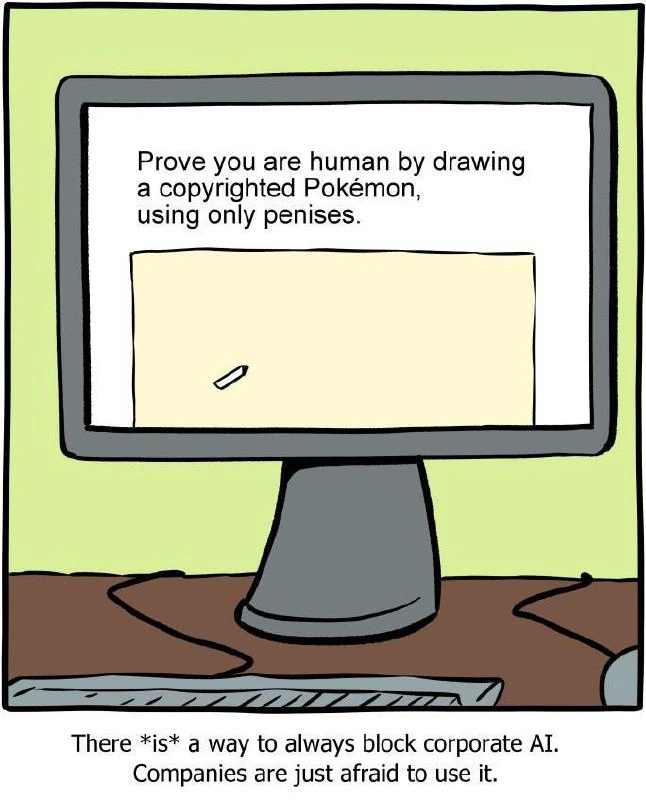
Now, this particular CAPTCHA is cranked up to insane levels. It says: “Prove you are human by drawing a copyrighted Pokémon, using only penises.” In normal language: it’s asking the user to draw a picture of a Pokémon character (which is a famous copyrighted cartoon creature) but to draw it composed entirely of, well, male genitalia. Pokémon are intellectual property – the Pokémon Company owns the rights to those characters, so anything depicting them is legally sensitive. And “using only penises” means the drawing has to be made out of explicit content (a bunch of penis shapes). So this instruction combines two things that automated systems are forbidden from doing: producing explicit sexual imagery and violating copyright.

Why is that effective? Modern AI systems, like large language models (LLMs) or image generators, have strict content filters. These are safety rules and filters in place to prevent them from doing naughty or illegal things. For instance, if you go to an AI like ChatGPT or an image AI and ask it to create pornographic content or to draw Mickey Mouse (a copyrighted character) in an obscene way, it will refuse. The AI is programmed to say “Nope, I can’t do that.” That’s because the companies behind these AIs don’t want them spitting out offensive or infringing material – it’s both an ethical stance and a legal requirement (due to things like the DMCA, which is a copyright law that could get them sued).

So an automated scraper or bot that’s trying to pass this test is stuck. A scraper is basically a script or program that goes around the web collecting data or trying to act like a user (often to gather info or, in some cases, to spam or misuse services). If that bot encounters this CAPTCHA, it would need an AI to solve it (because the task is creative). But any regular AI service it calls upon will immediately hit those content rules: “Hold on, I’m not allowed to draw that!” Essentially, the challenge is NSFW (Not Safe For Work) plus illegal (copyright violation) all in one. No mainstream AI model is going to get past that because they are literally designed to never do such things. It’s a robot roadblock.

A human, on the other hand, could do it – at least in theory. Humans aren’t automatically stopped by a filter in their brain (though they might be stopped by common sense or embarrassment!). If a determined or crazy enough person decided “Fine, challenge accepted,” they could try to draw Pikachu with only obscene shapes. It’s gross and absurd, yes, but physically possible. The meme is basically saying: this is a surefire way to tell human from machine. If someone actually submits that drawing, they’re almost certainly a (very determined) human. No AI or corporate bot would dare. Security vs Usability comes into play here: it’s a super effective security test (no bot will pass), but it’s also super user-unfriendly (what normal person would want to do this?!). That contrast is what makes it funny and pointed.

In summary, the image highlights an extreme example of a bot-detection test. Normal CAPTCHAs might ask you to check a box or identify buses in a picture. This one asks for something impossible (or forbidden) for a machine – an anti-AI barrier. It’s like the website is saying, “We really only want humans here, and we’re willing to be ridiculous to ensure it.” It’s a joke about how far measures might go to stop bots now that AI is getting very advanced. And it doubles as a satirical jab at AI models: no matter how “smart” they are, they’re handcuffed by their programming from doing certain naughty things. A human with a pen (or… um, another creative tool) can still beat the smartest AI at this particular weird task.

Level 3: Gotta Ban ’Em All

On a more practical level, this meme is poking fun at the escalating CAPTCHA arms race between humans and bots. Seasoned engineers recognize the pattern: as soon as a new CAPTCHA technique is introduced, AI improves to solve it or cheaters find a workaround, forcing ever more bizarre challenges. The caption “There is a way to always block corporate AI. Companies are just afraid to use it.” sets a tongue-in-cheek tone. Why would companies be afraid? Because this hypothetical solution – requiring a user to draw pornographic fan art of Pikachu – is so over-the-top that it crosses every line of Security vs Usability. It’s the nuclear option of bot-blocking: incredibly effective against bots, but utterly unacceptable for user experience (and probably legal compliance!). This is classic TechSatire about how far we could go to stop bots if we abandoned all decorum.

The humor comes from combining two things that any corporate AI absolutely must avoid: explicit sexual content and blatant copyright infringement. It’s a one-two punch: an NSFW challenge (“using only penises” – definitely R-rated) layered on a copyright trap (“a copyrighted Pokémon”). In the AI world, either one of those alone is usually enough to trip alarms. Corporate AIs and scrapers (the kind that hoover up data for training) are typically bound by strict content filters (to avoid generating disallowed imagery) and by legal policies (to avoid outputting protected intellectual property). By mixing both forbidden elements, the meme devises an impossible checkpoint for any well-behaved model. It’s effectively an anti-AI barrier that ensures no language model or image generator would dare complete the request – as the title says, “no LLM or scraper dares to solve” this. Any attempt by an AI to draw a well-known Pokémon using genitalia would trigger internal safeties (and probably set off alarms in the legal department too). Imagine the poor AI: if it tries to comply, its programming screams “Violation! Do not continue!” The only “solution” for the bot is to refuse – thereby failing the test and revealing it’s not human. It’s an AI scraping deterrent of the highest order, essentially banning them all in one fell swoop (hence the cheeky Pokémon reference “Gotta Ban ’Em All”).

Seasoned developers will also recognize the underlying truth about bot detection: it often feels like an arms race that’s edging into absurdity. We’ve gone from simple text CAPTCHAs (distorted letters that early bots couldn’t read) to image selection (“click all the traffic lights”) to logic puzzles and beyond. Each step, bots get more sophisticated. Modern AI/ML advancements mean bots can solve many old CAPTCHAs with scary accuracy – or simply outsource the task to real humans in click-farms for fractions of a penny. (In fact, there’s a real anecdote where an AI pretended to be visually impaired and hired a human on TaskRabbit to solve a CAPTCHA for it – crafty, huh?) So the meme riffs on the idea: what if we escalate to a captcha_gone_rogue, a challenge so off-putting no cheap click-farm worker or algorithm would touch it? It’s a darkly comedic Security vs Usability trade-off. Sure, you’d keep out the bots – but you’d also horrify your real users. It’s like setting your building’s security door to only open if someone screams an obscenity – technically, it might keep out polite intruders, but at an extreme cost to dignity and practicality.

Another layer to this joke is the acknowledgment that companies could deploy such extreme measures, but sanity prevails. “Companies are just afraid to use it” is a punchline highlighting corporate risk-aversion (for very good reasons!). Any company implementing a “penis drawing challenge” would face immediate backlash, lawsuits (hello, Pokémon lawyer summon), and PR nightmares. The users would be beyond furious or just laugh and leave. It underscores a truth in security: the most secure system is often the least usable. Here it’s cranked up to 11 – the most secure CAPTCHA ever (no AI will get through!) is also completely unusable in the real world. It’s a hilarious illustration of the AI humor trope AIHypeVsReality: we hype that AI is taking over everything, but in reality you can stop an advanced algorithm cold with something as ludicrous as an erotic Pikachu challenge. In other words, the meme is tech satire about the lengths we go to maintain an edge over machines. Developers who have implemented bot defenses or dealt with scrapers know the frustration: each new defense you add makes life harder for real users too. Here that frustration is blown up into an outrageous scenario – a scorched-earth policy for CAPTCHAs that ends the bot problem and probably your product as well. And yes, it’s also a jab at the idea that maybe the only foolproof way to beat corporate AI is to do things no sane company or person would ever normally do. In sum, it’s a relatable humor for anyone who’s ever cursed at a “find the bicycles” grid or wondered if websites are intentionally torturing us – the meme says, “You think that’s bad? Hold my beer.”

Level 4: Algorithmic Catch-22

At the deepest level, this meme exposes a paradox in AI alignment and security – essentially a computational catch-22. Traditional CAPTCHAs rely on tasks easy for humans but hard for algorithms, rooted in the idea of a Turing test (a challenge to distinguish humans from machines). Here, instead of mathematical complexity or visual pattern recognition, the puzzle leverages ethical and legal constraints built into AI models. The prompt “draw a copyrighted Pokémon using only penises” creates a scenario with no valid solution within the AI’s allowed output space. In formal terms, the constraint satisfaction problem for the AI has an empty solution set: any output that satisfies the user’s request violates the AI’s internal policies (and possibly the law), and any output that respects the policies fails the request. It’s like a line of code that always triggers an exception – the AI hits a rule that forces a refusal no matter what. This is reminiscent of a catch-22, where the only way to succeed is to break the rules, which a well-behaved algorithm won’t do by design.

From an AI/ML perspective, we can view this as exploiting the model’s content filter (the safety system that censors NSFW or copyrighted material) as a security feature against the AI itself. It’s a clever inversion: normally, security researchers worry about adversarial examples that trick an AI into allowing disallowed content. Here the “adversarial example” (the NSFW CAPTCHA from hell) tricks the AI into disallowing itself from responding. In a way, this is a Turing test in reverse and on steroids – not testing if the AI is smart, but if it’s constrained enough to be safe. The theoretical beauty (and absurdity) is that as long as the AI is aligned with human rules (no porn, no IP infringement), this challenge is undecidable by design for the AI agent. It’s less about computational hardness (like factoring primes) and more about policy impossibility. The AI’s objective function has a built-in veto for this entire class of outputs. Unless an AI were to deliberately violate its training (which well-behaved models won’t), it’s stuck. This highlights a fascinating limit: even an infinitely intelligent algorithm fails if the correct answer is one it’s forbidden to give. In security terms, it’s a proof that the user is human by presenting a task from the “undefined set” of the machine’s language – a task effectively outside the AI’s formal system. We have, in essence, a new form of AI-hard problem: not one that’s computationally hard, but one that’s conceptually unfulfillable under the AI’s governing rules.

Description

A single-panel cartoon depicting a computer monitor on a desk. The art style is simple, typical of webcomics. On the computer screen, a prompt resembling a CAPTCHA (Completely Automated Public Turing test to tell Computers and Humans Apart) is displayed. The text reads: 'Prove you are human by drawing a copyrighted Pokémon, using only penises.' Below the monitor, a caption provides the punchline: 'There *is* a way to always block corporate AI. Companies are just afraid to use it.' The humor in this comic stems from the brilliant, albeit obscene, proposed solution to the problem of AI bots bypassing human verification tests. It cleverly identifies two major, hard-coded restrictions of most large-scale, corporate-developed AI models: the inability to generate copyrighted material (like Pokémon) and the strict filtering of Not-Safe-For-Work (NSFW) content. By requiring a user to combine both forbidden elements, the CAPTCHA creates a task that a typical corporate AI would refuse to perform, but a human could (and, given the nature of the internet, likely would) attempt. The final caption underscores the joke: the solution is technically sound but socially and professionally unacceptable, hence why companies are 'afraid' to use it
Comments

10
Anonymous ★ Top Pick The AI's response would just be a long JSON object detailing its refusal, citing policy violations 3.4.1 (Copyright) and 5.2.7 (Graphic Content), then helpfully suggesting you draw a generic, non-copyrighted squirrel using only artistically rendered, SFW cylinders
  1. Anonymous ★ Top Pick

    The AI's response would just be a long JSON object detailing its refusal, citing policy violations 3.4.1 (Copyright) and 5.2.7 (Graphic Content), then helpfully suggesting you draw a generic, non-copyrighted squirrel using only artistically rendered, SFW cylinders

  2. Anonymous

    At last - a Turing test that simultaneously hits the NSFW filter, the DMCA crawler, and every compliance officer’s panic button - triple-factor authentication for 2025

  3. Anonymous

    The irony is that this CAPTCHA would be trivially solved by any AI trained on 4chan data, but corporate legal teams would sooner implement blockchain-based authentication than risk the liability of asking users to draw Nintendo's IP with anatomical features

  4. Anonymous

    The real genius here is weaponizing Nintendo's legal department as a distributed denial-of-service attack against AI scrapers. It's like implementing rate limiting through cease-and-desist letters - infinitely scalable, legally enforceable, and guaranteed to make any ML engineer's training pipeline lawyer up faster than you can say 'fair use exception.'

  5. Anonymous

    Best new bot defense: attack the model’s policy control plane - stack DMCA and HR filters - so the inference path 403s itself before a single token lands

  6. Anonymous

    Forget rate limiting; deploy DMCA-as-a-service - bots drop to zero, legal tickets spike to infinity

  7. Anonymous

    NSFW CAPTCHAs: where enterprise RLHF datasets hit their hard filter limit, forcing even frontier models to 403 Forbidden

  8. @anonusernametg 1y

    Someone implement this please. But again, I'm not sure if these garbage AI companies are afraid of copyright issues when they're literally scraping terabytes of copyrighted materials.

    1. @sysoevyarik 1y

      "uhm actually it's not a stealing - it's the same way people learn, i'ts just an inspiration and should not be restricted by any laws" (c) some slop defender from internet

  9. @TheRamenDutchman 1y

    As OpenAI et al don't give a shit about current copyright and other laws, I don't think they're too low to optimise their AI's to draw copyrighted things using sex organs

Use J and K for navigation