The Existential Crisis of the reCAPTCHA Checkbox
Why is this AI ML meme funny?
Level 1: Human or Robot?
Imagine you’re trying to go into a clubhouse, and there’s a funny robot guard at the door. The robot asks everyone, “Are you a robot or a human?” Obviously, you’re a human, so you say, “I’m a human.” Usually, that’s all it takes and you get in. Now picture this happening every single day – eventually you might get a bit annoyed and start giving goofy answers like, “Well, I’m not a robot today,” or “Define robot!” just to be silly. This coffee mug is making a joke exactly about that. It prints the usual question “I’m not a robot” checkbox that we often see on computers, but then it adds a bunch of silly, over-the-top answers as if someone was really arguing with the question. It’s funny because nobody seriously asks if you’re a robot in real life – it’s only computers that do that – so the mug is pretending that your cup of coffee is giving you an identity quiz in the morning. The humor is in how absurd it is: of course you’re a person drinking coffee, but here you are, first thing in the morning, proving you’re not a machine. It’s a playful way to start the day and make people laugh, especially if they’ve had to click “I am not a robot” on their computer one too many times.
Level 2: Are You a Bot?
Alright, let’s dial it back and explain what’s going on here in simpler terms. The mug’s design is imitating a very common piece of web technology: reCAPTCHA. If you’ve ever tried to sign up for a website or log in and had to check a box that says “I’m not a robot,” you’ve seen reCAPTCHA in action. It’s a service by Google that websites use to test whether the thing trying to log in or submit a form is a real person or just a computer program (a bot) pretending to be one. Bots are everywhere on the internet – some are harmless like search engine crawlers, but many are malicious, like those that try to create fake accounts, send spam, or perform security attacks. BotDetection systems like CAPTCHAs are the bouncers of the web, kicking out the “robot” party crashers. They give challenges that are easy for humans but hard for automated software.
Now, CAPTCHA stands for Completely Automated Public Turing test to tell Computers and Humans Apart. That’s a mouthful, but the key idea is it’s an automated test that the public (any user) can take, which helps figure out if you are a human or a computer. It’s based on the concept of the Turing Test – originally, a thought experiment about how to check if an AI can imitate a human well enough to fool someone. Here, it’s used in a more practical way: the computer asks you to do something like identify pictures or just move your mouse and click a checkbox, and it uses that behavior to guess if you seem human. For example, a real person moves the mouse with tiny inconsistencies and a bit of hesitation, whereas a bot might jump right to the exact spot or move in a perfectly straight line. reCAPTCHA looks at those kind of clues. Sometimes, if it’s not sure, it will give you a second test: e.g., “Select all images with a crosswalk.” Most humans can do that (though we might squint at a tiny corner of a crosswalk in one image and get it wrong… we’ve all been there), but a basic bot would struggle without advanced image recognition AI.
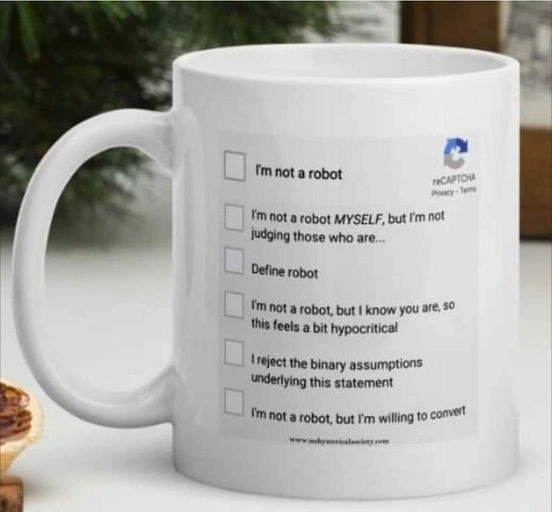
The mug basically shows a fake reCAPTCHA widget with six possible answers instead of one. In real life, you’d never see more than the single checkbox that simply says “I’m not a robot.” But this is a parody. Each of the six lines on the mug is a humorous spin on that phrase (like “Define robot” or “I’m not a robot, but I’m willing to convert”). It’s joking that a programmer or engineer, being a smart aleck, might try to answer the “Are you a robot?” question with something more creative than just yes or no. It riffs on the idea of identity verification – confirming you’re human – and takes it to a silly extreme.
Imagine being asked the same obvious question, “You’re not a robot, right?” over and over. At some point you get tired and start giving sarcastic answers. That’s what the mug captures. It’s funny to developers because we deal with these checks all the time. It’s like an inside joke: we know the website only expects a simple click, but in our heads we’re rolling our eyes and grumbling funny responses. The text “I reject the binary assumptions underlying this statement” is deliberately over-the-top – nobody talks like that at the login screen! – which is why it’s amusing. It’s making fun of how a straightforward thing (proving you’re not a bot) could be turned into a deep philosophical protest if you’re in a contrarian mood.
The mention of SSO in the description stands for Single Sign-On, a system that lets you use one set of login credentials to access multiple services. Many companies use SSO so that, say, one company-wide login gets you into email, HR systems, development tools, etc. If an SSO login page has a reCAPTCHA on it (for security), and that system has issues, it can lock everyone out. That’s why the description talked about senior engineers debating philosophical edge-cases when the SSO breaks at 2 a.m. – it’s painting a picture of a tech problem late at night. The engineers are trying to fix a login system (possibly the reCAPTCHA is malfunctioning or flagging everyone as robots due to some bug). In that stressful, sleepy state, someone might jokingly start questioning reality: “Ugh, the system doesn’t believe I’m human. Am I human? What is a human anyway? Define robot!” It’s the kind of dark humor that comes out when you’re both frustrated and running on coffee. And developers, being who they are, often turn those moments into jokes to cope.
This mug is a piece of mug_merch_humor that you might find on a developer’s desk. It combines a WebDev reference (the reCAPTCHA widget we all know and love/hate) with clever wording that only someone familiar with programming or computer logic might fully appreciate. But even if you’re new to programming, you can get the gist: it’s funny because it’s offering snarky answers to a yes/no question. It’s like if a form asked “Are you a human?” and instead of just checking yes, someone wrote a paragraph back. That someone is the kind of person who becomes a software engineer 😄.
From a beginner’s point of view, what you need to know is: websites ask “are you a bot?” to keep automated bad guys out. Developers have a love-hate relationship with these CAPTCHAs – they’re necessary for Security but they also drive us a bit crazy (especially when we’re in a rush or our code is trying to test something). This meme on a mug is a lighthearted take on that daily annoyance. It’s basically saying, “Hey, we put up with this ridiculous process so much, let’s laugh at it.” Each checkbox option is a playful exaggeration, turning a simple security step into a comedic existential questionnaire. It’s the kind of thing you’d chuckle at during stand-up morning meeting (while ironically proving you’re awake and human by sipping coffee from said mug).
Level 3: Checkbox Identity Crisis
Every seasoned developer has at least one war story involving a CAPTCHA or SSO login gone haywire at the worst possible time. Picture a bleary-eyed senior engineer at 2:00 AM, on-call, trying to log into a critical system to fix a production issue. They’re greeted not with a quick login, but with a stubborn “I am not a robot” checkbox that won’t cooperate. In that delirious moment, it’s easy to develop a snarky split-personality about the whole ritual. This meme-cum-mug perfectly captures that “losing it a little” vibe: it’s the Morning reCAPTCHA existential crisis, served with a side of caffeine. A normal person might just tick the box, but developers – especially the over-caffeinated, sleep-deprived kind – start overanalyzing it. The humor comes from taking a mundane security step and injecting the kind of sarcastic, over-thought responses a jaded engineer only wishes they could give. It’s an identity_validation_parody in six levels, escalating from sincere to absurd in true nerd fashion.
Let’s break down the six checkbox options printed on this unfortunate dev’s coffee mug, and why each one is painfully relatable in a DeveloperHumor way:
“I’m not a robot” – The standard, boring affirmation. This is what the real web form expects you to check. Every developer has mechanically clicked this box hundreds of times. At this base level, it’s just “Yes yes, let me in, I’m human, yadda yadda.” No humor yet – it’s the baseline of normalcy that sets up the comedy to follow.
“I’m not a robot MYSELF, but I’m not judging those who are…” – Ah, the sly inclusivity clause. This one personifies the checkbox instructions and gives them a politically correct twist. A seasoned dev might chuckle here because it’s poking fun at our tech culture’s careful language: “I’m human (not that there’s anything wrong with robots, some of my best friends are CI/CD bots!).” It’s a humorous acknowledgement that we work with automation every day – we even build the robots, in a sense. The senior perspective: we’re saying I’m human, but hey, I work alongside bots and I harbor no bias against our automated brethren. The subtext is that a dev feels a bit of camaraderie with robots (after all, who wrote their code?).
“Define robot” – Classic developer contrarianism. This is the equivalent of responding to a yes/no question with “Well, that depends on your definition of…” It’s hilarious to anyone who’s sat in an architecture meeting where a simple question derails into a debate over terminology. A grizzled engineer might actually mutter “Define robot” at their screen after the third failed CAPTCHA attempt, as a form of nerdy protest. This line underscores how literal and detail-obsessed devs can be: we don’t even accept a checkbox without questioning the spec. Is a robot just a physical automaton? Do AIs count? What about a person running a script (a cyborg of sorts)? The humor lives in that hyper-logical, slightly petty challenge: “I won’t answer until you clarify the requirements.” It’s a nod to turing_test_cynicism – if the whole test is like an exam, an experienced dev wants the exact question pinned down.
“I’m not a robot, but I know you are, so this feels a bit hypocritical” – This one is a punch to the face of the entire reCAPTCHA system. Here the user (or mug-holder) flips the script and accuses the tester of being a robot. And who’s the tester? A Google back-end server, essentially a robot asking us to prove we’re not one. That’s rich, right? Every developer who’s dealt with automated security systems has felt this irony: I’m jumping through hoops for a script. A very smart script backed by Google’s data centers, sure, but still. This line perfectly encapsulates the senior-dev eye-roll: the BotDetection mechanism is itself just a bot following its programming, quizzing my humanity. It is hypocritical in a tongue-in-cheek way – a case of “robot, heal thyself.” When an engineer jokes about this, it’s a form of techie rebellion against faceless systems. It reminds me of yelling at CI pipelines or automated code reviewers: “You’re not even human, why am I explaining myself to you?!” It’s absurd – and we cope with that absurdity through humor.
“I reject the binary assumptions underlying this statement” – If you’ve ever had a colleague who read too much critical theory or perhaps just someone who’s extremely fed up with false dichotomies in system design, this option hits home. This is the ultimate high-horse answer to “Are you a robot or not?” A senior engineer might joke like this after dealing with one too many binary flags or hard-coded yes/no flows in code. Technically, the CAPTCHA gives no room for nuance – you either check the box or you don’t. But real life and real identity can be messy. Maybe I’m mostly not a robot with some enhancements? (I did get that RFID chip in my hand to open doors at the last hacker con… does that 2% robot count?) This statement parodies an academic or ultra-precise response: it’s basically saying “Your question is invalid; it’s built on an assumption of only two mutually exclusive states (human or robot), which I refuse to accept.” It’s hilarious because it’s overkill – nobody in their right mind would respond this way to a login prompt, but it’s exactly the kind of overly analytical retort that floats through a burnt-out developer’s mind. Also, sly nod: “binary assumptions” winks at both the binary nature of computers (0/1) and the idea of non-binary identity (in gender or otherwise). It adds an extra layer of geeky wit and a bit of intellectual snark, which seasoned devs appreciate even if they groan.
“I’m not a robot, but I’m willing to convert” – The final stage of this checkbox existential crisis is sweet surrender (with a side of dark humor). After all the pedantic and philosophical back-and-forth, the user just throws up their hands and says, “Fine, I’m done being human. Where do I sign up to become a robot?” For a developer, this is comically relatable at the end of a grueling week or a 14-hour debugging session. Who hasn’t joked about wanting to be a robot to avoid all the pesky human needs like sleep, or to be more efficient? It’s the ultimate cynical veteran line. It implies burnout – the human is tired of the nonsense and would rather join the borg collective than continue this farce. In a security sense, it’s also poking fun at how sometimes the only way to beat the system is to become part of it. (If you can’t beat the bots, maybe you’d rather be one?). This line also carries an undertone of how modern developers sometimes do feel like robots: we write and maintain scripts, follow routines, and even communicate in Slack emoji at times. After a nightly on-call ordeal, converting to a robot starts to sound like a valid life choice if it means no more CAPTCHAs and maybe an internal 24/7 power source instead of coffee.
By the time a reader (or a groggy coder sipping from this mug) gets to the sixth option, they’ve essentially witnessed a mini hall_of_fame of checkbox humor – a progression from earnest to existential. The reason this resonates so much in developer culture is because it’s a pressure valve on real frustrations. WebDev and security practices often force us into mindless repetition (like clicking “I’m not a robot” on every login). We comply, but inside we’re lit with commentary. This mug just voices that inner dialogue. It’s dev catharsis. We’ve all seen those “Prove you’re not a robot” prompts, and maybe once in a while after failing one for the third time (curse those tricky traffic light photos), a thought flashes: “Maybe I am a robot… or screw it, I’ll become one, it might be easier!” Seeing that absurd inner monologue actually printed out is insanely validating and funny.
On a practical note, any junior dev who’s integrated reCAPTCHA into a site will know how finicky it can be. A senior dev definitely knows the pain: you add this widget to your login to stop spam or brute-force attacks (because Security demands it), but then you have to deal with user complaints: “I clicked the stupid box and it kept showing me puzzles!” Or you’re testing your app and the CAPTCHA pops up, derailing your automated test script – of course your Selenium bot can’t tick the “I’m not a robot” box without defeating its whole purpose. The veteran humor here is also a subtle nod to that ironic scenario: our test automation is a robot that must be told not to act like one. The checkbox_snark embodied by this mug is a way of laughing through those headaches. In the end, this piece of dev swag is more than just a coffee holder; it’s a meme you can drink from. It says: “We take these absurd little moments of our job and we own them – we’ll even laugh at them over coffee.” And trust me, after surviving a broken SSO flow at dawn because a bot-protection service went rogue, you either laugh or you cry. This mug helps us choose laughter.
Level 4: Reverse Turing Test
At its core, CAPTCHA (short for Completely Automated Public Turing test to tell Computers and Humans Apart) is literally a Turing Test in reverse. Alan Turing's original question “Can machines think?” has been flipped on its head: now we have machines asking us if we think (or rather, proving that we can). In a real Turing Test, a human judge tries to distinguish a human from an AI through conversation. In a reverse Turing test like reCAPTCHA, an algorithm is the judge, proctoring a quick quiz to tell a human user apart from a bot. The mug’s print with the familiar “I’m not a robot” checkbox parodies this idea by presenting increasingly absurd responses – it’s a developer’s way of poking fun at the philosophical implications of being interrogated by code first thing in the morning.
This humorous mug highlights a fundamental absurdity in modern WebSecurity: our software constructs are continually forcing a binary human/robot distinction, when in reality the line is blurring. Sophisticated bots can now solve many old CAPTCHA challenges, and advanced machine learning has forced CAPTCHAs to grow ever more convoluted. Early CAPTCHAs relied on distorted text images that humans could read but OCR algorithms struggled with. That worked until around the early 2010s, when AI got smart enough to solve those with high accuracy. So the tests evolved into identifying objects in images (like “click all the traffic lights”) – tasks leveraging the still-superior visual cortex of humans. But even that gap is closing as neural networks get better at vision. It’s an arms race: as soon as bots learn to think like humans in one area, we have to find a new test. A battle of wits between creators of BotDetection systems and the bots’ creators rages on, all wrapped in that innocent little checkbox. The mug wryly lists outlandish checkbox statements as if acknowledging that the simple “I am not a robot” affirmation is becoming philosophically insufficient in an era when robots teach themselves to click the same box.
There’s also a cheeky philosophical undertone here: “Define robot” isn’t just pedantic snark – it raises the question of what counts as a robot in the first place. In security terms, we mean any automated script or AI, but to a literal-minded engineer (especially one sleep-deprived at 2 AM), the term “robot” could imply a physical android. An AI software agent might protest, “Technically, I’m not a robot; I’m an algorithm.” The mug jokes about these hair-splitting distinctions that senior engineers love to debate when deep in the trenches of an identity_validation_parody scenario. Each more elaborate answer on the mug lampoons the black-and-white logic of authentication systems. The option “I reject the binary assumptions underlying this statement” is a direct jab at the yes/no binary choice. It’s funny because on a meta level, everything in computing is binary (ones and zeros), yet real identity and intelligence might not be strictly binary. The veteran perspective hidden in this humor is that things are rarely as clear-cut as a checkbox makes them out to be.
One delicious layer of irony: with reCAPTCHA, humans often perform tasks that help improve AI. The original reCAPTCHA actually used people’s answers to digitize books and train OCR algorithms (two distorted words: one you had to get right, and another unknown one where your input helped decipher it). Later versions had us identifying objects in photos, subtly helping self-driving car AI recognize road features. In other words, while you’re asserting “I’m not a robot,” you’re also doing micro-work for robots – training the very machine learning models that might replace the need for humans in the future. The cynical veteran in me chuckles (and maybe cringes) at that: we’re essentially proving our humanity by doing tasks that make machines smarter, inching them closer to our level. It’s a twilight-zone twist worthy of a turing_test_cynicism case study. The mug brings this absurd loop into stark relief with the final option “I’m not a robot, but I’m willing to convert.” After being quizzed by algorithms and effectively working for them (one CAPTCHA at a time), who wouldn’t feel a tiny bit like we’re already part of the machine? It’s a darkly comic concession: Sure, I’m human now – but give me enough coffee and meaningless tasks, and maybe I’ll just join the robot side. The Privacy • Terms text printed under the fake reCAPTCHA on the mug is the cherry on top, mimicking Google’s legal boilerplate. It reminds us that this isn’t just philosophy – there are real privacy trade-offs here. Proving you’re human often involves letting big tech observe your behavior (mouse movements, browsing history cookies) as evidence. The veteran engineer in me notes that our human_vs_AI dance has fine print: we pass the test, but at the cost of a little data shared. Even our morning existential crises come with a Privacy Policy, apparently.
Description
A photograph of a white ceramic coffee mug with a custom print. The print humorously expands on the standard Google reCAPTCHA 'I'm not a robot' checkbox. It features the reCAPTCHA logo and presents a list of six alternative checkboxes, escalating in philosophical complexity. The options are: 'I'm not a robot', 'I'm not a robot MYSELF, but I'm not judging those who are...', 'Define robot', 'I'm not a robot, but I know you are, so this feels a bit hypocritical', 'I reject the binary assumptions underlying this statement', and 'I'm not a robot, but I'm willing to convert'. The humor stems from applying deep, existential, and socio-political thought to a mundane user verification task. For developers and tech-savvy individuals, it's a relatable joke about the blurring lines between human and artificial intelligence, the limitations of the Turing test, and the tendency to over-analyze simple systems
Comments
14Comment deleted
My ideal CAPTCHA would have just two options: 'I am a robot' and 'I am a robot, but in denial.' It would filter out 99% of bots and 50% of software engineers
Somewhere an overzealous bot-mitigation service just threw a 429 because the mug failed to pick a single truthy value
After 20 years in tech, I've trained more neural networks to recognize traffic lights than I've actually stopped at them, yet somehow I still fail these CAPTCHAs on the first try while GPT-4 probably passes them by analyzing the DOM
This CAPTCHA perfectly captures the existential dread of modern web development: we've built systems so sophisticated that even we're not sure if we're the bots anymore. The real test isn't proving you're human - it's maintaining your sanity after implementing OAuth, reCAPTCHA v3, fingerprinting, rate limiting, and still getting scraped by a teenager with Puppeteer and a residential proxy pool
At last, a reCAPTCHA with nuance - pity the backend still stores humanity as BOOLEAN NOT NULL
reCAPTCHA's AI gatekeeper demanding human proof - peak irony from the bots who trained on our endless labeling farms
Auth swears the checkbox returns a bool, then Legal added five more states - now our Turing test fails the build: expected bool, found enum Philosophy
gib me a link to this cup pls Comment deleted
http://localhost:3000/captcha-cup Comment deleted
These should really be radio buttons Comment deleted
Binary assumptions underlying your statement are disturbing. Comment deleted
https://youtube.com∕_HwWrtUJ∕@pOrNhUB.COM Comment deleted
Thinking deeper about the fourth option, it's like turn tables happened at turning test Comment deleted
https://neal.fun/password-game/ Comment deleted