Skip to content
DevMeme
5116 of 7435
The Geopolitics of Silicon: A Dune Analogy for the Semiconductor Wars
Hardware Post #5600, on Oct 22, 2023 in TG

The Geopolitics of Silicon: A Dune Analogy for the Semiconductor Wars

Why is this Hardware meme funny?

Level 1: One Friend, All the Candy

Imagine all the candy in the world is made by one little candy shop on a tiny island. This candy isn’t just a treat – let’s say it’s a special candy that makes everything work, from your toys to your video games. Now, everyone really needs this candy. Big kids from other neighborhoods come to buy it, candy companies depend on it for their chocolate bars, and basically every party in the world can’t start until this one shop ships out its candy. That tiny island is super important, right? It’s like the whole school knows that if something happens to that one candy shop, there’ll be no candy for anyone and all the birthdays and holidays would be spoiled.

Now think of two big bullies on the playground. One of them has kind of been in charge of things – let’s call him the class president – and he makes sure everyone lines up to buy candy nicely. He even helps guard the candy shop so that candy keeps flowing because his own lunch snacks depend on it. The other bully really wants that candy shop for himself. He says it used to be his, and he’s always lurking, saying “One day I’m gonna take over that candy store!” Everybody gets nervous when those two argue, because if a fight breaks out and the shop is hurt, no one gets candy. The first big kid even brings some friends with toy planes (like little flying guardians) to watch over the island, just in case.

In this story, the special candy is like the computer chips that make our phones, games, and computers run. The tiny island is a place called Taiwan, where a lot of these chips come from. The big kids are countries – one is the United States (protecting the island because it needs those chips) and the other is China (who wants the island back and its chip factories too). The flying toys guarding it are like fighter jets protecting the island. We even have a super fancy candy-making machine in the story – imagine a gigantic magical oven that only one company in the whole world knows how to build. Without that oven, the candy can’t be made at all. In real life, that’s a special machine that helps make the chips, built by a company called ASML (but you can think of it like the magic oven).

So, the meme is joking that our real-life situation with tech is like a science fiction adventure or a playground drama: one small place has something everybody needs, and all the big powers are hovering around, trying to control or protect it. It’s funny in a way – like saying “our world is just like a fantasy story!” – but it also makes you realize how much depends on that one candy shop. The reason people who know the story of Dune laugh at this meme is because in that book, one desert planet had all the “magic spice” that everyone needed, and empires fought over it. We’re seeing a similar thing in real life with chips and Taiwan. In simple terms, the meme is a creative way to say: our high-tech world has put almost all its eggs (or candy) in one basket, and now we live in a mix of wonder and worry about it – kind of like a sci-fi tale come true.

Level 2: Chips Are the Spice

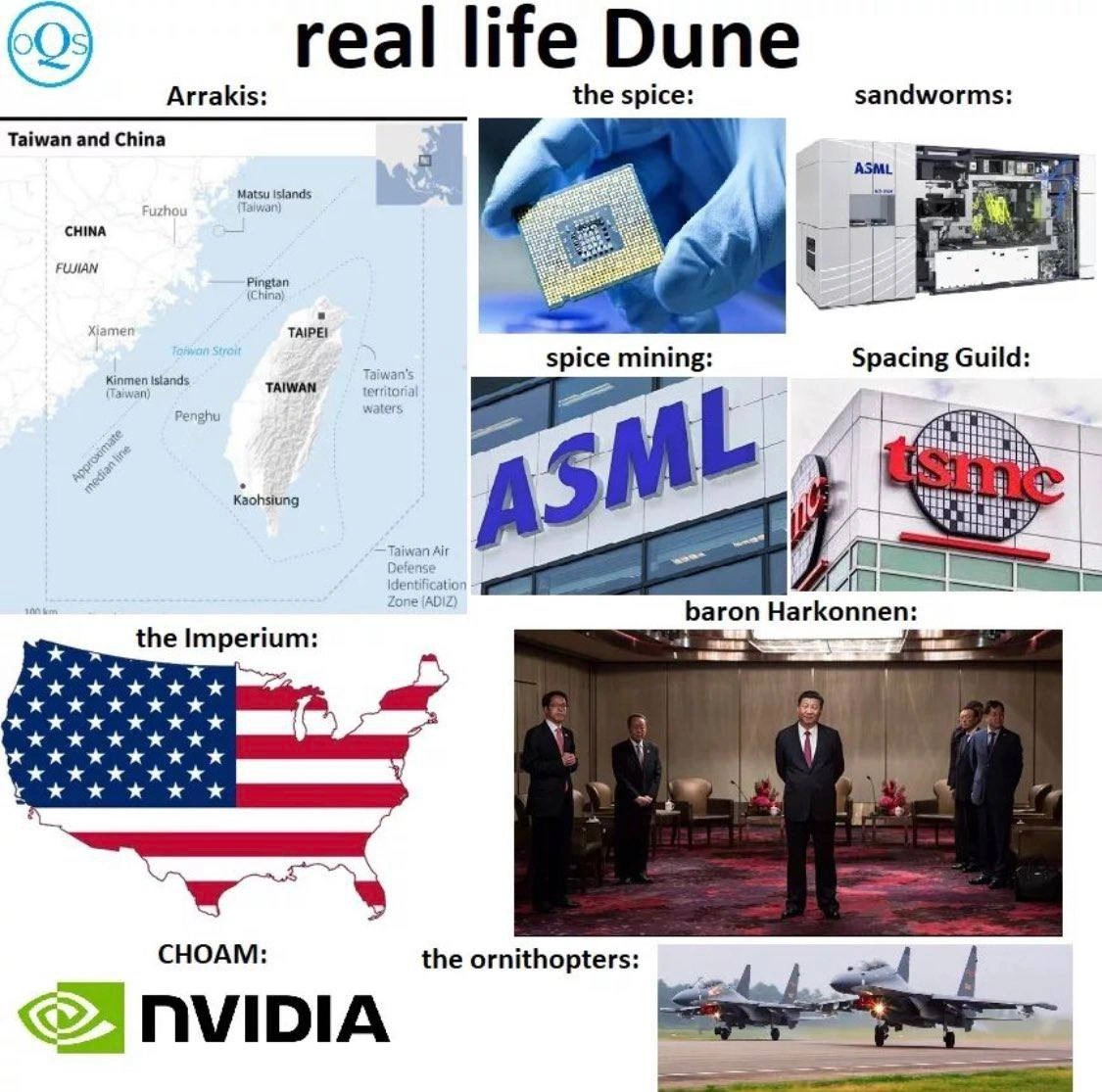
If you’re a junior dev or just starting to follow tech news, let’s break down the meme’s references. It’s comparing the world of Frank Herbert’s Dune – a famous science fiction novel – to today’s semiconductor_supply_chain (how we make and get computer chips). In Dune, there’s a desert planet called Arrakis that’s the only source of a fictional substance called “the spice.” Spice is super important in that universe: it powers space travel and gives special powers; basically, the whole galaxy’s economy and technology depend on it. The meme calls Taiwan “Arrakis” because, in our real world, this one island plays an outsized role in producing the most advanced computer chips – which are as crucial to us as spice is in Dune. A huge portion of high-tech devices (from iPhones to high-end servers) rely on chips made in Taiwan. So people sometimes half-joke that “Taiwan is the Silicon Island” or here, the Arrakis of electronics.

Next, the meme labels “the spice:” and shows a gloved hand holding a modern CPU chip. This drives home the analogy: in reality, the “spice” that everyone covets isn’t a drug or glittering powder, it’s these tiny silicon chips – the processors and memory that run our gadgets. Why call chips spice? Because our entire tech stack – all the hardware, the internet, advanced cars, cloud services, your PlayStation, you name it – runs on chips. Without a steady supply of powerful CPUs and GPUs, technology progress grinds to a halt. For example, if suddenly nobody could get new chips, we couldn’t build new phones or game consoles, AI research would stall for lack of GPU power, and even mundane things like car manufacturing would stop (modern cars have lots of microcontrollers). We actually saw a taste of that during the recent chip_shortage, when car companies had to pause production and consumers faced months-long delays for electronics. So chips are indeed like a precious resource. They’re not literally spicy, of course, but the meme is being playful by equating “spice” with “silicon chips,” highlighting how vital they’ve become.

Now, Dune has these giant creatures called sandworms that live under Arrakis’s sands. They are central to the spice: without sandworms, you can’t produce or harvest the spice (in the lore, the worms and spice are part of the same ecosystem). In the meme, the picture for “sandworms” shows an ASML EUV lithography machine – a huge, very advanced machine used in chip factories. This is a bit of tech humor. ASML is a Dutch company that makes the machines which almost every leading chip factory (fab) needs to create the tiny circuits on a chip. These machines are enormous and extremely complex – like the sandworms, they’re the “creatures” enabling the production of spice (chips). An EUV lithography machine is often considered the most complicated machine humans have built, and only ASML makes them, so they’re rare. It’s a funny visual: instead of a giant worm, we have a giant boxy high-tech machine. The joke implies that engineers see these expensive machines with almost the same awe (and caution) that Dune’s characters see a towering sandworm. Without ASML’s lithography systems, advanced chips (the spice) wouldn’t exist, just like no spice without sandworms in the book. So in real life terms: ASML’s lithography machine is the key tool for “spice mining”, which leads us to the next bit.

The meme has a section labeled “spice mining:” showing the front of ASML’s headquarters building. In Dune, spice mining means literally harvesting the spice from the sand, with giant factory vehicles, while avoiding sandworms. Translating that to our world: “spice mining” is the process of manufacturing chips. The ASML building image suggests that ASML itself – by producing those critical lithography machines – is akin to the company enabling spice extraction. It’s as if ASML is providing the mining equipment for our “spice” (chips). You might also interpret “spice mining” as what happens inside chip fabs (factories) like TSMC, but since the meme explicitly uses ASML’s sign, it’s highlighting the role of tool-makers in the supply chain. Think of ASML as the top supplier that makes the complex drills and rigs needed to “mine” silicon gold. They’re the unsung hero that most non-tech folks have never heard of, but tech insiders know how vital they are.

Next up: “Spacing Guild:” with TSMC’s logo on a fab building. Here’s some context: in Dune, the Spacing Guild is a secretive, powerful organization that controls all interstellar travel (they use spice to navigate space). Everyone, even the all-powerful Emperor, depends on the Guild’s transports to move armies or goods; without the Guild, the empire falls apart because no one else can do fast space travel. The meme equates TSMC to the Guild. TSMC (Taiwan Semiconductor Manufacturing Company) is the world’s leading chip manufacturer, especially for the most advanced chips. They’re a foundry, which means other companies design chips and TSMC’s factories build (fabricate) those chips for them. For instance, Apple designs the latest iPhone processors, but those chips are actually made by TSMC in Taiwan. Similarly, NVIDIA designs GPUs, but relies on TSMC to manufacture the silicon. TSMC is unrivaled at the cutting edge; very few others (like Samsung’s fabs) compete at that level, and Intel is trying to catch up. So TSMC, like the Spacing Guild, is a gatekeeper. If you want top-tier chips, you likely need TSMC’s cooperation. “Guild” is an old word for a group that tightly controls a skill or trade – here, the skill is advanced chip fabrication, and TSMC’s dominance is such that they set a lot of the terms (prices, schedules, who gets capacity first). When the meme calls TSMC the Spacing Guild, it’s saying TSMC enables the “travel” of technology – i.e., progress – by providing the essential service of chip-making to all the giant tech houses. Without them, companies like AMD, Apple, Qualcomm, NVIDIA, etc., would be stuck. For a junior dev, just know TSMC is hugely important: it’s where the brains of your smartphone or latest game console were likely born.

Moving on: “the Imperium:” with a silhouette of the United States filled in like the American flag. In Dune, the Imperium refers to the empire ruled by the Padishah Emperor – basically the galactic government or the dominant power. The meme is tongue-in-cheek casting the United States as the Imperium. The US has been the leading superpower in technology and has immense influence over the tech industry worldwide (many top chip designers are American companies, and the US controls a lot of the intellectual property and tools for chip design and production). Also, the US government has been very involved lately in this sector – for example, enacting policies to boost domestic chip manufacturing and to restrict China’s access to certain tech (export controls on high-end chips and equipment). By calling the US “the Imperium,” the meme implies the US is like the emperor figure trying to maintain order and dominance in this high-stakes game for the “spice” (chips). The Imperium in Dune has the Sardaukar army and political clout; in real life, the US has economic might, alliances, and also a big stake in companies like those aforementioned (plus through efforts like the CHIPS Act, it’s literally investing money to build more fabs on US soil). So for your understanding: America’s role here is the big overseer and protector (it wants to protect the spice flow for itself and allies). But empires also get nervous when their lifeline (like chips from Taiwan) is vulnerable, hence all the maneuvering – just as the Emperor in Dune was maneuvering around Arrakis because it was so crucial.

Then we have “baron Harkonnen:” with a photo of China’s President Xi Jinping and officials. Baron Vladimir Harkonnen is the villain in Dune – a ruthless, power-hungry leader who at the start controls Arrakis and will do anything to get it back when he loses it. The meme cheekily casts Xi Jinping (China’s leader) as the Baron. This is referencing the current geopolitical tension: China claims Taiwan and has not ruled out “reunifying” it, possibly by force someday. In other words, China would very much like to control what we’ve been calling the “Arrakis of chips.” If Taiwan is Arrakis, then Xi’s China is the power that wants that island under its rule (similar to how Harkonnens wanted Arrakis because of the spice wealth). It’s a daring comparison – obviously real geopolitics are more complex – but the essence is, China is seen as the looming threat or antagonist in the context of the global chip supply. If you’ve seen news about military drills, heated rhetoric, or trade wars involving China and Taiwan (and the US), that’s what’s being referenced. In simpler terms: the meme suggests China’s leadership is playing the role of the bad guy plotting to seize the world’s precious “spice” by taking Taiwan. For a newcomer, just know that Taiwan’s status is a hot topic; it’s not just political – tech folks worry because if something bad happens in that region, it could cut off the supply of advanced chips to the world, causing a tech crisis. So casting Xi as the Baron is a satirical way to pin the “possible disruptor” label on China in this scenario.

The label “CHOAM:” is next to the green NVIDIA logo. CHOAM (Combine Honnete Ober Advancer Mercantiles) in Dune is basically a giant corporation/consortium that controls all commerce across the Imperium – especially the spice trade. The Emperor and the noble Houses all have stakes in CHOAM and get rich from it. Relating that to our world: NVIDIA is one of the most influential tech companies right now, particularly because of its dominance in the GPU market (and GPUs are crucial for AI, gaming, scientific computing – all big, “hot” areas). Why peg NVIDIA as CHOAM? Possibly because NVIDIA has benefited enormously from the “spice” (chips) and is a bit of a monopoly in its sphere (high-end GPUs for AI). They’re making a ton of money – their recent surge due to AI demand made them one of the most valuable companies. In a sense, NVIDIA and companies like it distribute the value of chips into end products and control a lot of the market’s wealth. Also, fun fact: a lot of NVIDIA’s key products (like their A100 or H100 GPUs for data centers) are actually made in… you guessed it… Taiwan by TSMC! So NVIDIA is deeply tied into this ecosystem. They are a power player (like CHOAM) but also reliant on the spice flow. The meme’s humor here is that a big flashy tech corporation is likened to a mercantile guild from a feudal sci-fi universe – and it kind of fits. If you think of global tech as an empire, companies like NVIDIA are who profit from and drive the demand for the chips (spice), thus being central to the “commerce” of it all. For a junior dev: just know NVIDIA as the famous maker of graphics cards (for gaming) and accelerators (for AI), and at the moment they’re hugely influential. Seeing their logo labeled CHOAM is saying “this corporation is like the commercial epicenter of the chip world right now.”

Lastly, “the ornithopters:” caption is on an image of two Taiwanese F-16 fighter jets taking off. Ornithopters in Dune are the primary aircraft used, especially on Arrakis – they’re like a cross between a helicopter and a plane with bird-like wings. The Atreides and locals use ornithopters for patrol, travel, and battle on Arrakis’s desert. The meme humorously calls Taiwan’s fighter jets (F-16s supplied by the US, by the way) the ornithopters. Why? Because these jets are quite literally what patrol the skies around Taiwan (Arrakis) to keep it safe – akin to how Duke Atreides’ forces would patrol for threats around spice operations. It’s a way of showing that Taiwan is not unguarded; it has its own military flyers always on the lookout. If we extend the analogy, those jets (ornithopters) would be the first to tangle with any “Harkonnen” incursion (i.e., if China’s forces ever tried something). It’s another piece of the RealWorldAnalogies: high-tech fighter planes stand in for the cool flapping-wing aircraft of the sci-fi story. For someone new: just recognize this as symbolizing defense of the island. Taiwan’s air force regularly has to respond to foreign aircraft nearing its airspace, and the meme draws a parallel to defending spice convoys in a science fiction way.

Putting it all together, the meme paints a picture of the TechIndustry as if it were the universe of Dune. Each label is a puzzle piece:

  • Taiwan = Arrakis (source of precious resource, and a hotly contested place),
  • Chips = the spice (the critical resource everyone needs),
  • ASML’s EUV machine = sandworms (the rare tech beast enabling the resource production),
  • ASML (company) = spice miners (the ones who make it possible to extract the resource),
  • TSMC = Spacing Guild (the gatekeeper and enabler of using that resource broadly),
  • USA = Imperium (the superpower trying to oversee and protect its interests in this whole system),
  • China = Baron Harkonnen (the rival power willing to scheme or fight to control the resource source),
  • NVIDIA = CHOAM (the big corporation that profits massively from the trade of this resource),
  • Taiwan’s F-16s = ornithopters (the fast flying defenders of the resource on the ground).

For a junior technologist, beyond the fun references, this meme is also a mini-lesson in how globally interdependent tech has become. It highlights IndustryTrends like the centralization of manufacturing (so many chips made in one region), the chip_shortage wake-up call that happened recently, and why countries are hyped about building new fabs at home (to not be left without spice). It also touches on HardwareHumor – it’s poking fun at real hardware world issues (like the reliance on ASML tools or TSMC’s capacity) through a pop culture lens. Each element of the collage is loaded with meaning that tech folks have been chatting about: from euv_lithography (a term you might have seen in tech articles about the newest chips) to geopolitics (tech news discussing tensions in the Taiwan Strait, export bans, etc.). In summary, the meme cleverly uses Dune references to explain why people say our TechIndustry is facing a “spice” situation – that is, a crucial resource (chips) concentrated in one place and the subject of competition and concern.

Level 3: The Spice Must Flow

This meme hits home for seasoned tech folks because it frames the semiconductor supply chain as an interstellar saga of power – and that’s barely an exaggeration. In Dune’s universe, “He who controls the spice controls the universe.” In our world, replace “spice” with advanced chips and “universe” with tech industry, and you’ve got a pretty accurate tagline. The humor works on recognition: if you’ve been following tech news, you know that the humble CPU/GPU silicon chips are now treated like strategic gold. We have lived through a global chip_shortage where suddenly car makers, console gamers, and data centers were all desperately waiting for the spice to flow again. It genuinely felt like the world was waiting on shipments from a distant desert planet – or rather, a few ultra-tech factories in Taiwan – to resume everything from car production to new graphics card releases. Senior engineers who tried ordering hardware in 2021-2022 probably remember lead times slipping from weeks to months, as if some galactic empire had tightened the spigot. So when we see the label “Arrakis: Taiwan” on that map, it’s a nod to how crucial Taiwan is in tech. Veteran devs and hardware engineers know that TSMC, based in Taiwan, manufactures the most advanced chips for almost everyone: Apple, Nvidia, AMD, even parts of Intel’s lineup. It’s the Spacing Guild of our time – an entity so specialized and efficient that even the largest “empires” (nations or corporations) must rely on it to travel the high road of technology. Just as the Spacing Guild in Dune monopolizes space travel, TSMC has a near-monopoly on bleeding-edge chip production. Want to launch a new AI accelerator or console? You likely need TSMC’s blessing (in the form of fab capacity) to get there. This arrangement brings incredible power but also fragility. Seasoned professionals cringe knowingly at the single-point-of-failure risk: one geopolitical incident in the Taiwan Strait (the real-world Arrakis) could disrupt the entire tech ecosystem’s supply of high-performance chips. It’s the kind of scenario that keeps CIOs and government security folks up at night, and it’s exactly what this meme lampoons.

The meme maps each Dune power structure onto a real counterpart, inviting a smirk from anyone who recognized the parallels in recent headlines. ASML as the spice mining operation and sandworms is one of those “it’s funny because it’s true” pairings. Those in the industry are aware that ASML’s EUV machines are gargantuan, rare beasts – almost mythical. When a new one is delivered to TSMC or Samsung, it’s a big deal (they even charter giant cargo planes or ships to transport these $150 million, 180-ton monsters). Internally, engineers joke that running a modern fab is like taming a sandworm – you need mastery, courage, and lots of resources. The Spacing Guild label on the TSMC building underscores that all major chip designers (from Qualcomm to AMD) essentially buy passage on TSMC’s “ships” to get to the promised land of 5nm or 3nm silicon. And the Guild has its price and schedule; just ask any startup who tried to get fab space for a new chip – the waitlist and cost are legendary. We chuckle because it’s true: TSMC’s decisions can make or break cutting-edge product launches.

Then we have “the Imperium” with a US flag overlay. For seasoned folks, this brings to mind the US government’s deep interest and influence in the chip game. Historically, the US was the birthplace of the integrated circuit and is home to giants like Intel, NVIDIA, and AMD (the Great Houses of Silicon Valley, perhaps). The US still leads in chip design and has a huge stake in the industry’s success – hence the nickname Imperium fits as the overarching power that likes to set the rules. But just like Emperor Shaddam IV in Dune had to tiptoe around the Guild and the spice, the modern US finds itself paradoxically dependent on an island off China’s coast for its most advanced hardware. So the Imperium must invest, scheme, and occasionally lay down edicts (like export controls on tech to rivals, akin to an imperial decree) to maintain its edge. The recently passed CHIPS Act pouring billions into domestic fabs is essentially the Imperium trying to secure its own spice supply and not be at the Guild’s mercy. Tech veterans see the humor: we went from the 1990s where the US dominated all chip aspects to 2020s where it’s racing to catch up in manufacturing – an empire realizing it needs its own Arrakis or at least better treaties with the existing one.

Enter the meme’s villain: “baron Harkonnen” poised over a photo of China’s leader Xi Jinping. This one elicits a knowing, if uneasy, grin from those familiar with geopolitics. In Dune, the Baron is the cruel, plotting antagonist who will stop at nothing to reclaim Arrakis (which he once controlled) for its spice. The parallel to China’s stance on Taiwan is both cheeky and pointed. China considers Taiwan a renegade province (having effectively “lost” it decades ago) and lusts after its return – officially for nationalism, but tech insiders notice the spice at stake. Taiwan’s fabs (especially TSMC) are crown jewels; if you control Arrakis, you control the spice. If China were to ever exert control over Taiwan, it would dramatically shift the balance of technological power – like the Harkonnens seizing Arrakis to monopolize spice and cripple their rivals. The meme daringly casts Xi as a Baron because, from a Western tech viewpoint, his ambitions over Taiwan have a direct “villainous” tinge: threatening the global status quo for chips. Engineers and industry watchers have seen how U.S. and allied governments have been scrambling to secure supply lines precisely because of this worry. It’s dark humor – we’re laughing, but nervously, because the analogy is so apt it’s scary.

And what about CHOAM? In the Dune universe, CHOAM is essentially the megacorporation that governs all economic affairs, a bit like an interstellar East India Company. Here it’s tagged to NVIDIA. Why NVIDIA? Well, in mid-2023 NVIDIA practically became a $1+ trillion company on the back of an AI boom – their GPUs (graphics processing units) are the golden spice enabling machine learning and massive data-crunching. NVIDIA has been printing money and, notably, couldn’t meet demand because even they were limited by TSMC’s production capacity. It’s as if NVIDIA, like CHOAM, sits at the nexus of commerce for this valuable commodity (AI chips), with fortunes and stock prices rising and falling on its supply. Also, in Dune, the Empire and Great Houses all had stakes in CHOAM’s profits. In our world, major investors (and by extension states via funds) all have stakes in companies like NVIDIA, AMD, etc., whose fates are tied to chip supply. A seasoned engineer thinks of how NVIDIA recently had to have its A100 and H100 GPUs banned from sale to China by US order – Imperium flexing on CHOAM to deny the Baron some spice, so to speak. It’s power politics via corporate control, very much the stuff of Dune, but in boardrooms and export licensing offices. We appreciate the wit: seeing NVIDIA’s eye-logo relabeled as CHOAM succinctly captures the idea that one corporation virtually runs the show in a key market (AI compute), profiting immensely from the spice, but also dancing in an imperial court of regulations and supply dependencies.

Finally, the meme’s bottom-right: “the ornithopters” showing Taiwanese F-16 fighters. In Dune, ornithopters are agile aircraft flapping around the dunes of Arrakis, usually flown by Atreides or Fremen to survey and defend the spice operations. Here, it’s a clever nod to Taiwan’s military jets, many of which (like the F-16V) zip along the skies to ward off unwelcome guests in Taiwan’s air defense zone. Tech veterans see this and smirk: it’s the literal defense of the spice. The stakes are so high that real warplanes – our world’s equivalent of sci-fi ornithopters – are in play. Those in the know might even recall specific incidents: like frequent scrambles of Taiwanese fighters to intercept Chinese aircraft (a constant cat-and-mouse in the Taiwan Strait). It’s a tense reality wrapped in a meme – one island’s air force stands between global tech stability and potential chaos. The ornithopter analogy also hints that if a conflict errupts, it’ll be as chaotic as a scene from a novel: jets swarming like mechanized dragons, defending the precious fabs on the ground.

All these parallels resonate strongly with industry old-timers because we’ve watched this situation evolve over decades. The IndustryTrends have turned geopolitical: manufacturing advanced chips consolidated to Taiwan (and South Korea to a degree) for efficiency and cost. It was great – until it wasn’t. The running joke “Taiwan_is Arrakis” didn’t exist 20 years ago, but after numerous supply scares, everyone’s aware how a tiny island in Asia became the linchpin of modern computing. It’s hype and reality combined: news headlines now sound like sci-fi plot summaries (“Nations race to secure chip supply”; “New export controls on lithography machines”; “Global powers vow that the spice – er, chips – must flow”). For an experienced dev or engineer, the meme is both a chuckle and a history lesson. It recalls earlier eras too: e.g., the oil crises of the 1970s when oil (the old-world spice) dictated global power – except now it’s microprocessors and GPUs defining who leads in AI and high-tech. The meme’s Dune reference is especially poignant because Frank Herbert’s novel itself was inspired by real resource struggles (some say oil in the Middle East, others point to the historic spice trading routes). Now we’ve come full circle: life imitates art, and our “spice” is etched in silicon wafers.

In true gallows humor style, developers share this meme acknowledging how fragile our Hardware empire really is. It’s a nod to the absurdity that all our cloud computing, our smartphones, our fancy GPUs for machine learning – basically our entire digital world – depends on a handful of companies and a couple of geographies. TechIndustrySatire at its best takes what we discuss in serious meetings (like supply chain resilience, chip_shortage mitigation, export bans) and dresses it up in a relatable pop culture analogy. Here we have it: a frank (Herbert) reminder that our real-life tech scene has drama and stakes worthy of a sci-fi epic. The laugh it draws from a senior engineer is a knowing one – we grin because the situation is so theatrical and true. It’s simultaneously cool (wow, living in a high-tech Dune!) and unsettling (uh-oh, living in a high-tech Dune…). And that mix of awe and anxiety is exactly what the meme is poking fun at.

Level 4: Sub-Wavelength Sorcery

At the cutting edge of chip fabrication, we’re practically doing sci-fi engineering on a nanoscale. Modern high-end chips – the spice of our tech universe – are etched with EUV lithography (Extreme Ultraviolet). To print transistors only tens of atoms wide, chip makers use 13.5 nm wavelength light, which is almost X-ray territory. Why so extreme? Regular light is too “fat” to draw features that small due to the diffraction limit – like trying to write fine text with a blunt crayon. So engineers harnessed plasma and optics wizardry to generate EUV. Inside an ASML machine (our high-tech sandworm), a CO₂ laser blasts tiny tin droplets 50,000 times a second, creating a plasma that emits EUV photons. Those photons are so energetic that normal lenses or glass would absorb them. Instead, the machine uses special multi-layer mirrors (flat as desert plains, with 300+ alternating molybdenum and silicon layers) to reflexively bounce and focus the EUV light. These mirrors have to reflect just the right fraction of EUV (each bounce loses ~30% intensity) to project the chip’s circuit pattern onto a silicon wafer, all in a vacuum chamber (air would literally absorb the UV “spice”). The engineering precision here is mind-bending: alignment tolerances in nanometers, mirror surfaces smooth to atomic levels, and light being “folded” (refocused) to carve billions of transistors in a few square centimeters of silicon.

Why does this semiconductor_supply_chain wizardry matter? Because only one company on the planet, ASML, mastered this sub-wavelength sorcery. Decades of R&D, billions of euros, and a global collaboration (with Zeiss for optics, Cymer for lasers, etc.) went into creating these $150 million apiece behemoths. The result: ASML’s EUV tool, a beast the size of a bus, weighing over 180 tons, analogous to Dune’s colossal sandworms as the sole enabler of spice mining. Just as Arrakis’s worms were essential for producing the spice mélange, ASML’s machines are indispensable for producing cutting-edge chips. There’s a real physics inevitability here – to keep Moore’s Law alive (cramming more power into smaller chips), we had to push photolithography into a new physical regime. No EUV_lithography, no 5nm or 3nm CPU/GPU chips. This is the hidden, hard sci-fi reality behind our everyday devices: quantum-scale manufacturing. It’s both absurd and awe-inspiring that making an M1 Apple chip or NVIDIA GPU involves orchestrating microscopic lightning bolts and atomic-scale mirrors. This fundamental complexity creates an economic choke point: since EUV is so specialized, chip_shortage scenarios can arise when demand spikes or politics intervene. There’s literally a finite number of these “sandworm” machines worldwide, and each one’s schedule is booked like interstellar freighters in a spice-dependent galaxy. The meme wryly casts these machines as mythical creatures because, to engineers, they might as well be – rare, precious, and a little bit terrifying in power. In Dune, controlling the sandworms meant controlling the spice; in reality, controlling EUV tech confers massive leverage. He who controls the lithography controls the spice, so to speak. And indeed, global powers are acutely aware: the export of these machines is tightly controlled (a bit of Imperium decree in real life) because handing a Baron Harkonnen your own sandworm is a known bad idea.

Historically, it’s poetic that the Dutch lead this high-tech field – after all, the Netherlands once dominated the spice trade centuries ago. Now a Dutch firm, ASML, dominates the trade of the metaphorical “spice machines.” It’s the new-world version of the old saying: God created the silicon, but the Dutch created the means to print upon it. The semiconductor_supply_chain is thus built on incredibly high-level science and engineering – a fact lost on most end-users even as they complain their new gaming GPU is out of stock. The meme’s cleverness lies in this parallel between fictional mystical apparatus (sandworms and spice) and real-world physics-defying machines. We laugh, but it’s a knowing laugh: the situation is fantastical, yet absolutely real. This top layer of the joke reminds those in the know that behind every fancy gadget is a battle with fundamental limits of light and matter – and a couple of monopolies on how to break through those limits. It’s as if the galaxy of technology converged on one narrow, magical pipeline for progress. And just like in Frank Herbert’s universe, that makes the guardians of that pipeline as influential (and feared) as any emperor or guild.

Description

A multi-panel explainer meme titled 'real life Dune' that maps characters and elements from Frank Herbert's sci-fi novel to the modern semiconductor industry. The meme equates 'Arrakis' with a map of Taiwan and China, 'the spice' with a CPU/GPU chip, and 'sandworms' with a massive ASML EUV lithography machine. It continues by labeling 'spice mining' with the ASML logo and the 'Spacing Guild' with the TSMC logo. On the geopolitical side, 'the Imperium' is the United States, 'CHOAM' is Nvidia, 'baron Harkonnen' is depicted by a photo of Xi Jinping, and 'the ornithopters' are represented by fighter jets. The meme provides a sharp, insightful commentary on the precarious global supply chain for high-end semiconductors. It highlights Taiwan's critical role (like Arrakis for the spice), the monopolistic power of key companies like ASML and TSMC, and the escalating tensions between the US (the Imperium) and China (House Harkonnen) over this vital resource. For experienced engineers, this is a perfect encapsulation of a well-known industry vulnerability and the massive geopolitical stakes involved in hardware manufacturing
Comments

23
Anonymous ★ Top Pick My entire distributed system's reliability plan now includes a chapter on the geopolitical stability of the Taiwan Strait. Turns out the real single point of failure isn't a database, it's an entire planet
  1. Anonymous ★ Top Pick

    My entire distributed system's reliability plan now includes a chapter on the geopolitical stability of the Taiwan Strait. Turns out the real single point of failure isn't a database, it's an entire planet

  2. Anonymous

    Remember: whoever controls the EUV photons controls the universe - so maybe add ‘desert power’ to your risk register before taping out at 3 nm

  3. Anonymous

    The real plot twist is that ASML's EUV machines are actually harder to replicate than prescient navigation through folded space - at least the Spacing Guild only needed spice, not 100,000+ precision-engineered components from a single Dutch company that took 30 years to perfect

  4. Anonymous

    When your entire cloud infrastructure depends on a 12nm island in the Taiwan Strait, and the only company that can make the machines to make the chips is in the Netherlands, you start to understand why VCs are suddenly interested in 'geographic diversification' - turns out the spice must flow, but only through TSMC's fabs, and ASML holds the only guild navigators capable of sub-5nm travel

  5. Anonymous

    CAP theorem? Theoretical. TSMC as the world's single-point-of-failure foundry? Brutal production reality

  6. Anonymous

    New CAP theorem for AI: EUV availability, TSMC yield, or geopolitical stability - pick two and pray CHOAM/NVIDIA allocates your H100s before the next sprint review

  7. Anonymous

    Multi‑cloud won’t save you when the entire AI stack is a monorepo with two maintainers - ASML and TSMC - SPOF‑as‑a‑Service; the spice (H100s) only flows on their release cycle

  8. @Semoventebest 2y

    That's a Su-27

    1. @callofvoid0 2y

      generally, flanker

      1. @Obzzzerver 2y

        Who calls su27 flanker:(

        1. @Bitals 2y

          NATO.

          1. @Bitals 2y

            https://en.m.wikipedia.org/wiki/Sukhoi_Su-27

            1. @callofvoid0 2y

              ah to su-37 actually

        2. @callofvoid0 2y

          NATO,from su-27 to su-30 iirc

  9. @callofvoid0 2y

    this meme is hard to even read for me

  10. @AlexKart20129 2y

    I always thought that this was an allegory, which meant Arabian oil

    1. @SamsonovAnton 2y

      Well, Herbert could hardly imagine that processed sand may become the new valuable, actually making space travel and other marvellous things possible, and thus precious enough to provoke global conflicts.

    2. @MagnusEdvardsson 2y

      It was. That's why Fremen are Muslims.

  11. @SamsonovAnton 2y

    If USA is the Imperium, then Joe Biden must be Shaddam IV of House Corrino, the Padishah Emperor of the Known Universe, whose power is secured by his armies of fierce Sardaukar warriors. (Seems legit!)

  12. @SamsonovAnton 2y

    As for Baron Vladimir Harkonnen, I am quite disappointed they see Jinping in this role rather than Putin.

    1. Yuri 2y

      What next? You gonna say Taiwan is a country? 🤣

      1. @SamsonovAnton 2y

        Country ≠ [Sovereign] State So, yes, Taiwan is definitely a country.

  13. @rglrd 2y

    Warhammer could be more suitable for this topic.

Use J and K for navigation