Skip to content
DevMeme
5245 of 7435
AI-Generated Calm in the Face of Armageddon
AI ML Post #5754, on Dec 16, 2023 in TG

AI-Generated Calm in the Face of Armageddon

Why is this AI ML meme funny?

Level 1: Staying Calm in Chaos

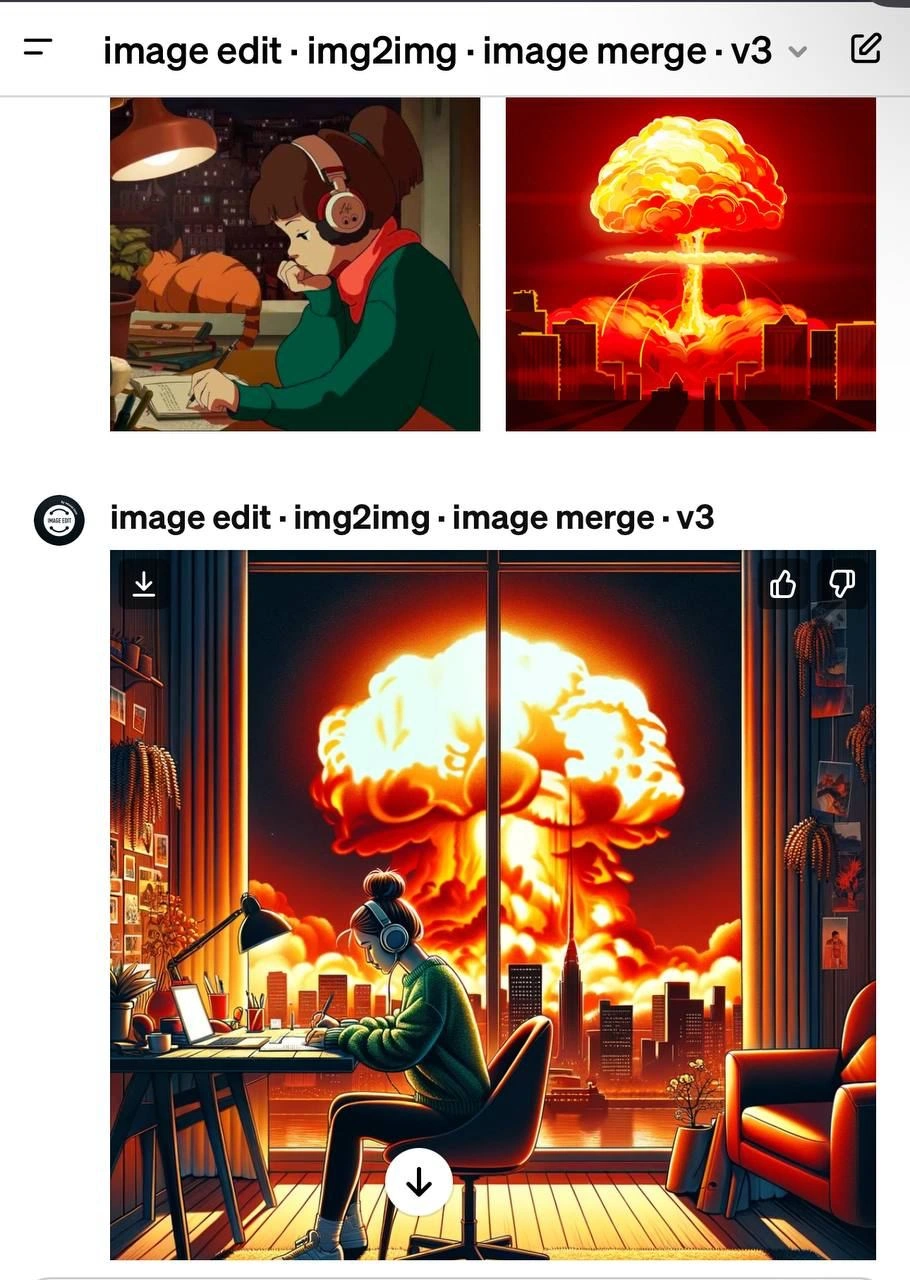
Imagine you’re doing your homework at your desk, headphones on, listening to your favorite relaxing music. You’re completely focused, maybe even sipping some hot chocolate. Now imagine outside your window, something totally crazy is happening – like a giant explosion lighting up the sky. The whole city looks like it’s in danger, but you’re just sitting there calmly writing or typing away. Sounds silly, right? That’s exactly the picture this meme paints. It’s funny because normally if you saw a huge explosion outside, you’d panic or at least look shocked. But here, the girl (who represents a coder or engineer) is as chill as ever, not even looking up from her work.

This scene is an exaggeration of a real feeling in the tech world: sometimes a computer system or website breaks in a really big way (imagine all your toys suddenly breaking at once – that kind of big). The people who have to fix it might actually appear very calm and focused while working on the solution, even though it’s a serious problem. It’s a bit like a firefighter being calm while putting out a fire – they have a job to do and panicking won’t help. The meme uses the giant explosion outside as a wild symbol for “everything is going wrong,” and the girl calmly coding represents the engineer staying cool to handle it. The humor comes from how extreme the situation looks versus how relaxed she is. It’s saying, in a funny way, that good engineers try to be steady and composed even when things are blowing up around them (sometimes literally in their computers!). Essentially, it’s a cartoon-ish way to show “Keep calm and carry on” – or as a popular joke in these circles goes, “This is fine.”

Level 2: On-Call Life 101

Let’s break down what’s happening here in simpler terms. In software development and IT, “production” or prod is what we call the live system that real users are using (like a website or service running for the public). A production incident means something has gone very wrong with that live system – kind of like the app or site is “on fire” (not literally on fire, but it’s severely broken or down). We often joke that production is burning when users can’t use the service or there’s a major bug. In the image, the huge mushroom cloud – which is what you see after a nuclear bomb explosion – symbolizes a huge disaster in production. In other words, the system didn’t just catch a small fire, it practically nuked itself! This could mean a data center outage, a major security breach, or a buggy update that crashed everything. It’s an extreme way to visualize a ProductionOutage or meltdown.

Now, who’s the calm person at the desk? That represents a developer or an SRE (Site Reliability Engineer) who is on-call. On-call means it’s their responsibility to respond if something breaks in production, even if it’s late at night or early morning. Companies often rotate this duty among the DevOps/SRE team. When you’re on-call, your phone (or a pager app like PagerDuty) will alert you if a critical problem arises. It’s like being a firefighter but for computer systems – instead of a firetruck, you grab your laptop. Here the developer is super calm, typing away with her headphones on, even though a “nuclear” disaster is visible outside. That’s a humorous exaggeration of how an experienced on-call engineer will approach an emergency: by staying cool and focused, almost zen-like. Panicking won’t help resolve the issue; you have to methodically debug and fix things, so they try to remain unfazed externally.

The lofi girl in the meme is a reference to a well-known YouTube livestream called “lofi hip hop radio – beats to relax/study to”. It’s an endless animation of a girl in headphones writing in a notebook, with a cat napping nearby, set to very chill music. Many coders actually play that music in the background while working to help them concentrate. So, the meme took that calm “lofi coder” aesthetic and threw in the most chaotic background possible – a nuclear explosion. It’s highlighting the contrast. On one side, calm and cozy coding session with coffee and music. On the other side, absolute chaos – the kind of production issue that gives engineers nightmares. This contrast is funny to developers because it’s a bit relatable: sometimes when everything is breaking at once, you might actually throw on a calming playlist to steady your nerves and get down to troubleshooting, trying to act normal while your brain is racing.

Also, a quick note on the interface text at the top (“image edit · img2img · image merge · v3”): this indicates the meme image was created using a generative AI image merge tool. Essentially, the meme maker used an AI to combine two images (the lofi girl and the explosion) into one seamless picture. AI image tools have a mode often called img2img (image-to-image), where you give example images and it blends or alters them. That detail isn’t central to the joke, but it’s a neat inclusion showing how tech-savvy the meme is – even the meme itself is made with new tech. For a junior developer or someone new to DevOps, the key takeaway is: this meme is about the contrast between a calm engineer and a catastrophic system failure. It uses an over-the-top disaster (nuclear blast) to humorously illustrate what a major outage feels like, and it portrays the engineer as almost unrealistically peaceful – which is exactly the absurdity that makes it funny in a dark, relatable way.

Level 3: Keep Calm and Pager On

This image perfectly captures the SRE mindset under pressure: everything is on fire (or outright exploding), yet you’ve got to stay composed and keep typing – because freaking out won’t fix anything. The left half of the source shows the famous “lofi girl”: an anime-style girl in headphones, peacefully studying to chilled beats. This has become an icon of focus and calm, especially for developers who actually listen to lofi hip-hop while coding. The right half shows a massive red-orange nuclear mushroom cloud over a city – the ultimate symbol of a catastrophic event. By merging these, the meme paints a darkly funny picture recognized in DevOps circles: the developer remaining serene and productive while a production outage of apocalyptic proportions rages on. It’s basically the DevOpsHumor version of the “This is fine” dog sitting in a burning room.

Any seasoned on-call engineer can relate: you might be internally screaming as alerts flood in, Slack is blowing up, and the Production environment is in free-fall – but externally you’re trying to channel zen vibes, methodically checking metrics and logs. There’s a kind of OnCallHumor in looking impossibly unbothered by a production incident that feels like the end of the world. In reality, an experienced DevOps or SRE engineer develops a bit of a shell: after being paged at 3 AM for the 5th time this month, you might just sigh, put on your noise-cancelling headphones (maybe even that same lofi playlist), and get to work. The juxtaposition of a calm coder and a nuclear blast is exaggerated, but not by much – veteran engineers jokingly call some deployments “nuking prod” when they go disastrously wrong.

The interface text shown (“image edit · img2img · image merge · v3”) is actually part of the joke’s meta. It reveals that this composite image was created with an AI image editing tool (likely a Stable Diffusion variant or similar). Essentially, someone fed the AI those two source images and got this surreal mashup out – a very 2023 way to make memes. Interestingly, that feels symbolic too: using futuristic tech (generative AI) to depict a very old story in IT. From the days of lone sysadmins managing on-prem servers to modern cloud infrastructure managed by teams, one truth remains: when ProductionIncidents go nuclear, the people on-call have to channel monk-like calm to save the day. This meme resonates through shared trauma and pride – only those who’ve battled real Production outages know how absurd and necessary that chill attitude is. It’s a coping mechanism turned into a visual gag. The city may be glowing radioactive, but hey, the code must go on.

Level 4: Cascading Failure Chain Reaction

In the world of distributed systems and DevOps, a “nuclear explosion” in production isn’t just colorful hyperbole – it’s a pretty apt metaphor. A massive failure in one part of a complex system can trigger a cascading failure across dependent services, much like an uncontrolled chain reaction. In reliability engineering terms, we talk about blast radius: how far the damage spreads when something goes catastrophically wrong. If a critical microservice goes down and circuit breakers or bulkheads (design patterns to contain failures) aren’t in place, that one failure can propagate and multiply. One misbehaving component calls another, queues back up, threads lock up, databases overload – soon the entire stack is glowing red-hot, figuratively melting down. This is analogous to a nuclear reactor without control rods: energy (or error throughput) builds exponentially until BOOM – total system failure.

Site Reliability Engineers (SREs) often reference the “cascading failure” nightmare scenario in post-mortems of major outages. For instance, if Service A becomes slow, then Service B (which calls A) starts piling up threads waiting on A, then Service C (calling B) times out and retries blindly – soon you have a perfect storm, an explosive spike in load and errors. Such chain reactions have taken down entire data centers before. Seasoned engineers design graceful degradation: maybe the system should shed load or serve partial results instead of going nuclear when a dependency fails. But despite all best practices, complex production systems can still surprise you with new failure modes – those are the moments when everything breaks at once, reminiscent of a mushroom cloud on the monitoring dashboards.

The meme’s juxtaposition of a calm coder with a literal atomic blast through the window is a tongue-in-cheek nod to this reality. The calm developer is the “control rod” in this meltdown: absorbing the panic, dampening the oscillations, and preventing a total production annihilation. There’s even a whiff of chaos engineering here – the kind pioneered by Netflix’s Chaos Monkey – where you intentionally introduce failures to practice staying chill during a simulated catastrophe. It’s as if the SRE in the picture has run so many GameDay drills that even an apocalyptic failure is just another scenario to manage. The humor lands because any engineer who’s dealt with a severe outage knows the theory: big systems can fail in big ways – but you still have to step in and stabilize the core, no matter how surreal the scale of the blast.

Description

This image is a meta-meme showcasing AI image generation, structured in two parts. The top part displays two source images under the heading 'image edit · img2img · image merge · v3'. On the left is the iconic 'Lofi Girl' anime character, studying peacefully at her desk. On the right is a stark, fiery image of a nuclear bomb exploding over a city. The bottom, larger part of the image presents the AI's synthesized result: a detailed illustration of the Lofi Girl, still wearing her headphones and diligently working at her desk in a cozy room, but through the large window behind her, a massive nuclear explosion is incinerating the city skyline. The meme humorously and effectively demonstrates the power of AI image merging tools to blend completely opposite concepts. For developers, this image is a powerful metaphor for maintaining focus and trying to be productive while a project is catastrophically failing, a production server is down, or the CI/CD pipeline is figuratively (and now literally) exploding
Comments

7
Anonymous ★ Top Pick This is a perfect visualization of a senior dev pushing a critical hotfix on a Friday afternoon, completely focused, while ignoring the catastrophic CI/CD pipeline failure notifications blowing up their second monitor
  1. Anonymous ★ Top Pick

    This is a perfect visualization of a senior dev pushing a critical hotfix on a Friday afternoon, completely focused, while ignoring the catastrophic CI/CD pipeline failure notifications blowing up their second monitor

  2. Anonymous

    Sure, the data center’s gone full mushroom cloud, but until the SLA breach survives the 5-minute Prometheus scrape interval it’s still “orange,” so I’ll just keep vibing and draft the postmortem ahead of the blast wave

  3. Anonymous

    The incident channel is discussing whether this counts as one outage or seventeen microservice failures while I'm just trying to finish this migration before the blast radius includes our region

  4. Anonymous

    When you merge that 'quick hotfix' directly to production on Friday afternoon and calmly continue coding while monitoring dashboards show everything's on fire - the img2img workflow perfectly captures that serene developer confidence right before the PagerDuty alerts start rolling in. At least the mushroom cloud has good color composition and proper anti-aliasing

  5. Anonymous

    After 48-hour debug sprint, code runs flawlessly - on your machine, while prod achieves thermonuclear blast radius

  6. Anonymous

    Finally, a model that merges lofi focus with SEV0 - writing the postmortem in flow while the error budget mushrooms outside prod

  7. Anonymous

    Drafting the “limit blast radius” RFC while our “atomic deploy” delivers a live demo outside

Use J and K for navigation