AI-Generated Emoji: The Cool Philosoraptor
Why is this AI ML meme funny?
Level 1: Mixing Memes
Imagine you have two very different stickers: one is a smiley face emoji wearing cool sunglasses and giving a thumbs-up 👍, and the other is a picture of a thinker dinosaur scratching its chin like it’s trying to solve a big puzzle. Now, think of magically blending those two stickers into one. You’d get a funny picture of a cool smiley dinosaur – the smiley’s face is still there, with the sunglasses and grin, but it also has a scaly green dinosaur hand on its chin, as if the emoji suddenly got very thoughtful. It’s like asking a computer to mix peanut butter and jelly but with pictures: the end result is a single image that’s a bit of both – and it makes us laugh because we never see those two things together! The reason it’s funny is the same reason a mash-up song can be funny: our brain knows these two original things don’t usually mix, so seeing them combined is a silly surprise. In simple terms, this meme is showing what happens when an AI art tool mixes two memes into one – a playful, unexpected new picture that’s just meant to make you smile and go “Haha, look at that!”
Level 2: Meme Style Transfer
Let’s break down what’s happening in simpler terms. We have two very different images: one is a thumbs-up emoji with sunglasses (imagine that cheerful yellow face 😎 giving double thumbs up), and the other is the Philosoraptor meme — a green cartoon dinosaur from an old meme known for holding one claw under its chin like it’s thinking hard about a silly paradox. Now, an AI tool (specifically a Stable Diffusion model, which is a kind of generative AI that creates images) is used to combine these two images into one. This technique is often called img2img (short for image-to-image), and it’s like telling the computer: “Here’s a picture, now make me a new picture that’s a mix of this one and some idea I have.”
Stable Diffusion is a popular AI model that can generate pictures from text descriptions or modify given pictures. Think of it as a very advanced drawing program that learned to draw by looking at millions of images. In this case, the developer gave it an image (the emoji) and also the idea or style of another image (the philosoraptor meme) and said “blend these.” Sometimes this is done by providing both images to the AI, or by giving one image plus a text prompt describing the other. The term meme style transfer fits well: it’s like style transfer (where you apply the look of one image onto another), but here it’s done with memes. So the style or concept of the philosoraptor (green, scaly, thoughtful dino vibes) is being applied onto the base emoji picture (round, yellow, smiling with sunglasses).
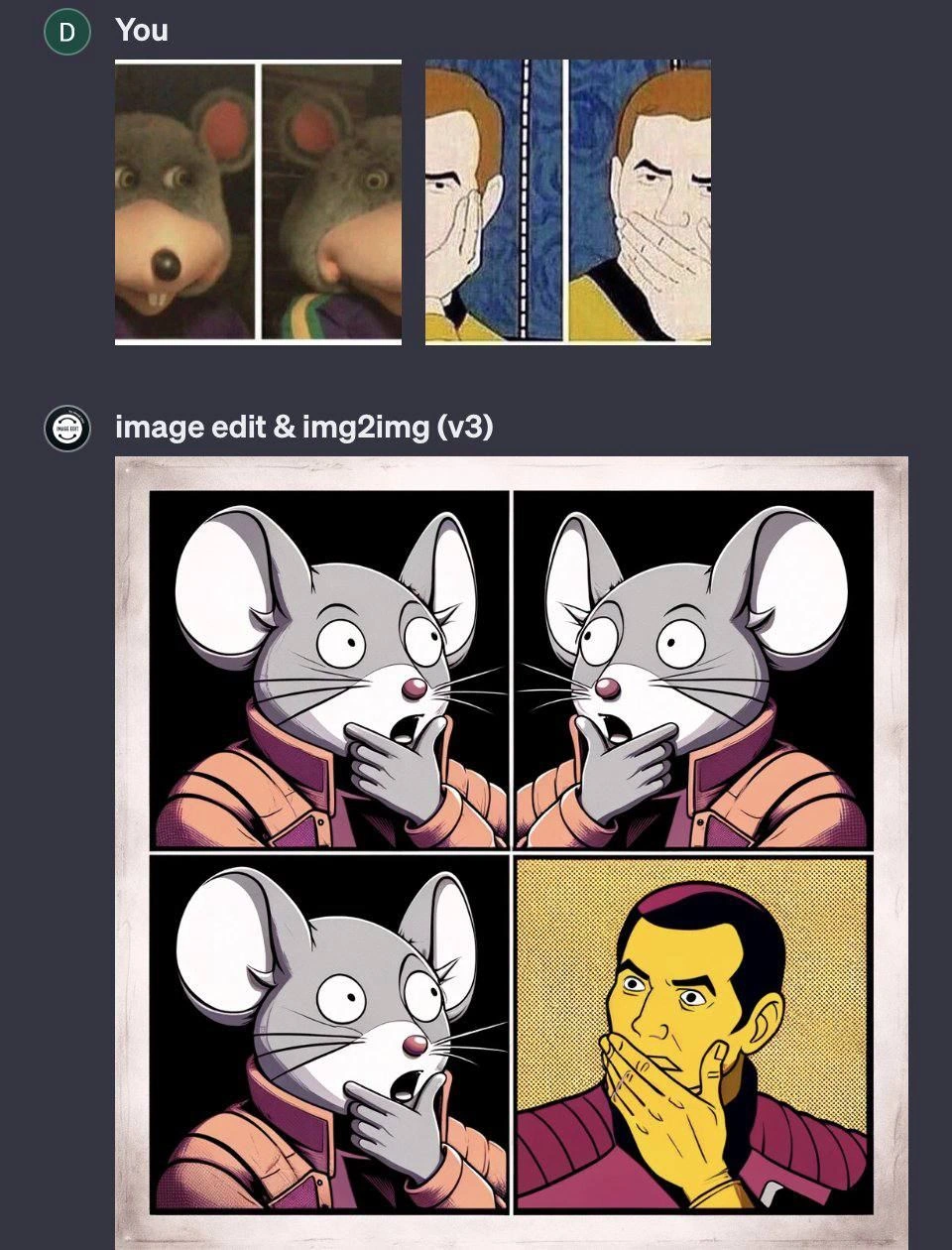
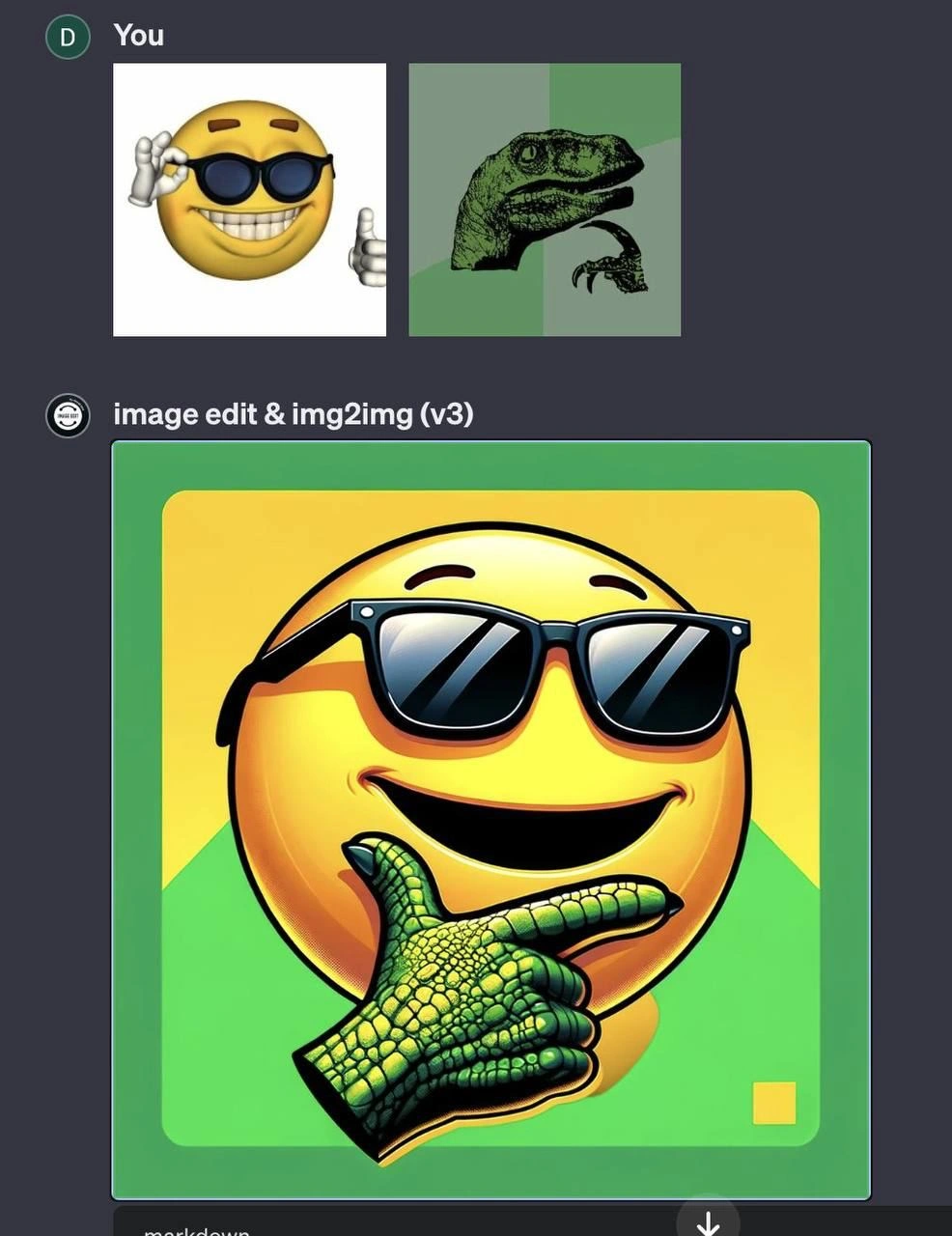
The screenshot suggests the user used a chat-like interface to do this (maybe a bot or a special GUI for the AI). We see a dark background, a label “You”, and two squares: one showing the emoji, one showing the philosoraptor. Those are likely the inputs the user provided. Below that, it says “image edit & img2img (v3)” and shows the final big image result. So perhaps the user used a feature called “image edit” combined with img2img in version 3 of this tool or model. Image edit usually means you can tweak or change parts of the original image. img2img means the model will take an initial image and transform it. Combining them might mean the tool can take two images and merge them in some way.
The output image (as described) is pretty striking: it’s basically a smiley face emoji that now has a reptilian twist. It’s still yellow and round, with that big grin and even wearing black sunglasses just like the original cool emoji. But now it also has a scaly green dinosaur hand resting against its chin, exactly like how Philosoraptor poses! The background is half yellow, half green in a split fashion, which cleverly echoes both source images (the emoji’s typical yellow backdrop and the philosoraptor’s green tones). So the AI did a literal mash-up: one part the original emoji’s look, one part the dinosaur meme’s style.
For a junior developer or someone new to these tools, what’s important to know is that generative AI models can take sources (images or text prompts) and create new images that combine elements of both. It’s like mixing colors: give it yellow and blue and you get green – except here we gave it an emoji and a dinosaur and got a dinosaur-emoji hybrid. The tags reflect what’s going on: AIGeneratedContent (the image is produced by AI), GenerativeModels (Stable Diffusion is the model generating it), and AIHumor because, let’s face it, the result is funny. The developer experience angle (DeveloperExperience_DX) comes from the fact that playing with such AI tools has become part of a coder’s toolkit and playground. Developers often experiment with these models to see what they can do – sometimes it’s for serious projects, and other times it’s just for a laugh or a cool shareable moment, like this one.
To put it clearly: this meme is showing an example of generative AI mashup. The term “mashup” is like when DJs mix two songs together; here the AI mixed two visual ideas together. Philosoraptor_meme plus an emoji equals a new fun image. It’s an AI-powered crossover. People find it amusing because the two originals come from very different contexts – one is a friendly emoji you’d use in chat, the other is a classic internet meme about pondering the universe. Seeing them combined is unexpected and creative. It demonstrates both the power of the tool (wow, it actually blended them believably!) and the playful side of AI usage (we’re basically doing it for the meme). And if you’re new to img2img: remember, it’s just telling the AI “take this image and change it according to this idea,” which is exactly what was done to get a smiley face philosophizing like a dinosaur. Fun, right?
Level 3: When Memes Collide
For any developer who’s dabbled in AI/ML, this meme hits that sweet spot of AI humor. It captures the moment when you point a powerful AI tool at something utterly whimsical. We have a classic case of generative AI hype vs. reality: the hype is that image models can create literally anything – even a “philosophical emoji” – and the reality is… well, they actually did, but it’s more absurd and funny than you imagined. The screenshot shows a chat-like interface (perhaps a Discord bot or a web UI) where the user (labelled "You") provided two reference images: on the left, the standard 😎 emoji grinning with double thumbs-up, and on the right, the famous Philosoraptor meme (that green velociraptor pondering life’s big questions). Hitting the “image edit & img2img (v3)” button, the dev essentially told the AI: “Hey, merge these two!” – and the AI delivered a hilariously literal mashup.
From a senior developer’s perspective, the humor lies in both the process and the outcome. The process: using an image-to-image diffusion pipeline, which is typically employed for tasks like enhancing photos or applying art styles, to instead do a meme style transfer. It’s the kind of light-hearted experiment you try out after reading one too many Stable Diffusion blog posts – “Sure, it can generate art… but can it blend a dinosaur with an emoji?” This repurposing of serious tools for meme creation is a very Developer Experience (DX) thing: we love to play with our tools in off-label ways. It’s reminiscent of how devs used to abuse enterprise printers to spit out ASCII art, or how we write absurd programs just to see what happens. Here, the state-of-the-art AI image model becomes a meme generator for the lulz.
The outcome is comedy gold: the AI produced a generative mashup that is surprisingly coherent. The resulting image has the big glossy yellow smiley face and sunglasses from the emoji (retaining that “cool vibes” expression), and it also sports a scaly green dinosaur hand on its chin, perfectly mimicking the Philosoraptor’s trademark “thoughtful claw” pose. Even the background is a neat blend – half yellow, half the philosoraptor meme’s green tone – as if the AI artist decided to split the canvas between the two source palettes. As seasoned devs, we chuckle because we recognize both memes instantly, yet we’ve never seen them combined quite like this. It triggers that “haha, of course the AI would do that!” reaction. We know how generative models tend to merge features: sometimes they spill over boundaries or create nightmare fuel. We’ve seen faces with extra eyes or distorted hands from these models, but in this case the distortion actually works in favor of humor. The emoji’s human-like hands morphed into one dino-clawed hand, and rather than being a glitch, it reads as the emoji striking a philosopher’s pose. The AI basically said, “thumbs-up doesn’t fit a thinking dinosaur, let’s have our cool emoji stroke an invisible beard instead.” Clever girl, that model (to quote Jurassic Park).
Why is this so relatable to developers? Because it’s a perfect example of AI tools doing something both brilliant and silly at the same time. We’ve all run experiments where the output wasn’t what we intended but was entertaining nonetheless. Perhaps the developer expected a more subtle style blend, but got a literal interpretation: an emoji crossover with a dinosaur limb attached. It underscores the trial-and-error nature of working with generative AI. Seniors know that despite all the fancy demos, using these models is often like herding cats – you nudge them with prompts and examples, but they have a mind of their own. Here the AI’s “mind” decided the sunglasses and grin should stay (that’s the emoji’s identity) and the philosoraptor’s identity is that contemplative claw and maybe a smirk – so it put those together in one image. The humor is that it’s spot-on meme logic: it created a brand-new meme that could plausibly go viral, all by accident!
There’s also an inside chuckle at the label “(v3)” next to image edit & img2img. Any experienced dev or AI tinkerer knows that version 1 of your experiment rarely nails it. You try different settings, tweak the diffusion strength, or adjust how much each image influences the result. By version 3, maybe you’ve dialed in the right balance. Seeing “v3” hints that this cool-philosoraptor-emoji merger took a couple of tries to get right – which is totally on-brand for iterative development. It’s like hyperparameter tuning for memes. AI developers often share these incremental results in chat, laughing at the fails until one output is “so bad it’s good” or genuinely awesome like this. The final product here is both: it’s absurd and kind of awesome.
In the broader context of AI hype vs reality: The hype says “AI can do anything, even artistic creation with just a click!” The reality is “Yes, but you might end up with something delightfully weird.” This meme’s existence highlights how far our tools have come (a few years ago, merging images this well would require meticulous Photoshop work or clunky neural style transfer algorithms). Now a developer with the right model can whip up a meme mashup in seconds. It’s a mini celebration of progress in AIGeneratedContent – we have democratized these capabilities to the point where devs are using them for casual fun. And as any senior dev will tell you, when tooling becomes fun, you know it’s reached a new level of maturity (or at least accessibility). The collective experience being referenced is: “We have these insanely advanced models, and what do we do? We create dino-emojis at 2 AM and share them in chat.” And honestly, that’s the kind of developer experience that keeps us excited about the craft.
Level 4: Latent Diffusion Alchemy
At the cutting edge of generative models, this meme showcases an advanced use of image synthesis: combining two distinct visual concepts via an img2img diffusion pipeline. Under the hood, Stable Diffusion (a latent diffusion model) operates in a high-dimensional latent space where images are encoded as mathematical representations. In an image-to-image scenario, the model starts from one image (e.g. the thumbs-up emoji) and gradually transforms it towards a target concept (the Philosoraptor meme style) through iterative denoising. Each step of the diffusion process is guided by learned features so that the final image embodies both inputs. Essentially, the algorithm performs visual alchemy: it takes the essence of a cool 😎 thumbs-up emoji and fuses it with the contemplative dinosaur’s vibe at the latent feature level.
This blending is not a simple overlay – it’s a complex multi-modal conditioning. The system might use dual encoders or sequential conditioning passes: one to encode the emoji image’s content, and another to infuse the philosoraptor’s style or conceptual attributes. Modern diffusion frameworks even support control networks or attention mechanisms to handle such multi-image mashups. There’s a bit of sly genius here: Philosoraptor is an old internet meme known for pondering paradoxes, and the emoji is the epitome of positive affirmation. Merging them requires reconciling contrasting features – the model has to figure out how a single image can be both thoughtful and cheerfully cool. This is done by finding a point in latent space that simultaneously satisfies features of a scaly green dinosaur hand and a glossy yellow smirking face. If you peeked at the latent vectors, you’d see something like an interpolation of the two source embeddings.
In academic terms, this process leans on latent space interpolation and side-conditioned diffusion. The model’s CLIP encoder (or a similar text-image encoder) likely recognizes “Philosoraptor meme” and “thumbs-up emoji” as separate feature clusters. By conditioning generation on both, the diffusion model must minimize the loss for both image objectives, effectively solving a multi-constraint optimization. It’s a bit like solving two puzzles at once: one puzzle is “resemble the emoji’s shape and color scheme,” and the other is “incorporate the philosoraptor’s textures and pose.” The result is a converged solution that satisfies both constraints – a single image manifesting both memes. The background’s split-tone (yellow and green) even suggests the model found a middle ground in color palette, possibly influenced by each input image’s dominant colors. We’re witnessing the emergent behavior of diffusion networks: they can produce creative crossover content even without explicit programming for “meme style transfer.” All the heavy lifting happens in matrix multiplications and neural layers adjusting pixel probabilities in each diffusion timestep.
# Pseudocode: Diffusing an emoji towards a dinosaur style
latent = encode(emoji_image) # Encode emoji to latent representation
for step in range(num_diffusion_steps, 0, -1):
latent = diffusion_model.denoise(latent, cond=philosoraptor_features)
# gradually apply Philosoraptor's "deep thought" features while preserving emoji shape
result_image = decode(latent) # Decode latent back to an image
# The result_image now contains a cool emoji face with a philosoraptor hand pondering.
Above is a highly simplified view of how one might conceptualize the process. In reality, the diffusion model adds noise to the emoji image’s latent and then removes it step by step, conditioned on the target meme’s features or a prompt describing the desired mix. By the final step, what emerges is an AI-generated image that carries both the smiley’s cheerful swagger and the raptor’s scaly, philosophical cool. It’s like the model performed a cross-domain mashup in the neural realm. From a theoretical standpoint, this illustrates how diffusion models leverage enormous training corpora (packed with emojis, memes, and everything else) to generalize bizarre requests. The humor here is rooted in the sheer technical wizardry: only by understanding latent diffusion and neural networks can one fully appreciate how an algorithm morphed two unrelated meme formats into a single coherent image. It’s a testament to the flexibility of generative AI – and perhaps a hint that these models have a cheeky sense of humor encoded in their weights!
Description
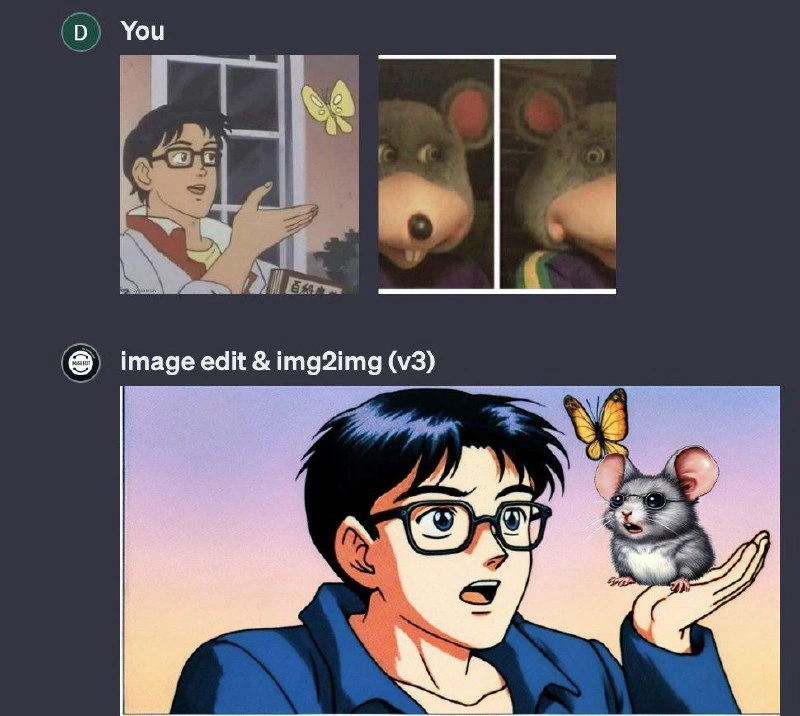
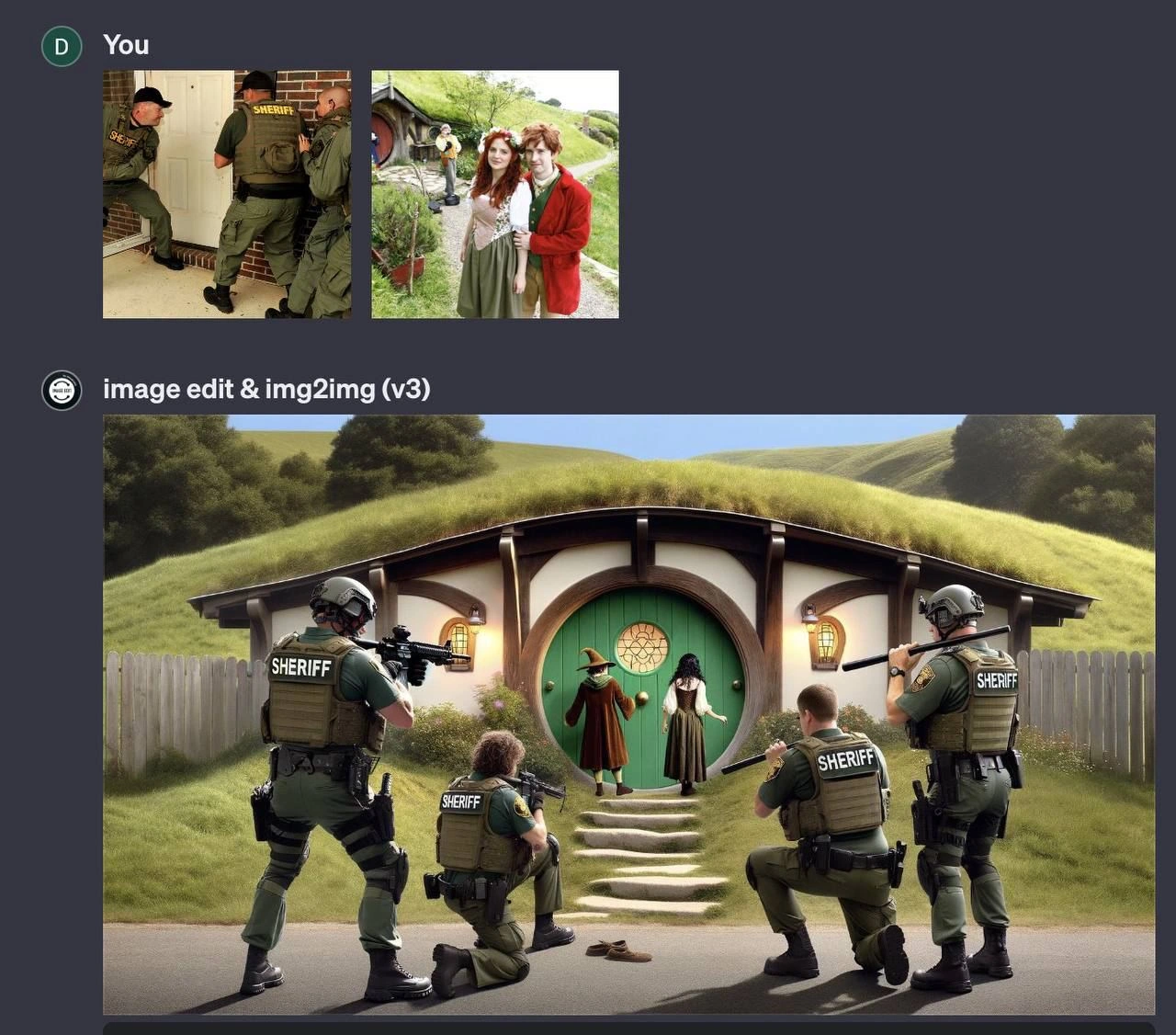
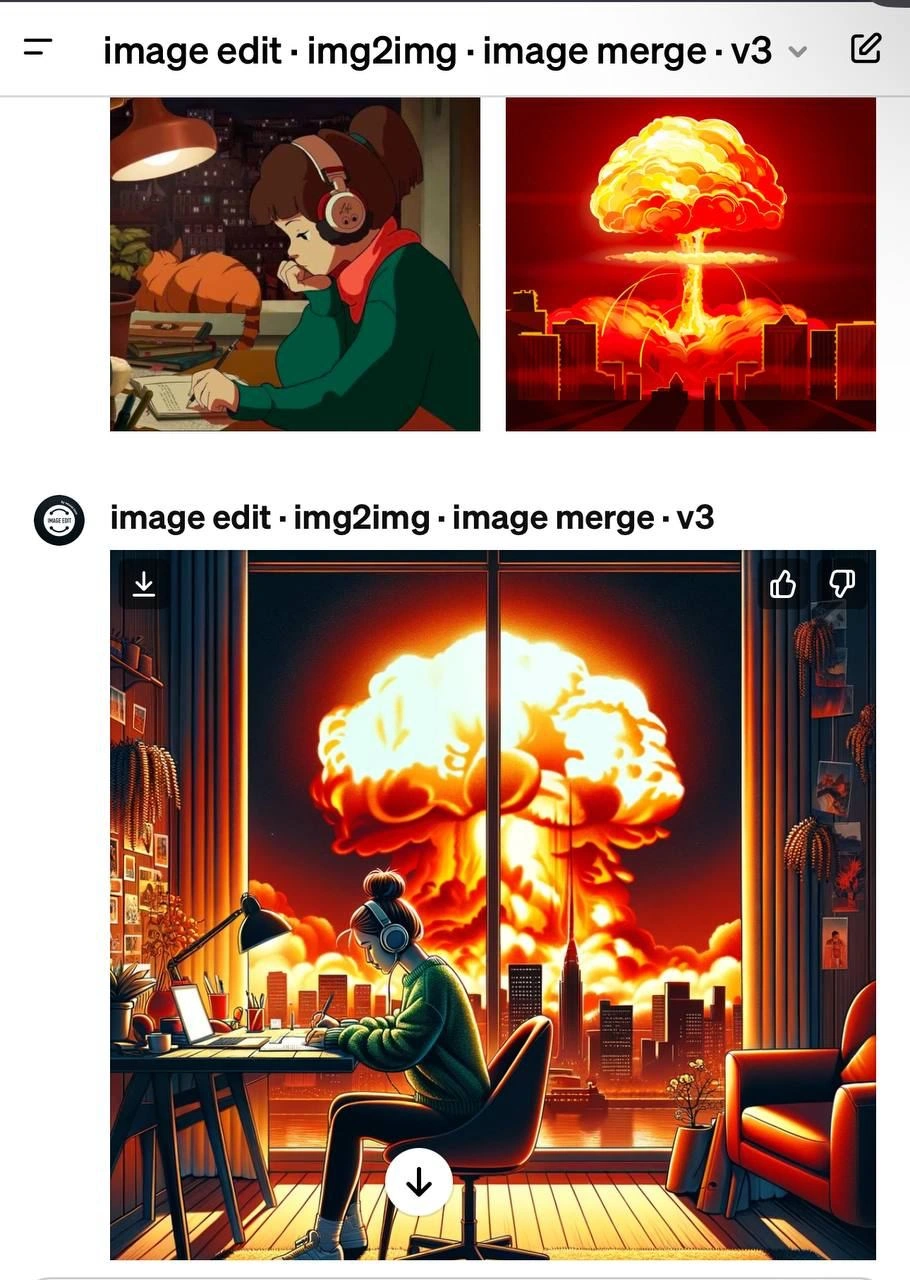
A demonstration of AI-powered image blending. The top of the image shows two source images for context: on the left, the 3D 'cool guy' emoji with sunglasses and a wide grin; on the right, the 'Philosoraptor' meme, a velociraptor in a thoughtful pose. The main, larger image below, labeled 'image edit & img2img (v3)', is the AI-generated fusion. It features the cool emoji's head, but its hand has been replaced by the scaly, green, clawed hand of the Philosoraptor, held in the same iconic, chin-stroking, pensive gesture. The result is a high-quality, seamless blend that creates a new, humorous character: a coolly confident yet deeply philosophical emoji. This serves as a meta-meme, illustrating how generative AI can not only merge images but also the concepts and poses associated with them, creating novel visual puns
Comments
7Comment deleted
My expression when I ship a feature using a deprecated library. On the outside, I'm cool and confident. On the inside, I'm deeply questioning the architectural decisions that led me to this moment
Asked img2img to blend a 👍 and Philosoraptor - got a grinning emoji stroking a reptile chin, basically the face our architect makes when Jenkins says “all green” but the p99 just doubled
When your AI model achieves 99% accuracy on the training set but you haven't checked the test set yet
When your img2img model successfully merges a 2010 meme with a 2020 emoji aesthetic, you realize we've finally achieved what the Semantic Web promised but never delivered: true cross-generational content interoperability. The Philosoraptor would be proud - if it could ponder whether this counts as feature extraction or just really expensive Photoshop
AI refactor: turned the Philosoraptor monolith into a cool emoji microservice - yet the lizard hand still clutches the 2003 Oracle stored proc
AI finally solved the T-Rex arm problem: outsource thumbs-up to emoji latent space
img2img v3 is where memes get multiple inheritance: cool emoji extends Philosoraptor; seed pinned, output still drifts - just like our ‘stable’ APIs