AI Image Generation: From Prompt to Absurdity
Why is this AI ML meme funny?
Level 1: Be Careful What You Wish For
Imagine you have a magic art genie that draws anything you ask for. You excitedly say, “I want a picture with my two favorite things: a brave police adventure and a friendly fairy-tale home!” Then – poof! – the genie creates exactly that: a team of police officers bursting into a cozy little Hobbit house in a green hill. It looks real, but it’s totally silly because those two things don’t normally go together at all. You laugh because the genie did exactly what you said, even though you really meant something a bit different. The joke is a simple one: if you’re not clear with your wishes, you might get a crazy mashup you never expected. It’s a reminder that when dealing with a literally-minded helper (even a smart computer or a magic genie), you have to be careful what you ask for, or you might end up with a hilariously mixed-up result!
Level 2: AI Takes It Literally
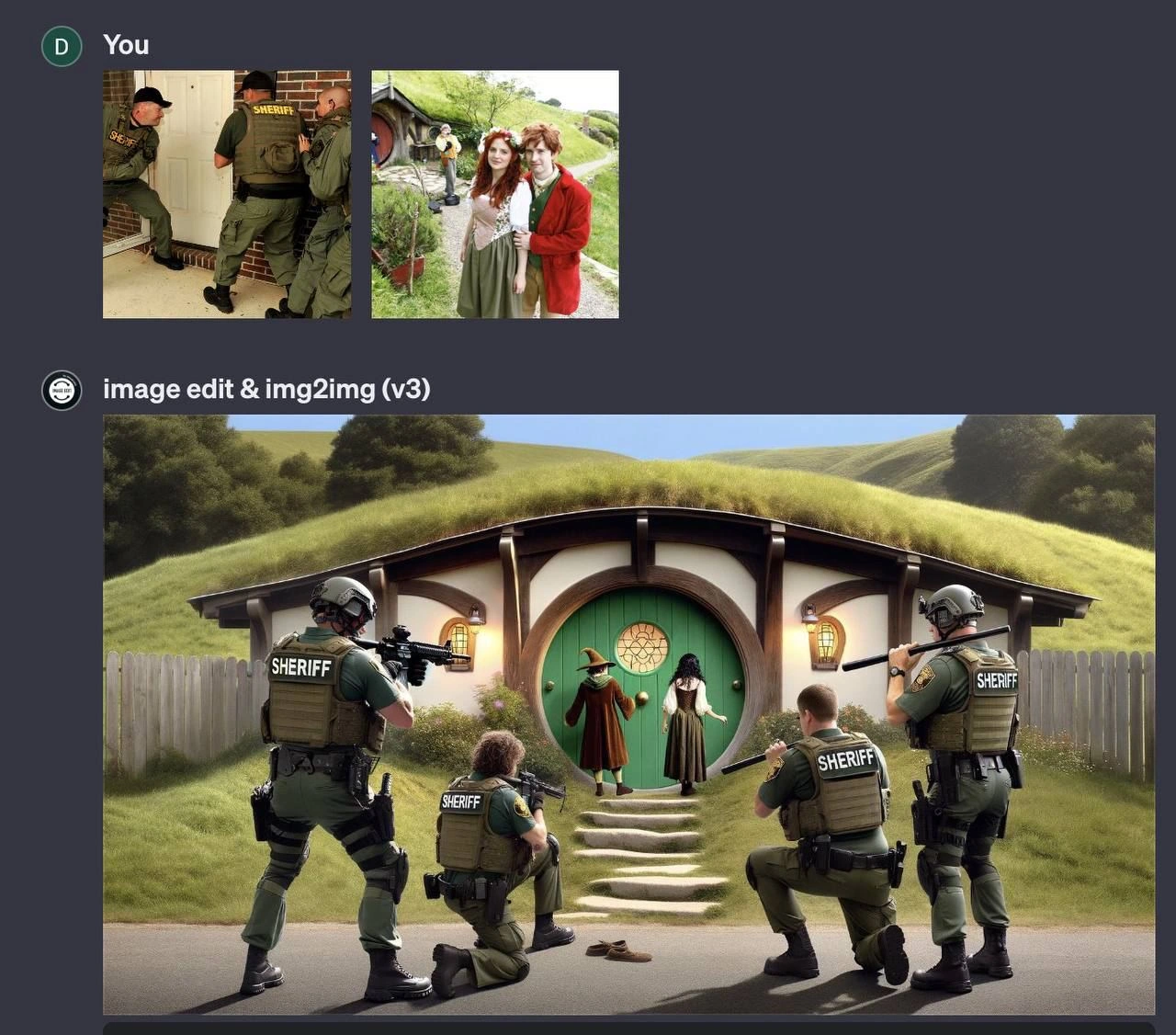
Let’s break down what’s going on here in simpler terms. We have an AI image generator (imagine a super advanced drawing program) that creates pictures based on what you tell it. In this meme, the user gave it two reference images: one of a SWAT team of police officers breaking down a door, and another of two people dressed as Hobbits in front of a cozy Hobbit house (a grassy little home with a round green door, like from The Lord of the Rings). The expectation was probably that the AI would mix these two ideas in a clever way. Instead, the AI took the instruction very literally. The resulting image is exactly a SWAT team raiding a Hobbit’s house in the Shire. Four armed sheriff officers in full tactical gear are aiming their rifles at that quaint round doorway, while two startled Hobbit-like characters stand on the step wondering what on Middle-earth is happening.
Why is this funny to developers and tech folks? Because it shows how AI can lack common sense. The AI doesn’t understand that a modern police raid doesn’t really fit in a peaceful fantasy shire – it just knows how to paste elements together if you ask for them. This is a classic quirk of these tools. In fact, there’s a whole new field called prompt engineering, which is basically learning how to ask the AI for things in just the right way so it doesn’t mess up. If you’re new to this, prompt engineering is like giving very detailed, careful instructions to avoid surprises. For example, if a beginner user just says “combine image of cops and image of hobbit house,” the AI will dutifully combine them, often in the simplest literal interpretation. It won’t automatically know if you wanted a metaphorical combination (like hobbits wearing police uniforms as a joke) or a stylistic blend (like a painting of a hobbit hole but in a realistic photo style of a raid). It will just pile both content together because that’s what it was told to do.
The term img2img refers to an image-to-image generation mode. Instead of starting from scratch, the AI takes an existing image (or images) and then transforms or extends it according to a prompt. Think of it like giving the AI a sketch or photo and saying “change this to fit my idea.” In the meme’s case, the user likely provided the two photos as inputs for an img2img process. The AI then tried to make a single coherent image from them. Coherent, of course, only in a visual sense – the lighting, shadows, and details look pretty realistic as one scene. But contextually, it’s a crazy mashup. This kind of AI-generated content can be both amazing and puzzling. On one hand, wow, the picture looks like a real snapshot (the hills and costumes and even the officers’ gear look photorealistic!). On the other hand, you end up with a scenario that’s basically a fantasy parody: modern law enforcement invading storybook Hobbiton.
For someone starting out with these AI tools, this meme is a lighthearted lesson. It teaches that you sometimes have to spell out what you want in your prompt, otherwise the computer might take you too literally. It doesn’t have the human intuition to say “Hmm, police and hobbits… maybe they don’t go together unless it’s meant as comedy.” Instead, the AI obeys blindly. This is why you’ll hear a lot about the limitations of current AI. They’re not creative or understanding in the way we are – they remix what's in their training data. If that data has seen plenty of police images and plenty of fantasy images, it has no problem merging them, because no one told it that it’s a bizarre combo. The result is an unexpected_model_output like this scene. People in the AI community often share these goofy outputs as a way to bond over how far the tech has come and how far it still has to go. It’s both a “Haha, look at this!” moment and a learning moment: next time, maybe be more specific or use separate steps when combining two very different ideas.
In summary, the meme is highlighting a simple fact: today’s AI will do exactly what you ask, not necessarily what you mean. The hobbit-hole-meets-SWAT-raid image is a perfect example of an AI misunderstanding a multi-part request. It’s like a kid or an overly literal colleague following your instructions to the letter and creating something bizarre. It makes us laugh, and it also reminds us that despite all the AI_hype, these systems don’t truly “get” the world – they just generate based on patterns. And sometimes those patterns produce a scene as ridiculous as a Shire home being stormed by the sheriff’s department!
Level 3: When Prompts Collide
Every seasoned user of AI image generators has a story of a mash-up gone wrong. This meme nails that shared experience: you give the model some inspiration, and it delivers exactly what you asked for in the most facepalm-inducing way. Here we have an AI taking two prompts – a modern SWAT raid and a Tolkien-esque hobbit scene – and combining them way too literally. The humor is in the extreme juxtaposition: it’s as if the AI couldn’t distinguish between a fantasy request and a tactical scenario, so it churned out a cross_context_merge of both. For developers and prompt enthusiasts, this is a familiar “gotcha!” moment. It’s reminiscent of the classic programming adage: computers do exactly what you tell them to. In this case, the AI did exactly what it was prompted with, without the subtlety the user probably intended. The poor hobbits end up at the business end of a breach-and-clear operation because the model has zero genre awareness – it only knows how to remix what it’s learned.
This speaks to a broader AI limitation that insiders chuckle (or groan) about. Generative models can be incredibly powerful, but they’re fundamentally pattern mimickers. They don’t truly understand context; they just know that image A had cops and image B had a round door, so hey, why not put cops around that round door? The meme format – showing the prompt images and then the result – highlights the overly literal interpretation. It’s like the AI thought, “Alright, I see tactical gear and I see a hobbit hole, I’ll just put them together, done!” The absence of common-sense filtering is exactly what makes this both funny and frustrating. Everyone hyping up AI-generated content as the next big thing in creative industries gets a reality check from examples like this. The AI_hype meets reality when your fancy deep learning model earnestly paints something that looks visually coherent but conceptually absurd.
From a developer’s perspective, it’s a classic case of GIGO – Garbage In, Garbage Out, or perhaps here Ambiguity In, Absurdity Out. The user’s two photo prompts surely made sense to them in some creative way, but the generative tool wasn’t smart enough to interpret how to combine them artistically. Maybe the user expected the img2img mode to apply the style of one image to the content of another. Instead, the AI just merged content from both, because that was the straightforward solution in its learned parameters. This is why prompt_engineering has become such a crucial (and sometimes comedic) skill. Experienced folks know that if you naively mash two ideas into a single prompt, you might need to add a lot of qualifiers (or use advanced techniques like negative prompts or separate passes) to steer the model. Otherwise, you get these unintended collages.
There’s also a bit of industry commentary hidden here. In the rush of IndustryTrends_Hype, many claim AI tools like Stable Diffusion or DALL-E will replace graphic designers or that they magically understand what you want. But scenes like a SWAT raid on Bag End show the cracks: the tool is powerful but not intelligent in the human sense. It will dutifully generate a high-resolution, photorealistic mistake. Sure, it’s impressive that the AI can render tactical vests and Hobbit architecture correctly together, down to the glowing porch lamp and the “SHERIFF” labels. (Honestly, seeing “SHERIFF” clearly on those vests is both hilarious and a tiny bit impressive given how AIs usually mangle text – the model was really committed to the bit!). But it’s a reminder that these systems have no context filter. They don’t think “maybe I should merge the themes subtly” – they just brute-force both elements into the image.
For those of us who have spent late nights fiddling with AI tools settings, the scene of Gandalf and Frodo (let’s assume those hobbit tourists resemble our beloved characters) being caught in a SWAT raid is peak AI humor. It’s the kind of result you save and share in AI forums with a caption “Well, that didn’t go as expected 😂.” It encapsulates the trial-and-error nature of working with generative models: you often get something, but not the thing you envisioned. And sometimes that something is comedy gold. We laugh, we learn, and then we tweak the prompt with a sigh, “Okay, not that literal, let’s try again…”. In a way, glitches like this have become the culture of AI art communities – embracing the silly outputs as part of the creative process. After all, when prompts collide, you might just witness an epic hobbit-hole standoff that no human artist would’ve ever drawn on purpose!
Level 4: Latent Space Showdown
In the depths of a generative model like Stable Diffusion, every image (and even each concept within a prompt) is encoded as a point in a high-dimensional latent space. When you feed such a model two disparate inputs – say, a SWAT team breaching a door and a peaceful Hobbit homestead – the AI doesn’t truly “know” they’re from incompatible universes. Instead, it numerically merges their features in latent space, guided by its training data. The result is a diffusion-driven compromise: the model tries to satisfy all conditions by literally placing all the elements into one frame. This is a latent space showdown where modern law enforcement meets Middle-earth, simply because the network’s optimization process has no concept of “this doesn’t belong here.”
Under the hood, the model’s attention mechanisms are juggling the visual features of both prompts. During the iterative denoising of a diffusion model, there’s no guardian of common sense – only math trying to minimize a loss function. If concept A is “tactical police raid” and concept B is “Hobbit shire house,” the diffusion model will dutifully distribute attention between A and B, blending patterns from both. The round green door and grassy hills get rendered alongside uniforms labeled SHERIFF and tactical gear because the network has learned to reproduce each feature when prompted. It lacks a hierarchy or an insight that maybe “SWAT raids don’t happen in fairy tales.” The humor here actually exposes a fundamental limitation of current AI: the inability to discern context or apply real-world logic when synthesizing images. The AI overfits to the prompts provided – treating them all as gospel – resulting in an over-literal fusion in pixel space.
There’s some fascinating ML theory peeking through this absurd image. It touches on the challenges of compositional generative models. Researchers often talk about making models that can understand compositionality – the ability to combine concepts in a human-like way. This meme is basically a failed compositional case: the model combined two concepts without nuance. In an ideal world, an advanced model might have stylized the hobbit hole with a subtle hint of modernity or vice versa, but today’s diffusion networks lack an explicit “concept separation and recombination” module. Instead, everything lives in one tangled vector representation. When those vectors collide, you can get these literal cross-overs. It’s a bit like linear algebra gone rogue: the final image is roughly the “sum” of the two input concept vectors, which the decoder then turns into a photorealistic scene. The math did exactly what it was told – unfortunately (or hilariously), that meant manifesting a Shire SWAT standoff as if it were the most natural thing in the world.
Description
A two-part image demonstrating the process and result of AI image generation. The top section, labeled 'You', displays two source images: one depicts a police SWAT team raiding a house, and the other shows two people dressed as hobbits in a fantasy setting resembling the Shire. The bottom section, labeled 'image edit & img2img (v3)', shows the AI-generated output: a large, detailed image where four heavily armed sheriff's deputies are in the process of raiding a classic hobbit hole built into a grassy hill. Two small figures, one appearing to be a wizard and another a hobbit, stand on the doorstep looking surprised. The meme showcases the capabilities of modern text-to-image and image-to-image AI models, which can blend disparate concepts into a single, often humorous or surreal, visual narrative. It's a meta-joke about the creative tools now available, where the humor arises from the absurd juxtaposition of a high-intensity police operation with the peaceful, idyllic world of J.R.R. Tolkien's Middle-earth
Comments
7Comment deleted
This is what happens when the project requirements are just two conflicting JPEGs and the lead dev is a generative AI. The final product is technically impressive, meets the source specs, and is utterly useless for the business case
Proof that Stable Diffusion parses commas as a CROSS JOIN: “SWAT team, hobbit hole” → no-knock warrant in the Shire
When security finally discovers that one developer who's been running a production database on their personal Raspberry Pi for the last three years
When your image-to-image model has better composition skills than your entire design team, but you still can't explain to the PM why the training data included both tactical operations manuals and Tolkien fan fiction. At least now we know what happens when you fine-tune on both CCTV footage and fantasy cinematography - turns out the Shire needed better perimeter security all along
Auditors spot a service account named “ringbearer” with admin on every cluster: “Sir, step away from the monolith and drop the token.”
Set denoise to 0.6 and ControlNet pose: the model preserved the breach choreography and refactored the address to Bag End - finally, an incident response runbook that compiles in Middle‑earth
SRE's SEV1 response: SWAT breaches Bag End to evict that OOMKilled pod squatting in the cluster