The Universal Excuse: Stack Overflow is Down
Why is this DevCommunities meme funny?
Level 1: When the Library Closes
Imagine everyone in a workshop builds things by following recipes from one enormous shared cookbook in the corner. One day the cookbook vanishes. Nobody can remember the recipes by heart — they never needed to — so all work simply stops, and the workers start fencing with rulers while standing on rolly chairs. When the supervisor storms in to yell, someone points at the empty cookbook stand, and the supervisor just says "ah, fair enough" and leaves. It's funny because the excuse is ridiculous and completely valid at the same time — and because everyone, including the boss, already knows nobody actually works without the cookbook.
Level 2: Blocked, Officially
Stack Overflow is the giant question-and-answer site where programmers post problems ("why does my code throw NullPointerException?") and others post solutions. For most working developers it functions as an external memory bank: you hit an error, you search it, and the top answer — written by someone who hit the same wall in 2013 — unblocks you in ninety seconds. "Down" means the site is unreachable: an outage, the same way Netflix or your school portal sometimes just stops loading.
The comic's logic chain, spelled out: developer hits a problem → the usual ninety-second fix is unavailable → developer is blocked → blocked time is legitimate downtime → sword fighting commences. Early in your career you'll discover both halves of this personally: first, the slightly deflating realization that much of professional programming is skilled searching rather than heroic memorization (this is normal and fine — knowing how to find and evaluate answers is the actual skill); and second, the concept of being blocked — when your work genuinely cannot proceed because something you depend on (a code review, a broken build, a down service) is outside your control. The boss's "OH. CARRY ON." is the fantasy version of every standup where you've said "still blocked" and hoped nobody asked follow-up questions.
Level 3: The Single Point of Failure Nobody Architected
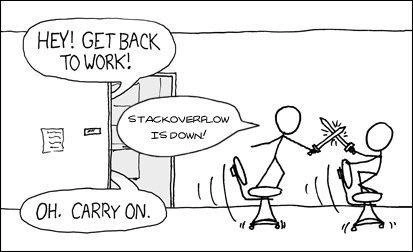
This stick-figure comic is a direct remix of the most famous excuse in software history — the xkcd "compiling" strip, where two developers sword-fight on office chairs and deflect the boss with "MY CODE'S COMPILING!" Here the panels are nearly identical — same hallway, same rolling chairs, same off-panel boss yelling
HEY! GET BACK TO WORK!
— but the sanctioned excuse has been upgraded for the modern era:
STACKOVERFLOW IS DOWN!
OH. CARRY ON.
The substitution is the entire thesis. The original gag dated from an era when the bottleneck on developer productivity was machine time: compilers were slow, builds took twenty minutes, and waiting was structurally legitimate. By swapping in Stack Overflow, the comic asserts that the bottleneck has migrated from the toolchain to a third-party knowledge service — and, more cuttingly, that management now accepts this. The boss's instant "OH. CARRY ON." is the punchline's sharpest edge: the dependency is so universally understood that it requires no explanation, no ticket, no postmortem. An external website's availability has become part of every company's effective SLA without appearing in any architecture diagram.
What makes it "too real" rather than merely cute is that the dependency is genuine in a way that polite engineering culture under-admits. Modern development is heavily recall-augmented: nobody memorizes the exact incantation for parsing dates in Java, the correct ffmpeg flags, or which of the four ways to center a div currently works. That knowledge is outsourced to a communally-maintained cache, and Stack Overflow spent fifteen years being that cache. Real SO outages produced a measurable, industry-wide phenomenon — engineers joking on every other platform that work had globally halted — which is the rare case of a meme being empirically verifiable. The comic also slyly indicts copy-paste-driven development: if your team's velocity drops to zero when a Q&A site goes down, the outage didn't create the problem, it revealed it — the same way a region failure reveals that your "multi-region" system had one writable database all along. And there's an irony layer for the historically inclined: Stack Overflow's own engineering was famous for running one of the internet's busiest sites on a handful of servers, meaning the global developer workforce's single point of failure was itself a monument to not over-engineering.
The sword-fight on rolling chairs matters too. It's not depicted as idleness — it's the universal physical language of "blocked but on the clock," the kinetic sibling of refreshing a status page. Every open-plan office has seen its equivalent.
Description
This is a single-panel, black-and-white stick-figure comic, characteristic of the webcomic XKCD. On the left, a manager-like figure leans out from a doorway, shouting 'HEY! GET BACK TO WORK!'. Inside the room, two other stick figures are engaged in a sword fight with daggers while balancing on rolling office chairs, which are shown with motion lines. One of the developers yells back, 'STACKOVERFLOW IS DOWN!'. Hearing this, the manager figure calmly replies from the doorway, 'OH. CARRY ON.'. The humor lies in the immediate and unquestioning acceptance of the excuse. Stack Overflow is such an indispensable resource for programmers for debugging, finding code snippets, and understanding concepts, that its absence is considered a legitimate blocker to all productive work. The manager's resignation to the situation hilariously validates this dependency, implying that the only logical activity during such an outage is, naturally, sword fighting on office chairs. For senior developers, it's a knowing nod to the fact that no matter how experienced you are, you still rely on the collective knowledge of the community
Comments
8Comment deleted
Our disaster recovery plan has three steps: 1. Check if Stack Overflow is down. 2. If it is, declare a company-wide holiday. 3. If it isn't, wonder why the build is still broken
Stack Overflow went 503, so the team failed over to the Swivel-Chair Consensus Algorithm - latency’s brutal, but at least the swordfight has strong eventual consistency
The day Stack Overflow went down, we discovered that half our senior engineers had been copy-pasting the same incorrect solution for years, but it worked because everyone else was copy-pasting the compensating bug from a different answer
Stack Overflow going down is the only outage where the postmortem is written by every other company's engineering org
When Stack Overflow goes down, it's not a service outage - it's a company-wide force majeure event. Senior engineers suddenly remember they have 15 years of experience but can't recall the exact syntax for that one thing they've done a thousand times. The collective productivity drop is measurable in real-time across the entire tech industry, as developers worldwide simultaneously realize their 'expertise' is actually just knowing which Stack Overflow answer to copy from
Stack Overflow is our L3 knowledge cache; when it misses, the Confluence failover has RPO=never and RTO=whenever, so we benchmark chairs instead
Stack Overflow outage: the one SPOF where even SREs clock out guilt-free
Stack Overflow is down - turns out our bus factor is one external domain and our internal docs are aspirational