C++ Error Reporting: The Best It Can Do
Why is this Languages meme funny?
Level 1: Crash Without a Clue
Imagine you ask your friend why your toy isn’t working, and instead of answering you, they just faint on the spot. You’re left standing there confused, with zero explanation. That’s what’s happening here in computer terms. The programmer is asking the C++ program “What went wrong?” and the program’s only response is essentially to collapse. It’s both funny and frustrating — funny because it’s such an absurdly unhelpful response, and frustrating because you still have no idea what went wrong. In simple terms, the joke is that the software didn’t give any explanation; it just stopped working, leaving the poor developer to figure out the mystery on their own. Anyone can relate to the feeling of trying to get an answer and getting nothing useful. In this meme, that feeling is turned into a little story: the developer wanted a clue, but the program’s “best it could do” was to suddenly crash. The humor comes from how ridiculously uninformative that is, kind of like a prank where the computer just gives up instead of helping.
Level 2: C++ Crash Course
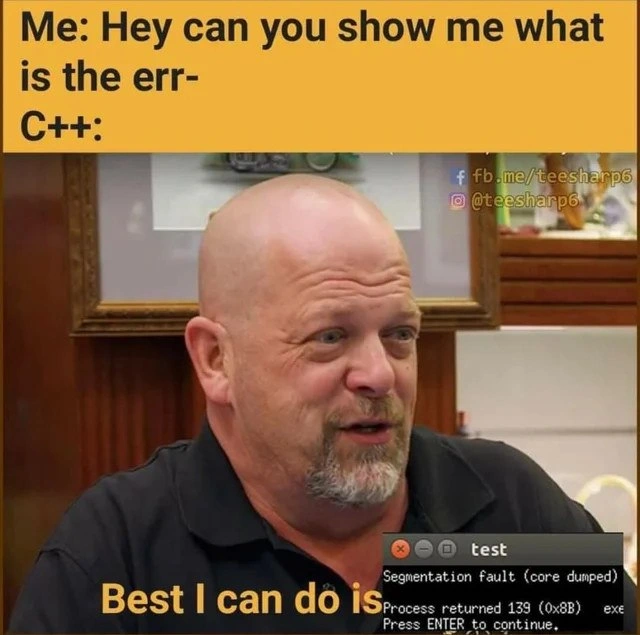
Let’s break down what’s happening in this meme in simpler terms. The meme text says: “Me: Hey can you show me what is the err- C++:” and then shows the Pawn Stars guy saying “Best I can do is” followed by “Segmentation fault (core dumped)” in a terminal window. In other words, the developer is asking C++ to show what the error is, and C++ basically replies with a generic crash message. The top text actually cuts off at “err-” as if the program didn’t even let the question finish before collapsing. This format is using the Pawn Stars TV show meme: you ask for something valuable (like detailed error info) and the shop owner (here personified by C++ itself) says “the best I can offer is…” something much less useful. It’s a fun way to show that C++ isn’t giving the developer the answer they wanted.
Now, what is a segmentation fault? In straightforward terms, it’s when a program crashes because it tried to access memory incorrectly. Think of a program’s memory like an organized storage: certain sections belong to your program, and other sections are off-limits. A segmentation fault (often shortened to “segfault”) means the program stepped into a memory section where it wasn’t allowed. When that happens, the operating system steps in and says “No way, this program is doing something wrong” and stops it. The result is your program quits unexpectedly with that message "Segmentation fault". In C++ (and C), this usually happens due to mistakes with pointers or array indices:
- A pointer is a variable that holds a memory address (like a reference to a place in memory). If a pointer doesn’t point to a valid area (for example, if it’s
nullptr– which is like saying “points to nothing” – or it’s uninitialized garbage data), and you try to use it, the program can crash. - If you have an array of 5 items and you try to read or write the 6th item (out of bounds), you’re touching memory that isn’t allocated for that array. C++ won’t stop you from attempting it, but the moment you do, it can cause a segfault because you’ve hit memory you shouldn’t touch.
- Using memory after you’ve freed it (or deleted it) is another common mistake. For instance, if you delete an object and then still try to use that object, that memory might no longer be yours. Accessing it can lead to a crash.
In languages with automatic memory safety (like Python, Java, or C#), the runtime would usually prevent these kinds of errors or at least throw a clear exception (“Index out of range” or “Null reference!” with details). But C++ doesn’t automatically check these things. C++ gives programmers a lot of power, including direct control of memory – this is why we call it manual memory management, because you’re in charge of allocating and freeing memory. The downside is, if you make a mistake with those pointers or memory, the program simply fails without a nice explanation. It’s like C++ says, “You have the freedom to shoot yourself in the foot, and I won’t necessarily warn you if you’re about to do it.” That’s why when a C++ program crashes due to a memory error, it typically just prints “Segmentation fault” and stops. No line number, no description of what exactly went wrong.
The message “(core dumped)” that often follows “Segmentation fault” is telling you that the system saved a dump of the program’s memory (a core dump) at the moment it crashed. This dump is basically a snapshot that a developer can load into a debugger tool to inspect what the program was doing when it died. It’s not something most beginners interact with directly, but it’s there so that advanced users can try to figure out the cause after the fact. The line “Process returned 139 (0x8B)” is basically the shell or program environment saying “the program exited with an error.” 139 is an exit code that specifically means a segmentation fault occurred. (The number might seem random, but it’s just a code the operating system uses internally to mark this kind of crash.) So all together, the terminal is showing: the program crashed due to a segmentation fault, a core dump was created, and it exited with an error status.
For someone new to C++ or coming from languages that hand-hold a bit more, this is a shock! Instead of an explanatory error message, you just get this blunt output. The meme is poking fun at that situation. The developer asks, essentially, “Can you at least tell me what went wrong?” and C++ responds with “Segmentation fault (core dumped)” – which is the least helpful answer, basically “It broke.” It’s funny in the meme because it’s so true: C++ often won’t explain the bug for you. The burden is on the developer to go into a debugger or add logs or use tools to find out exactly where and why the crash happened.
So, in summary, this meme highlights a common debugging frustration with C++:
- C++ programs can crash due to memory errors (like bad pointer usage or array indexing mistakes).
- When they do, the error message is just a terse segfault notice with an optional “core dumped” note. Not very newbie-friendly!
- The “Pawn Stars” format jokingly casts C++ as a guy who isn’t going to give you what you asked for. You wanted details? “Best I can do is tell you it crashed.”
If you’ve ever run a C++ program and seen “Segmentation fault,” you can probably relate. It means you’ll have to roll up your sleeves and debug the hard way, because that’s all the info you’re getting from the runtime. The humor here comes from recognizing how painfully common and uninformative that scenario is — and sometimes all you can do is laugh and say, “Thanks C++, very cool.”
Level 3: Best I Can Do is Crash
For a seasoned developer, this meme hits close to home. It parodies the famous Pawn Stars meme format: someone asks for something valuable, and the pawn shop guy (Rick Harrison) lowballs them with "Best I can do is..." followed by something far less impressive. In the image, C++ is personified as Rick, and the developer begs, "Hey, can you show me what the error is?" Any hope of a detailed explanation is immediately dashed by C++’s response: "Best I can do is Segmentation Fault (core dumped)." The humor lies in that absurd negotiation – the programmer wants clarity, and C++ basically says, “Nope, here’s a cryptic crash instead.” It’s a wry commentary on how unhelpful low-level languages can be when things go wrong.
Every experienced C++ programmer has encountered the dreaded segfault and its minimalistic error report. It's practically a rite of passage. You run your program expecting either correct output or at least an error message pointing you in the right direction, but instead you get a cold "Segmentation fault (core dumped)" with an exit code 139, and nothing else. It’s the software equivalent of dialing tech support and getting disconnected after a single beep. 🤦♂️ In higher-level languages like Python or Java, an error might come with a stack trace or at least an exception type (e.g., IndexError or NullPointerException) and maybe even a line number. But with C++ and manual memory management, a lot of errors simply cause an immediate crash with no contextual info. The meme exaggerates this trait by imagining C++ as an obstinate pawn shop owner who won’t even entertain the request for more details. "You want helpful error info? Sorry, best I can do is a core dump." It's funny because it’s true — C++ often leaves you hanging like that.
The shared PTSD among developers is real: seeing that core dumped message flash on your screen instantly triggers memories of long debugging sessions. You can almost hear a collective groan from anyone who’s chased a segfault at 3 AM. The meme leverages that common experience. We laugh, perhaps a bit bitterly, because we’ve all been that person desperately asking the program “Why did you crash?” only to be met with silence and a hex code. The humor has an edge of frustration: you know the code blew up somewhere, but now you have to play detective in the dark. Veteran devs joke that when a C++ program dies like this, it's basically saying "I have no idea what just happened either, good luck!" The exit code 139 and the core dump are like the program’s final enigmatic words before it keels over.
Why is this such a persistent problem? It comes down to C++’s philosophy and power. C++ gives you low-level control and high performance, but with that comes the responsibility (or burden) of memory management. If you misuse a pointer or go out of array bounds, there’s no safety net. The program doesn’t politely log “Oops, you messed up at array index 10”; it just segfaults, often without warning. This is a classic example of “undefined behavior” in C++ – do something the language doesn’t allow, and all bets are off. In practice, as seasoned devs know, it usually manifests as a segmentation fault. But that one-liner error is about as informative as a blank stare. It’s the bare minimum. The meme nails this: C++ offering the "best it can do," which is essentially the least helpful response imaginable.
In real-world scenarios, when you see that "Process returned 139" in your CI pipeline or your application logs, you know you’re in for a fun time (sarcasm very much intended). It means somewhere, likely:
- a pointer went null or wild and got dereferenced,
- or an array index was out-of-bounds,
- or memory that was freed was later used (use-after-free),
- or some other low-level memory snafu occurred.
But the program itself isn’t going to tell you which one of those happened or where in the code. Seasoned developers have a sort of gallows humor about it: "Ah, segmentation fault ... guess I’ll fire up the debugger and start digging through the core dump or sprinkle print statements to narrow it down." It’s a bit like waking up to find your car isn’t in the driveway — you know it’s gone, but now you have to figure out how and why without any witnesses.
The industry has collectively learned these lessons over time. We have tools and best practices to mitigate the pain: smart pointers (std::unique_ptr, std::shared_ptr) to reduce raw pointer mistakes, sanitizers and static analysis to catch errors, and even newer languages like Rust that are designed to prevent such crashes at compile time. Yet, with billions of lines of C++ code out there (and plenty of new C++ being written for performance-critical applications), segmentation faults remain a fact of life. Even the best C++ wizards occasionally see their code go boom with no more clue than “core dumped.” That’s why this meme resonates: it’s exaggerating a truth we all know. C++ won't hold your hand – if you screw up with memory, the most feedback you might get is that sarcastic Pawn Stars grin and "I can offer you a segmentation fault, take it or leave it."
The meme is a lighthearted way to commiserate about debugging frustration. It's as if the entire C++ community is Rick from Pawn Stars, telling us "You want specifics? Sorry, the best I can do is vaguely imply you messed up." We chuckle at the format, but inside we’re thinking, "Yep, been there." In short, the joke lands because it captures the unique mix of power and peril that comes with C++: you asked for control and speed, and you got it, along with all the segfaults that come as part of the deal.
Level 4: SIGSEGV Under the Hood
At the lowest level, a segmentation fault (often abbreviated segfault or noted as signal SIGSEGV) is an operating system safety mechanism kicking in when a program attempts to access memory it doesn’t have permission for. In a language like C++, which relies on manual memory management (meaning the programmer directly controls memory allocation and pointers), there's no built-in safety net checking pointer validity at runtime. So when you stray out of bounds—say by dereferencing a nullptr or writing past the end of an array—the CPU’s memory management unit detects this invalid access and raises an exception. The OS intercepts it and sends signal 11 (SIGSEGV) to the process. This is the system essentially saying “You've hit a forbidden memory region.” Historically, the term “segmentation fault” comes from older architectures where memory was divided into segments (code, data, stack, etc.), and touching an address outside your allowed segment would trigger a fault. Modern systems use virtual memory pages and protection bits, but the concept is similar: illegal memory access = program gets walloped by the OS.
When that signal isn’t handled by the program (and let’s be honest, most C++ programs don’t catch a SIGSEGV because there’s not much you can do once memory is corrupted), the OS’s default action is to terminate the process. This abrupt shutdown often comes with a final gift: a core dump file. That’s what the (core dumped) part of the message hints at. A core dump is a snapshot of the program’s memory and CPU state at the moment of crash. The nomenclature “core” harks back to the days of magnetic core memory in early computing – when programs crashed, the contents of that core memory could be “dumped” to disk for later analysis. Today’s core dumps serve the same purpose: you can load the core file into a debugger to perform a post-mortem analysis, effectively asking “What were you doing at the moment you died, program?” It’s a forensic artifact for debugging after the fact.
Notice the “Process returned 139 (0x8B)” in the meme’s screenshot. That number is a wink from the OS about what happened. On Unix-like systems, when a program is terminated by a signal, the shell often reports an exit code equal to 128 + the signal number. Since SIGSEGV is signal 11, we get 128+11 = 139. The hexadecimal 0x8B is just 139 in base 16. In other words, 139 means the program crashed due to a segmentation fault. It’s not a code the programmer explicitly returns; it’s a system convention letting you know a fatal memory access violation took your program down. Experienced developers recognize exit code 139 instantly as “uh-oh, we dereferenced something we shouldn’t have.” (There’s also a certain dark humor here: we've all seen 139 so many times that it's practically a badge of honor in the C/C++ world, albeit one you’d rather avoid earning).
To make this concrete, consider a minimal C++ example that would produce a segfault:
#include <iostream>
int main() {
int *p = nullptr;
*p = 42; // Attempt to write to address 0x0 -> triggers SIGSEGV (invalid memory access)
std::cout << "This line will never be reached.";
return 0;
}
Running this program would immediately crash with something like:
$ ./a.out
Segmentation fault (core dumped)
$ echo $?
139
We tried to write to memory address 0x0 (NULL), which is definitely off-limits – hence the CPU/OS promptly halted execution. The program doesn’t get to print anything after the bad access; instead, the only output is the system’s segfault message and a non-zero exit status. Unlike exceptions in managed languages (which can be caught and give you a stack trace), a segmentation fault in C++ is a forced stop with no helpful error details from the program itself. The real clues of why it crashed are locked inside that core dump or need to be poked at with a debugger or specialized tools like Valgrind or AddressSanitizer. According to the C++ standard, this kind of error is actually categorized as undefined behavior. That means the language specification doesn’t guarantee what will happen – your program might crash immediately (which is usually the case on modern OSes), or worse, it might not crash at all but silently corrupt data. The typical outcome is indeed a segmentation fault thanks to hardware memory protection, but the lack of any descriptive error message is by design. C++ deliberately trades away some memory safety and runtime checks for raw performance and flexibility. The result: when something goes off the rails with pointers, the best feedback you often get is exactly what this meme shows – a blunt "Segmentation fault (core dumped)". This one-line tombstone is C++’s version of "something broke, somewhere, good luck figuring it out".
Description
This meme uses the popular 'Best I can do is' format featuring Rick Harrison from the TV show 'Pawn Stars'. The top panel sets up the scenario with text: 'Me: Hey can you show me what is the err- C++:'. The main image shows Rick Harrison looking skeptical, with his catchphrase 'Best I can do is' at the bottom. Overlaid on the image is a small window from a desktop environment, likely a Linux distribution, titled 'test'. The window displays a classic C++ error message: 'Segmentation fault (core dumped)', followed by 'Process returned 139 (0x8B)' and 'Press ENTER to continue.'. The humor lies in personifying C++ as a shrewd pawn shop owner who offers the least helpful information possible when a developer asks for error details. A segmentation fault is a notoriously vague error for anyone working with C++ or other low-level languages, indicating a memory access violation without pointing to the cause, making it a universally painful and relatable experience for senior developers
Comments
7Comment deleted
Modern languages give you a stack trace, a detailed error, and a link to a probable solution. C++ gives you a segfault, which is the programming equivalent of your car making a weird noise and then just exploding
C++ is the only colleague who, when asked for a status update, hands you a 2-gig core file, says “best I can do,” and reminds you the line numbers were optimized out three builds ago
After 20 years in the industry, I've learned that C++ error messages follow the Pawn Stars negotiation model: you ask for a helpful stack trace with line numbers, and the best it can do is dump core and leave you to divine the issue from assembly code and a cryptic exit code that basically means 'something touched memory it shouldn't have' - which in a million-line codebase is about as helpful as being told 'the bug is somewhere in the code.'
C++ developers know that 'Segmentation fault (core dumped)' is just the compiler's way of saying 'I've narrowed down your bug to somewhere between line 1 and EOF - you're welcome.' It's the programming equivalent of a doctor saying 'the problem is somewhere in your body' after a full examination. At least Rust would've caught this at compile time and written you a dissertation about why your code is unsafe, complete with helpful suggestions and a link to the documentation. But here we are, staring at exit code 139, firing up GDB for the third time today, and wondering if that pointer arithmetic from 2 hours ago was really as clever as we thought
Asking C++ for a readable error is how you learn that 139 = 128 + SIGSEGV - enjoy spelunking a 2GB core in gdb because you forgot -g and ASan
Me: can you show me the error? C++: best I can do is a core dump - bring gdb, ASan, and the compiler flags for that one .so someone built in 2016
C++ error reporting: a full postmortem dump before you've even autopsied the bug