Skip to content
DevMeme
1473 of 7435
The Duality of Cloud Infrastructure Purpose
DevOps SRE Post #1648, on May 31, 2020 in TG

The Duality of Cloud Infrastructure Purpose

Why is this DevOps SRE meme funny?

Level 1: Serious Tools for Silly Fun

Imagine your school has a super high-end computer lab that’s meant for important projects and homework. Now picture one of the tech-savvy kids who has the keys to that lab. One day, when things are slow, they decide to use all those powerful school computers to host a big Minecraft game for their friends after class. Instead of doing a serious class project, they’ve basically turned the school’s study computers into a giant game server. It’s kind of naughty but also funny. They’re using something built for work and important tasks to do something purely for fun. That’s exactly what’s happening in this meme. The first part shows the person doing what they’re supposed to – using the big, fancy computer setup to help work (like making sure a website can handle lots of people). The second part shows them, with a cheeky grin, repurposing that same setup to play Minecraft when they’re bored. It’s like using a big professional kitchen to bake cupcakes for a few friends – way more capability than you need, but hey, if you have access, why not? We find it funny because it’s a playful misuse of resources: a work tool turned into a toy. The emotional core is that mix of mischief and cleverness – someone doing something they probably shouldn’t, in a very smart way, just to have a bit of fun. It’s the classic idea of turning your workplace into your playground when no one’s watching, which feels both daring and hilarious even to those of us just reading about it.

Level 2: Cloud Playground

Now, let’s break down what’s happening in simpler terms. The meme shows Winnie-the-Pooh in two moods corresponding to two captions. In the first (casual Pooh), the text says something like using K8s clusters for easy load balancing and scaling when needed. “K8s” is shorthand for Kubernetes, an open-source system that helps manage containers (lightweight, portable packages of software) across many computers working together, which we call a cluster. Think of Kubernetes as a manager that makes sure an app has the right number of copies running and that users are evenly spread out across those copies – that’s what load balancing means (sharing the work so no one server gets overwhelmed). Scaling up means adding more copies of an app when lots of people are using it, so everything stays smooth. DevOps engineers (DevOps = Development + Operations folks) and SREs (Site Reliability Engineers) use Kubernetes and cloud tools to keep websites and services running reliably. They set up things on the cloud infrastructure (servers provided by companies like Amazon AWS, Google Cloud, etc.) so that if, say, a shopping website suddenly gets a ton of visitors, the system can handle it by automatically adding more server power. All of that is depicted in the top panel as the “normal, sensible” use of these technologies — it’s basically what they’re paid to do. The phrase “easily load balance and scale up when needed” is 100% the kind of goal every web service has. So Pooh is just chill in a t-shirt, like “yeah, another day in the cloud, doing the right thing.”

In the second panel (Pooh in a tuxedo looking proud), the caption says the engineer is turning the company’s cloud into Minecraft servers. A Minecraft server is a program that lets multiple people join and play together in the same Minecraft world over the internet. Usually, you might run a Minecraft server on a spare PC or rent a single cloud server for it. But here, our bored (and creative) DevOps engineer is using the company’s whole cloud setup — which might be a powerful Kubernetes cluster — to host their game. This is like using a high-end tool for a very off-label purpose. It’s funny because the cloud setup can scale massively and handle thousands of users, but they’re using it to host a game for maybe a few friends. The “tuxedo” Pooh image is a meme way to say “I feel fancy and clever doing this.” It’s an ironic fancy-pants attitude about something that’s actually kind of a silly misuse of resources.

To put it plainly: the person in the meme should be deploying business applications on those servers (like a normal work duty), but instead they’re deploying Minecraft for fun. The top text is the responsible engineer doing containerization and cloud management; the bottom text is that same engineer turning the workplace’s cloud into a gaming playground. It highlights a bit of DevOps humor: folks who manage big server clusters sometimes can’t resist trying out fun experiments on them. All the key tech terms here – Kubernetes, load balancing, scaling, cloud infrastructure – are real tools/concerns for keeping online services running. The meme jokes that with all that power and boredom combined, even a video game server can slip into the mix. For a junior developer or someone new to these concepts, imagine being able to push a button and get dozens of computers working together on something; normally you’d use that for a big website… but here someone used it to run a game. It’s both a little naughty and a nod to how powerful modern cloud tech is (you can host anything if you know how!). And importantly, it shows the playful side of engineering culture – even serious infrastructure can become a toy under the right (or wrong) circumstances.

Level 3: From Microservices to Minecraft

For the experienced DevOps or SRE crowd, this meme hits on a familiar blend of DevOps humor and guilty pleasure. In the first panel, we have the everyday heroics: “Creating K8s clusters to easily load balance and scale up when needed.” That’s standard operating procedure in modern cloud setups. Spinning up a Kubernetes cluster (perhaps via Terraform scripts or kops) to run scalable microservices is what keeps websites up during traffic spikes. You set up containerization so each service runs in its own isolated box, you configure auto-scaling so that if user load doubles, your app can automatically go from 3 to 30 instances, and you add load balancers so no single server melts under pressure. It’s the bread-and-butter of Cloud Infrastructure management – efficient, sensible, maybe even a bit routine for a seasoned engineer. Pooh in his plain red shirt represents that normal, correct (if a bit unexciting) use of fancy tech.

Then comes the punchline in the second panel: “Turning company cloud infrastructure into Minecraft servers.” Now Pooh dons a tuxedo and a smug grin, as if this idea is the epitome of sophistication. The contrast is immediately hilarious to anyone in Cloud or DevOps_SRE roles. It’s taking the well-oiled cloud machinery, meant for handling enterprise workloads, and using it as a personal playground. Why is this funny to senior devs? Because many of us have seen or done something similar (if not with Kubernetes then with earlier tech): using spare servers or cloud credits for side projects, sometimes totally unrelated to work. It’s an open secret in some companies that the infrastructure team might run a private game server or two after hours. In the gaming culture of engineers, setting up a LAN party or hosting a multiplayer game on powerful hardware is almost a rite of passage. This meme gives that trope a modern twist – instead of a spare old server, it's the auto-scaling, container-scheduled, many-nodes-at-my-disposal Kubernetes cluster hosting the fun.

The senior perspective also catches the nuanced mischief here. Company cloud infrastructure is expensive and supposed to be for business, but a bored DevOps engineer with admin access might think, "Well, our cluster is at 10% load over the weekend, why not deploy a Minecraft pod or two?" The absurdity is that we’re treating Minecraft—a sandbox game—as if it were a microservice in our architecture. We apply all the best practices: containerize the server, deploy it with monitoring and alerts (maybe they even set up Prometheus metrics for player count and Grafana dashboards charting TPS (ticks-per-second) performance!). The engineer might brag, half-jokingly, about 99.99% uptime for their game world thanks to multi-zone failover. It’s humor born from the intersection of work and play: only a DevOps person would think to merge those contexts. It’s as if all the tedious tasks of keeping enterprise systems running become fun quirks when applied to a game. We laugh because it’s so extra — a complete over-engineering for a personal Minecraft realm — and yet, it’s completely plausible in our line of work. After all, if you have a hammer (and Kubernetes is one heck of a hammer), everything starts to look like a nail; if you have a cluster, why not run everything on it?

There’s also a hint of the containerization zeitgeist: “Can it run Doom?” used to be the benchmark of geek creativity on odd hardware; nowadays, “Can it run Minecraft in a container on Kubernetes?” is the cloudy new spin. And the answer is yes, it can – ridiculously well. A savvy DevOps might run a quick command:

kubectl create deployment minecraft --image=itzg/minecraft-server
# This starts a Minecraft server Pod on the K8s cluster

With one line, they’ve turned a serious cluster into a personal game host. The meme’s tuxedo Pooh implies this is a classy move – as if redirecting corporate cloud power for gaming is an enlightened upgrade of priorities. In truth, every senior engineer knows it’s tongue-in-cheek. It pokes fun at ourselves: the same folks who configure multi-region failover for databases might also allocate a few gigs of RAM for a Minecraft world when no one’s looking. It’s a bonding joke — a DevOps humor gem that says “we take our play as seriously as our work (and maybe vice versa).” The dual panels reflect the internal monologue of a bored DevOps engineer: Sure, I can build robust, auto-scaling services… but I could also have some fun with all that power. The reason it resonates with experienced folks is because it’s both aspirationally mischievous and technically feasible, highlighting the sometimes blurred line between engineering prowess and geeky indulgence.

Level 4: Load-Balanced Leisure

At the highest technical tier, this meme spotlights Kubernetes cluster orchestration being repurposed in an overkill fashion. Kubernetes (aka K8s) is essentially a distributed operating system for containers, built on rigorous distributed systems principles. Its control plane maintains cluster state via a strongly consistent data store (etcd using the RAFT consensus algorithm), ensuring that whether you're deploying a mission-critical microservice or a game server, the desired state is tracked reliably across nodes. In a normal scenario, creating K8s clusters to easily load balance and scale up when needed is a textbook use of container orchestration: you define a desired number of instances (pods), and the Kubernetes scheduler employs algorithms (like bin packing and priority scheduling) to place those pods on available nodes, respecting resource requests and tolerations. It even sets up virtual IPs and iptables magic for load balancing traffic evenly across pod replicas. The humor here is that all this sophisticated machinery – automated scaling triggers, health-checks, service discovery, etc. – is being marshaled to host a blocky multiplayer game. The cloud infrastructure that could elastically handle surges in web traffic can just as well respond to a sudden influx of Minecraft players by spawning new server pods. That’s load-balanced leisure: using an enterprise-grade auto-scaling group to ensure your friends never experience lag.

From a purist view, it’s both absurd and geekily impressive. Kubernetes treats a Minecraft server container just like any other app: if demand increases (more player load), a Horizontal Pod Autoscaler could theoretically create more pods; if one node goes down, the controller manager will reschedule the game pod elsewhere, keeping the Minecraft world persistently available (with the help of a PersistentVolume storing the world data). We’re talking about a level of high availability and fault tolerance for a casual game that rivals production web services. The meme tickles seasoned engineers because it’s a collision of two worlds: serious SRE-grade reliability engineering and carefree gaming. The underlying technical irony lies in using concepts like deployment manifests, cluster scheduling, and service meshes for something so non-critical. It’s like using a Formula 1 racing engine to power a go-kart – a blend of impressive and ridiculous. The Kubernetes control plane doesn’t judge your workload; it will dutifully apply the same declarative state reconciliation to a game server as it would to a payment service. This deep technical backdrop – consensus protocols ensuring your creeper farm stays up 24/7, auto-scaling making sure your castle build session never lags, and load balancers possibly distributing players – is what makes the meme a chef’s kiss of cloud humor. It playfully touches on how DevOps engineers can take colossal, elegant tech and apply it to the most whimsical uses.

Description

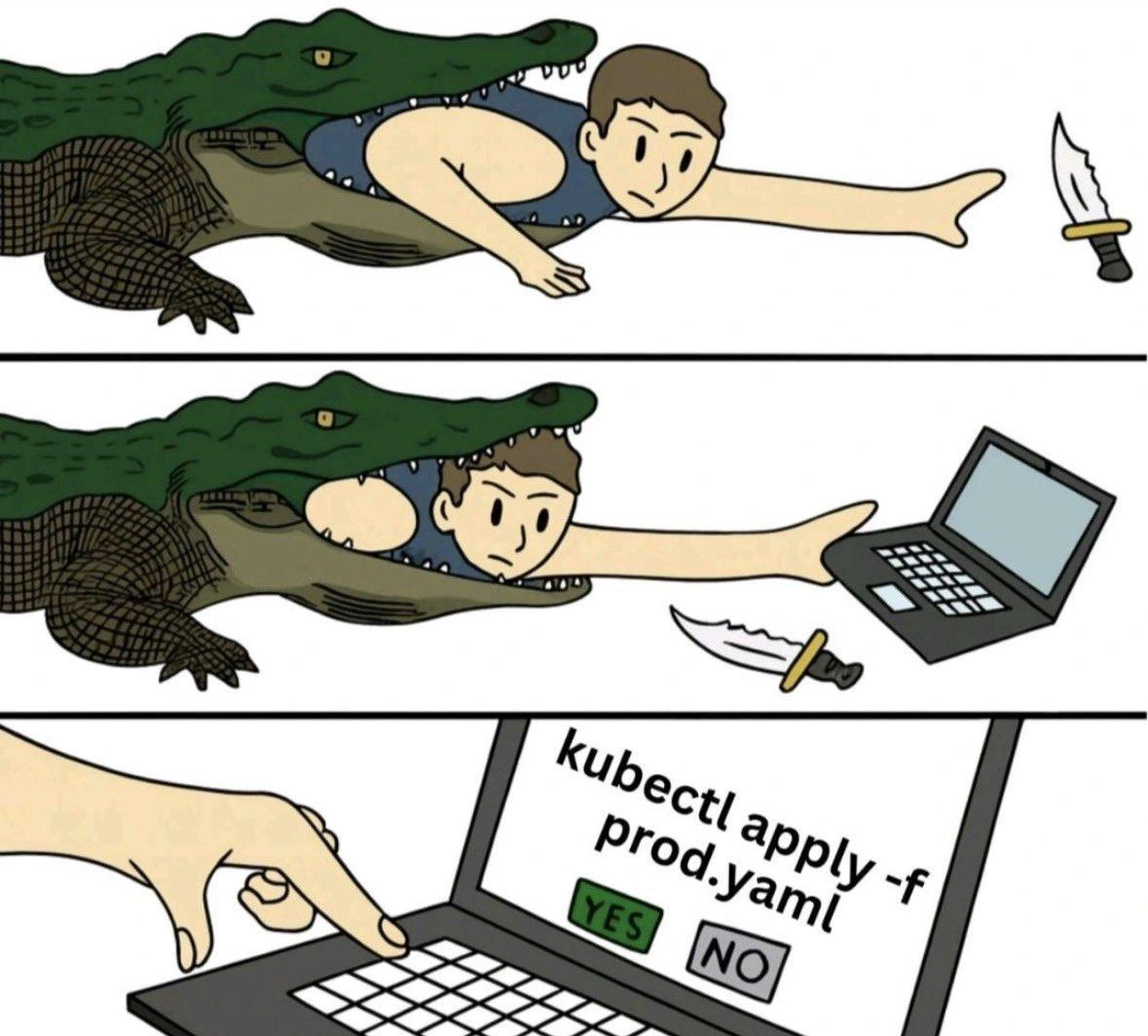
This is a two-panel 'Tuxedo Winnie the Pooh' meme format that contrasts two different uses of cloud infrastructure. In the top panel, a standard, unimpressed Winnie the Pooh is shown next to the text: 'Creating K8s clusters to easily load balance and scale up when needed'. This represents a conventional, business-oriented use of technology. In the bottom panel, a sophisticated, smug-looking Winnie the Pooh in a tuxedo is paired with the text: 'Turning company cloud infrastructure into Minecraft servers'. This represents a more playful, and likely unauthorized, use of the same powerful resources. The humor comes from elevating the frivolous act of hosting a game server to a higher plane of existence than the actual intended purpose of the expensive infrastructure, a sentiment relatable to any engineer with access to powerful systems
Comments

7
Anonymous ★ Top Pick The CFO sees a $10,000 monthly cloud bill and thinks 'scalable enterprise solution'. The SRE who spun up the Minecraft server on it sees it and thinks 'worth it for the zero-latency creeper farm'
  1. Anonymous ★ Top Pick

    The CFO sees a $10,000 monthly cloud bill and thinks 'scalable enterprise solution'. The SRE who spun up the Minecraft server on it sees it and thinks 'worth it for the zero-latency creeper farm'

  2. Anonymous

    I call it “synthetic load testing”: spin up a Minecraft namespace in prod, watch the HPA hit 50 nodes, and send Finance a Grafana dashboard labeled “player count.”

  3. Anonymous

    The real reason your K8s cluster has 99.999% uptime isn't because of your brilliant disaster recovery strategy - it's because the entire SRE team will riot if the Minecraft server goes down during their lunch break raid on the Ender Dragon

  4. Anonymous

    Every senior engineer knows the real reason we advocate for Kubernetes adoption isn't the horizontal pod autoscaling or declarative configuration - it's that a properly configured K8s cluster can run a surprisingly robust Minecraft server with better uptime than most production services. The irony? The Minecraft server probably has better monitoring, more comprehensive disaster recovery, and actually gets patched on schedule

  5. Anonymous

    Amazing how the only workload that finally proves your HPA, Ingress, and cluster-autoscaler settings is a 'team-building' Minecraft deployment - with RBAC, quotas, and cost-center chargebacks mysteriously disabled

  6. Anonymous

    We called it HPA validation: deploy a Minecraft server on the K8s cluster, autoscaling finally behaves - and FinOps finally learns what egress costs

  7. Anonymous

    K8s: Effortlessly scaling pods while turning your cloud bill into a Minecraft end-game dragon hoard

Use J and K for navigation