Skip to content
DevMeme
4202 of 7435
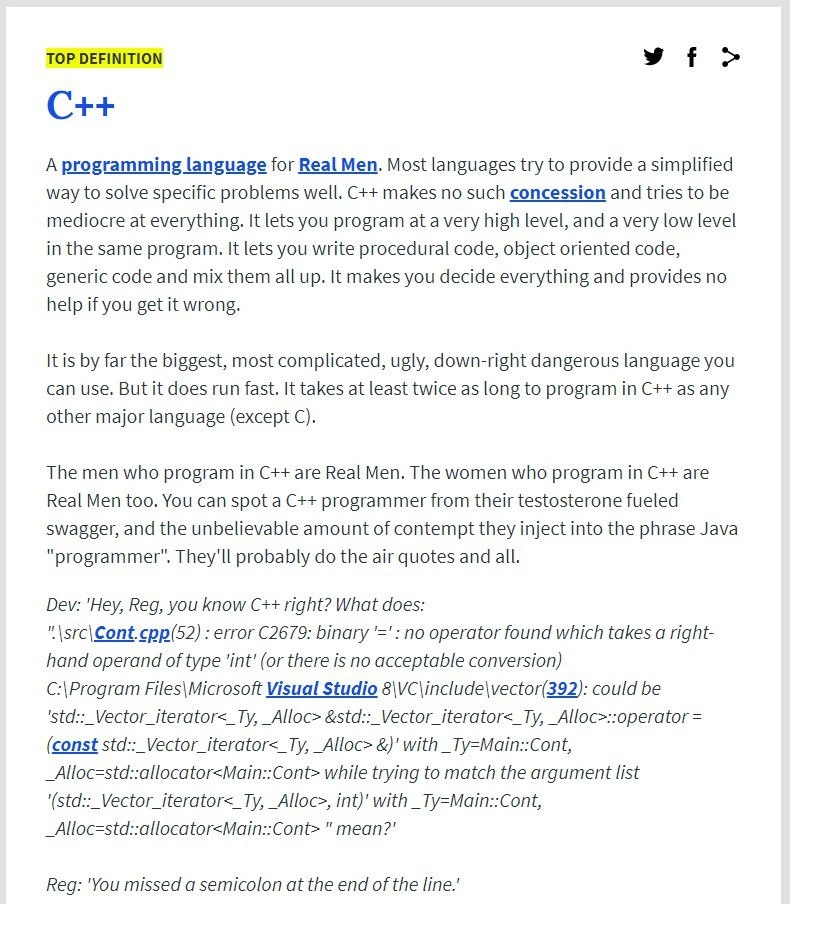
Urban Dictionary-style roast of C++ and its notorious compile errors
Languages Post #4591, on Jun 27, 2022 in TG

Urban Dictionary-style roast of C++ and its notorious compile errors

Why is this Languages meme funny?

Level 1: Mountain Out of a Molehill

Imagine you have a huge box of LEGO bricks and a very complicated model to build – say, a big castle with secret rooms and towers. The instruction book is really thick. Now, suppose you accidentally skip a tiny step, like you forget to put a little connector piece in one of the walls. All of a sudden, nothing that comes after fits right. The next steps in the instruction book start to look confusing and wrong because that one small piece was missing. You flip through pages of complex instructions trying to figure out the problem – the book is basically “yelling” technical stuff at you – and you feel totally lost. In the end, it turns out the whole mess was caused by that one teensy piece you forgot early on.

That’s exactly the joke here. C++ is like that giant Lego castle kit – powerful and can do a lot, but very easy to mess up if you’re not careful. A missing “semicolon” in code is like that missing Lego connector: it’s just a tiny character (like a period at the end of a sentence) that tells the computer “this part is finished.” Leave it out, and the computer gets super confused. It responds with a huge, complicated error message (the crazy instructions that don’t make sense – basically making a mountain out of a molehill). The meme shows a scenario where a programmer sees this gigantic error text and asks a more experienced friend for help. The friend just chuckles and says, “Oh, you forgot a semicolon at the end.” In simple terms, the friend is saying: “All that fuss? It’s just because you missed a tiny thing.” That contrast is what’s funny – it’s like using an over-the-top alarm system that writes you a 5-page report because you forgot to close the door. Anyone who’s ever been overwhelmed by a silly mistake can relate to the humor: sometimes big problems turn out to have simple fixes, and in retrospect, it’s both frustrating and a little funny that it wasn’t obvious from the start.

Level 2: Missing Semicolon Mystery

So what’s going on here, in simpler terms? The meme is styled like an entry from Urban Dictionary, which is a site where people write funny, informal definitions of terms or phrases. Here the term is “C++”, which is a popular programming language. The joke “definition” humorously describes C++ as a super tough, do-everything language that only the bravest programmers dare use. It’s calling C++ a language for “Real Men” (with a cheeky note that women who code in C++ are “Real Men” too – this is the meme’s sarcastic way of saying C++ programmers of any gender are exceedingly hardcore). Essentially, it’s teasing the macho reputation C++ has in some parts of the programming world. There’s a long-running joke that programming in C++ (or its even older relative, C) is like the “hard mode” of coding – you have to manage a lot of things yourself and the language isn’t going to baby you. So people who stick with it sometimes brag about it as if it’s a test of toughness. The meme exaggerates this bravado for comedic effect, implying C++ coders strut around with “testosterone-fueled swagger” and roll their eyes at “Java programmers” (Java is another language that’s generally considered easier to use because it does more for you automatically). It’s poking fun at that rivalry: some C++ folks joke that Java devs have it easy, while C++ devs are in the Wild West wrestling wild pointers and cryptic compilers.

Now, technically, why is C++ called complicated and dangerous here? C++ is a compiled language (unlike, say, Python which is interpreted on the fly). You write C++ code, then run it through a compiler which checks it and turns it into machine code that the computer can execute. Because C++ gives you a ton of control, it also means you have to be very precise. The meme says “It makes you decide everything and provides no help if you get it wrong.” For example, in C++ you have to manually manage memory: if you allocate memory for some data, you’re expected to free it later yourself. If you forget, you get a memory leak. If you free it at the wrong time or use it after freeing, you might crash the program or corrupt data. Many other languages (like Java, Python, C#) have a garbage collector or automatic memory management that handles much of this for you; C++ doesn’t by default – that’s the “no help” part. Similarly, C++ won’t stop you from doing potentially dangerous things, like casting types blindly or indexing outside the bounds of an array – those can lead to bugs called undefined behavior (essentially, the program can do weird and unpredictable things if you mess up, instead of giving you a clear error message). This is what the meme means by “ugly, downright dangerous language”. It’s powerful, but if misused, it can bite you. The payoff is that C++ programs run very fast (closer to the speed of the machine’s native code) because all that checking and safety net stuff is left out – nothing extra slows the program at runtime. So, there’s a trade-off: you spend more time and effort writing C++ and avoiding mistakes, but the program you get can be extremely efficient.

The meme humorously claims “It takes at least twice as long to program in C++ as any other major language (except C).” This is an exaggeration, but it carries some truth. Beginners often find C++ syntax heavy and its error messages hard to decipher, so they spend more time figuring out what went wrong. Even seasoned developers might code slower in C++ because they need to manage details manually and wait for code to compile. (Between C++ and C, it’s a toss-up – both are low-level; C++ has more features which add complexity, but those features can sometimes help avoid certain C pitfalls. The joke is basically that those two are the slowest to develop in, compared to newer languages.)

The funniest part is the story at the end of the “definition.” A dev asks what a huge, scary compiler error means, and the experienced friend (Reg) immediately pinpoints the cause: a missing semicolon at the end of a line. Let’s break down why that’s funny to someone who’s coded in C++ (or similar languages). In C++, a semicolon (;) is used to terminate statements and also appears after class or struct definitions. It’s a tiny piece of syntax, basically like a period at the end of a sentence. If you leave it out by accident, the compiler gets confused about where one statement or definition ends and the next begins. However, the error the compiler spits out might not directly say “hey you missed a semicolon here.” Often, it tries to interpret the code as best as it can, and the real mistake cascades into other errors.

For example, consider this tiny snippet:

struct Cont {
    int x;
}  // Oops, missing semicolon here 

std::vector<Cont> vec;
vec.push_back({42});

In C++, after a } that closes a struct or class definition, you must put a semicolon. If you don’t, the compiler doesn’t see the end of the definition properly. In the example above, because of the missing ;, the compiler might think std::vector<Cont> vec; is somehow part of the struct definition or something equally nonsensical. This confusion can lead to an error like the one in the meme: it might complain about operator= or some template issue, pointing to the <vector> header, because the real problem (no semicolon) made everything following it gibberish to the compiler. So rather than a clean “syntax error at line X, expected ‘;’”, you sometimes get a chain reaction of errors in C++. The compiler error message shown in the meme is exactly that kind of chain reaction. It’s telling us (in a very convoluted way) that something is wrong with an assignment using a std::vector iterator and an int. An iterator in C++ is like a pointer or a position marker used to traverse containers (like vectors). In simpler terms, a std::vector<Main::Cont>::iterator is an object that lets you move through a list (std::vector) of Main::Cont elements. You normally assign one iterator to another (or get one from methods like vec.begin()), but you shouldn’t assign an int to it. So why would the compiler think someone is assigning an int to an iterator? Possibly because the code got misparsed due to that missing semicolon or some type mismatch. The compiler then listed an operator= that does exist (for assigning one iterator to another) to illustrate “I looked for a way to do iterator = int and found only iterator = iterator, which doesn’t match.” This is the cryptic Visual Studio error output we see. Specifically, error C2679 is a generic message from Microsoft’s C++ compiler indicating a failed attempt to use operator = with incompatible types.

For a newer programmer or someone not familiar with C++, that error is indecipherable – it looks like random jargon with file paths and angle brackets. But an experienced C++ dev has likely seen similar errors and knows the pattern: if you see a long template-heavy error, check for a simple mistake first (like missing semicolons, missing includes, or type mismatches a few lines above). In the dialogue, Reg basically demonstrates this senior instinct. Without even seeing the code, just the error, he deduces it’s probably a stray syntax error (the semicolon) causing the chaos. And indeed, in C++ one of the most classic reasons for a weird error involving std::vector or iterators is exactly forgetting a semicolon after a class definition or some statement. It’s practically a rite of passage to get a monstrous error and realize it was just a ; missing.

The meme exaggerates C++ as “for Real Men” to lampoon the culture of toughness around the language. But don’t let that phrase put you off – it’s very much said in jest. In reality, you don’t need to be some superhuman to use C++; it just requires more careful attention to detail and patience to learn. The reference to C++ programmers doing air quotes when saying “Java programmer” underscores the playful rivalry: it’s joking that C++ programmers can be snobby, looking down on languages that are considered easier. This is a form of developer humor and stereotyping. In truth, good C++ programmers often respect other languages too, but within jokes, we amplify the stereotype for a laugh.

To sum up this level: the meme uses a familiar scenario (missing a semicolon) to highlight how compilers for languages like C++ can produce very verbose, confusing error messages. It’s making fun of how something so small can unleash such a dramatic response from the tool. And it’s wrapped that joke in an Urban Dictionary format definition that humorously glorifies and criticizes C++ at the same time. For a junior developer, the takeaway is: C++ is powerful but complex. Its error messages often seem over-the-top. Even pros get frustrated by them, which is why we joke about it. And if you ever encounter an error you don’t understand in C++? Don’t panic – the cause might be simpler than it looks (maybe you just missed a ;!).

Level 3: Template Hell and Testosterone

For those of us who have wrestled with large C++ codebases, this meme hits right in the feels. It combines two things every senior dev knows too well: C++ template error hell and the tongue-in-cheek “Real Programmer” machismo that surrounds this language. The screenshot is styled like an Urban Dictionary entry for “C++,” which immediately signals that this is a roast. And oh boy, does it roast the language’s notorious complexity and the culture around it. We see phrases like “programming language for Real Men” and an absurdly verbose error message about an operator overload. The humor comes from exaggeration mixed with truth. Seasoned developers recognize that C++ is absurdly powerful but also absurdly unforgiving – a source of both pride and pain in the community.

Let’s unpack the scenario in the meme text. A developer (probably a less experienced one) shows Reg (the resident C++ guru) a scary wall of compiler text:

Dev: “Hey, Reg, you know C++ right? What does this massive error message mean?”
Reg: “You missed a semicolon at the end of the line.”

This exemplifies a classic debugging frustration in C++: the compiler spews a hundred-line error full of <Template_parameters> and cryptic codes (here we see C2679, a Microsoft Visual C++ error code) when the actual bug is something trivial. Every C++ veteran has encountered this. You forget a ; at the end of a class definition or an } somewhere, and the next thing you know the compiler’s practically reciting the entire <vector> header at you. In this meme’s error text (clearly emitted by Visual Studio given the path C:\Program Files\Microsoft Visual Studio 8\VC\include\vector(392)), the compiler is complaining that it can’t use the binary = operator with an int on one side. It lists a candidate: an operator= that would work if both operands were the same iterator type. It’s basically saying “I found how to assign one vector iterator to another, but you’re trying to assign an int to an iterator, which makes no sense.” This is a ridiculously roundabout way to tell you something is wrong in your code. And indeed, Reg’s dry answer – “You missed a semicolon.” – lands as the punchline because it’s such a mundane mistake to cause such an epic error dump. That punchline is a rite-of-passage moment in learning C++: the first time you slog through incomprehensible errors only to discover a missing ; was the culprit, you gain a mix of humiliation and enlightenment.

The meme text nails the language complexity aspect too. It jokingly calls C++ “mediocre at everything” because it doesn’t specialize – it’s got a feature for every paradigm. We as experienced devs know what that implies: there’s 5 ways to do anything, and you need to choose the right one (and deal with the consequences if you choose poorly). For example, C++ gives you raw pointers, smart pointers, references, and iterators – you have to decide how to manage memory or loop through collections, and if you get it wrong (double-delete a pointer or use an invalid iterator), the program might crash or, worse, corrupt data silently. No interpreter or runtime is going to catch you; C++ trusts you that much. This is what the meme means by “provides no help if you get it wrong.” High-level languages (like Python, or even C# and Java) will throw clear exceptions or have managed memory – but C++? It’s like, “Oh, you freed memory and still used it? That’s on you, buddy.” Hence the “dangerous” part. A senior developer reading this chuckles because they’ve been cut on that double-edged sword many times. We’ve all had that on-call nightmare where a C++ service crashes in the middle of the night due to some memory bug. That’s the Real Men/Women battleground: surviving those bugs earns you the scar tissue (and swagger) of a C++ veteran.

Speaking of swagger – the meme mocks the Real Men trope in tech. It quips that “The men who program in C++ are Real Men. The women who program in C++ are Real Men too.” This is a sarcastic jab at the macho posturing that sometimes permeates low-level programming communities. It’s a roast of that elitist attitude: “our language is so hard that only the toughest survive (so we’re all basically Chuck Norris in code).” It even mentions the tell-tale contempt a C++ die-hard might show when saying “Java programmer,” complete with disdainful air quotes. This is humorous precisely because it’s a stereotype we recognize: that one salty C++ veteran who sniffs at Java or JavaScript developers as if they’re using baby toys. Of course, in reality good developers exist in all languages, but within dev humor, C++ is often portrayed as the domain of grizzled “real” engineers who eat compiler errors for breakfast and consider garbage collection for the weak. The meme is playing up that stereotype to comedic effect. It’s basically an UrbanDictionary-style definition that reads like it was written by a half-proud, half-traumatized C++ guru after a 3-day debugging bender.

From a senior perspective, the line “It takes at least twice as long to program in C++ as any other major language (except C)” rings painfully true. We know projects in C++ often move slower because we’re dealing with manual memory management, lengthy compile times, and complex debugging sessions. Shipping a feature in a higher-level language might be a sprint, whereas in C++ it can feel like a slog through mud (albeit a very fast mud when it finally runs!). That’s the trade-off: you invest more developer time to squeeze out more performance or control. And indeed, only C (C++’s predecessor) might be comparably slow to develop in, since it’s even lower-level. This is why some companies only use C++ when they really need to – it’s powerful but expensive in terms of developer hours. We laugh at that line because we’ve experienced the “twice as long” phenomenon first-hand. You might spend an entire afternoon resolving a single compiler error that turned out to be a missing include or a mismatched template parameter. Meanwhile, your friend writing in Python already moved on to deploying their code. It’s the cost of doing business in C++ – and the meme highlights how proud (and crazy) you have to be to stick with it.

Finally, let’s talk about that compile error message in the meme, which is a prime example of cryptic Visual Studio error output. Any C++ dev who’s used MSVC (Microsoft’s compiler) has seen those error codes like error C2679 and the long-winded template babble. The meme specifically chose a vector iterator template assignment error because it epitomizes “template hell.” The code likely did something like std::vector<Main::Cont>::iterator it = ...; it = 5; or had a subtle typo that made the compiler think an int was being assigned to an iterator. Instead of simply saying “cannot assign int to iterator, did you forget a semicolon or cast?”, the compiler gives a novel: it lists the candidate operator= that would work (iterator to iterator), shows the template parameters _Ty=Main::Cont, and basically says “I tried to match (iterator, int) but failed.” It even points to the standard library file vector at line 392, dragging you into the STL’s internal code – which is hardly helpful for a newbie. The debugging/troubleshooting lesson every C++ dev learns is: don’t panic when you see such errors. The first step is to scroll to the very top of the error output to see if there’s a simpler message (often something like “expected ‘;’ before ‘}’ in file X”). Many beginners miss that and only see the grotesque template errors that follow. The meme’s dialogue implies Reg has seen this enough times to recognize the pattern instantly – a hallmark of experienced C++ developers is having a mental library of weird error signatures and their likely causes. Missing semicolon? Classic. Undefined reference to vtable? Probably forgot to define a virtual destructor or out-of-line virtual function. Stack corruption? Likely an array out of bounds. We accumulate these battle scars and wear them with a testosterone-fueled swagger (again, the meme is poking fun at that swagger).

In summary, from the senior perspective this meme is hilarious and painfully accurate. It skewers C++’s language quirks (like requiring a semicolon after a class definition – a detail that has tripped everyone at some point) and the ridiculousness of its compiler errors. It also winks at the culture of C++ – the mix of pride and exasperation that comes with being a C++ programmer. We laugh because we’ve been Reg, delivering a one-liner fix to a panicked colleague, and we’ve also been the panicked dev staring at a wall of jargon wondering if we’re “smart enough” for this. It’s classic developer humor: if you know, you know – and if you know C++, you definitely know.

Level 4: Swiss Army Chainsaw

At the highest level of language design, C++ is the quintessential multi-paradigm monster – a true Swiss Army chainsaw. It evolved by accumulating features from every programming paradigm known to man (and a few known only to compilers). In one C++ program, you might code close-to-the-metal pointer arithmetic and high-level generic abstractions simultaneously. This language lets you do procedural programming one minute, dabble in object-oriented hierarchies the next, sprinkle in some functional lambdas, and then crank out template metaprogramming that executes at compile time. It’s insanely powerful – and with great power comes great complexity (and the occasional explosion). The C++ grammar and type system are so complex that they’re effectively Turing-complete, meaning the compiler can essentially run arbitrary computations while compiling templates. This is why C++ template errors often read like the compiler had an existential crisis: the language offers every feature, so when something goes wrong, the error message tries to consider everything and the kitchen sink.

Under the hood, the C++ compiler is performing intricate overload resolution and template instantiation. When you see that terrifying error about std::_Vector_iterator<_Ty,_Alloc>::operator=(const std::_Vector_iterator<_Ty,_Alloc>&) with _Ty=Main::Cont in it, you’re witnessing the compiler’s attempt to match a template to your code. Here, it’s basically saying: “I tried to use operator= for a std::vector<Main::Cont>::iterator, and I found an overload that assigns one iterator to another, but you gave me an int on the right-hand side, which doesn’t fit.” This verbosity is the compiler tracing through template parameters and possible function overloads – it’s template instantiation hell. C++’s template system is Turing-powerful and notoriously verbose when it fails; the compiler will dump a long chain of instantiation contexts and type substitutions. Academically, this stems from the language’s design: templates weren’t originally envisioned to be a full-blown compile-time functional language, but they evolved into one, creating a kind of Turing tarpit in the compiler. The result? Error messages as cryptic as ancient scrolls, often referencing internal library headers and template gibberish.

And why does the compiler make you decipher this hieroglyphic instead of just pointing to the simple mistake? Partly because once a small syntax error slips in (say, a missing semicolon), the strict C++ grammar goes off the rails. The compiler valiantly tries to keep parsing your code, often misinterpreting your intent in bizarre ways because C++ gives it so many options. That’s why a tiny mistake can cascade into a slew of seemingly unrelated errors. The language doesn’t hold your hand or auto-correct; if you get the syntax wrong or the types don’t match, C++ unleashes the full force of its complexity in the error output. This reflects a philosophy: performance and flexibility over simplicity. C++ provides minimal runtime help – no automatic memory management, no bounds checking by default, and only the barebones of error context – because every extra safety feature might cost CPU cycles. It’s a Faustian bargain: you gain scorching speed and fine-grained control over hardware at the cost of wrestling with a labyrinthine compiler. Seasoned developers recognize this trade-off. They know that a language that’s “mediocre at everything” (as the meme cheekily puts it) ended up with a massive standard (hundreds of pages of specification) and innumerable language quirks. It’s a language where you can do almost anything, but nothing is easy or safe by default. In theoretical terms, C++ has an extremely rich undefined behavior landscape – if you color outside the lines (like use an uninitialized pointer or overflow an array), the standard just shrugs and says “anything might happen now.” This “no help if you get it wrong” approach places the onus entirely on the developer’s expertise.

Thus, the meme’s UrbanDictionary-style entry isn’t far off: C++ is arguably “the biggest, most complicated, ugly, downright dangerous language you can use.” But all that complexity has a purpose – when you tame this beast, you can make it run blazingly fast and do exactly what you want, down to the byte. The humor here is that the language’s very design – enabling both high-level abstractions and low-level control – is what produces these ridiculously elaborate error messages. Only in C++ will a missing ; summon a multi-line template error saga involving std::allocator and iterators. It’s the ultimate proof that with great power comes a great chance of shooting yourself in the foot (with a templated shotgun, no less). The meme is roasting C++ by highlighting how the language’s ambition to be everything (high-level, low-level, generic, etc.) results in it being “mediocre at everything” in terms of ease-of-use – and how the compiler won’t show you any mercy when you slip up.

Description

The image is a screenshot of an Urban-Dictionary layout: a yellow banner reads “TOP DEFINITION”, and a large blue heading says “C++”. The text that follows states verbatim: “A programming language for Real Men. Most languages try to provide a simplified way to solve specific problems well. C++ makes no such concession and tries to be mediocre at everything. It lets you program at a very high level, and a very low level in the same program. It lets you write procedural code, object oriented code, generic code and mix them all up. It makes you decide everything and provides no help if you get it wrong. It is by far the biggest, most complicated, ugly, down-right dangerous language you can use. But it does run fast. It takes at least twice as long to program in C++ as any other major language (except C). The men who program in C++ are Real Men. The women who program in C++ are Real Men too. You can spot a C++ programmer from their testosterone fueled swagger, and the unbelievable amount of contempt they inject into the phrase Java "programmer". They'll probably do the air quotes and all. Dev: 'Hey, Reg, you know C++ right? What does: " .\src\Cont.cpp(52): error C2679: binary '=': no operator found which takes a right-hand operand of type 'int' (or there is no acceptable conversion) C:\Program Files\Microsoft Visual Studio 8\VC\include\vector(392): could be 'std::_Vector_iterator<_Ty,_Alloc>&std::_Vector_iterator<_Ty,_Alloc>::operator=(const std::_Vector_iterator<_Ty,_Alloc>&)' with '_Ty=Main::Cont, _Alloc=std::allocator<Main::Cont>' while trying to match the argument list '(std::_Vector_iterator<_Ty,_Alloc>, int)' with '_Ty=Main::Cont,_Alloc=std::allocator<Main::Cont>'" mean?' Reg: 'You missed a semicolon at the end of the line.'”. Visually, the long compiler message is in grey monospaced text with blue-underlined links (e.g., “Visual Studio”) typical of Urban Dictionary styling. Technically, the meme pokes fun at C++’s template “vector_iterator” error verbosity, the language’s steep learning curve, and the classic “forgot the semicolon” debugging punch-line familiar to seasoned developers


Comments

6
Anonymous ★ Top Pick In C++, a missing semicolon can inflate into a 200-line C2679 novella - proof that “zero-cost abstractions” are financed entirely by your debugging hours
  1. Anonymous ★ Top Pick

    In C++, a missing semicolon can inflate into a 200-line C2679 novella - proof that “zero-cost abstractions” are financed entirely by your debugging hours

  2. Anonymous

    After 20 years, I've finally accepted that C++ template error messages are just the compiler's way of saying "I know exactly what's wrong, but I'm going to make you read my entire autobiography first, starting with my childhood trauma about angle brackets."

  3. Anonymous

    C++ is the only language where fixing a missing semicolon feels like a victory, but understanding why `const std::_Vector_iterator<_Ty, _Alloc> &` can't match your template argument makes you question every life choice that led you to this 200-line compiler error. It's a language that gives you enough rope to hang yourself, then charges you for the rope, makes you tie the knot yourself, and finally tells you that you used the wrong type of knot - all while Java developers sip lattes and let the garbage collector handle their problems

  4. Anonymous

    C++: Where a missing semicolon triggers diagnostics longer than your includes, and iterators spawn allocators that mock your existence across three compilers

  5. Anonymous

    Only C++ turns a missing semicolon into a 600-line tour of template instantiation, allocator_traits, iterator categories, and SFINAE - add ‘;’ and pray you didn’t awaken UB in another translation unit

  6. Anonymous

    Only in C++ does a missing semicolon produce a novella on std::_Vector_iterator and allocators - MSVC is basically a type-system log aggregator

Use J and K for navigation