Skip to content
DevMeme
4201 of 7435
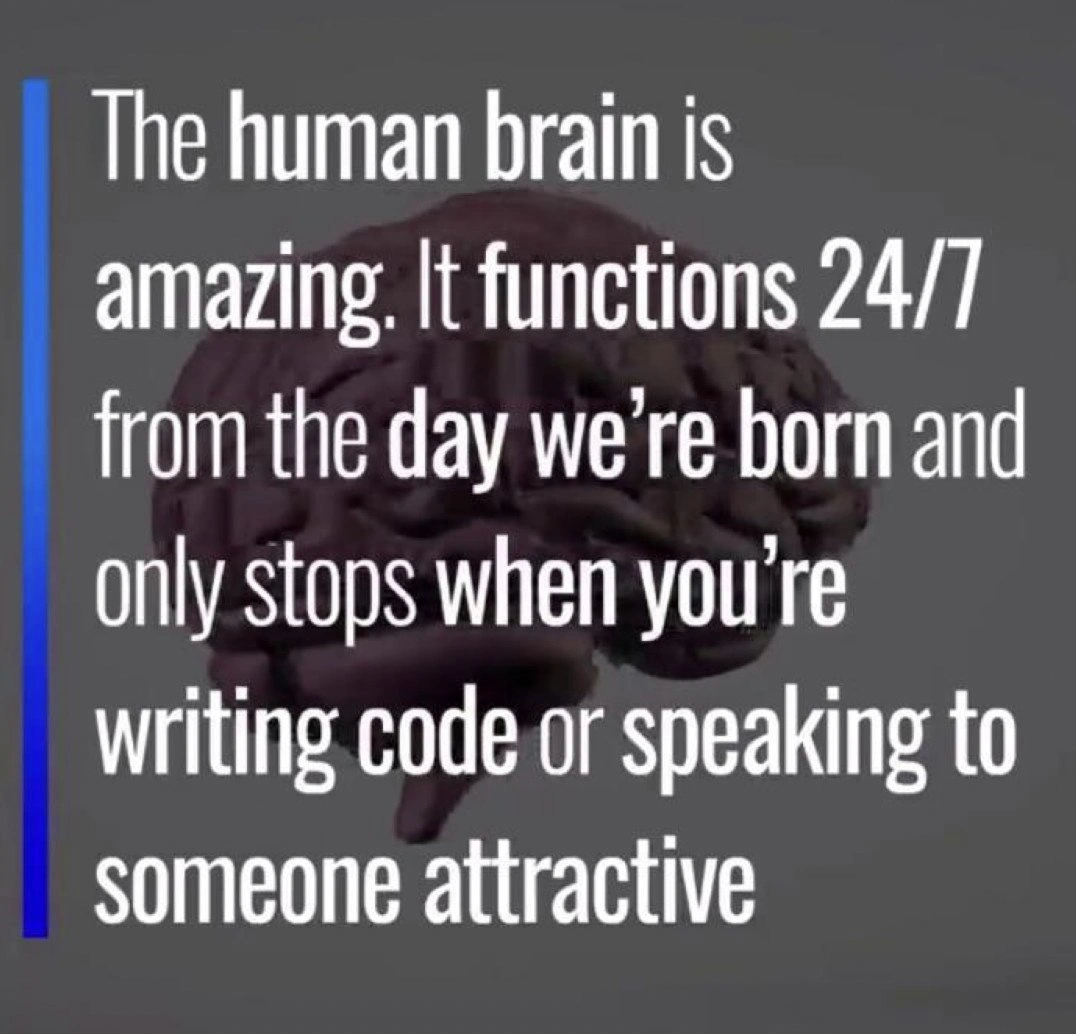
Brain runs non-stop - until a dev starts coding or tries flirting
DeveloperProductivity Post #4596, on Jun 27, 2022 in TG

Brain runs non-stop - until a dev starts coding or tries flirting

Why is this DeveloperProductivity meme funny?

Level 1: Brain Takes a Break

Imagine your brain is like a little engine that’s always running. It runs all the time: when you’re eating, playing, even when you’re sleeping, it’s humming in the background. Now, think about two hard things: one is doing a really tricky puzzle (like a big math problem or a hard game), and the other is talking to someone you really, really like (which can make you nervous). This meme says that the brain is amazing and never stops working… except in these two moments! It’s a funny way to say sometimes our mind freezes or goes empty right when we need it the most.

Have you ever tried to remember an answer during a test and couldn’t, but then remembered it later when the test was over? Or maybe you wanted to say something cool to a person you like, but your mind went blank at the last second? It feels like your brain just paused. That’s the joke here. Our brains are super smart, but even they take a little break or get stage fright once in a while. It’s a silly exaggeration that makes us laugh because we’ve all felt that way: brain on, brain on, brain on… and then poof, brain off!

Level 2: Coding Brain Freeze

So, what’s going on here, in simpler terms? The meme jokes that our brain, which normally works non-stop (even when we sleep it’s doing something), suddenly stops working right when we try to write code or talk to someone we find really attractive. Of course, the brain doesn’t literally stop – it’s a humorous exaggeration. But it feels like it stops. Let’s break that down:

  • Writing code can cause a “brain freeze” because coding is hard! It requires a lot of concentration and mental effort. When you’re programming, you have to keep track of many details at once (like what each part of the code does, what the variables contain, what the goal is, etc.). This heavy mental workload is often called cognitive load. If that load gets too high, your mind can go blank for a bit. It’s like when you try to do mental math with a really long list of numbers – you might suddenly forget what you were doing. Many developers (even experienced ones) get stuck staring at the screen, unable to think of the next step, especially when debugging tricky issues. This is the coding_brain_lag the meme hints at: mental fatigue hitting right when you need your brain to be sharp. New developers might first encounter this in a big programming assignment or their first hackathon, where after many hours, your mind just says “Nope, I need a break.” It’s a super common developer frustration and a very relatable developer experience: you feel like a computer that’s frozen. In fact, programmers jokingly compare a tired brain to a crashed program or a phone that needs to recharge. The term brain_shutdown here isn’t scientific; it’s just humorously saying “my brain turned off for a moment.”

  • Speaking to someone attractive can trigger what we call social anxiety or nervousness. Ever had a crush or someone you really wanted to impress, and when you got the chance to talk to them, your mind went totally blank? That’s exactly the scenario the meme is pointing to. It’s saying even if we’re smart or talkative normally, the moment we try to speak to that really cute person, suddenly we can’t think of anything to say – as if the brain hit a pause. Your heart might be racing, you’re worried about saying the wrong thing, and bam – no words come out. In developer or nerd memes, this is a common self-tease: the image of a brilliant programmer who can solve complex algorithms but freezes up when it comes to basic social interaction. It plays on the stereotype that many tech folks are shy or awkward (which of course isn’t true for everyone, but it’s a familiar trope in humor). So the meme is using developer self-deprecation in a fun way: “I can build an app, but I can’t even say hi to a person I like without my brain malfunctioning.” That’s the joke.

A key term mentioned is context switching – this comes from both human psychology and computing. For computers, context switching is when the CPU switches from one task to another, which has an overhead (basically, a little delay and work needed to swap tasks). For humans, it’s similar: if you’re deeply focused on something (like coding) and suddenly have to change context (like answer a random question, or talk to someone unexpectedly), your brain has to dump some of what it was working on and adjust. This can make you momentarily disoriented or blank. In the meme’s situations, either you are writing code and someone interrupts you (boom, brain stalls), or you are just overwhelmed with nerves when trying to talk to someone (different context, same freeze effect). That’s the mental_context_switch at play – jumping from one mental “mode” to another can be difficult.

Overall, the meme is a lighthearted way to say: developers are human. No matter how smart or capable our brains are, we all experience moments where our mind just doesn’t cooperate. It could be due to mental fatigue (too much coding without a break), or due to anxiety in a social situation. Either way, it’s totally normal. This joke resonates especially in tech circles because many in IT or programming have felt exactly this – super confident with code, less confident in other situations – and it’s comforting and funny to see that shared as a joke. It’s classic CodingHumor mixing with a bit of real-life humility.

Level 3: Context Switch Overload

At a senior developer level, this meme humorously nails the concept of cognitive overload and brutal context switching costs. Why does the brain_shutdown happen exactly when writing code or attempting flirtation? It’s all about hitting the cognitive_load_limit. Writing code is a mentally intensive task — you’re juggling complex logic in your head, remembering API details, tracking program state, and maybe even simulating the code’s execution. The brain’s working memory (our mental “RAM”) has finite capacity. When you stare at a code editor (your trusty IDE) and your mind suddenly goes blank, it’s a classic case of coding_brain_lag. Essentially, your brain’s CPU hits 100% utilization: threads scramble, the cache misses, and you get a momentary freeze. Experienced devs know this feeling all too well — that “what was I doing again?” moment after an interruption, or the late-night bug that leaves you mentally exhausted and staring at the screen as if it’s in hieroglyphs. It’s like our brain performs 24/7 background processing (breathing, daydreaming, random shower thoughts) but as soon as we demand serious foreground processing (like debugging a heisenbug), we risk a context switch cost so high that everything just grinds to a halt. This is a core irony in DeveloperProductivity: the tools and techniques we use demand intense focus, but our biological hardware (the brain) can only handle so much before it gives us the spinning beach ball cursor of doom.

On the other side of the meme’s equation, we have the social anxiety mode that kicks in “when you’re speaking to someone attractive.” This is poking fun at the stereotypical developer’s DeveloperMindset and social prowess (or lack thereof). Many developers (especially those of us who identify with nerdy, introverted tendencies) joke about their social awkwardness. It’s a self-deprecating trope (developer_self_deprecation_meme) grounded in truth: high-pressure social interactions (like trying to flirt or even just speak smoothly with someone you’re really drawn to) can cause anxiety that blanks out your thoughts. Physiologically, it’s a mild fight-or-flight response — adrenaline rises, your heart races, and suddenly your eloquent speaking skills drop to null. 😅 All those witty remarks you had queued up in your brain cache just evaporate. In technical terms, it’s as if your brain throws an Exception – an Unhandled Exception: AttractionOverloadError. The brain that was “amazing” and running 24/7 has now hit a fatal error and needs to reboot once the threat (or beautiful person) passes.

The humor here resonates strongly in DeveloperHumor circles because it hyperbolically contrasts the brain’s theoretical stamina with very real moments of human frailty that programmers experience. It’s a relatable developer experience: even the smartest coders have stories of staring blankly at a simple bug for hours (DeveloperFrustration at its peak) or awkwardly stammering through a conversation at a conference after someone charming asked about their work. The meme is essentially saying: “Our brains are incredible, except when we desperately need them not to short-circuit.” This highlights a slice of MentalHealth in tech – acknowledging mental fatigue and anxiety with a dash of humor. The shared laughter is a coping mechanism. We’ve all had those humbling moments where our intellect or charisma just times out. By joking that the brain “only stops” during coding or flirting, devs collectively commiserate over the struggle to maintain focus and composure in challenging situations. It’s an inside joke among engineers that underscores how taxing mental_context_switch can be. Whether switching from reading error logs to explaining your job to a cute stranger, the context shift is no trivial task for the gray matter. The result? 🧠 Brain freeze – our mental OS performs an abrupt core dump right when we least want it to.

To seasoned engineers, this meme also hints at the importance of managing cognitive load and context switches in our work. It’s why practices like the Pomodoro technique or “flow time” blocks exist – to minimize interruptions (each interrupt is a costly context switch that might wipe out your mental state). And it’s why many developers sheepishly avoid pair programming with their crush 😛. In more serious terms, optimizing developer experience (DeveloperExperience_DX) often means acknowledging human limitations. We design better tools (like autosave, linters, code search) to reduce mental burden so our brains don’t segfault when coding. We also learn social skills gradually, treating them as another system to debug without overwhelming our mental circuits. The meme exaggerates to make a point: even a 24/7 functioning brain has its Achilles’ heel, and in the dev world that’s heavy coding sessions and high-stakes human interaction. As any battle-scarred senior dev will tell you, knowing your limits is key. Yes, the human brain is amazing — but knowing when it’s in overload or anxiety mode and giving it a break is how you avoid the real-life “blue screen” moment.

def brain_activity(task):
    print("Brain is running normally 24/7...")
    if task in ["writing code", "talking to someone attractive"]:
        # Oops, cognitive overload or social anxiety triggers a "brain freeze"
        raise Exception("BrainFreezeError: Cognitive functions temporarily halted!")
    # Otherwise, brain continues its background brilliance
    return "Thoughts are flowing."

In practice, every developer has hit that mental wall where no solution comes to mind until you step away (brain reboot via a walk or coffee). And many have felt their mind go blank when trying to impress someone, embodying the classic nerd trope. The meme exaggerates the 24/7 uptime of the brain to set up the punchline: that two specific scenarios can break even the most powerful “processor” we know (our mind). It’s funny because it’s true enough to sting a little. We laugh, and in that laughter, we recognize the importance of rest, managing mental fatigue, and maybe not taking ourselves too seriously when our brain goes 404 Not Found at a critical moment.

Description

Image shows a grey background with a semi-transparent 3-D model of a human brain centered behind bold white text. A vertical blue bar sits on the far left edge. The full on-screen text reads: “The human brain is amazing. It functions 24/7 from the day we’re born and only stops when you’re writing code or speaking to someone attractive.” The visual joke contrasts the brain’s constant activity with two situations familiar to many engineers: mental blanks while writing code and social awkwardness. Technically, it plays on cognitive load, context-switching, and developer productivity fatigue, making it a relatable meme for software professionals who’ve experienced ‘brain freeze’ in front of an IDE or during small talk
Comments

6
Anonymous ★ Top Pick Pretty sure my brain runs a stop-the-world GC - open the IDE or meet an attractive human, and every thread hits a safepoint until someone restarts the JVM with coffee
  1. Anonymous ★ Top Pick

    Pretty sure my brain runs a stop-the-world GC - open the IDE or meet an attractive human, and every thread hits a safepoint until someone restarts the JVM with coffee

  2. Anonymous

    The brain's exception handler triggers identically for NullPointerException and UnexpectedAttractionException - both dump core and require a hard restart

  3. Anonymous

    The brain's ability to maintain perfect uptime until encountering a romantic interest or a particularly gnarly merge conflict is a well-documented phenomenon in systems biology. Interestingly, both scenarios trigger the same panic response: elevated cortisol, sweaty palms, and an overwhelming urge to check Stack Overflow for answers that don't exist

  4. Anonymous

    During coding or flirting, my prefrontal scheduler hits priority inversion - the amygdala preempts all threads, triggers a stop‑the‑world GC, and throughput drops to zero

  5. Anonymous

    Catastrophic context-switch thrashing: brain TLB flushes entire cache on code commits or crush interrupts

  6. Anonymous

    My brain’s SLA is five nines until I start writing code or talk to someone attractive; then it triggers stop-the-world GC and my mouth returns 503: Service Unavailable

Use J and K for navigation