Skip to content
DevMeme
6636 of 7435
All Modern Digital Infrastructure Depends on the C Programming Language
Languages Post #7269, on Oct 14, 2025 in TG

All Modern Digital Infrastructure Depends on the C Programming Language

Why is this Languages meme funny?

Level 1: House of Cards on an Old Table

Imagine building a super tall tower out of LEGO blocks – a tower so tall it reaches the ceiling. That tower is like all our modern apps and websites running in the cloud. Now picture that you decided to build this huge LEGO tower on top of a really old, wobbly wooden table. The table is like the old C code at the foundation of today’s technology. As you keep stacking LEGO pieces (adding more cool features and services), everyone can see the whole structure shaking a bit because the poor old table underneath is straining. It’s funny in a yikes kind of way, right? We’ve got this amazing, futuristic tower of blocks (that’s our hyperscale microservices and shiny new tech) but it’s balanced on a base that could have cracks. If that rickety table leg (the old code) were to snap, the entire LEGO skyscraper would come tumbling down in an instant. This meme is basically joking that no matter how modern and high-tech things look on top, underneath it all there’s something ancient holding it up – and we’re all just a bit nervous and amused by how precarious that is. It’s like saying, “We built a rocket ship… but the launchpad is made of cardboard.” The idea makes us laugh because it’s a cartoonishly exaggerated truth: everything new is resting on something old, so we better hope that old foundation is strong enough not to collapse!

Level 2: Shaky Infrastructure 101

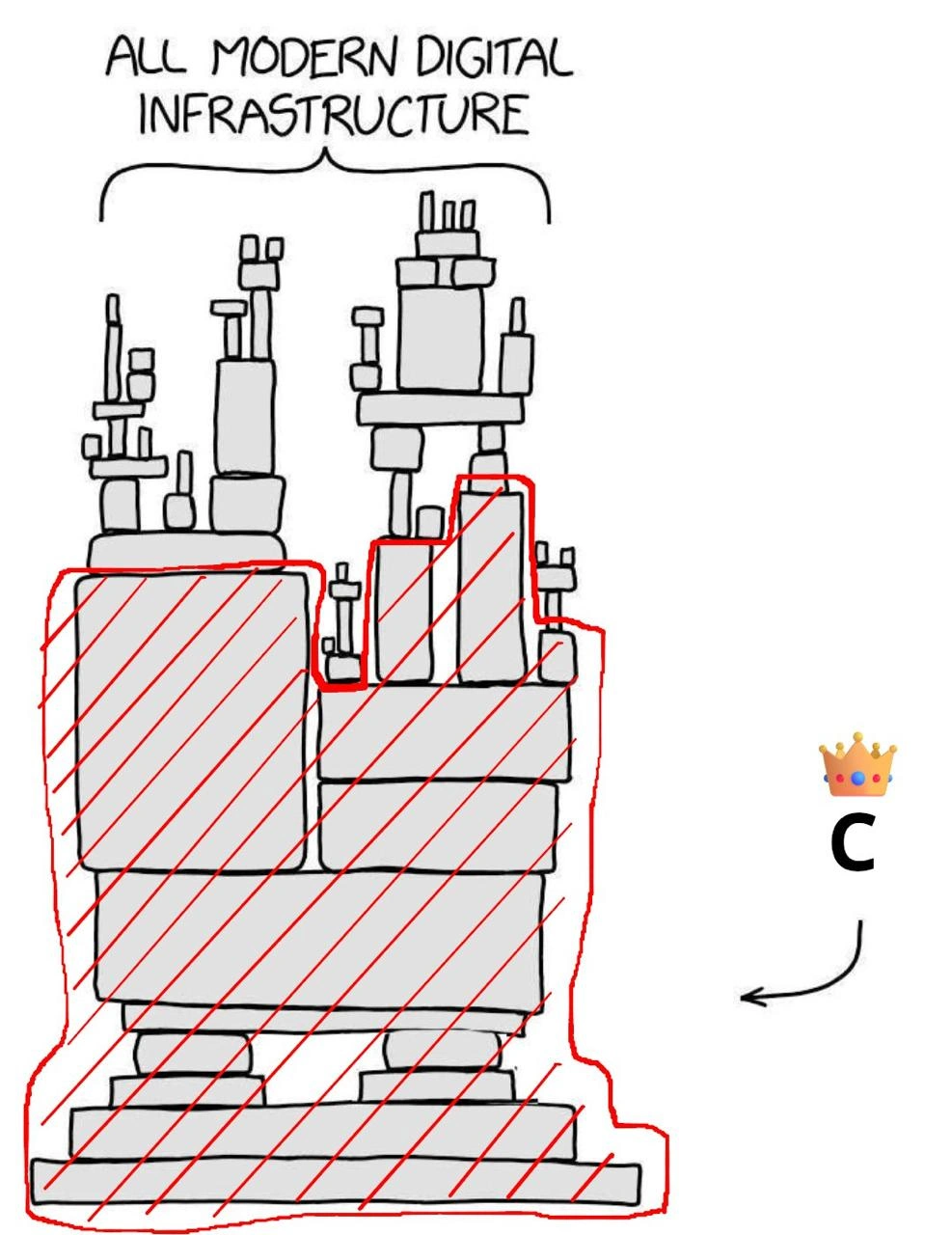
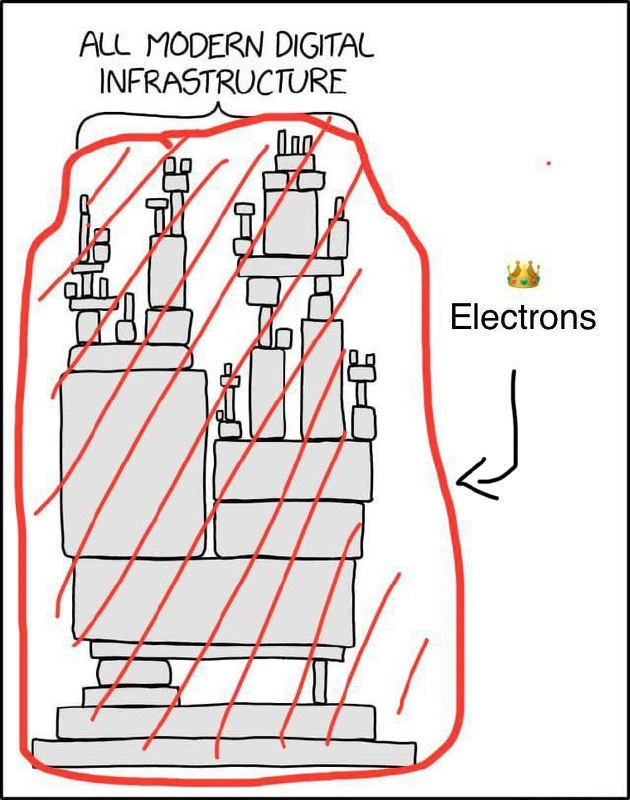
Let’s break down what’s going on for a junior developer or someone new to these concepts. The drawing is a metaphor for how our software systems are built. The tall stacks of blocks represent modern infrastructure – think of all the apps and services running in the cloud, often using a design called microservices. In a microservices architecture, a big application is split into many small, independent services that talk to each other. Companies like Netflix or Amazon run hundreds of these tiny services (that’s the “hyperscale” part – it means operating at huge scale, with tons of instances and traffic). Now, each of those services might be written in a high-level programming language (like Python, Java, Go, JavaScript, etc.), and they run on top of operating systems and cloud platforms. The funny – or scary – part highlighted by this meme is that underneath all those layers, at the very foundation, a lot of code is written in C, a programming language that’s been around for ~50 years (C was first created in the early 1970s!). The red-striped blocks in the lower two-thirds of the tower are the meme’s way of shading in that foundation layer to draw attention to it. And the crown on the letter “C” is saying “C is king”, because it quietly rules everything above it.

Why is C at the base of so much tech? C is a low-level programming language, often used to build the fundamental pieces of software: operating systems (like Linux, Windows, Mac OS), database engines (MySQL, PostgreSQL), and language interpreters (the default Python interpreter, CPython, is mostly C code!). C gives programmers a lot of control over the hardware – you can manage memory directly and do pointer arithmetic (manipulating memory addresses). That makes it super fast and efficient, which is why it became the go-to language for system software. But it also means programmers have to be very careful; there’s no automatic safety net if they make a mistake. Bugs in C can cause serious issues like crashes or security vulnerabilities (e.g. the dreaded buffer overflow, which can cause a program to overwrite memory it shouldn’t).

Now, modern_stack_on_c means that all the cool new stuff – cloud services, containers like Docker, orchestration tools like Kubernetes, web servers, etc. – ultimately rely on components written in C. For example, you might write a web service in a high-level language, but that service will call into libraries (maybe a database driver or a web server component) that are written in C or C++. Those libraries in turn rely on the operating system’s functionalities (things like reading from disk, sending network messages), and the OS (like Linux) is written in C. There’s an expression “high-level languages are built on low-level languages” – here, C is the low-level language doing the heavy lifting. It’s like the base layer of infrastructure for almost everything software.

Dependencies are another key idea: a dependency is something your code needs in order to work. Modern software often has a dependency tree a mile long (frameworks depending on libraries depending on other libraries, and so on). Dependency management is the practice of keeping track of these and making sure the right versions are used, etc., to avoid DependencyHell (which is when dependencies conflict or break – definitely a headache!). In our context, the “dependency” being pointed out is that no matter what new tech you use, you ultimately depend on C code somewhere underneath. That old C code is essentially legacy code – code that’s been inherited from earlier times and is still in use. “Legacy” isn’t always bad; it often means the code is battle-tested and reliable. But it can also mean it wasn’t designed with today’s needs in mind, and changing it is risky or difficult (hence it can be seen as technical debt if it causes problems down the line). Imagine you have a super modern app, but one of its critical pieces is an old program written decades ago – if that old piece has a flaw, the whole modern app can fail. That’s why we sometimes refer to it as a “shaky foundation.”

So in simpler terms, this cartoon is saying: Look, all the fancy new digital services (the tall towers) ultimately stand on top of an old base – the C language and its code (the red-striped part). It’s a tongue-in-cheek reminder that even the newest innovations aren’t as independent as we might think; they rely on the earlier generations of software. This is a common situation in technology: new layers get built on top of older layers, because redoing everything from scratch would be impractical. For a junior dev, the takeaway is both awe-inspiring and sobering: your cutting-edge cloud application might internally be using something written by Dennis Ritchie (the creator of C) back when bell-bottom jeans were in style! The meme humorously stresses the importance of understanding those underlying layers. After all, when something goes wrong deep down (say a C library bug causes a segmentation fault), it can cascade up and crash the high-level services – much like a tremor in the foundation can topple a building.

Level 3: Precarious Legacy Tower

This meme hits senior developers right in the feels because it’s so true it hurts. It shows “ALL MODERN DIGITAL INFRASTRUCTURE” as a wobbly Jenga tower of tech, with shiny microservice stacks perched precariously atop a thick, red-striped foundation labeled C. The crown emoji on the C is a cheeky way of saying: “Surprise! The real king of your cloud kingdom is that 50-year-old C code at the bottom.” The humor comes from the absurdity and TechnicalDebt we all recognize – we boast about our Kubernetes clusters, serverless functions, and fancy frameworks, but under the hood, so much of it still runs on C. It’s like bragging about a cutting-edge rocket ship that secretly has a rusty Model-T engine powering it. Experienced devs have lived through the consequences of this: one tiny flaw in a dependency written in C can topple production. Remember the Heartbleed bug in OpenSSL? A minor C pointer mistake in a low-level library put the entire internet’s security at risk. Or the time a routine update of the GNU C library (glibc) triggered frantic patching across thousands of servers? These war stories are why veterans smirk at this image – it portrays the fragility beneath our industry’s grand edifices. Each gray block in the tower is like a service or layer (database, container runtime, web server, library, OS) and virtually all the lower ones are implemented in C/C++. We keep piling new abstractions on top (microservices on containers on VMs on hardware), and each time we say, “Don’t worry about the lower layers.” But of course, we do worry – because if that ancient foundation cracks, everything above comes crashing down. The meme’s visual style even echoes that famous xkcd “skyscraper” comic about precarious dependencies, poking fun at how the entire tech stack might rely on one unmaintained project. Here it’s not an obscure module in Nebraska, but the venerable C language itself propping up the world. Seasoned engineers recognize the irony: after all the LanguageWars and hype about new languages and frameworks, it turns out LowLevelProgramming in C is still the ultimate linchpin. In meetings we talk up DependencyManagement and best practices, yet we deploy apps that are essentially balancing on 1970s-era code. The phrase “building on the shoulders of giants” becomes “building on the shaky shoulders of aging giants who wrote malloc()”. The meme is funny because it exposes our collective cognitive dissonance – we’re scaling out to hyperscale and microservices, touting how modern and advanced we are, all while quietly crossing our fingers that the old C foundation beneath doesn’t implode. Those red diagonal stripes scream danger: here be dragons (written in C). Any senior dev who’s been paged at 3 AM due to a LegacyCode crash or mysterious segmentation fault in production will chuckle (perhaps nervously) at this image. It’s both a chuckle and a wince – acknowledging that our entire digital world is a house of cards where the bottom card says “#include <stdio.h>”.

Level 4: Turtles All the Way Down

In computing, there's a saying: “All problems can be solved by another level of indirection… except for the problem of too many layers of indirection.” This meme perfectly satirizes that paradox. Hyperscale microservices represent layer upon layer of abstraction, scaling out into complex distributed systems. Yet peel back each layer, and at the very bottom you hit raw C code from the 1970s. It’s a digital case of turtles all the way down: modern container orchestration -> running on a VM -> on an OS kernel -> on firmware -> ultimately on logic gates. Every high-level service is ultimately dependent on lower-level routines often written in C (or its close CFamily cousins). This cartoon highlights the leaky abstraction principle: no matter how high-level our cloud infrastructure gets, the messy low-level details (pointer arithmetic, manual memory management, undefined behavior) inevitably seep through when things go wrong. We’ve built skyscrapers of software (modern_stack_on_c) but the ground floor is decades-old LowLevelProgramming in C. And C is both powerful and perilous – it’s ground zero for raw pointer arithmetic and direct memory access, which means a stray *ptr = 0 or buffer overflow in a core library can reverberate up and crash far loftier services. Formal verification and memory-safe languages aspire to shore up this shaky base, but replacing a 50-year-old foundation isn’t done overnight (just ask the banks still running LegacyCode in COBOL!). Until then, the industry lives with an uneasy truth: our sleek hyperscale architectures conserve complexity by offloading it to that old C code. The technical debt at the foundation obeys a grim arithmetic: stack too many layers and even a 99.9% reliable base layer can drag overall reliability down – e.g. $0.999^{10} \approx 0.990$ (almost 1% failure chance if 10 such layers must all work). And we have dozens of layers! It’s a system built on trust and duct tape from the UNIX epoch. To seasoned engineers, the meme’s crowned “C” block isn’t just a joke – it’s a reminder of DependencyHell at scale, a nod to the fact that one must trust the bedrock or risk the entire tower teetering. In essence, this image underscores the deep truth that in software architecture everything new simply adds a new hat, but the old bones still carry the weight.

Description

A hand-drawn illustration showing the familiar 'ALL MODERN DIGITAL INFRASTRUCTURE' tower of stacked blocks with red diagonal hatching covering nearly the entire structure. To the right, a crown emoji sits above a large bold letter 'C' (representing the C programming language) with an arrow pointing into the tower. The meme makes the point that the C programming language underpins virtually all modern computing -- operating systems, compilers, embedded systems, and most foundational software are written in C. This is part of the xkcd-style series showing fundamental dependencies of tech infrastructure
Comments

8
Anonymous ★ Top Pick Every programming language you love was either written in C, compiled by something written in C, or runs on an OS written in C -- C doesn't wear the crown, it IS the throne
  1. Anonymous ★ Top Pick

    Every programming language you love was either written in C, compiled by something written in C, or runs on an OS written in C -- C doesn't wear the crown, it IS the throne

  2. Anonymous

    We've built cloud-native, serverless, AI-powered castles in the sky, but they all rest on a 50-year-old foundation held together by pointers, manual memory management, and the collective hope that nobody introduces another buffer overflow

  3. Anonymous

    Your shiny service mesh may have a service mesh, but one rogue *malloc* down in libc still decides your SLA

  4. Anonymous

    After 20 years in tech, you realize every abstraction layer you've built is just a fancy wrapper around some C code written by a bearded wizard in 1973 who's still maintaining it because nobody else understands the pointer arithmetic

  5. Anonymous

    After decades of 'C is dead' predictions and countless 'modern' replacements, we've built an entire digital civilization on a language where forgetting a single semicolon can crash a satellite, yet somehow it remains the bedrock beneath every abstraction layer we've invented to avoid writing it directly - proving that the real technical debt isn't the code we write in C, but our collective inability to escape its gravitational pull

  6. Anonymous

    Our “cloud‑native, serverless, microservice” diagram ends with 14 boxes…and one syscall in 1970s C; the SLA is basically “don’t trigger undefined behavior.”

  7. Anonymous

    Kubernetes on Docker on Linux? Still one rogue pointer in C away from the kingdom crumbling

  8. Anonymous

    Your serverless, memory-safe, multi-cloud stack still ends at open() in glibc; uptime is just not angering half a century of C

Use J and K for navigation