Skip to content
DevMeme
6635 of 7435
All Modern Digital Infrastructure Depends on Quartz Miners
Infrastructure Post #7270, on Oct 14, 2025 in TG

All Modern Digital Infrastructure Depends on Quartz Miners

Why is this Infrastructure meme funny?

Level 1: Just a Rock

Imagine you built the tallest LEGO tower in the world, and at the very bottom of it, there’s one single little brick that everything depends on. If that tiny brick slips out, the whole tower wobbles or falls. Kinda funny, right? In the world of computers, that “little brick” is basically a rock – a small quartz crystal. All our super high-tech gadgets, the internet, and video games are like that giant tower, and a tiny rock inside a computer is like the special brick keeping it all standing straight. We usually don’t think about it, but without that rock ticking away like a tiny heartbeat, nothing in the tech world would work correctly. The meme is making us laugh by saying: “See all this amazing digital stuff? It still needs a plain old rock to keep it going!” It’s a simple reminder that even the fanciest technology is built on something very basic.

Level 2: Unsung Hardware Heroes

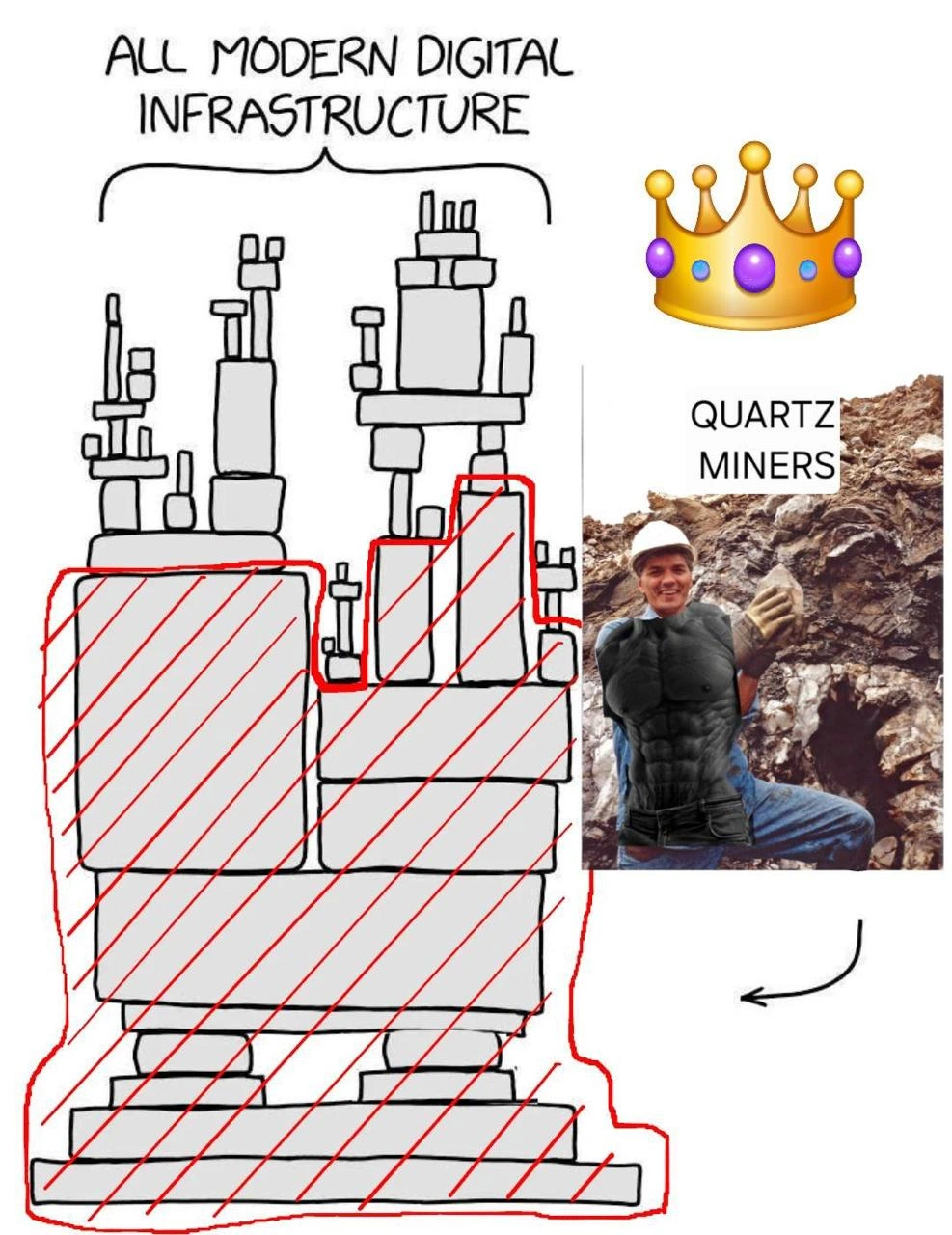
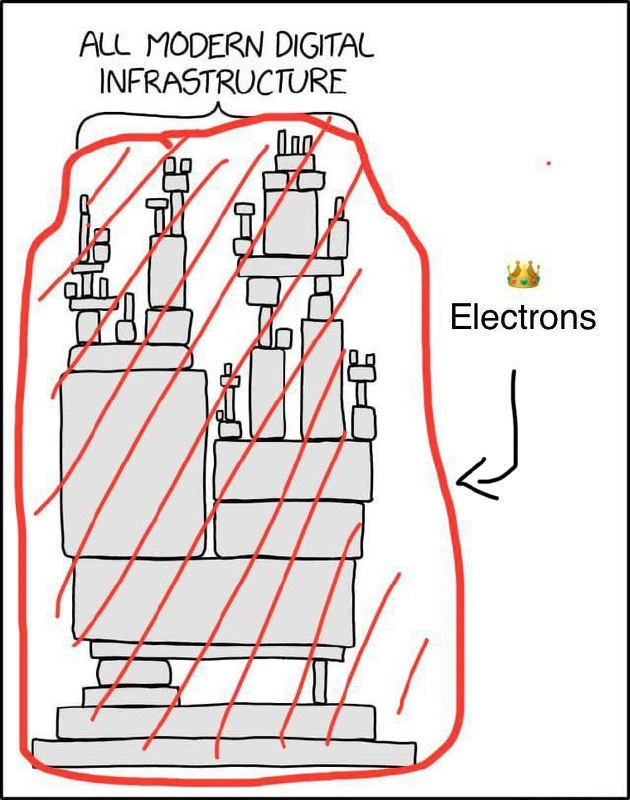
In simpler terms, this meme is highlighting the physical stuff at the bottom of all our fancy software stuff. On the left, the cartoon stack labeled “ALL MODERN DIGITAL INFRASTRUCTURE” represents everything we deal with in tech: big servers, clouds, networks, applications – all the layers that make your internet work. As developers, we often talk about these layers: using Kubernetes to manage containers, deploying microservices, scaling across regions in the cloud. Those are the grey blocks stacked high in the drawing. But notice the thick red-hatched base at the very bottom – the cartoon is emphasizing that there’s a foundational piece holding everything up. That foundation is a real-world hardware component: the quartz crystal oscillator.

So, what’s a quartz crystal oscillator? It’s basically a tiny piece of quartz (the same type of mineral as quartz rock) inside every computer and smartphone that acts like a very precise clock. Quartz has a special property: if you run a little electric current through it, it vibrates at a steady rate (this is due to the piezoelectric effect, though you don’t need to remember that term). These vibrations are extremely consistent, like a metronome or the ticking of a super-reliable clock. The computer’s circuits count those vibrations to keep time. In fact, the speed of every processor (the CPU) is set by this – for example, a 3.5 GHz CPU uses an oscillator that helps it tick 3.5 billion times a second in sync. Without this, the CPU wouldn’t know when to do the next calculation; it’d be like a band with no drummer to set the rhythm. In networking and infrastructure, everything from timing events to coordinating messages between servers relies on having a common time reference, which ultimately comes from these little timing_oscillators on each machine.

The right side of the meme drives this point home with a bit of humor: it shows a buff “QUARTZ MINER” character in a cave, swinging a pickaxe at rock. There’s even a crown emoji above him, implying he’s the true king. This image is saying, “Here’s the real hero of tech – the guy mining the quartz (or the quartz itself) that we need to keep everything running.” It’s a funny exaggeration, of course. In reality, quartz crystals used in electronics are often grown in factories or labs for purity, but originally quartz did come from mines (and some still does). The meme isn’t literally about miners saving the day everyday; it’s using that image to symbolize all the unsung_hardware_heroes behind our modern computers. We rarely talk about the people who design and produce chips, circuit boards, and components like oscillators. Yet, without them, our high-level software skills wouldn’t matter because there’d be no platform to run things on. It’s easy for a newcomer to tech to learn about cloud servers and programming and forget that at some point, everything runs on electricity, pulses, and physical parts. This meme is a light-hearted HardwareHumor reminder of that reality: even the most advanced “cloud” system ultimately depends on a tiny crystal behaving properly. In other words, no matter how high-tech or “virtual” something seems (like a Kubernetes cluster spanning the globe), it still has boots – or rather, rocks – on the ground.

In summary, the meme teaches a fun little lesson: pay attention to the basics. The entire infrastructure stack (all the layers of technology) can be thought of like a giant tower built on a single brick. Here, that brick is the quartz clock inside your machine. Everything in computing is built in layers of abstraction – we have software relying on operating systems, which rely on firmware, which rely on hardware, which in turn rely on even more fundamental hardware, like the system clock. That lowest layer might be out of sight, but it’s absolutely critical. This is the HiddenComplexity the meme points out. For a junior developer or someone new to systems, it’s a revelation that even something as ethereal as cloud software ties back to something as tangible as a piece of rock. It’s almost poetic: our digital world’s stability comes from nature’s crystals. And it certainly gives you a newfound respect for hardware – those tiny chips and pieces you never see but which work tirelessly to make your code run correctly every millisecond.

Level 3: Jenga Tower of Tech

The meme humorously illustrates that our lofty infrastructure stack – all the VMs, containers, clusters, and clouds – rests on a very unassuming foundation. Picture the entire tech world as a giant Jenga tower of abstraction_stack_jenga. At the top, you have things like Kubernetes orchestrating microservices across data centers. Engineers spend days debating service meshes, multi-cloud strategies, and the latest architecture patterns (the equivalent of meticulously rearranging blocks near the top of the tower). But the meme zooms out to remind us of the block at the very bottom: a little quartz_crystal providing the clock signal. That bottom block is highlighted in red in the sketch labeled “ALL MODERN DIGITAL INFRASTRUCTURE,” and if you pull it out, the whole tower of tech would come tumbling down. In other words, all our modern digital infrastructure is ultimately built on a rock – literally a piece of quartz.

This juxtaposition is classic TechSatire. It pokes fun at how we sometimes obsess over high-level complexity while forgetting the humble physical foundations. A seasoned engineer might chuckle (perhaps a bit cynically) because they’ve learned that no matter how abstracted or “cloud-native” a system is, it still boils down to hardware and physics. It’s a bit like being reminded that “the cloud” is just someone else’s computer – and that computer, in turn, is synched by a crystal oscillator. We rarely acknowledge the unsung_hardware_heroes (like the quartz or the people who manufacture them), but they quietly ensure our software abstractions don’t implode. The crown emoji labeled “QUARTZ MINERS👑” crowns the miner as the true king of the stack, implying that those who dig up or produce these crystals deserve royal respect. It’s a cheeky way to say: forget the superstar developers and architects for a second – hail to the hardware folks literally chiseling the raw materials that make all this possible!

From a senior perspective, there’s also a grain of truth that’s almost painful: we’ve built incredibly complex distributed systems, yet a trivial physical failure can bring them down. Consider RealWorldConstraints we’ve all seen: a datacenter power glitch, a failed oscillator, or clock drift can wreak havoc on software. For instance, if a server’s quartz clock runs slightly fast or slow, its timestamps can drift out of sync. In a distributed system, skewed clocks can cause strange bugs — like log entries from the “future” or authentication tokens that appear invalid because one machine’s clock is off. Many of us have encountered that one server that “lost time” because its timing_oscillator was faulty or its battery died; suddenly, SSL certificates start failing (since the system thinks it’s year 1970) or databases complain about impossible transaction times. It’s a relatable mini-nightmare in RelatableDevExperience: everyone scrambling to debug the software, only to discover the hardware clock was the culprit. This meme captures that feeling with humor: all our sleek software layers amount to nothing if the physical layer foundation isn’t solid. It’s both humbling and comforting to remember that beneath the virtual machines and autoscaling groups, there’s a tiny bit of Earth (quartz) ticking away, making it all possible. We truly have a HiddenComplexity in our systems – a little geological rhythm maker that we usually take for granted. And as any battle-scarred ops engineer will tell you with a smirk, sometimes the hardest bug is fixed not with a patch but by swapping out a piece of hardware you never thought about – say, a crystal that’s lost its mojo.

Level 4: Time from a Stone

At the very bottom of every digital wonder is a sliver of quartz crystal quietly vibrating billions of times per second. This isn’t metaphorical – it’s literally a tiny piece of mined rock slicing time into ultra-precise intervals. Thanks to the piezoelectric effect, applying voltage makes quartz physically oscillate at a stable frequency (think of it like a tuning fork made of crystal). Each vibration produces an electrical pulse, a tick of the master clock that orchestrates all CPU operations. In hardware design terms, the quartz oscillator provides the reference clock signal that all the synchronous logic on a motherboard relies on. Modern CPUs might multiply that base frequency up to gigahertz speeds, but the fundamental heartbeat still comes from that original quartz pulse.

This is deep in the physical_layer_foundation of computing — beneath microseconds and nanometers, we depend on the regularity of a natural resonance. Quartz crystals are preferred because of their high Q factor (quality factor), meaning they oscillate with a very pure tone at a consistent frequency (minimal drift). If you’ve ever wondered how your 3.20 GHz processor knows to tick 3.2 billion times a second, the answer is a tiny crystal-cut resonator generating a base frequency that’s electronically scaled up. Without this rock-steady timing oscillator, a system’s complexity would collapse into electronic cacophony: logic gates would flip at the wrong times, data buses would clash, and even something as simple as incrementing a counter would fail because there’s no agreed-upon “next moment” to do the increment. In essence, the elegant dance of billions of transistors inside a chip stays in sync only because a piece of quartz keeps the beat.

It’s amusing and profound that even as we engineers architect ever more abstract systems, we’re ultimately harnessing a quirk of geology. The entire field of computing sits atop a RealWorldConstraints bedrock: you can scale to the cloud and beyond, but you still need a reliable ticking from a timing_oscillator carved from crystal. We’ve built a skyscraper of abstraction on fundamental physics. In fact, one could say the Hardware has the final word – no tick from the crystal, no tock from the processor, no matter how fancy your Kubernetes or AI. The laws of physics are the ultimate dependency, and here those laws are embodied in a tiny quartz slab. It’s a beautiful irony that our global digital infrastructure’s sense of time comes from vibrating stones – a reminder that every byte of the cloud is ultimately grounded in atoms.

Description

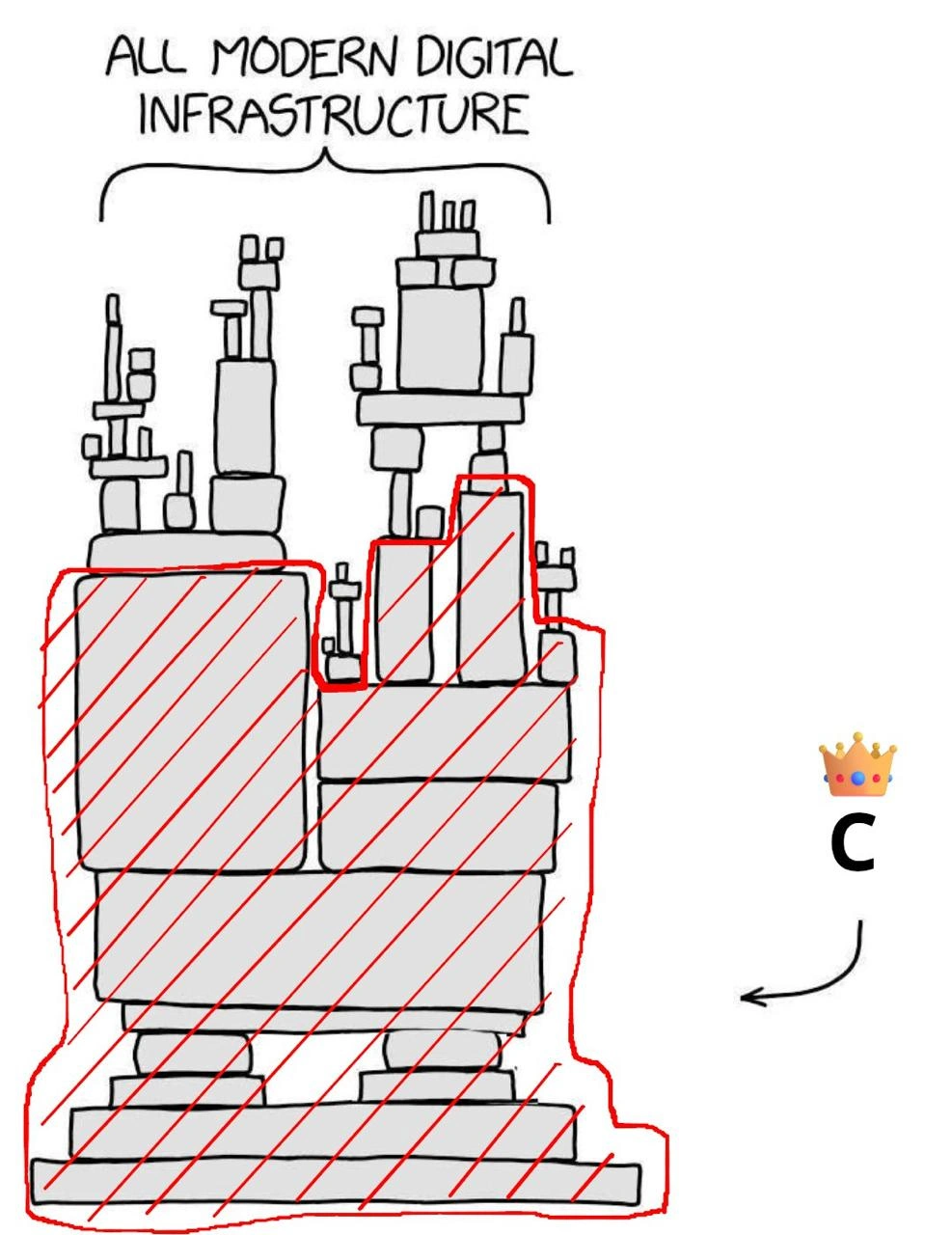
A hand-drawn illustration showing the 'ALL MODERN DIGITAL INFRASTRUCTURE' tower from a recurring meme series, with red diagonal hatching covering the structure. To the right, a crown emoji sits above a photo of a real quartz miner -- a man in a hard hat and vest posing with a piece of quartz rock, labeled 'QUARTZ MINERS'. An arrow points from the miner into the base of the infrastructure tower. The meme highlights that silicon chips (and by extension all computing) depend on quartz/silica, which must be physically mined from the earth. It is a variation in the series showing different fundamental dependencies of tech infrastructure
Comments

8
Anonymous ★ Top Pick Cloud computing is just someone else's computer, which is just someone else's refined sand, which is just some guy with a pickaxe wondering why his rock is worth billions
  1. Anonymous ★ Top Pick

    Cloud computing is just someone else's computer, which is just someone else's refined sand, which is just some guy with a pickaxe wondering why his rock is worth billions

  2. Anonymous

    We spend our days arguing about container orchestration while the entire stack is propped up by some dude named Dave who happens to be really good at finding shiny rocks

  3. Anonymous

    Sure, your microservice fleet is fully GitOps-driven, but if that 32 kHz crystal drifts, the whole empire still segfaults in real-time

  4. Anonymous

    We've abstracted away everything from assembly to kubernetes, but somewhere a guy with a pickaxe is still the reason your microservices can maintain consensus timing

  5. Anonymous

    We spend countless hours optimizing Kubernetes clusters and debating serverless architectures, but the entire digital economy literally runs on rocks that someone had to dig out of the ground. Every microservice, every container, every 'cloud-native' application - it all traces back to miners extracting quartz. Next time you're in a heated debate about infrastructure-as-code versus ClickOps, remember: someone with a pickaxe is the true king of your stack. The most critical dependency in your supply chain isn't in your package.json - it's in a mine shaft

  6. Anonymous

    We argue Raft vs Paxos, but the actual consensus leader is a 32.768 kHz quartz resonator with ±20 ppm drift - courtesy of someone swinging a pickaxe

  7. Anonymous

    Five 9s and Raft timeouts all trace back to a $0.20 quartz resonator with ±20ppm drift - turns out our “single source of truth” is literally a rock

  8. Anonymous

    Microservices liberated us from monoliths - except for that one Quartz instance silently cronning the empire since 2003

Use J and K for navigation