An Immutable Opinion, Declared in Code
Why is this Languages meme funny?
Level 1: Set in Stone
Imagine you decide something and then write it down in permanent marker for everyone to see. Now you say, "Try to change my mind!" But since it's in permanent ink, no one can rub it out or alter it. This meme is doing the same thing, but with a little piece of computer code. The person’s sign basically says, "My mind is made up and locked – you can’t change it." It’s funny because it’s like someone saying their opinion is set in stone. In everyday terms: they’re super stubborn. They’ve made up their mind and even used a "no erasing allowed" kind of writing (in this case, computer code) to prove it. So when you look at it, you get that silly, warm feeling of "Haha, they really aren’t going to budge, are they?" It's a goofy way to show how unshakeable someone’s belief is, by pretending that belief is a locked box that nobody can open.
Level 2: Can't Change a Const
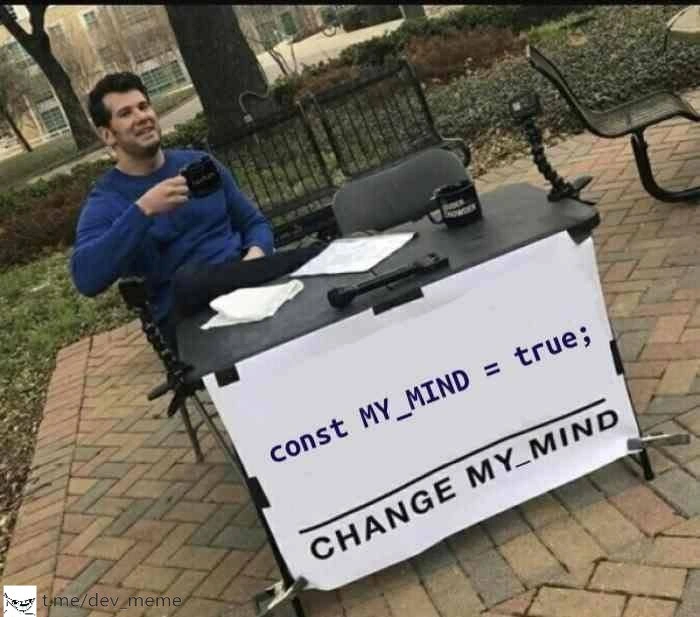
This meme is a mash-up of a popular internet joke format and a bit of JavaScript code. The sign in front of the person uses a code snippet: const MY_MIND = true;. In programming, especially in JavaScript, the keyword const means you're creating a constant variable. That is, you give MY_MIND a value of true and the language won’t let you change that value later. It's like telling the computer, "This variable is final – no take-backs!" If you try to write code that does MY_MIND = false afterward, JavaScript will throw an error because you attempted to reassign a constant. For example:
const MY_MIND = true;
MY_MIND = false; // ❌ Uncaught TypeError: Assignment to constant variable.
Here, MY_MIND is a stand-in for the person's opinion or mindset. The lower part of the sign says “CHANGE MY MIND,” which is usually an open challenge for someone to prove you wrong. But ironically, by using const in code, the meme implies you literally cannot change that value. In other words, the person is saying "My mind is made up (true meaning firmly decided) and I've locked it in code. Good luck trying to convince me otherwise!" It's a fun play on the idea of something being unchangeable.
To break it down: immutable means unchangeable. In many programming languages, we have ways to make variables immutable. In JavaScript and languages in its ecosystem, const is how you do that for a variable binding. Other languages have similar concepts (like final in Java or const in C++), but the joke sticks to JavaScript syntax, which many developers recognize. The humor comes from mixing a real-life scenario (someone stubbornly holding an opinion) with code that enforces the same thing. The image is from the "Change My Mind" meme, where normally someone states an opinion on a sign and dares people to contradict them. Here the opinion is written as code that disallows any contradiction by its very format. For a junior developer or someone new to coding, the key takeaway is: const makes a variable unchangeable, so writing const MY_MIND = true; on a sign comically means "my opinion is permanently 'true' and you can't flip it." It's a nerdy way of saying "I'm not budging!"
This is very relatable developer humor. In the developer community, we joke about being stubborn on certain tech opinions (like choice of editor, language, or tabs vs spaces). By using a code joke, this meme speaks to those who know the little quirks of JavaScript syntax and enjoy a good syntax humor gag. The Languages tag fits because it's literally using a programming language feature as the punchline. And anyone who's tried to change a constant in code (and gotten a frustrating error) will sympathize and laugh at how that feeling is applied to a person's mindset here.
Level 3: Immutable State of Mind
In this meme, a developer has literally hard-coded their opinion using the JavaScript const keyword. The sign on the table reads const MY_MIND = true;, which in code means "my mind is set to true and cannot be reassigned." This clever twist combines a famous dev joke format with actual syntax from the JavaScript ecosystem. The humor hits experienced programmers on multiple levels: it's a play on immutability in code and the stubbornness of human opinions.
From a seasoned coder's perspective, seeing const MY_MIND = true; is an instant wink. In JavaScript (as of ES6), const declares an immutable constant — once assigned, you can't do MY_MIND = false later without throwing an error. It's a way to enforce that a value remains unchanged, a practice adored in functional programming and safer coding patterns. Here, that technical concept of an unchangeable variable is applied to someone's mindset. We’ve all met developers with an opinion so fixed it might as well be in read-only memory. Tabs vs spaces? Vim vs Emacs? Once some folks set their stance, good luck budging it. This meme nails that sentiment by treating a personal stance as if it’s a const in code.
The “Change My Mind” template is usually about inviting debate on a controversial statement. But by using a constant in code, the meme says: this opinion isn’t just strong – it’s literally not up for modification. It’s as if the guy at the table executed:
const MY_MIND = true;
and now any attempt to argue would result in a compiler (or rather interpreter) error. An experienced dev might chuckle, recalling how trying to change a constant in code leads to a crash or exception. In JS, for example, attempting:
MY_MIND = false;
after that declaration would bomb out with a TypeError. The joke extends beyond syntax: it’s poking fun at how developer communities operate. People in tech often hold fierce opinions about languages, frameworks, or best practices. The banner essentially says this dev’s viewpoint is immutable – a tongue-in-cheek nod to both code immutability and the stubborn resilience of geeky debates.
By using a monospace font and a real code snippet, the meme lives in that sweet spot of coding humor where understanding the JavaScript const keyword is key to getting the gag. Senior engineers appreciate the double meaning: in programming, immutability can be a virtue that prevents bugs, but in personal beliefs it translates to pig-headedness. The image conjures the very real dynamic of tech discussions: once someone has declared something with the certainty of a constant, arguing with them is as futile as reassigning Pi to 3.15. It’s a relatable inside joke about the relentless logic we coders apply to our world – sometimes to absurd effect. After all, if code says you can’t change it, well, challenge denied.
Description
This image utilizes the popular 'Steven Crowder's Change My Mind' meme format. A man in a blue shirt sits confidently at a table outdoors, on what appears to be a college campus patio. A large white sign is propped on the table in front of him. The original text of the meme, 'CHANGE MY_MIND', is visible at the bottom of the sign. Edited above this, in a monospaced font simulating code, is the line 'const MY_MIND = true;'. A watermark for 't.me/dev_meme' is in the bottom left corner. The humor arises from the intersection of programming and rhetoric. In JavaScript and many other modern languages, 'const' declares a variable that cannot be reassigned - it's immutable. The meme cleverly equates a deeply held, unchangeable belief with a constant variable, making the 'Change My Mind' challenge an impossible task by definition
Comments
7Comment deleted
Sure, you declared your opinion as a const. But we all know there's a junior dev somewhere who will just mutate the object it's pointing to when you're not looking
It’s only immutable until the VP yells “pivot” and some hero does `globalThis.MY_MIND = false // hotfix in prod`
The junior dev who suggested we could just override const in production with a webpack plugin is now leading our blockchain initiative
The beautiful irony here is that while const prevents reassignment of the binding, it doesn't make the referenced object immutable in JavaScript - so technically, if MY_MIND were an object, you could still mutate its properties. But try explaining that distinction during a heated architectural review about whether to use const everywhere, and watch the room divide faster than a poorly implemented microservices migration. The real question is: would Object.freeze(MY_MIND) have made this philosophically bulletproof, or just frozen the debate in perpetual deadlock?
In JavaScript const only freezes the binding - so to change his mind you don’t need persuasion, just a new scope and a shadow variable; classic enterprise reorg
Senior architect facing microservices evangelism after one too many K8s outages: const MY_MIND = true;
const MY_MIND = true; - strong opinions, weakly held: you can’t reassign the variable, so we just mutate the requirements until it evaluates to true