Skip to content
DevMeme
4215 of 7435
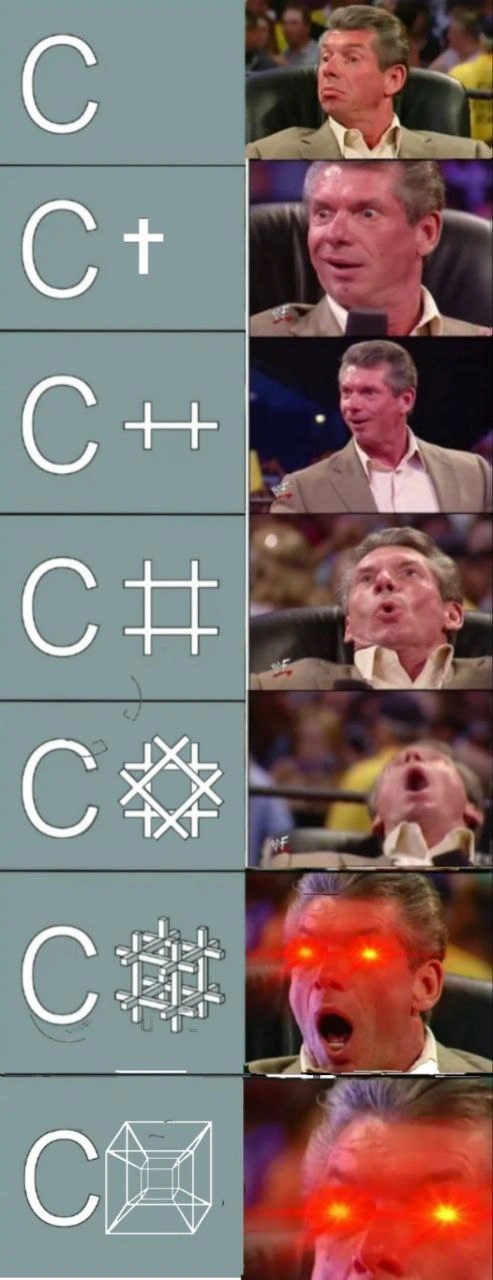
Escalating Vince McMahon reacts to C, C+, C++, C#, and beyond
Languages Post #4607, on Jun 28, 2022 in TG

Escalating Vince McMahon reacts to C, C+, C++, C#, and beyond

Why is this Languages meme funny?

Level 1: The More the Merrier

Imagine you have a simple toy, like a small car. First, you show this plain car to a kid – they smile a little. Now you give them a car plus a cool spoiler on the back (car+!) – the kid’s eyes light up a bit more. Then you hand over a car with two pluses – meaning it’s a super car with extra gadgets and turbo boosters (car++!!). Now the child is on the edge of their seat, really excited. Next, you reveal a car with a sharp new paint job and lightning decals – it’s like the car’s gone musical and high-tech (car#?) – the kid’s jaw drops in amazement. But you’re not done: you bring out a car with a sparkling star on it, something totally out-of-this-world – their eyes start practically glowing with joy. Then, unbelievably, you show a car inside a cube (a 3D super futuristic car in a glass box!) – and the kid falls over backward with mind-blown excitement 🔥. This is exactly what the meme is doing with the letter “C” and symbols: each time we add something (a plus, a sharp, a star, a cube), it’s like making the “toy” more fancy, and the reaction gets bigger. It’s funny because the excitement keeps growing in a silly way – the more you add, the merrier it gets! In simple terms, the meme is joking that programmers get more and more excited with each new fancy version of a programming language, just like a child getting happier with every extra feature on a toy.

Level 2: Meet the C Family

Let’s break down each part of this meme and the programming languages (and pseudo-languages) involved, in case you’re newer to the C language family or the joke:

  • C – This is the original C. It’s a programming language created in the early 1970s (yes, that long ago!) and is famous for being simple, fast, and close to the computer’s hardware. Think of C as the solid old-school language used to build operating systems (like parts of Windows or all of Linux) and embedded systems. It’s procedural (meaning you write step-by-step instructions for the computer). In the meme’s first row, “C” by itself doesn’t impress our spectator (Vince McMahon looks pretty neutral), which humorously reflects how a modern audience might see plain old C as nothing flashy. But C is respected – many of us learn it in school to understand how memory and low-level stuff works. It’s the baseline of this joke’s “family.”

  • C+ – Now, here’s a trick: there isn’t actually a language called “C+.” This is the meme being cheeky. If you know C++, you might assume maybe there was a C+… but nope, it jumps straight to C++ (with two pluses) in real life. The meme includes “C+” as a fake step, and Vince suddenly looks intrigued. Why? It exaggerates how simply adding a “+” (meaning “plus”) to a tech name can make it sound new or better. It’s like saying “C, but a little more!” For a newcomer, this might be a bit confusing – you haven’t missed a language, don’t worry! It’s there to set up the pattern of plusses making things exciting.

  • C++ – Pronounced “see plus plus,” this is a real programming language and a very important one. Created in the 1980s by Bjarne Stroustrup, C++ started as “C with Classes,” meaning it took C and added the ability to use objects (a way to bundle data and functions together, supporting Object-Oriented Programming or OOP). The name C++ comes from the ++ operator in C, which means “increment” (add one). For example:

    int count = 1;
    count++;
    // now count is 2, because "++" adds 1
    

    So C++ literally implies “C, one step incremented.” Pretty clever, right? When people first learn about C++, they often get excited because it can do everything C can do and higher-level stuff like classes, inheritance, and templates (generics) to write more complex programs. In the meme, by the time we get to “C++,” Vince is leaning forward with eyes wide – as if to say “Oh wow, now we’re talking!” This mirrors how a lot of developers react when they move from C to C++ and discover all the new features (and also perhaps how folks in the ’90s were hyped about C++’s power in applications like games, real-time systems, etc.). Of course, C++ is more complicated to learn; many a junior developer has felt both excitement and overwhelm dealing with things like memory management, pointers, and the infamous C++ compile errors. But overall, it’s seen as C’s bigger, feature-rich sibling.

  • C# – This one is pronounced “see sharp” (like the music note, not “C hashtag” 😅). C# is a language developed by Microsoft around 2000. If you’re a newer dev, you might encounter C# when building Windows applications, using the Unity game engine, or doing web development with .NET (for example, ASP.NET for web backends). It’s part of Microsoft’s .NET platform and is designed to be modern and easier to use in some ways than C++. For instance, C# handles a lot of memory cleanup for you (thanks to something called garbage collection, which automatically frees memory so you’re less likely to have those nasty memory leaks or crashes). It also has a huge standard library and elegant features for making GUI apps or web services. If you’ve coded in Java, C# will feel familiar – the syntax (the code structure) is similar, using classes and objects, but tailored by Microsoft. In the meme, Vince’s reaction to C# is ecstatic – mouth open in astonishment. This captures how big of a deal C# was for many programmers; it was like, “Whoa, C++ with the safety wheels on and a ton of new goodies!” Another fun fact: the # in C# looks like four plus signs arranged in a grid. So, some geeks joke that C# is actually “C++++” – meaning Microsoft turned it up to 11, so to speak. It’s also poking at how naming went from plus signs to a musical symbol to seem cool and different. Many junior devs first hear “C#” in school or bootcamps when learning about different programming languages. And yes, at first you might call it “C-pound” or “C-hash” (we’ve all been there), but your senior colleagues will quickly let you know it’s pronounced “C Sharp.” 😉

  • C✴ (C-star) – Now we’re venturing into imaginary territory. The meme goes beyond the real languages into made-up ones to push the joke. “C✴” shows the letter C with a star-like symbol (an asterisk ). In programming, the asterisk * often means multiplication or is used for pointers in C, but here it’s more like saying “C-star” as a name. This isn’t an actual programming language you’ll find in the docs – it’s making fun of how, after pluses and a sharp, maybe someone would try a “star” to indicate an even cooler C. (Interestingly, a language named C* – pronounced “C star” – did exist in a niche form for parallel computing, but it’s very obscure. The meme is probably not referencing that directly, just playing with symbols.) By this point in the meme, Vince’s eyes are glowing red – an over-the-top expression of mind-blown excitement. For a junior developer, seeing a symbol like ✴ in a language name is clearly a joke, but it reflects real trends where new tech names often include special characters or fancy terms to stand out (think of languages like Go!, Rust – even a bang (!) or star in some library names).

  • C⧉ (C double-sharp) – The symbol shown is like two overlapping sharp signs or a funky lattice. It resembles a musical double sharp symbol. In music, “C double-sharp” would actually mean “play a C two semitones higher,” which ends up sounding like a D note. As a programming joke, “C⧉” or “C double-sharp” implies beyond C# – like an even more advanced version. There’s no real “C double-sharp” language, but the meme uses it to say, “okay, what if someone made a C with two sharps?!” It’s humor through absurd exaggeration. Vince at this stage looks completely overwhelmed with excitement, which is how the meme underscores the silliness: as if developers would totally lose it over something as crazy as “C##” (maybe that’s how you’d textually represent C double-sharp). For context, no company or group has made a “C##.” However, there is a language called D (which is basically an attempt to be a successor to C++ and was jokingly the next letter after C), and there’s also a language called F# (F sharp, by Microsoft again, for functional programming). So using musical notation in names isn’t unheard of. But “double sharp” is taking it comically far. As a new dev, you don’t need to know any “C double-sharp” – just recognize this panel as pure parody. It’s highlighting how each time you add a fancy symbol, some folks act like it’s revolutionary.

  • C (Cube) – The final entry shows C with a little wireframe cube (³) as if it’s “C to the third power” or C³ (C-cubed). This is the meme going completely off the rails in the best way. There’s no programming language that’s literally called “C Cubed.” This is a playful imagining of “what’s the ultimate evolution of C’s name?” Visually, a cube also hints at 3D or maybe something multi-dimensional. One could joke it’s “C in 3D” or “the third dimension of C.” When explaining this to a non-programmer friend, you might say: “They’re just stacking symbols on the name to make it sound super advanced – like C raised to the power of 3!” In the meme, Vince is in a state of blissful shock, eyes blazing bright. That’s the punchline: the hype has literally gone off the charts. For a junior dev, the takeaway is seeing how the meme built up from a simple letter to a crazy cube – it’s showing how tech culture sometimes obsesses over new versions or fancy-named upgrades, to a ridiculous degree. It’s okay if you haven’t heard of half the symbols – they’re intentionally ridiculous. The humor comes from recognizing the pattern: each new name tries to sound more epic than the last, and the reaction gets correspondingly over-the-top.

Overall, this meme is a light-hearted jab at developer culture. It plays on the idea that programming languages (especially those related to C) have progressively flashier names and that programmers can be fanatical about each “new” thing. If you’re just starting out, you’ll soon notice that debates like “C vs C++ vs Java vs C# vs Python…” can get surprisingly passionate (welcome to the language wars 🙃). Each language has its pros and cons, and often the hype can make them seem like sports teams with loyal fans. This meme just cranks that concept up to 11 — from a single letter to a cubed symbol — to get a laugh. And now you’re in on the joke: you know your C’s, pluses, sharps, and that any further symbols are just the programming world being extra. Happy coding, and remember not to take the hype too seriously!

Level 3: The C Arms Race

The meme humorously portrays an escalating arms race in the C language family – each new variant of C is hyped as the next big thing. On the left, we see a ladder of language names: C, then a fictional C+, then real languages C++ and C#, followed by absurd made-up ones like C✴ (C-star), C⧉ (a double-sharp symbol), and finally C with a 3D cube (C-cubed). On the right, WWE’s Vince McMahon reacts with increasing enthusiasm at each step, eyes eventually glowing laser-red. This format (the popular Vince McMahon reaction meme) exaggerates how developers go wild for every new twist on C. It’s poking fun at naming convention humor: the idea that slapping extra symbols on “C” implies it’s newer, better, more powerful – and that developer hype grows accordingly. Seasoned programmers recognize this as a satire of language wars and version inflation. We’ve all seen colleagues get overly excited about “the next C++” or “Java killer” or some new framework with an extra plus or sharp in its name.

From a historical perspective, the meme condenses decades of language evolution into a punchline. C (developed in 1972 at Bell Labs by Dennis Ritchie) is a low-level, efficient language – a bit like portable assembly. It’s powerful but requires manual handling of memory (you allocate and free memory yourself) and has a simple procedural paradigm. In the 1980s, Bjarne Stroustrup introduced C++, playfully naming it with the ++ operator (which in C means increment by one) to signify it was “one step beyond C.” This was more than a name – it reflected real new features: C++ added classes, objects, templates, and other abstractions atop C. Developers in that era were amazed – just like Vince’s wide-eyed stare – because now they could organize big programs with object-oriented programming while still getting C’s speed. But with great power came great complexity; jokes about C++’s size (“an octopus made by nailing extra legs onto a dog,” as one wit put it) are practically folklore. Nevertheless, the industry hype for C++ was huge, and many C developers leaned forward in their chairs for this “improved C,” just as Vince does.

The meme’s third real entry, C# (pronounced “C Sharp”), came in 2000 from Microsoft. Its name is a double pun: in musical notation, a sharp (♯) raises a note, suggesting C# is a step above C. Also, the sharp symbol # can be viewed as two overlayed plus signs (look closely and you’ll see a grid of four pluses), cheekily implying C# = C++++. In other words, Microsoft skipped right past the nonexistent C+ and the already-taken C++ and went even further – a tongue-in-cheek one-upmanship! Technically, C# was designed to combine the power of C++ with modern conveniences like garbage collection (automatic memory management) and a rich runtime library. It was aimed partly at Java (some called it Microsoft’s Java killer), but its syntax owes much to the C/C++ tradition. Upon its release, many programmers were floored (like Vince falling back in awe) because C# made building Windows apps and web services easier without the foot-gun hazards of raw pointers. If you’ve ever heard .NET developers gush about C#’s features (properties, LINQ, async/await) improving on C++, that’s the kind of developer enthusiasm this meme parodies.

After C#, the meme plunges into parody overdrive. “C+” is shown as an intermediate step even though no real language stopped at a single plus – that’s part of the joke. (In reality, there’s no popular “C+”; you jump straight to C++ or lose your nerd license.) But the mere idea of adding a plus to C makes Vince start to grin. Then C++ (two pluses) really gets him ecstatic, as it should – it’s the real deal upgrade. Next, C# blows his mind with a new symbol and a whole new ecosystem (he’s slack-jawed). Now the meme creators ask, why stop there? So they imagine C✴ (C-star), humorously implying a “C with a star quality” or maybe referencing the wildcard/asterisk. In computing, * often means pointer or multiplication, but here it’s just a funny way to outdo “sharp” – and Vince’s eyes start glowing red, anime-style, from the overload of awesomeness. Then comes C⧉, a glyph resembling a dense mesh of # signs – essentially “C double-sharp.” In music, a double sharp (𝄪) raises a note by two semitones (so C double-sharp is actually the note D – perhaps an inside joke that the next logical language name could have just been “D”!). Indeed, there is a real language named D (created in the 2000s to succeed C++), but fandoms rarely hype it like the meme’s fictional “C⧉”. Still, the meme portrays “C double-sharp” as a mind-melting concept – Vince’s eyes glow hotter, signifying nuclear-level hype. Finally, C³ (C cubed) is depicted with a wireframe cube. This suggests taking C to the third power – a 3D extrapolation, or maybe “C to the power of three.” It’s pure absurdity; there’s no C³ language in reality (so far!), but it symbolizes version inflation taken to its extreme. By this point, Vince is convulsing in euphoria, eyes blasting with red laser intensity, overwhelmed by how galactically awesome this hypothetical C³ must be. This crescendo jokes about how each new programming language (or version) is marketed as an exponential leap (even if sometimes it’s just minor syntactic sugar). It satirizes our industry’s tendency to chase shiny new languages and frameworks – a phenomenon every veteran recognizes with a mix of amusement and exhaustion.

In essence, the meme resonates with developers because it’s ridiculously relatable. We’ve lived through hype cycles: the next language is always touted as “the one true solution”. The C family is a perfect example of this hype escalation. C begat C++, which begat rivals and offshoots like Java and C#, and beyond – each accompanied by conference keynotes, fervent blog posts, and heated debates in the break room or on Reddit. The meme condenses all that into a visual joke: just keep adding pluses or symbols to the name and watch the crowd go wild. Seasoned devs chuckle because they’ve seen how real this pattern is. There’s also a subtext of language rivalry: fans of C, C++, and C# each like to claim their favorite is superior. The meme playfully suggests that no matter what comes next – be it “C star” or “C double-sharp” – some developers will declare it the new king and lose their minds with excitement. It’s a hyperbole, of course, but not far off from how tech trends sometimes feel. In the end, “Escalating Vince McMahon reacts to C, C+, C++, C#, and beyond” is a witty commentary on both our tech history of iterative language design and the never-ending developer humor around naming and hyping the “next big language.”

Description

Vertical meme split into two columns. The left column is a blue-gray panel that shows seven increasingly complex variants of the letter C, stacked top to bottom: "C", "C+", "C++", "C#", "C✴" (a star-shaped asterisk), "C⧉" (a dense lattice of hash symbols), and finally "C" followed by a wire-frame cube suggesting C³. The right column contains successive reaction shots of a suited man in an arena audience: neutral, interested, leaning forward, amazed, mouth agape, eyes glowing red, and finally eyes glowing brighter with a tilt backward. The meme parodies how programmers hype each successive spin-off of the C language, poking fun at naming conventions, version inflation, and language wars in developer culture

Comments

21
Anonymous ★ Top Pick We keep adding punctuation - C+, C++, C#, C✴, C⧉, C³ - but deep inside main.c the undefined behavior is still smoking a cigar from ’72
  1. Anonymous ★ Top Pick

    We keep adding punctuation - C+, C++, C#, C✴, C⧉, C³ - but deep inside main.c the undefined behavior is still smoking a cigar from ’72

  2. Anonymous

    Watching junior devs discover that C# has nothing to do with C++ is like explaining to stakeholders why your microservices rewrite of their C codebase will take three years and cost ten times more than just adding proper error handling to the original

  3. Anonymous

    The progression from C to C++ was manageable - we got classes and templates. C# brought us garbage collection and a runtime. But somewhere between triple-pointer dereferencing and visualizing hypercube memory layouts, we stopped writing code and started performing dimensional sorcery. The real question isn't whether you can traverse a 4D array in C - it's whether your sanity survives the pointer arithmetic required to do it without segfaulting reality itself

  4. Anonymous

    C: segfaults lie flat. C++: segfaults fold into origami. C∛: segfaults warp spacetime

  5. Anonymous

    Modernization roadmap: C → C+ → C++ → C# → C* → C** → C³ - operator count climbs, undefined behavior stays O(1)

  6. Anonymous

    Every extra glyph is just another layer between you and UB: + buys RAII, # buys GC/JIT, and the hypercube is C### where the segfault arrives wrapped in a NullReferenceException with a 4D stack trace

  7. @azizhakberdiev 4y

    Hypercube can be shown only in movement

  8. @feedable 4y

    jew logo

  9. @failingtwice 4y

    Star of David

    1. @feedable 4y

      jew logo sounds better

      1. @karim_mahyari 4y

        Better readability I guess

        1. @feedable 4y

          no, it just implies that jews are a company

          1. @karim_mahyari 4y

            Oh, I see

      2. @RiedleroD 4y

        Hitler thought so too and made it mandatory for jews to wear one (not even the same as the davids star, that's why the distinction is important)

        1. @RiedleroD 4y

          well, he called it the jew star. but same thing, the actual thing is called the davids star (or star of david), and that's kind of important

  10. @karim_mahyari 4y

    I would like to write an abomination in C-Hypercube

  11. @Zhenyokmsk 4y

    eight-spoked star symbols are also widely used, e.g. in Islam (Rub el Hizb) and Hinduism (Star of Lakshmi)

  12. @ZgGPuo8dZef58K6hxxGVj3Z2 4y

    C++++^4 makes more sense to me

  13. @azizhakberdiev 4y

    Anyways, what is C+? Academic grade?

    1. @L2CacheGay 4y

      That’s Holy C my dude

  14. Deleted Account 4y

    Hi I love this meme

Use J and K for navigation