Skip to content
DevMeme
4214 of 7435
Crossing the 80-char line reveals Java’s verbose abyss for JS and Python
CodeQuality Post #4606, on Jun 28, 2022 in TG

Crossing the 80-char line reveals Java’s verbose abyss for JS and Python

Why is this CodeQuality meme funny?

Level 1: Crossing the Line

Imagine your teacher draws a margin on your notebook and says, “Don’t write past this line.” You ask, “Why? What happens if I do?” Now picture that if you do, your simple little story suddenly turns into a gigantic, complicated paragraph that never ends. The comic is like that: the snake (Python) is the teacher telling the little yellow box (JavaScript) to keep his code sentence short and neat (under 80 characters). The yellow box is curious what could possibly happen if he writes a line longer than that. Then POOF! – a magical coffee cup (Java) appears with a flood of big fancy words and long code. It’s as if going beyond that line made the code become super long and complicated all at once.

In normal life terms, it’s like saying: “Keep your sentences short, or else you’ll end up writing a whole book chapter in one go!” Python and JavaScript usually write in short, clean sentences, but Java is like someone who speaks in very long sentences with lots of technical words. The joke is funny because it pretends that breaking a small rule (writing a line that’s too long) would open a door to an overwhelming world of endless words. It’s a silly exaggeration – in reality, nothing so dramatic happens if your code line is a bit long, but it might be harder to read. The comic just makes a playful point: short and sweet is good, and if you’re not careful, your code could become as verbose (wordy) as a big old Java program. It’s the coder’s version of a tall tale, and that’s why it makes programmers chuckle.

Level 2: The 80-Char Frontier

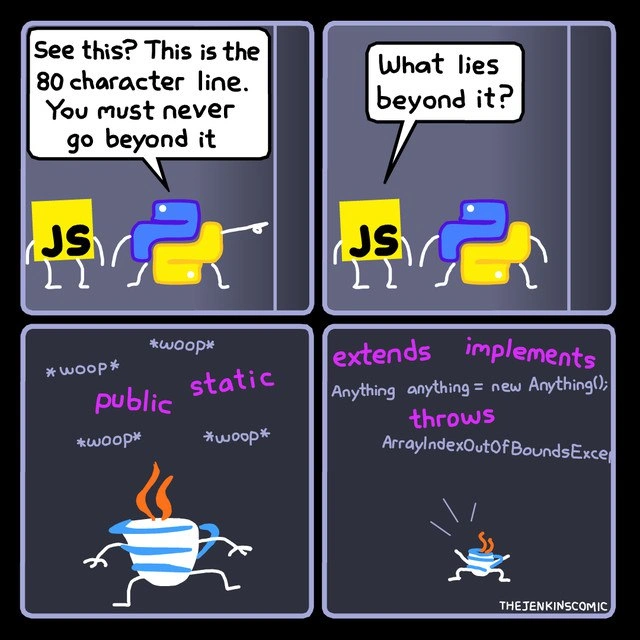
In this four-panel comic, we see a funny scenario about code style rules and different programming languages. In the first panel, the Python snake (blue and yellow, shaped like the Python logo) points to a vertical grey line and says: “See this? This is the 80 character line. You must never go beyond it.” This line is literally drawn in the picture, and it represents a common coding standard: don’t write code lines longer than 80 characters. Many coding style guides (like Python’s own guide called PEP 8) tell developers to keep each line of code short, typically under 80 characters (letters, numbers, symbols) long. It’s like a margin or limit to make code easier to read. If a line is too long, it might wrap around on the screen or be hard to see without scrolling, making the code less clear. Linters (tools that automatically check code for formatting and style issues) will often warn you if you have a line that’s, say, 100 characters long when the limit is 80. So, Python (the snake character) is acting like a strict teacher or an experienced dev, warning JavaScript (the yellow box with “JS” on it) not to break this rule.

In the second panel, JavaScript asks, “What lies beyond it?” – basically, “What’s on the other side if I do cross that line?” This sets up the joke: the young curious character wants to know why that rule exists. And then the comic goes wild in panels 3 and 4 with the answer.

Suddenly, Java appears – represented as a little steaming coffee cup (Java’s icon, since Java is named after a type of coffee). There are woop sound effects to show Java just magically poofing into existence beyond the 80-character boundary. Around the coffee cup, we see a bunch of Java keywords and code fragments floating in mid-air, drawn in a magenta/purple font. Words like public and static show up first, then in the last panel we see extends implements, and a snippet of code Anything anything = new Anything();, and throws ArrayIndexOutOfBoundsExce… (which is cut off, implying the word continues beyond the panel). All of this together looks chaotic and overwhelming, almost like an abyss of code beyond the safe 80-character line. The Python and JS characters are nowhere to be seen in those last panels – it’s just Java’s realm over there!

Let’s break down those Java terms to understand the contrast:

  • public and static: These are keywords in Java. public is an access modifier that means “this thing is visible to everyone (other classes can use it).” static means “this belongs to the class itself rather than an instance.” In Java, you often see public static void main(String[] args) as the standard way to start a program – that line alone has a couple of keywords and can be long. By contrast, in Python or JavaScript, you don’t have to write either of those words to define a basic function or start a script. So Java requires extra words up front.

  • extends and implements: Java is an object-oriented language where you define classes. A class can extend another class (meaning it inherits from a parent class) and implement interfaces (which are like contracts of methods that a class promises to have). For example, a Java class might be declared as public class MyCar extends Vehicle implements Drivable. Just that portion of a Java class definition already has the class name, one or more parent/interface names, and keywords extends/implements – it can easily become a long line if the names are longer. In Python, if you want to inherit from a class, you just put the parent in parentheses like class MyCar(Vehicle): and there’s no special word for implementing interfaces (Python handles that differently). In JavaScript (especially modern ES6 classes), you would use class MyCar extends Vehicle { ... } but typically JavaScript doesn’t have explicit implements for interfaces (since it’s not strongly typed in that way). So, Java tends to need more text to express the same idea.

  • Anything anything = new Anything();: This looks like a generic piece of Java code demonstrating how Java handles variable declarations and object creation. In Java, you must declare the type of a variable, then its name, then use new TypeName() to create an object of that type. If we imagine “Anything” is a class name, Anything anything = new Anything(); means: “declare a variable named anything of type Anything, and set it to a new instance of the Anything class.” Notice how the word “Anything” appears twice? Once for declaring the type of the variable, and once for calling the constructor to make a new object. This repetition is often jokingly criticized as Java being verbose (wordy). Meanwhile, in Python you’d just do:

    anything = Anything()
    

    And in JavaScript (using modern syntax) you might do:

    const anything = new Anything();
    

    In both those cases, you only see the class name Anything once. You don’t have to declare the type explicitly on the left-hand side in Python or JS because those languages are dynamically typed or use type inference. So, Python and JS require fewer characters for the same operation. The comic highlighting Anything anything = new Anything(); is a way to poke fun at how Java forces you to be extra explicit and thus ends up with longer lines of code.

  • throws ArrayIndexOutOfBoundsExce…: This is referencing a part of a Java method signature dealing with exceptions. In Java, some errors (called exceptions) are “checked exceptions,” which means a method that might cause such an error must declare that it throws that exception type. ArrayIndexOutOfBoundsException is the name of an exception that occurs when you try to access an index of an array that doesn’t exist (like going past the end of an array). That class name is really long – a lot of Java exception names are very descriptive but also very lengthy. In a method definition, you’d see something like:

    public void getElement(int index) throws ArrayIndexOutOfBoundsException {
        // ...
    }
    

    Just adding throws ArrayIndexOutOfBoundsException onto the end of the method line makes it super long. In Python, by contrast, you would just raise an IndexError when something is out of bounds, and you don’t declare that in the function signature at all. In JavaScript, you’d probably handle such an error differently too (maybe by returning undefined or throwing an Error at runtime), but again you wouldn’t see it in the function definition line. So this is another example where Java code is lengthier on the same line.

All these bits (public static ... extends implements ... new Anything() ... throws Exception) highlight how Java’s syntax often results in more text on one line. The comic exaggerates that beyond the 80-character mark, you’ll be drowned in all these Java keywords and symbols. It’s a playful way to say: if you don’t keep your code lines short and tidy, you might end up writing or encountering code that’s overwhelmingly verbose (like some Java codebases can be).

Now, why are Python and JavaScript depicted as the ones staying within 80 characters? Both Python and JavaScript communities value readability, but Python is especially known for its strict style guide, PEP 8, which literally says “Limit all lines to a maximum of 79 characters.” Python programmers and many code editors will actually draw that vertical rule at 79 or 80 chars to remind you. JavaScript doesn’t have one single universal style guide like Python’s, but many JS projects adopt a rule around 80 or 100 characters per line for consistency and readability. It’s common for teams to run a linter or code formatter (like ESLint or Prettier for JS) that might enforce an80-char (or sometimes 120-char) line length. So, JavaScript developers would at least be familiar with the idea of a “max line length” even if it’s not always exactly 80. The cartoon uses Python as the authority on it (since PEP 8 is famous for that rule), and JavaScript as the curious one learning about it.

The humor is language-nerd humor but it’s pretty accessible to any programmer who’s dealt with formatting rules. The idea of physically crossing a line in the code editor and unleashing a monster is funny because normally the 80-character limit is just a guideline – nothing magical actually happens if you go to column 81. Your linter might complain, or a colleague might comment on your pull request, but you’re not literally summoning Java code from the void. Here though, the comic pretends that the moment you exceed that length, bam! – you open a portal and Java code comes spilling out. It’s mixing the universes of these programming languages in a whimsical way.

It also gently satirizes Java’s verbosity. Java has a reputation for being more verbose and ceremonious compared to Python or JavaScript. “Verbose” in programming means you have to write a lot of syntactic noise (extra words or boilerplate) to get something done. This doesn’t mean Java is bad – in fact, all those keywords (public, static, type declarations, etc.) have a purpose (they make the code explicit, type-safe, and the behavior clear to the compiler). But it’s true that after coding in Python or JS, when you look at equivalent Java code, it feels like an overly formal letter. It’s like the difference between writing a quick note and writing a detailed legal document. The quick note (Python/JS) is short and to the point; the legal document (Java) is thorough but long-winded. This comic plays on that contrast.

To a newer developer (a junior), the takeaway humor is: There are style rules like keeping lines short, and every language has its own style and typical length. Python is saying “keep your code lines short for cleanliness,” and JavaScript is learning why. The big scary thing beyond the limit is Java code, implying “if you don’t keep things concise, you’ll end up writing code as lengthy as Java’s.” It’s an affectionate poke at how Java code can be very verbose. And indeed, many juniors first encountering Java after Python/JS are struck by how much you have to type. This meme just visualizes that feeling in a fun way.

So, summarizing the references:

  • 80 characters line: a common maximum line length in coding for better readability (part of code quality and style guides).
  • Python (snake): known for clean, readable code and strict style guides (PEP 8 is basically coding standards for Python).
  • JavaScript (JS block): also usually concise, but here playing the student role. Modern JS can be pretty terse (with things like arrow functions, etc.), and style rules also exist.
  • Java (coffee mug): stands for the Java language, which is being teased for verbose syntax (lots of keywords like public, static, extends, implements, etc.).
  • Keywords and code shown: examples of why Java lines get long (need for explicit declarations and handling).
  • ArrayIndexOutOfBoundsException: a famously long exception name in Java – emblematic of Java’s tendency toward descriptive but lengthy names (and checked exception declarations).

The comic is totally relatable developer humor. If you’ve ever tried to adhere to a coding standard and wondered “why do we do this?”, the comic jokingly answers: because if you don’t, you might descend into chaos – here symbolized by an onslaught of Java code. It’s not truly saying Java is chaos; it’s hyperbole for the sake of fun. Python and JavaScript devs often good-naturedly rib Java for being heavy. And even Java devs often joke about their own language’s verbosity (how many times have we written public static void or dealt with long class names?).

In the end, it’s highlighting a bit of culture in programming: those seemingly arbitrary rules like line length exist to improve readability (especially in code reviews or when printing code or viewing two files side by side). Many of these rules come from limitations of the past (old monitors, old printers, etc.), but they persist as conventions. Breaking them won’t summon a real Java monster, but the exaggerated “Java abyss” is a comical metaphor for messy, hard-to-read code. It gets a laugh because developers know that feeling when a single line of code just goes on forever: “uh oh, this is turning into Java territory!”

Level 3: The Verbosity Abyss

At the heart of this comic is the 80-character line limit – a venerable coding standard line that’s literally drawn in the first panel. The blue-and-yellow Python snake (representing Python) warns the yellow JS block (representing JavaScript) to “never go beyond” this vertical rule. Why so dramatic? In coding culture, an 80-char line is a famous boundary for code readability. It’s a convention rooted in history (old IBM punch cards and early terminal screens were 80 columns wide) and carried on by style guides for code quality. For seasoned developers, seeing that thin grey margin in an editor is as familiar as highway lane markers – cross it, and you’re in dangerous territory.

So, JavaScript asks curiously, “What lies beyond it?” – and the comic answers with a tongue-in-cheek horror reveal: Java’s verbose abyss. In panels 3 and 4, a steaming coffee cup (the classic Java icon, since Java is named after coffee) materializes with a magical woop sound. Surrounding it are magenta keywords like public and static, followed by a cascade of extends, implements, Anything anything = new Anything();, and throws ArrayIndexOutOfBoundsExce…. This sudden eruption of Java code is the punchline: if you cross the 80-character limit, you fall into a world of Java’s notorious verbosity – a giant wall of text full of boilerplate code and long-winded syntax. It’s a playful exaggeration of a real language quirk: Java often requires a lot more characters to express the same idea compared to Python or JavaScript. That magenta “public static” is instantly recognizable to any Java developer (public static void main anyone?), and seeing it appear like a summoning spell is hilariously relatable. The comic artist (this is from The Jenkins Comic, noted in the corner) cleverly visualizes Java’s boilerplate as a kind of Lovecraftian monster lurking beyond the style guide boundary.

Why is this funny to developers? It riffs on a common developer experience (DX): strict code style rules versus real-world code. Python’s style guide (PEP 8) famously recommends a 79 or 80-character line limit to keep code clean and readable. JavaScript developers, especially those using linters or Prettier, also often stick to around 80 or 100 characters per line for similar reasons. We’re taught that going beyond that length is bad form. But then there’s Java – a powerful, enterprise stalwart of a language – which by design tends to produce long lines. For example, in Java you often declare classes with inheritance and interfaces in one line, like:

public class BigManager extends BaseManager implements TimeKeeper, RecordKeeper {
    // ... imagine more code here ...
}

That single line could easily stretch beyond 80 characters, especially with descriptive class and interface names. And inside those classes, Java’s verbosity continues: you define variables with types and instantiate objects by repeating the type on both sides. The comic’s Anything anything = new Anything(); is a perfect parody of that pattern. In a dynamically-typed language like Python or a more succinct one like JavaScript, you’d never repeat yourself quite like this – you’d simply do anything = Anything() in Python or let anything = new Anything(); in JS (no type declaration on the left). But Java requires that explicitness: the type must be stated, the new keyword must be used, and the line becomes object type + variable name + “= new” + object type again + parentheses. It’s a form of ceremony or boilerplate that makes Java code more verbose by nature.

Now add Java’s exception handling into the mix. In Java, if a method might throw an error, you declare it in the method signature with throws ExceptionType. The comic picks the example of throws ArrayIndexOutOfBoundsException – which is one of the longer exception class names (and a classic Java error when you go past an array’s last index). Just imagine a real method signature:

public static void processData(String[] input) throws ArrayIndexOutOfBoundsException {
    // ... processing ...
}

That single line is already pushing or exceeding 80 characters, and we haven’t even written the method’s body! For a Pythonista used to writing def process_data(input): on one tidy line, the Java version looks like a small paragraph. The humor is that beyond the 80-char limit lies exactly this – lines so long they seem like endless gibberish to someone who isn’t used to Java’s style. The comic exaggerates it to an abyss: the tiny Java coffee cup is shown dwarfed by an infinite scroll of magenta keywords and code fragments trailing off the panel, as if Java’s verbosity is infinite once unleashed. It hits home for any developer who’s opened a Java class file where one line just keeps going…and going – or had to use horizontal scroll to read code.

The interplay between the characters is also brilliant. Python is portrayed as the wise mentor who strictly follows clean code style guides (PEP 8’s dictate about 80 chars). JavaScript, often a more free-form language historically, is the curious youngster asking “why, what’s beyond that rule?” The answer is a gentle jab at Java – a language both Python and modern JS like to think of as the verbose elder. It’s a multilanguage inside joke, contrasting language paradigms. Python and JavaScript are dynamically-typed, often more concise, with a focus on developer ergonomics (e.g., Python’s philosophy of readability, and modern JS’s use of terse syntax like arrow functions). Java, by contrast, comes from an older school where explicitness and verbosity were considered okay, even necessary – resulting in a lot of keyword clutter and repetitious patterns.

In essence, this meme hilariously captures a relatable developer experience: abiding by arbitrary-seeming coding standards (like a hard 80-character limit) and the fear that breaking them will lead to unmaintainable, messy code. For veterans, it also pokes fun at Java’s verbosity – something we’ve all grumbled about when a simple task requires writing a whole page of code. The joke lands because it’s grounded in truth: many times, keeping code neat (no overly long lines) does help maintain code quality, and yes, Java can feel like an entire different dimension of verbosity. The comic just literalizes that feeling by turning the spillover beyond column 80 into a chaotic Java dimension. For those of us who’ve spent late nights wrestling with both PEP8 errors and Java classes named AbstractSingletonProxyFactoryBean (yes, that’s a real Spring Framework class!), this humor is spot-on. It’s a lighthearted reminder that every language has its quirks, and sometimes the rules and the reality clash in comical ways.

Description

Four-panel comic with a dark purple background. Panel 1: a yellow square labeled “JS” and a blue-yellow snake shaped like the Python logo stand beside a vertical grey rule; Python says, “See this? This is the 80 character line. You must never go beyond it.” Panel 2: JavaScript asks, “What lies beyond it?” Panel 3: a steaming coffee cup representing Java materializes with *woop* sound effects around magenta words “public” and “static”. Panel 4: the Java cup is tiny in front of scrolling magenta keywords “extends implements” and grey code fragments “Anything anything = new Anything();” and “throws ArrayIndexOutOfBoundsExce…”, ending with the signature “THEJENKINSCOMIC”. The joke riffs on long-standing code-style guidelines (PEP 8, linters) that limit line length to 80 characters; Java’s traditionally verbose syntax is humorously portrayed as what lurks beyond that boundary, contrasting concise JavaScript/Python idioms with Java’s boilerplate


Comments

21
Anonymous ★ Top Pick We don’t enforce the 80-column rule for readability - it’s to prevent anyone from accidentally typing a Java generic like Map<Class<? extends Enum<?>>, List<Supplier<CompletableFuture<Void>>>> and opening a portal to boilerplate hell
  1. Anonymous ★ Top Pick

    We don’t enforce the 80-column rule for readability - it’s to prevent anyone from accidentally typing a Java generic like Map<Class<? extends Enum<?>>, List<Supplier<CompletableFuture<Void>>>> and opening a portal to boilerplate hell

  2. Anonymous

    The 80 character limit is like a gateway drug - you start with clean Python, experiment with JavaScript's flexibility, and before you know it you're writing AbstractSingletonProxyFactoryBean and convincing yourself that 'enterprise-grade' justifies a 47-character class name

  3. Anonymous

    The 80-character line isn't just a style guide boundary - it's the event horizon beyond which Java's ceremonial verbosity warps spacetime itself. Cross it, and you'll find yourself in a dimension where 'AbstractSingletonProxyFactoryBean' is considered a reasonable class name and every method signature requires more inheritance declarations than actual logic. Meanwhile, Python and JavaScript developers watch from the safety of their concise syntax, wondering if Java engineers are paid by the character

  4. Anonymous

    80 columns isn’t a style rule; it’s a safety rail - step past it and you’re in Java, where a single method signature needs word‑wrap, annotations, and a project charter just to throw ArrayIndexOutOfBoundsException

  5. Anonymous

    Beyond the line: where JS's 'undefined' becomes Java's unchecked RuntimeException hiding in plain boilerplate sight

  6. Anonymous

    Beyond column 80 is the checked-exception zone where Java generics perform a line-width DDoS and your linter auto-files the Jira against you

  7. @neekoisthebestdecision 4y

    I’m using typescript and I’m beyond 80 character line

    1. @VolodymyrMeInyk 4y

      who do you think you are?!

      1. @lord_asmo 4y

        newAnything();

  8. D Y 4y

    BTW I'm not against throws in typescript.

  9. Deleted Account 4y

    I'm using python and java both with 120 limit

  10. @skylightxo 4y

    You guys are pathetic, I write everything in one line without any linters or limits. I call it a "one liner"

    1. dev_meme 4y

      one-liner SPA, with isomorphic code-sharing so the single line of JS is used both on client and backend

      1. @azizhakberdiev 4y

        That's why semicolon exists in js

  11. @anilakar 4y

    Most .py guidelines nowadays say 100 or 120 chars. And readable trumps short any day.

  12. Денис 4y

    80 limit is for miserable laptop users

  13. @ZgGPuo8dZef58K6hxxGVj3Z2 4y

    Wait we can write everything in more than one line?

    1. dev_meme 4y

      Don’t try it, the rest of us will think of you as an amateur

      1. @ZgGPuo8dZef58K6hxxGVj3Z2 4y

        Hahahhahahahha

  14. @SamsonovAnton 4y

    Thanks god I'm using BASIC with explicit line numbers in source text! 10 PRINT "Hello world!" 20 GOTO 10

  15. @asm3r 4y

    It's legacy of 80x25 text mode in 1990s?

Use J and K for navigation