Skip to content
DevMeme
4565 of 7435
From fresh C coders to corporate zombies fueled by Monster Energy
Languages Post #5007, on Nov 18, 2022 in TG

From fresh C coders to corporate zombies fueled by Monster Energy

Why is this Languages meme funny?

Level 1: Playground to Office

Imagine you and your best friends love building with LEGO blocks when you’re kids. You’d sit together on the floor, excitedly stacking pieces to make cool castles and cars. Even if you stayed up late because you were having so much fun, you’d be laughing and enjoying every minute. Now fast forward a bunch of years: you’ve grown up, and building isn’t just for fun anymore – it’s your job. Instead of LEGO, you’re constructing real houses or big complicated machines. You have a boss who says, “This needs to be done by tomorrow morning!” and customers who will be upset if it breaks. You’re not building with pals at your own pace; you’re working with other adults under a lot of pressure. You stay up late again, but this time it’s not fun – you’re exhausted, your hair’s a mess, and the only thing keeping you awake is a giant can of energy drink (like a super-strong soda). In short, what used to feel like play has now become hard work. The meme is funny because it shows this exact change with coding: writing computer programs in college felt like a fun group project, but doing it as a job made the same activity feel tiring and stressful. The college coders looked happy and energetic (like kids on a playground), while the working coders look drained and sleepy (like tired adults in an office late at night). It’s a cartoon way of saying, “When you turn your fun hobby into a career, it might not be so fun anymore!”

Level 2: Coding Bliss vs Coding Blues

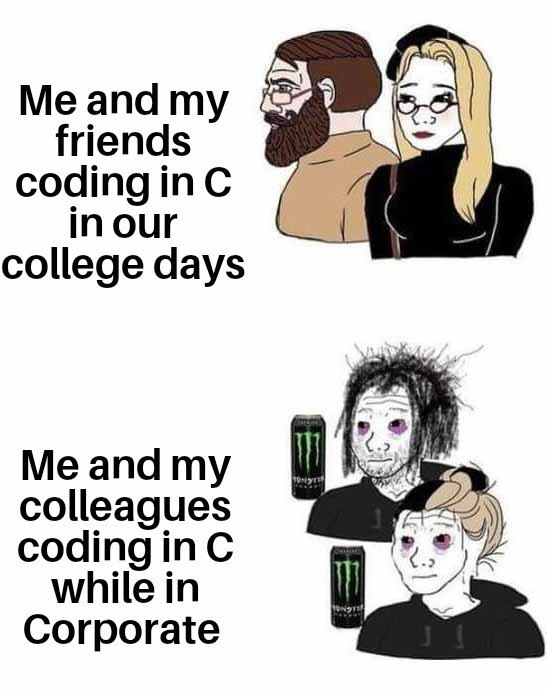
At this level, let’s break down exactly what’s happening in the meme and why it’s humorous, especially for someone newer to programming or just entering the tech world. The meme is a two-panel Wojak comic — Wojak is a simple cartoon face used in many internet memes to represent generic people or emotions. Here, we have Wojak characters illustrating “college vs. corporate life” for C programmers. The top panel’s caption says:

“Me and my friends coding in C in our college days.”

Next to that text, the image shows two college students (a bearded guy and a blonde girl, both Wojak-style) who look happy, lively, and well-rested. They’re clean and smiling, presumably representing how the meme’s creator and friends felt during university while programming in C. The message is that back in college, coding in C was a fun, social activity. You’d work on assignments or personal projects with your buddies, maybe staying up late in the computer lab, but it was exciting. The phrase “coding in C in our college days” implies this was a time of learning and enthusiasm. Working with C felt empowering: you were writing in a language that let you do low-level things like manage memory or play with system calls – serious computer science stuff. Yet it was done in an academic setting, where the stakes were relatively low. If your program crashed, you might miss out on a perfect grade, but you could often just rerun it or ask a teaching assistant for help. There was a sense of blissful experimentation. College coders are typically passionate; they pull late nights out of fascination (and okay, sometimes procrastination), but it’s almost fun. You’re fueled by curiosity (and maybe some coffee or energy drinks, but in a more lighthearted way). The top image characters being well-groomed and cheerful shows that this intense work hasn’t yet taken a toll on their health or appearance.

Now, the bottom panel’s caption reads:

“Me and my colleagues coding in C while in Corporate.”

Here, the scenario shifts to the professional world – “corporate” meaning working in a company or industry job. Instead of “friends”, it says “colleagues”, indicating these are now coworkers. The picture shows three figures (Wojak style) who look completely drained and burnt out. They have messy, unkempt hair; their eyes have dark circles or a slightly crazy look, and their expressions are fatigued. Each of them is holding a can of Monster Energy, a popular energy drink known for high caffeine content. Monster Energy cans are black and neon green (you can see those colors in the image), and they’re practically a symbol of late-night coding sessions or anyone needing a jolt of energy to stay awake. The joke here is visual and textual: the same people who were bright and perky in college are now zombie-like in their jobs, kept functional only by caffeinated drinks. This stark change highlights developer fatigue and frustration that can happen when you’re coding in C as a full-time job.

So, why does coding in C at a company turn these people into zombies? A few key points for a junior developer to know:

  • C is a low-level programming language. This means it gives you a lot of control over the computer, which is powerful but also means you have to manage many details yourself. One big detail is memory. Unlike easier languages (like Python or Java) that do automatic memory management (they free up unused memory for you with something called a garbage collector), C requires you to manually manage memory. That means whenever you allocate memory (with functions like malloc), you’re responsible for freeing it (free) when you’re done. Forgetting to free memory causes a memory leak, and messing up pointers (variables that store memory addresses) can cause crashes or weird bugs. In college, dealing with these issues is part of learning, and programs are usually short-lived; a leak might not even be noticed because the program ends and the operating system cleans up. In a corporate setting, however, C programs might run for days, weeks, or indefinitely (like a web server or an embedded system), and memory leaks will pile up and eventually break the system. This means corporate C developers must be extremely careful and detail-oriented, which is stressful.

  • Bugs in C can be hard to find and fix. A tiny mistake, like forgetting one & or * in front of a variable (taking an address or dereferencing a pointer), can cause a program to misbehave. The term pointer bugs refers to errors in how pointers are used (like pointing to the wrong memory). These often lead to segmentation faults (when your program tries to access memory it’s not allowed to). In a college assignment, a segfault just means your program crashes and you need to debug your code. In a corporate environment, a segfault could mean an entire service or application crashes unexpectedly. That might trigger alerts in the middle of the night and require immediate attention. As you can imagine, getting woken up at 3 AM to fix a mysterious crash isn’t fun and, if it happens often, it will make you very tired and cranky.

  • Corporate projects are usually much larger and more complex than college projects. In college, even if you coded in C, you probably worked on relatively contained assignments – maybe a few thousand lines of code at most, often written by you or your classmates from scratch. In the corporate world, you might be dealing with a huge existing codebase (hundreds of thousands or millions of lines of C code) that has evolved over years. This code likely has some technical debt (old code or shortcuts taken to meet deadlines). Learning how it all works is challenging, and modifying it without introducing new bugs can be nerve-wracking. It’s a bit like inheriting an old, massive Jenga tower: one wrong block (code change) can make the whole thing topple. That pressure can turn fun coding into a tense chore.

  • Work culture differences – college vs corporate. In college, your time spent coding with friends had a social and learning aspect. If you pulled an all-nighter, it was with buddies, maybe with joking around, music, and the thrill of finishing something cool. In a job, if you’re pulling an all-nighter, chances are it’s because something went wrong or there’s an intense deadline. Your teammates (now called colleagues) might be cool people, but everyone is stressed about delivering results. Managers might be pressuring you, or customers might be waiting. The whole atmosphere can be more pressurized. This often leads to a culture of “crunch time” (working extra hours to meet a deadline) and relying on caffeine to push through. The Monster Energy drink in the meme is basically shorthand for “I have to stay up late working, and coffee might not even be enough, so I’m drinking this super-caffeinated stuff.” It’s humorously exaggerated – not every C coder in a company is shotgunning Monster drinks – but it’s a relatable trope that tech folks laugh about.

  • Burnout and appearance. The bottom panel Wojak characters have visibly aged (wrinkles, eye bags) or are not taking care of themselves (messy hair, looking pale). This is exaggeration for comedic effect, but it’s based on a real phenomenon: developer burnout. When someone is overworked and stressed for a long time, they might start looking tired or older than they are. The meme artist drew the college coders as young and fresh and the corporate coders as deteriorated to emphasize how the years of stressful coding in C have aged them. It’s an example of using visuals to convey mental and physical exhaustion. Those Monster cans in each character’s hand hint that they probably do this (work late fueled by energy drinks) all the time, not just once.

All these points combined explain the joke: the same activity (coding in C) looks and feels very different when you’re a student vs. when you’re an employee. It’s funny to developers because many have experienced this shift first-hand or seen older colleagues who went through it. It’s workplace humor mixed with coding humor. Seeing beloved classmates turn into tired coworkers is both a scary thought and a shared chuckle. We often joke that in tech (and other fields), the job can age you quickly – and this meme captures that idea in a simple, pretty spot-on way.

For a junior developer or a student, the meme is also a bit of a tongue-in-cheek warning: love coding in C? Great, but be aware that in the real world, it can be tough and taxing. The meme has an absurdity to it (no one literally becomes a cartoon zombie), but it reflects real sentiments. The top panel is the ideal – you coding happily with friends, gaining skills. The bottom panel is the reality many face – you using those same skills under pressure, maybe on legacy code, with years of cumulative stress showing on your face. It contrast the developer experience (DX) between learning versus doing it as a job.

In simpler terms, the meme says: Coding in C was my happy hobby in college, but in the corporate world, it turned into a stressful grind. And it exaggerates that by showing the college coders all fresh-faced and the corporate coders like caffeine-dependent zombies. Any programmer who has gone from school to industry will likely smirk at this because they’ve felt a bit of that transformation themselves.

Key terms explained for clarity:

  • C Language: A powerful programming language (part of the “C family” of languages) known for being close to the computer’s hardware. It’s fast and efficient, but it doesn’t provide a lot of safety nets. You have to manage many things yourself (especially memory).
  • Manual Memory Management: In C, the programmer explicitly allocates and frees memory. Think of it like having to remember to clean up and recycle every single time you use something – if you forget, there’s a mess. Other languages have a garbage collector, which is like an automatic cleaning service for memory. C doesn’t, so you do it by hand. This gives you flexibility to handle memory exactly how you want (which can be great for performance) but also means it’s easy to make mistakes.
  • Pointer: A variable in C that holds a memory address (basically, it “points” to a location in memory). If a normal variable is a house, a pointer is like a piece of paper with the house’s address on it. Pointers are very powerful (you can directly access and modify memory locations), but if you have a wrong address on that paper (pointer pointing to the wrong place), you might end up at someone else’s house (accessing memory you shouldn’t) – that’s how crashes and bugs happen.
  • Segmentation Fault (segfault): A common error when running C (and C++) programs. This happens when the program tries to read or write memory that it’s not allowed to. It’s like the operating system saying, “Whoa, you’re not supposed to be messing with that memory!” and then halting the program. You’ll usually just get a cryptic message like “Segmentation fault (core dumped)” and have to figure out what went wrong in your code.
  • Monster Energy: A brand of energy drink loaded with caffeine and sugar. Tech folks joke about it (and other energy drinks like Red Bull) because it’s famously used to stay awake and alert, especially during crunch times or hackathons. In the context of the meme, it symbolizes needing artificial energy to continue coding when you’re exhausted.
  • Corporate Culture (Crunch Time): Corporate culture refers to the work environment and norms in companies. In some tech companies (especially for product launches or emergencies), there’s a culture of “crunch time” – meaning employees work very long hours for a period to meet a deadline. This can lead to burnout. So a “caffeine-fueled crunch” is when developers are pushing themselves to work perhaps late into the night, relying on coffee/energy drinks to stay productive.
  • Developer Burnout: A state of physical and mental exhaustion caused by prolonged stress and overwork. Signs include feeling tired all the time, losing interest or pleasure in work you used to enjoy, and sometimes health issues. The meme’s bottom panel illustrating the coders as zombie-like is a humorous exaggeration of how burnout might feel or look.

By combining all these elements, the meme strikes a chord with developers: it’s saying “Remember how coding was when we were young and optimistic? And look at us now – drained, over-caffeinated, dealing with the same code but under way more stress.” It’s funny, a bit sad, and very recognizable to anyone who’s made that journey from student to professional coder, especially in the realm of C programming.

Level 3: Production Pressure Cooker

In the top half of the comic, coding in C looks almost idyllic – a bunch of college friends huddled together, probably low-level programming late at night for fun, fueled by curiosity (and maybe some pizza and soda). Writing C in college often feels like a thrilling challenge: you’re learning how computers really work at the metal. You get to play with pointers and memory, build data structures from scratch, maybe even write a simple operating system for a class. It’s tough, but it’s academic tough – the kind where you pull a fun all-nighter with friends in the lab, bond over debugging, and still manage to laugh when you finally fix that segmentation fault. The characters in the top panel look fresh and enthusiastic: bright eyes, neat hair, exuding confidence. That was us in our early 20s, feeling like systems coding warriors conquering projects one pointer at a time. Back then, a bug in our C code was a learning experience, not a make-or-break crisis. A memory leak in your assignment? Meh, the program finishes in 2 seconds and the OS reclaims the memory anyway – you might lose a few points, but no one’s getting paged at midnight.

Fast forward to the bottom panel: “Me and my colleagues coding in C while in Corporate.” Here, the vibe has done a 180. Those same coders (now a few years older) look absolutely exhausted – dark circles under their eyes, hair frazzled like they’ve been through a tornado of debugging sessions. They’re literally clutching cans of Monster Energy just to stay functional. This is a not-so-subtle jab at corporate culture in software engineering, especially in systems programming roles. Late nights are no longer optional bonding experiences; they are often mandated by looming deadlines or 2 AM production outages. The Monster Energy cans represent the lifeblood of burnt-out developers: obscene amounts of caffeine. (It’s a running joke in tech circles that critical systems run not on electricity, but on caffeine and sheer developer willpower.)

So why did our happy C hobbyists turn into corporate zombies? The meme is highlighting the harsh reality of developer experience (DX) when you move from the sandbox of school into the pressure cooker of professional work. In a company, your C code isn’t solving neatly-defined textbook problems – it’s entangled in a decades-old codebase with global side effects. Those “pointer bugs” and “manual memory-management headaches” are no longer just grading deductions; they’re show-stopper production bugs that might crash a service or, worse, corrupt data silently. When a segfault happens in production, it’s your pager buzzing and a swarm of panicked Slack messages from the ops team. Suddenly the fun puzzle of debugging becomes a high-stakes emergency. The phrase “it works on my machine” doesn’t cut it when the code is deployed to thousands of machines worldwide.

There’s also the technical debt aspect: many corporate C codebases are old. C has been around since 1972, and a ton of critical infrastructure (operating systems, database engines, embedded systems, you name it) is written in it. When you join a company as a C developer, chances are you’re inheriting a giant legacy codebase written by dozens of developers over many years, with varying coding styles and questionable workarounds. Imagine trying to read through a massive function with pointer arithmetic that was written before you were born – and finding a comment “// TEMPORARY FIX, REFACTOR LATER” from 2005. 😅 Maintaining such a system can turn the most eager coder into a weary soul. Each new feature or bug fix is like defusing a bomb: one wrong move with a pointer and you might blow up something unrelated. That constant caution and frustration wears you down. It’s a classic corporate humor trope: the young idealistic developer vs. the grizzled veteran who’s seen one too many all-nighters.

The visual contrast in the meme nails this perfectly. In the first panel, “me and my friends” implies camaraderie and passion – coding in C was a group adventure, probably done out of genuine interest. In the second, it’s “me and my colleagues” – that word alone, colleagues, hints at a more formal, maybe impersonal environment. Instead of friends coding for fun, it’s coworkers grinding because it’s their job. The fun of discovery has shifted to the fatigue of deadlines. You can almost hear the cynical inner voice of those characters saying, “We used to do this for fun, what happened to us?” The answer: burnout happened. Crunch time, on-call rotations, constant pressure to deliver efficient and bug-free C code in a business setting – it all accumulates. The result is developers who jokingly (or not-so-jokingly) resemble zombies. They might joke, “I survived another release cycle, but at what cost?” – half in jest, half in genuine weariness.

It’s worth noting that this isn’t just about C as a language; it’s about how corporate workplace culture can drain you. C just happens to amplify it here because it’s unforgiving. Take a look at the Monster-chugging avatars: those bags under their eyes and messed-up hair are a badge of honor in some dev teams, sadly. They scream “late-night coding session.” Maybe they were up until 4 AM analyzing a core dump file trying to trace which part of the code overran a buffer. Maybe they’re on their third energy drink because there’s an urgent patch to deploy for that one memory leak crashing the server every 48 hours. In many companies, being a systems programmer means you’ve accepted a life of late-night coding and firefighting. It’s practically a meme in itself that where a college student might party all night, a corporate dev instead debugs all night.

Despite the dark humor, developers share this meme because it’s deeply relatable. It’s a form of workplace humor that validates the shared struggle: “Yes, C in the real world really did this to me!” It satirizes the transformation – from bright-eyed enthusiasts to bleary-eyed burnouts. Importantly, it also hints at mental health in tech. The zombie look isn’t just for laughs; it reflects real issues like developer fatigue and burnout. Long-term stress, poor work-life balance, and constant caffeine intake aren’t healthy (surprise!). The meme exaggerates the visuals (we don’t literally become black-eyed ghouls… well, unless the coffee machine breaks), but it’s poking at a true trend: many programmers feel (and sometimes even look) significantly more worn-down after years in high-pressure coding jobs. The Monster Energy is a perfect prop – it’s the unofficial drink of death marches and crunch mode, with that tongue-in-cheek implication that the devs are now basically running on toxic green fuel.

In summary, the humor comes from contrast and truth. College vs. Corporate is a classic meme format, and here it’s applied to C developers. It’s funny because it’s true: so many of us remember the early days when programming was pure joy and curiosity. Then we think about last week’s 12-hour debugging marathon at work and chuckle (or cry) at how far we’ve fallen. The same C language that once made us feel powerful now has us in a headlock, demanding yet another can of Monster to get through the day. The meme resonates as both coding humor and a bit of a cautionary tale: this could be you, if you’re not careful with your career and health. It’s a knowing laugh among developers – we’ve all seen that transformation, in ourselves or our peers, and while we joke about it, it also reminds us that behind great code often lie a few empty energy drink cans and a lot of hard work.

Level 4: Heap Hellscape

C programming drops you straight into a manual memory management maze – a realm of pointers, heaps, and the ever-looming specter of undefined behavior. In college, you might’ve treated malloc and free as magic incantations to get your project working. Under the hood, though, calling malloc carves out a chunk on the heap (a big pool of memory) and gives you a pointer – essentially a raw memory address. Forget to free that memory later and you’ve created a memory leak; keep doing that in a long-running corporate application and you’ll eventually exhaust RAM like a sink slowly overflowing drop by drop. Free the memory too soon, and any pointer still referencing it becomes a dangling pointer – a ghost address pointing at memory that’s no longer yours. Use it by accident, and you’ve invoked the dark art of undefined behavior, where anything can happen: maybe nothing noticeable, or maybe a segmentation fault that crashes your program out of the blue.

This is fine when you’re a student debugging on your own laptop – a crash just means an annoying error message and a quick rerun of your program. But in a corporate production environment, a segmentation fault can mean a critical service goes down. (Ever see a server process “Core Dumped” at 2 AM? That’s a bleary-eyed developer’s alarm clock.) Modern operating systems have memory protection, so accessing memory you shouldn’t triggers a segfault signal and kills the process for safety. Great for the OS; not so great when that process was handling thousands of user requests. Now you’ve got an outage, an incident report to write, and yes – an all-nighter to pull.

C’s low-level power is a double-edged sword, and veteran C developers have the scars to prove it. Without a garbage collector (there’s no friendly background process cleaning up for you as in Java or Python), every byte is your responsibility. The trade-off? You get blazing performance and direct hardware control – C is often used in low-level systems programming like operating systems, embedded devices, or high-performance libraries. But the cost is constant vigilance. One off-by-one error in pointer arithmetic, and you’ve quietly corrupted memory two hours before the program finally explodes. As a result, teams invest in tools like Valgrind or address sanitizers to catch leaks and buffer overruns, and they enforce strict code reviews for memory-handling logic. Even so, the complexity of real-world systems means some bugs slip through and only manifest under specific conditions (high load, specific data, long uptime). Those are the hair-pullers: the infamous Heisenbugs that vanish when you try to debug them and reappear at 3:47 AM when you’re on call.

Underneath the meme’s humor is this harsh reality: C gives you full control of memory, but with zero safety nets. Each * pointer you dereference is essentially a loaded foot-gun – if you’re careful and experienced, you’ll hit the target with great power; if not, you’ll shoot yourself in the foot and spend the night figuring out why it hurts. The CFamilyLanguages (C, C++, etc.) all inherit some of this “freedom and fallout.” It’s thrilling in college to play with these concepts on small assignments. But scale that up to millions of lines of code running 24/7 in a corporate environment, and that same thrill turns into a source of chronic stress. When the meme shows those developers clutching Monster Energy cans with wild hair and hollow eyes, it’s symbolizing countless hours lost in this very heap hellscape – chasing down wild pointers, deciphering core dumps, and patching memory leaks under pressure. In short, C giveth performance, but taketh away sanity.

// A tiny C example of a big headache:
#include <stdlib.h>
#include <string.h>
#include <stdio.h>

int main() {
    char *data = malloc(5);
    strcpy(data, "Hello");   // use allocated memory
    free(data);              // free it (good so far)
    // Oops: Use-after-free bug - data is a dangling pointer now.
    printf("%s\n", data);    // undefined behavior: could print "Hello", garbage, or crash
    return 0;
}

// In college, this might crash and you’d just rerun your program. In production, this same bug could intermittently crash a critical service, unleashing havoc and 3 AM incident calls.

Description

A vertical two-panel Wojak comic on a white background contrasts two stages of C developers’ lives. Top panel: two clean, well-groomed Wojak characters (one bearded male, one blonde female) face right; to their left, black bold text reads: "Me and my friends coding in C in our college days." Bottom panel: three disheveled, exhausted Wojak figures with frizzy or unkempt hair hold multiple black-and-green Monster Energy cans; the caption beside them says: "Me and my colleagues coding in C while in Corporate." The meme highlights how the same low-level C work that felt exciting in academia becomes a caffeine-driven grind under production pressure, pointer bugs, and manual memory-management headaches. It humorously comments on corporate burnout, late-night debugging, and the aging effect of long-term systems programming

Comments

13
Anonymous ★ Top Pick In college we debugged dangling pointers; twenty years later we ARE the dangling pointers - kept alive by Monster and a legacy codebase where freeing anything is considered an outage risk
  1. Anonymous ★ Top Pick

    In college we debugged dangling pointers; twenty years later we ARE the dangling pointers - kept alive by Monster and a legacy codebase where freeing anything is considered an outage risk

  2. Anonymous

    The real difference isn't the language complexity - it's discovering that the 'temporary workaround' from 1987 is now load-bearing infrastructure, the original developer retired to a beach in Thailand, and you're debugging a race condition in a 50,000-line function called 'doStuff()' while the CTO asks why you can't just 'add AI to it'

  3. Anonymous

    The transition from college C to corporate C: where 'malloc' goes from a learning exercise to a nightly terror, and you realize that every segfault in production is just another reason to keep Monster Energy in business. Twenty years later, you're still debugging the same pointer arithmetic someone wrote in 1997, except now it's 'critical infrastructure' and you can't rewrite it because 'if it ain't completely broken, don't touch it.'

  4. Anonymous

    College C: reallocating stacks for fun. Corporate C: reallocating blame after the prod segfault

  5. Anonymous

    In college, pointers pointed to ints; in corporate, they point to 2 a.m. SEV-1 bridges

  6. Anonymous

    College C was pointers on a whiteboard; corporate C is brokering peace between a 500k-LOC pre-C99 monolith, a homegrown allocator, and UB that only reproduces with -O3 + LTO at 2 a.m., so our observability is printf to a 115200 UART

  7. @DavidGarciaCat 3y

    not just C…

    1. @ilovethicktights 3y

      even carbon?

  8. @karim_mahyari 3y

    Maybe C is for more valuable goals. Corporate would rather have 8 hours of meetings a day. Corporate doesn't care for your memory management and that you don't have built-in strings and vectors.

  9. @im_ali_pj 3y

    based

  10. @Araalith 3y

    Tiny useless college pet projects with zero responsibility vs huge corpo enterprise projects. Hm...

  11. @MadDelBastard 3y

    why there two same pictures?

  12. dev_meme 3y

    Meme got a change request

Use J and K for navigation