C Pointer Power vs. C++ Reference Safety
Why is this Languages meme funny?
Level 1: Big Dog vs Little Dog
Imagine you have two pet dogs. One is a big, strong dog that can run anywhere it wants – even into places it shouldn’t go. This dog is super confident and never asks permission. Sometimes it might knock things over because no one is guiding it. This is like a C pointer, which is a programming tool that lets you go anywhere in the computer’s memory. The other dog is a small, shy dog that always stays right by your side. It won’t run off on its own – in fact, it needs to be put on a leash (tied to a spot) from the very start, and it will only stay in that safe area you placed it. It’s not strong enough to break the rules or roam freely. This is like a C++ reference, which is a programming tool that must be linked to something real immediately and then can’t switch to something else.
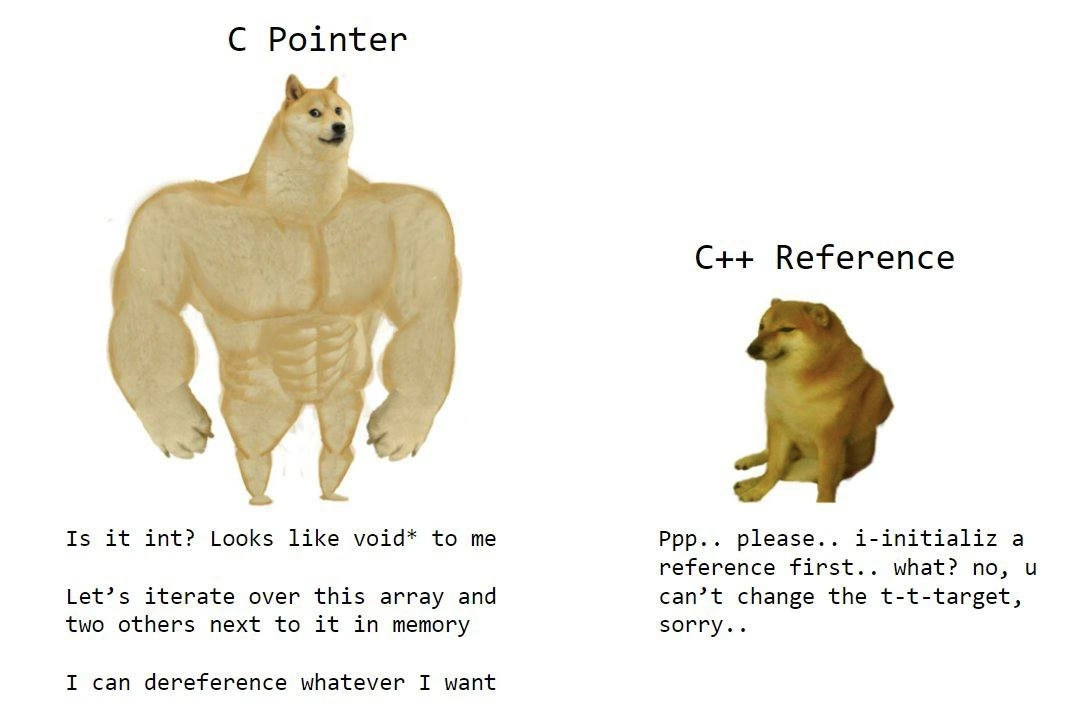
In the meme picture, the big muscular dog is saying he can do whatever he wants – peek at anything, go anywhere – and the little dog is nervously saying “um, you have to set me up first, and… sorry, I can’t change once I’m set.” The reason this is funny is because it’s just like real life with those dogs: the strong one is a troublemaker and the small one is a rule-follower. In programming, the C pointer’s wild behavior can cause trouble (if it runs into the wrong memory, the program can break, like the big dog causing a mess in a neighbor’s yard), whereas the C++ reference is well-behaved and safe (it will stay where it’s supposed to, but it’s also a bit less exciting). The big dog’s freedom vs the little dog’s caution is an exaggerated, silly way to show the choice programmers have: do you want total freedom (and risk making a mess), or do you want some safety (but with limits)? Even if you’re not a programmer, you can laugh at the contrast: one character is absurdly confident and reckless, and the other is overly timid and apologetic. It’s like one kid on the playground doing whatever dangerous stunt he wants, and another kid always asking the teacher for permission – seeing them side by side is funny because they’re such opposites!
Level 2: Bound for Safety
In simpler terms, this meme is comparing pointers in C to references in C++ by using the classic big dog vs small dog picture. C and C++ are both C family languages, but they handle something fundamental – how you refer to memory – in very different ways. The big muscular Doge on the left represents a C pointer, which is basically a super flexible variable that holds a memory address. Think of a pointer as a finger that can point to any memory location. In C, that finger can point to an int one minute, then you can cast it (void* cast) and make it point to a char or any other type the next minute. It’s as if the pointer is saying, “Type safety? Pfft, I do what I want.” This is why the meme has the buff dog saying “Looks like void to me”* – a void* in C is a raw pointer that doesn’t have a type attached, meaning you can cast it to any specific type when needed. C programmers use void* to write generic functions (like qsort or memory allocation functions) that work with any data type. It’s powerful but requires the programmer to be extra careful.
Another thing the left side brags about is iterating over an array and then continuing into adjacent memory. In C, pointers support arithmetic: if p is a pointer to the start of an array, p + 1 points to the next element, p + 2 to the element after that, and so on. This is really handy for looping through arrays manually. However, nothing in the language automatically stops you from doing p + 100 even if the array isn’t that large. If you go beyond what you’re supposed to, you might start reading or writing unrelated memory. That’s like stepping out of bounds – for example, reading past the end of an array might accidentally read whatever bytes happen to be in memory after the array. This is a major source of bugs. When the buff C pointer says “Let’s iterate over this array and two others next to it in memory,” it’s joking about this out-of-bounds access. In real life, doing that might crash your program or corrupt data, because you’d be trampling memory that isn’t part of the array (those “two others next to it” could be totally unrelated variables or just invalid memory). In technical terms, this is an unsafe memory access and leads to what we call undefined behavior – the program could do anything: crash, produce garbage output, or even seemingly work correctly and then fail later unpredictably. C doesn’t automatically check if you went out of bounds; it assumes you know what you’re doing. That’s why C is often described as having no safety net when it comes to memory.
Now, on the right side, we have the C++ reference (the timid doge) which is basically a feature C++ added to make certain things safer and easier. A reference in C++ is like a constant alias or a second name for an existing variable. One big rule is you must initialize a reference when you create it. For example, in C++ you’d do:
int number = 5;
int &ref = number; // ref is now a reference to number
You can’t just declare int &ref; without assigning it to refer to something – the compiler will error out. This is why the meme’s little dog is stuttering “please initialize a reference first.” It’s poking fun at how strict this rule is compared to pointers. With a pointer, you could do int *p; and not initialize it (though using it before initialization is a bug, but the compiler might not stop you). With a reference, the language forces you to initialize it, which is good because it prevents a whole class of errors where you accidentally use a reference that isn’t set to anything. In other words, you’ll never have a reference that “doesn’t know where to point” – it always aliases a valid object.
Another difference: once a reference is tied to a variable, it cannot be changed to refer to another variable. It’s fixed. In the above example, ref will always refer to number (until it goes out of scope). If later you have another variable int other = 10;, you cannot make ref switch to other. Writing ref = other; in C++ does not rebind the reference (like a pointer would); instead it copies other’s value into the original number. This is a common point of confusion for beginners. The meme captures this by the reference shyly saying you can’t change the target. It’s apologizing that “sorry, once I’m set, I’m stuck to that one thing.” This is by design: C++ references are meant to provide a reliable alias that you don’t have to worry about suddenly pointing somewhere else. In contrast, a pointer variable can be reassigned: if p was pointing to x, you can later do p = &y; to make it point to y. With a reference, there’s no such operation.
To put it simply:
- Pointer (in C or C++): A variable holding a memory address. You can change it to point somewhere else, you can do arithmetic on it (move it around in memory), and it can even be null (point to nothing). But if you misuse it (like pointing to the wrong place or not initializing it), you can crash the program or corrupt data. It’s powerful but dangerous, a key part of manual memory management.
- Reference (C++ only): Not a separate address-holding variable, but an alias to an existing variable. You can use it just like the original variable (no need to dereference with
*in code; you just use it by name), and it can’t be null or uninitialized (in normal use). However, you can’t make it reference a different variable later – it’s locked in. It’s safer and easier in scenarios like function parameters (where you want to refer to an original object without copying it, but also without the awkward syntax of pointers).
This meme is funny to programmers because it exaggerates these differences as personalities. The C pointer is like a hardcore old-school programmer’s tool: “I’ll do anything, just trust me (and if it breaks, that’s on you).” Seasoned devs might recall times when a stray pointer caused random bugs – e.g., you write to *(p + 100) accidentally and suddenly your program’s behavior goes crazy because you just overwrote some important data in memory. It’s considered a very macho tool in the sense that it doesn’t babysit you. The C++ reference is the opposite: a slightly protective tool that says, “I’ll help prevent certain mistakes, but in return, you have to play by my rules (initialize me, don’t expect me to change targets).” It’s almost timid because it places these limits that might frustrate someone coming from C’s unfettered world.
For a newer developer or someone still learning, the meme is also educational: it hints that a C pointer can be risky (the big dog might break things), whereas a C++ reference enforces some safety (the little dog is weaker but well-behaved). If you’ve ever accidentally used a pointer that wasn’t set (like forgot to call malloc or forgot to assign it to something valid), you probably got a nasty surprise (maybe a crash or weird output). If you tried something similar with a reference, the code wouldn’t even compile, saving you from that mistake upfront. On the flip side, if you wanted to change what your reference was referring to, you’d be surprised that you couldn’t – you’d have to switch to using a pointer in that case. So this contrast is something you learn when dealing with language comparison of C vs C++.
In summary, the buff C pointer in the meme stands for ultimate freedom in low-level programming (with the side effect of possible chaos), and the shy C++ reference stands for safety with restrictions. The meme humorously personifies these two concepts to show a truth in programming: more freedom often means more responsibility and risk, while safety often comes with rules and limitations. It’s a playful take on a fundamental concept in programming languages that even relatively new developers can start to appreciate once they’ve played with pointers and references.
Level 3: Off the Leash
This meme uses the buff Doge vs Cheems format to contrast C’s raw pointer power with C++’s restrained references. The C pointer (the swole Doge) embodies unapologetic low-level freedom: it can treat any memory as whatever type it wants, roam beyond array boundaries, and generally act like it owns the entire address space. In C, a pointer is literally a numeric memory address, and the language doesn’t stop you from performing wild pointer arithmetic or casting a pointer to a void* (generic pointer) and back. The buff pointer flexes by saying:
“Is it int? Looks like
void*to me.”
This line jokes about casting everything to void* (a pointer with no specific type) – a common C trick to bypass type checks. C lets you convert a pointer to any other pointer type (with an explicit cast), effectively telling the type system “I know what I’m doing” (famous last words). The meme also shows the pointer bragging:
“Let’s iterate over this array and two others next to it in memory.”
Here the pointer is doing dangerous pointer arithmetic – moving past the end of an array into whatever happens to be in memory afterward. In a healthy program, touching memory past an array’s end is strictly off-limits. But a buff C pointer doesn’t care; it’s off the leash. It can add an offset, wander outside the array, and start reading or writing UndefinedBehavior land. Seasoned C developers recognize this as a recipe for buffer overflows and memory corruption, yet the pointer’s attitude is: I can do it because the language won’t immediately stop me. In C, there are no runtime bounds checks on arrays, so writing *(p + 5) when p only points to an array of size 3 might compile fine – but at runtime you could overwrite something else (or trigger a segfault). The meme’s final pointer boast,
“I can dereference whatever I want,”
sums it up: the pointer will try to read or write any address you tell it to, whether it’s valid or not. This is a nod to how C offers ManualMemoryManagement and bare-metal freedom. You can manually calculate addresses, cast types, and dereference pointers arbitrarily, enabling high-performance and low-level control (great for things like systems programming, embedded devices, and data structure implementation). But with great power comes great responsibility: misuse leads straight into the abyss of Undefined Behavior. In the industry, countless bugs and security vulnerabilities (buffer overruns, invalid frees, stack smashing) have been caused by “buff” pointers doing whatever they want unchecked. Experienced C programmers have a mix of awe and terror for this power – it’s why C is known both for its efficiency and its sharp edges.
On the right side we have the C++ reference portrayed as a timid Cheems (small doge), highlighting the stricter rules in C++’s design for safety. C++ references were introduced as safer, more user-friendly aliases for variables, to avoid some of the pitfalls of pointers. The meme text captures the reference’s constraints in a stammering plea:
“Ppp.. please.. i-initializ a reference first..”
This refers to the rule that you must initialize a reference at the moment of declaration. In C++, you can’t have an uninitialized reference. For example, int &r; on its own is illegal – r has to immediately refer to some real int, like int &r = existingInt;. This contrasts with C (and C++ pointers) where you can declare a pointer and set it later, or forget to set it (leading to dangling or wild pointers). The reference is basically saying, “you can’t even create me without tying me to a valid target.” This eliminates an entire class of bugs where you accidentally use a pointer that doesn’t point anywhere meaningful.
The Cheems reference then apologetically says:
“what? no, u can’t change the t-t-target, sorry..”
Once a C++ reference is bound to an object, it cannot be reseated to refer to a different object. It’s like a permanent alias. If you have int &r = x;, you can’t later make r refer to a different y – any assignment to r will actually change x’s value, not make r point elsewhere. This is in stark contrast to pointers, which you can redirect at will (p = &y; is fine for a pointer p). The reference’s timid apology humorously shows how constrained it is compared to the free-wheeling pointer. It’s practically begging the programmer to follow the rules: initialize me and accept that I’m stuck to this one thing. These are the reference binding rules that every C++ dev learns. They make references safer (no null, no changing target), but also less flexible.
Why is this funny to an experienced developer? Because we’ve all seen the LanguageWars between C and C++ fans about control vs safety. C, the older language, treats the programmer like an adult at an all-you-can-eat memory buffet: go ahead, take whatever you want – just don’t blame me if you get sick. C++ (especially modern C++) tries to be a bit more protective, saying maybe let’s put some guard rails so you don’t drive off a cliff. The buff pointer’s macho lines are essentially caricaturing the old-school C ethos: “I don’t need safety, I have void* and I’ll even go poke around next to that array, thank you very much.” The shy reference’s stuttering is caricaturing C++’s cautious additions: “Actually, please follow these rules... if that’s okay... we just want things to be a little safer.” It resonates because it’s true: a C pointer will happily compile code that a C++ reference (or the C++ type system in general) would forbid or warn about. Seasoned programmers chuckle because they’ve debugged those wild pointer issues at 2 AM (when the pointer “dereferenced whatever it wanted” and corrupted memory). Many can recall the first time they encountered a segfault due to using an uninitialized pointer or indexing past an array – a rite of passage in LowLevelProgramming. Conversely, they remember learning that references in C++ can’t be null and thinking “hey, that’s nice – but also, wow, I can’t make this reference point to something else later?!” It’s the trade-off between flexibility and safety, perfectly illustrated with the buff vs timid doge meme characters.
In practice, both pointers and references are tools in C++. C++ hasn’t eliminated pointers at all – it simply gave programmers a choice. You use references for cleaner syntax and safety when you can (like passing function parameters without copying, e.g. void foo(const std::string &s) to avoid copying the string), and you use pointers when you need extra control or null semantics (like optional parameters, or interfacing with C libraries). Under the hood, a reference is often implemented as a pointer, but with compiler-enforced rules to prevent you from doing the crazy stuff. That means the CS_Fundamentals of how memory addresses work still apply – a reference is essentially a pointer constrained by language rules. The meme humorously personifies those constraints.
From a historical perspective, C’s wild-west memory model stems from an era of trust in the programmer and the need for performance. The result was incredible performance and low-level access, at the cost of MemorySafety pitfalls. C++ came later, as a C superset, and one of its goals was to introduce higher-level abstractions (like classes and references) that could reduce errors without sacrificing too much performance. The buff Doge might scoff, but even the most hardcore C developer knows the pain of tracking down a stray pointer bug. Meanwhile, the C++ reference, while safer, isn’t a cure-all – it’s just one safety belt. Modern C++ adds even more safety features (smart pointers, bounds-checking containers, sanitizers) to tame that wild memory muscle. But those early days of C vs C++ semantics are perfectly captured here: raw unchecked power versus cautious reliability. The humor lands because it’s exaggeration with a core of truth: sometimes working with C pointers really does feel like being a brazen bodybuilder flinging weights (or bytes) around, whereas using a reference feels like you’re being gently scolded by the compiler to play nicely.
// C pointer: wild and free (but dangerous)
#include <stdio.h>
int main() {
int nums[3] = {10, 20, 30};
int *p = nums;
// Legitimate use: iterate within bounds
for(int i = 0; i < 3; ++i) {
printf("%d ", *(p + i)); // prints 10 20 30
}
printf("\n");
// Illegitimate use: go out of bounds (undefined behavior)
printf("%d\n", *(p + 5)); // ??? - reading beyond array (who knows what's here)
void *v = p; // void* casts away the type (generic pointer)
char *cp = (char*) v; // cast to incompatible type (possible aliasing issues)
printf("%c\n", *cp); // interpreting an int as a char - just because we can
return 0;
}
In the code above, the C pointer p happily steps out of its array’s bounds – something a safe language would prevent or at least throw a runtime error for. We even cast an int* to a char* via void*, essentially saying “treat this 4-byte integer as four 1-byte characters”. The compiler won’t stop these dangerous casts; it trusts you. This could break strict aliasing rules and is generally a bad idea, but the buff pointer doesn’t mind living on the edge. Now compare that with a C++ reference scenario:
// C++ reference: constrained and safer
#include <iostream>
int main() {
int x = 42;
int &ref = x; // must initialize a reference
// int &ref2; // ERROR: a reference must be initialized
ref = 100; // OK: actually changes x to 100, reference is just an alias
int y = 200;
// ref = &y; // ERROR: cannot make ref refer to y; ref is not a pointer
// ref = y; // This assigns the value of y to x, doesn't rebind ref
std::cout << x << std::endl; // prints 100
// References can’t be null, so they’re always assumed valid.
// int &badRef = *reinterpret_cast<int*>(NULL); // if you force a null reference, it's UB
return 0;
}
In the C++ code, you see that int &ref = x; binds ref to x. Trying to declare ref2 without initialization would be a compile error – the shy reference insists on being tied to something real from the start. We then do ref = 100; which looks like we’re assigning 100 to ref, but since ref is just another name for x, it’s x that becomes 100. If we attempt ref = y; (where y is another int), it does not make ref refer to y – instead it assigns y’s value to x. The commented-out lines show illegal operations: you can’t rebind ref to a different integer after initialization, and ref isn’t a pointer so you can’t assign it an address directly either. Also, there's no concept of a “null reference” in normal usage; a reference must refer to a legitimate object. The only way to get a null reference is to do something twisted (like using reinterpret_cast as shown in the comment), which the language treats as UndefinedBehavior if you ever dereference it. Essentially, the C++ reference guarantees it’s an alias to a valid object or nothing – and “nothing” isn’t allowed by the type system. This is a big win for MemorySafety because it means if you have a reference, you don’t need to constantly check “is this valid?” the way you might with a pointer. The downside is, of course, less flexibility: you can’t decide later to make that reference point to a new object.
For a senior developer, the meme is a crack-up because it surfaces a classic design trade-off in a meme-able nutshell: C’s philosophy is that you’re the macho programmer who knows what you’re doing – you want a buff tool that can smash through walls (or iterate through arbitrary memory). C++’s philosophy (at least regarding references) is to be a bit more civilized – you get a tool that will only work within set bounds and will politely tell you “no” if you try otherwise. We laugh because we’ve been both characters: sometimes you need that raw pointer to do some low-level magic or optimize a piece of code to the max (and you feel like the buff Doge, wielding void* casts and manual memory control with pride). Other times, you appreciate the compiler catching your mistakes and preventing disaster, which is when you feel more like the cautious Doge, grateful for those rules. The exaggeration hits home – a C pointer truly can “dereference whatever” without immediate complaint, whereas a C++ reference truly will complain at compile time if you don’t initialize it or if you treat it like a pointer.
Ultimately, this meme is poking fun at the contrast between unsafe_memory_access_joke (the wild west style of C pointers) and the more controlled environment of C++ references. It’s an inside joke for systems programmers: if you’ve wrestled with a segfault caused by a stray pointer or if you’ve been frustrated that you couldn’t make a reference do pointer-like tricks, this meme speaks to you. It’s a lighthearted reminder that, in the world of programming languages, more power usually means more potential for chaos. And as any seasoned dev will tell you, sometimes that buff pointer that “can do anything” ends up causing a crash that the timid, rule-abiding reference would have avoided. The buff Doge might look superior, but everyone knows a misused pointer can bring even the strongest program to its knees. Meanwhile, the shy reference might seem weak, but it’s quietly saving your program from a whole class of errors. That ironic reversal – power causing trouble vs. restraint providing stability – is what makes this meme hilariously on-point.
Description
A two-panel 'Swole Doge vs. Cheems' meme comparing C pointers to C++ references. On the left, a muscular, confident Swole Doge represents the 'C Pointer,' with accompanying text that boasts of its power and flexibility: 'Is it int? Looks like void* to me,' 'Let's iterate over this array and two others next to it in memory,' and 'I can dereference whatever I want.' On the right, a small, anxious Cheems dog represents the 'C++ Reference,' with timid, pleading text highlighting its limitations and safety features: 'Ppp.. please.. i-initializ a reference first.. what? no, u can't change the t-t-target, sorry..' The meme humorously contrasts the raw, unsafe memory manipulation capabilities of C pointers with the safer, more restrictive nature of C++ references. For experienced developers, this captures the fundamental trade-off between the power that comes with direct memory access in C and the compile-time safety guarantees introduced in C++ to prevent common and severe bugs like segmentation faults
Comments
10Comment deleted
C pointers are the root password to your application's memory, while C++ references are the same password with a sudo command that only lets you run `ls`
At the heap bar, the C pointer’s doing shots of *(p++) across memory pages while the C++ reference hugs its first drink whispering, “I can’t leave - lifetime contract,” and ASan’s already calling the bouncers
After 20 years in the industry, I've learned that C pointers are like giving developers a chainsaw with no safety guard - incredibly powerful for surgery, but you'll probably lose a finger. Meanwhile, C++ references are that junior dev who keeps asking 'but is this const-correct?' during code review while your production server is literally on fire
This perfectly captures the philosophical divide between C and C++: C pointers are like giving a junior dev root access to production - technically unlimited power, but with great power comes great segfaults. Meanwhile, C++ references are the senior architect who insists on const correctness and RAII, nervously clutching their copy of 'Effective C++' while muttering about lifetime guarantees. The real irony? Both camps think they're the buff doge, and in production at 3 AM when you're debugging a memory corruption issue that only reproduces on ARM with -O3, you realize you're actually both the weak doge crying into your coffee
C pointers are the root SSH key to RAM; C++ references are the IAM policy - until lifetime bugs turn your ‘safer’ binding into a dangling alias and a 3am postmortem
C pointers are root on your address space; C++ references are the HOA bylaws - can’t reseat, still liable when UB burns the neighborhood; you probably meant std::span or gsl::not_null
C pointers: rewriting prod memory like it's your personal canvas. References: 'Sorry, I'm bound and can't help you segfault today.'
hah, then how rust ref look like?) Comment deleted
c when that pointer gers deref'd Comment deleted
C++ reinterpret_cast Comment deleted