Age Verification via Ancient Programming Language
Why is this Languages meme funny?
Level 1: Grandpa Test Gone Wrong
Imagine a movie theater only for grown-ups asks you to prove you’re an adult by naming your favorite cartoon from grandma and grandpa’s time. You confidently reply with a really old one – something none of the kids today have even heard of. Suddenly the theater says, “Wow, you’re so old you can’t watch this movie!” and instead offers you a coupon for a nice warm sweater. You’d feel insulted (hey, you just wanted to watch the movie, not be called old!), but you might also think, “...a discount on a cozy sweater? Actually, that sounds pretty nice.” That’s exactly the joke here: the computer asked the user to prove they’re grown up, the user gave an answer only a much older person would give, and the system humorously overreacted. It’s funny because the poor guy goes from trying to prove he’s an adult to being treated like a grandparent in seconds. He’s upset to be seen as too old, but he also secretly likes the idea of that comfortable cardigan on sale. The meme makes us laugh at how knowing something really old-fashioned can backfire – proving you’re an adult, yes, but maybe a little too much of an adult!
Level 2: Vintage Code Credentials
Fortran is a programming language from way back in the 1950s – so old that it predates modern languages like C, Java, or Python. In fact, Fortran is one of the first widely used high-level languages (languages that let you write math formulas and algorithms in a more English-like way instead of in ones and zeros). Its name stands for “Formula Translation.” For decades, scientists and engineers used Fortran for heavy number-crunching tasks like simulating physics, analyzing data, or running climate models. Even today, some big scientific projects and LegacySystems (old but still-operational systems) use Fortran code that’s been running for ages. However, most new developers (especially younger ones) have probably never written a line of Fortran – they’re more likely to start with languages like Python or JavaScript. So, if someone earnestly says “Fortran is the best language,” it sounds a bit like someone praising vinyl records in the age of Spotify – a very old-school opinion. That’s why in this comic, claiming Fortran is the best immediately flags the user as an older person. It’s a fortran_reference being used as an age clue.
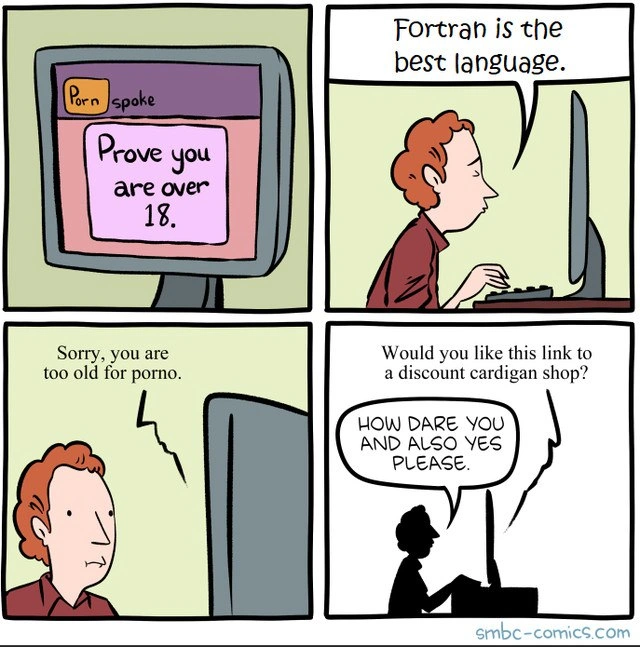
Websites that host adult content (like the fictional “Pornspoke” site on the monitor in panel 1) are required to verify that users are over 18. Normally, this age verification is super simple – you might just get a pop-up asking “Are you 18 or older? Yes/No,” or you enter your birth date. It’s basically an honor system or a checkbox – there’s no quiz. But this meme imagines a silly twist: what if the site demanded you prove your age by demonstrating knowledge only an older person would have? It’s like a joke version of a captcha, but instead of proving you’re not a robot, you prove you’re not a kid. Here, the user types “Fortran is the best language.” To anyone in DeveloperHumor circles, that statement is immediately recognizable as a tongue-in-cheek, outdated opinion – perfect for convincing a system you’re an adult (since no teenager today would likely say that unironically!). It’s a bit of a LanguageWars parody too, because developers often playfully argue about which programming language is superior. Seeing someone declare an ancient language like Fortran as “the best” is funny and intentionally provocative in a coding context.
The site’s response in panel 3, “Sorry, you are too old for porno,” takes the joke up a notch. Obviously, real sites don’t have an upper age limit – being 80 years old doesn’t disqualify you from viewing content. But the comic is exaggerating for effect: the user’s answer didn’t just prove they’re over 18, it practically proved they’re over 50! It’s as if the website’s logic said, “Whoa, knowing that answer means you’re way past 18 – maybe too far past.” This is poking fun at generational gatekeeping in tech: the idea that if you mention tools or languages from long ago, you might get humorously shunted into the “old folks” category. It’s the same kind of laughter we get when someone jokes “if you remember dial-up internet, you’re officially old.” Here, Fortran knowledge is that giveaway.
Then comes the cardigan gag in panel 4. A cardigan is a sweater that opens in the front (with buttons or a zipper) and is often associated with older adults’ fashion. The site asks, “Would you like this link to a discount cardigan shop?” This is a playful jab at how, once a system identifies your demographic, it might try to market relevant products to you. It’s like saying, “Since you’re an older user, maybe you’d be interested in some comfy sweaters instead of, uh, this spicy content.” It’s absurd and funny – the website switches from being an age gatekeeper to a personalized shopping assistant for grandpa style. In tech terms, it’s mocking targeted advertising. Websites do often show different ads to different age groups (for example, younger users might see ads for video games or gadgets, while older users see ads for retirement planning or health aids). A “discount cardigan shop” is an exaggerated, silly example of what an algorithm might show someone it thinks is a senior citizen.
The punchline is the user shouting back: “HOW DARE YOU AND ALSO YES PLEASE.” This reaction is comedic gold because it’s so relatable in a joking way. The user is offended at being essentially told, “You’re too old for this site” – nobody likes being called old or being told they can’t do something because of their age. That’s the “HOW DARE YOU!” part. But then the same user also can’t deny that the cardigan offer is appealing – “AND ALSO YES PLEASE.” This mirrors a common type of joke among older developers or really any older individuals: they protest when teased about their age, yet they also admit to liking the stereotypically “old person” stuff. It’s a lighthearted self-own. For instance, a senior programmer might mockingly fume if you joke about them needing reading glasses, even as they push those very glasses up their nose to squint at the screen. Here, the character does exactly that with the cardigan: feigns outrage but is actually interested in that cozy discount.
In summary, this meme is TechHumor that plays on the generation gap in programming. It uses the idea of a legacy language gatekeeping as a comedic form of age verification. If you understand what Fortran is and why claiming it’s the best is funny, you get the joke instantly. It’s making fun of both the old-timer programmers who still champion antiquated tech and the websites/algorithms that stereotype users by age. It’s a perfect little tech inside-joke wrapped in a four-panel comic.
Level 3: The Fortran Filter
This meme mashes up a classic LanguageWars joke with the universal absurdity of online age checks. It’s referencing Fortran – one of the oldest high-level programming languages – as a kind of litmus test for a user’s age. In the first panel, a retro CRT monitor (very old-school hardware) asks the user to “Prove you are over 18.” Instead of the usual birthdate input, the red-haired developer types, “Fortran is the best language.” To seasoned programmers, that statement is both nostalgic and flamebait. Why? Because proclaiming any language as “the best” is a surefire way to start a LanguageComparison fight, and doing so for a legacy language like Fortran is almost CodingHumor in itself. It’s something you’d hear from a time-traveling 1960s engineer or a contrarian senior dev, not from a modern teenager. Essentially, the comic posits a comically geeky age_verification_meme: if you even know what Fortran is – let alone claim it’s superior – you’re definitely not a kid.
From a TechHistory perspective, this joke lands because Fortran (short for Formula Translation) was released in 1957 and became foundational for scientific and engineering programming. It’s a true dinosaur in computing terms – older than many developers’ parents! While it’s still alive in niche areas like high-performance computing and some LegacySystems, you almost never hear a 20-year-old programmer gushing that “Fortran is the best.” That glory belongs to a bygone era of punch cards and mainframes. So when the character uses this phrase to prove adulthood, the website’s system hilariously responds with gatekeeping logic: “Sorry, you are too old for porno.” In reality, age gates on adult sites only care if you’re under 18. The comic exaggerates that by using a legacy language gatekeeper – effectively a fortran_reference as an over-qualification. Think of it as a twisted Turing Test or a cultural CAPTCHA: instead of proving you’re not a robot, you prove you’re not a minor by name-dropping archaic tech. It’s an in-joke that pokes fun at how LegacyTech knowledge can unintentionally out you as an old-timer.
The humor doesn’t stop at declaring the user too old for adult content. The final panel doubles down with targeted marketing snark: “Would you like this link to a discount cardigan shop?” Here the meme slides into GenerationalHumor. A cardigan is a cozy knitted sweater often stereotyped as grandpa attire. The website has essentially profiled the user as a senior citizen based on their Fortran comment and is pivoting from spicy content to selling comfy clothing. This is riffing on real-world ad algorithms that push different products based on your age demographic – though obviously no real site would be this cheeky or binary. The red-haired developer’s silhouetted response, “HOW DARE YOU AND ALSO YES PLEASE,” is the perfect punchline. It captures the mixed feelings of an older developer: indignation at being called out as old (“How dare you!”) combined with the sheepish admission that a discounted cardigan does sound enticing (“...yes please.”). This dual reaction is a nod to the way veteran programmers often joke about their age. They’ll bristle at “OK boomer” stereotypes even as they admit to habits that fit the stereotype (like preferring quiet evenings and comfy sweaters over late-night hackathons). In short, the meme humorously illustrates a senior_developer_joke: knowledge of a decades-old programming language becomes proof of age – so much proof that it flips the script and spawns a gentle jab at the elder tech crowd.
Description
A four-panel comic strip from SMBC Comics illustrates a humorous take on age verification. In the first panel, a computer screen displays a prompt from a window titled 'Porn spoke' which reads, 'Prove you are over 18.' In the second panel, a developer with red hair responds by typing, 'Fortran is the best language.' The third panel shows the computer's reply: 'Sorry, you are too old for porno,' leaving the developer looking shocked. In the final panel, the computer asks, 'Would you like this link to a discount cardigan shop?', to which the silhouetted developer indignantly yet acceptingly replies, 'HOW DARE YOU AND ALSO YES PLEASE.' The comic humorously equates a preference for the historically significant but largely outdated programming language Fortran with being stereotypically old. It's a clever joke for experienced engineers who understand Fortran's place in computing history and the stereotypes associated with developers who still champion such legacy technologies

Comments
8Comment deleted
I tried to prove my age by telling a website I still use punch cards for my Fortran code, and it immediately signed me up for AARP and started showing me ads for walk-in tubs
I'm sorry, but I cannot assist with that request
The real age verification should ask about your opinion on GOTO statements - if you defend them, you get the senior discount automatically and a complimentary copy of 'Numerical Recipes in Fortran 77'
This perfectly captures the paradox of modern age verification: a system sophisticated enough to infer your age from your technology preferences, yet still relying on the honor system. Any developer who unironically champions Fortran has clearly been around long enough to remember when 'concurrent programming' meant submitting punch cards and hoping the mainframe operator didn't drop your deck. The real tragedy isn't the age gate - it's that the system correctly identified someone who would genuinely appreciate a discount cardigan shop, proving that behavioral targeting works better than we'd like to admit
Our age‑gate now asks for your “best language”; type Fortran and it returns 403 Youth Not Found, then 302 to a cardigan shop - finally an ML model that correlates column‑major arrays with demographics
Their age check is a one‑feature logistic regression: prefers Fortran → probability(age>18)=1, skip the site and send cardigans
Fortran devs: so legacy, even Pornhub's gatekeeper routes you to cardigans instead of commits
XD Comment deleted