Skip to content
DevMeme
3547 of 7435
Crashing Prod: A Developer's Journey From Terror to Routine
OnCall ProductionIssues Post #3884, on Oct 31, 2021 in TG

Crashing Prod: A Developer's Journey From Terror to Routine

Why is this OnCall ProductionIssues meme funny?

Level 1: Here We Go Again

Imagine you’re stacking a tower of blocks as a kid. The very first time your block tower accidentally tumbles down, you might be really upset – maybe you even cry because you worked hard on it and suddenly it’s destroyed. Now think about if you rebuild that tower and it falls again, and you do this over and over. By, say, the twenty-sixth time your tower collapses, you probably won’t be crying anymore. You’d likely just sigh, shrug your shoulders, and start picking up the blocks without much fuss. You’ve gotten used to it falling. That’s exactly the feeling this meme is joking about. The “tower” here is a big important thing (a server running a website), and the person knocking it down is the developer. The first time it “falls,” the developer is scared and panicked (like you were with the blocks). But after it’s happened so many times, the developer reacts like, “Oh well, here we go again.” It’s funny because normally crashing something so important should be scary every time – but this shows the person becoming almost too comfortable with the chaos. The contrast between feeling panicked at first and then feeling completely unfazed later is what makes people laugh. It’s like seeing someone go from “This is the end of the world!” to “Meh, no big deal,” just because it happened a bunch of times.

Level 2: Crashing Prod 101

Let’s break down what’s happening in this meme in simpler terms. Production (or “prod”) is what we call the live, real-world environment where an application or website runs for users. A production server is like the main computer (or set of computers) running that live site. When we say a server “crashed”, it means it stopped working properly or went offline unexpectedly – kind of like a car engine stalling out. This could happen because of a bug (a mistake in the code), a configuration error, or even high load that the system couldn’t handle. In short, crashing production is a big deal because it means real users might be seeing errors or unable to use the service.

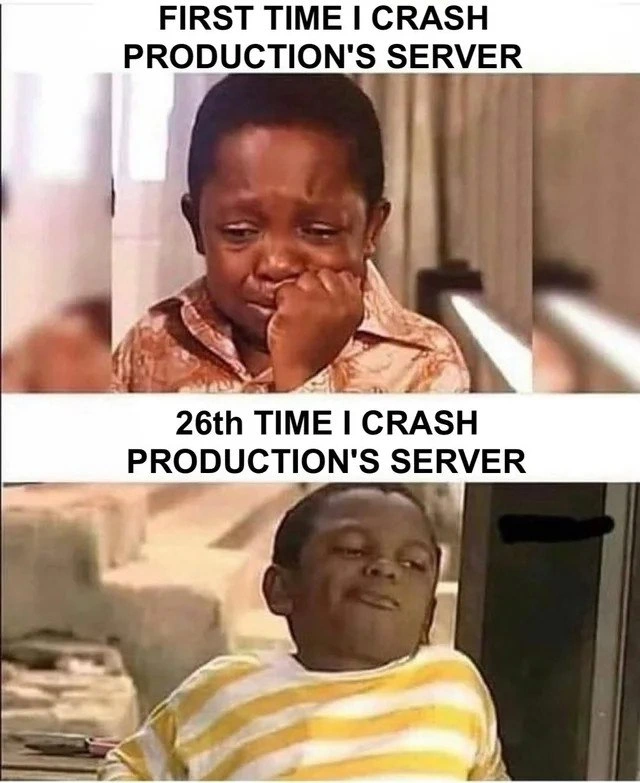
Now, the meme shows two pictures of the same child reacting very differently. The top caption says, “FIRST TIME I CRASH PRODUCTION’S SERVER.” The bottom says, “26th TIME I CRASH PRODUCTION’S SERVER.” It’s using an exaggerated scenario to illustrate how a developer’s emotional reaction can change over time with experience. The first time this person accidentally causes a production issue, they’re extremely upset – the kid in the picture is crying, which represents a developer who is super worried, maybe on the verge of tears or a panic attack. This makes sense: if it’s your first time breaking something in production, you might fear you’ll get in trouble, disappoint the team, or even get fired. Your heart races, you frantically try to fix things, and you feel awful.

On-call engineers or DevOps/SRE teams often can relate to that first-time panic. Being “on-call” means you’re responsible for responding if something goes wrong with the servers, often even if it’s late at night. So imagine it’s 2 AM, you deploy some new code or a bad hotfix, and suddenly the website goes down – alarms (literally) go off, maybe an app like PagerDuty calls your phone. The first time that happens, it’s terrifying. You jump out of bed, your mind is racing “What broke? Was it my code? How do I fix it fast?” You might be shaking while typing commands to restart things. This is why the meme’s first panel shows a child looking scared and sobbing – it perfectly captures that “Oh no, I messed up big time” feeling.

Now, look at the second panel of the meme. The same kid appears completely relaxed, leaning back with almost a carefree smirk. The caption says it’s the 26th time he’s crashed the production server. Of course, 26 times is an exaggeration (at least one hopes no single developer takes the site down that often!), but the point is to highlight how much the reaction has changed. By the time something disastrous has happened so many times, the person is no longer panicking. They’ve kind of seen it all before. Instead of crying or freaking out, they’re like “Huh, did it again. Oh well.” There’s a term for this in the world of operations: incident fatigue or alert fatigue. It basically means if you get alerted or paged about problems dozens of times, you start to become numb to it. It’s not that crashing production stops being bad – it’s that the person has gotten used to the chaos and maybe even a bit desensitized.

From a junior developer’s perspective, this meme might also be showing the journey from novice to experienced. The first time you deploy code that causes a major bug, it’s a huge shock. You might remember it forever (many of us do remember our first big prod mistake!). But over a few years, after working on many releases, almost everyone has caused at least a minor outage or serious bug at some point. With each incident, you (hopefully) learn something and also realize the world doesn’t end. The site went down, yes, but you brought it back up, maybe with help from teammates. The company didn’t fold, you weren’t immediately fired, and life moved on. By the umpteenth time, you know the drill: fix the issue, restore service, inform the team, later figure out what went wrong. The fear is replaced by a sense of “okay, let’s solve it.”

This is common in DevOps culture: teams strive to build resilience so that even if things break, they can recover quickly without drama. An experienced SRE (Site Reliability Engineer) or sysadmin has likely been through lots of outages and has playbooks or scripts to handle them. So, the calm look of the child in the second panel might also represent confidence born of experience. The engineer isn’t nonchalant because they don’t care – they’re calm because they know how to handle it now. They’ve probably got a checklist for restarting the server or rolling back the bad deployment. They might even have automated monitoring that pinpoints the issue. In other words, practice makes perfect less panic.

However, there’s also a bit of dark humor here. By the 26th time, instead of being traumatized, the developer could be burnt out or just over it. Sometimes in companies where production breaks often, engineers develop a sarcastic attitude as a coping method. They might joke around on Slack while fixing the issue, like "Oops, did it again. My bad, lol." even though it’s actually a serious incident. It’s a way to relieve stress. The meme exaggerates that aspect – normally, nobody’s truly happy about crashing a server, but you might act very casual outwardly to keep your cool. It’s a bit like a firefighter who’s been to so many fires that they calmly go about their work while a newbie might be trembling; the fire is still dangerous, but the veteran has seen it all.

In summary, this meme is showing: the first time a developer breaks the production environment, they freak out, and by the twentieth-plus time, they’ve grown used to it and react with a shrug. It’s poking fun at how a person’s response to repeated stress changes from panic to an almost humorous acceptance. It resonates with developers because many have felt that transition themselves. The captions and images highlight that contrast in a simple, relatable way – which is why it’s funny. After all, it’s the classic “the first time vs the nth time” joke applied to the nerve-wracking world of production outages.

Level 3: Alert Fatigue Armor

At a high level, this meme captures the jaded evolution of an on-call engineer. The first time a production server crashes under your watch, it's pure adrenaline and dread – you can practically hear your heart doing $ tail -f /var/log/panic. By the twenty-sixth time, that adrenaline has been replaced by a darkly comic resignation. The humor comes from incident fatigue: after enough 3 A.M. wake-up calls and frantic hotfix deploys, you develop a psychological shell akin to armor. It's often called alert fatigue in DevOps/SRE circles – the phenomenon where constant alerts make you stop reacting with urgency. You’ve seen the system go down so many times that another outage barely lifts an eyebrow.

This two-panel meme cleverly contrasts the rookie panic versus the veteran shrug. In the top frame, the child’s face is crumpled in worry: the developer’s first production incident triggers terror. Why? Because production is the real deal – when it’s down, real users are impacted, managers swarm, and the blame (even in a "blameless" culture) feels laser-focused on you. The caption "FIRST TIME I CRASH PRODUCTION'S SERVER" evokes that gut-wrenching moment every developer fears: deploying a bug or bad config that takes down the live site. The kid crying is basically you slumped over your keyboard, sweat on your brow, whispering “Oh no, what did I do?!” as alerts flood in.

Now fast-forward to the bottom panel: the same person, after 25 more production crashes, is leaning back with a smug, almost bored expression. The caption "26th TIME I CRASH PRODUCTION'S SERVER" is absurdly exaggerated to drive the joke home. By this point, our hypothetical dev has been through the fire so many times they’re practically fireproof. It’s a portrayal of desensitization. The once-nervous engineer now treats a full-on production outage like a mildly annoying bug report. It’s the SRE equivalent of a soldier lighting a cigarette while chaos erupts around them – not because the fire isn’t hot, but because they’ve been burned so often they know exactly how it goes.

Why is this funny to experienced devs? Because it’s painfully relatable. Seasoned engineers have all seen that colleague (or been that person) who goes from “Everything is on fire! OMG!” to “Everything is on fire... again. Meh.” after enough incidents. It’s a form of gallows humor: joking about horrific situations (like critical systems repeatedly crashing) as a coping mechanism. When you’re on your 26th ProductionIncident, panic is a wasted emotion – instead, you might crack a joke on the incident call like, “At least it’s not DNS this time,” while calmly restarting services. Each new ProductionIssue just becomes another line in the long list of war stories. :fire:

On a deeper level, this meme hints at the systemic issues and culture in some engineering teams. If the same poor soul (or team) is crashing prod that many times, something’s clearly broken beyond just the code. Maybe there’s intense deadline pressure that forces shipping untested changes, leading to ProductionBugs slipping through. Maybe the architecture is so fragile that small tweaks cause big cascades (a classic brittle monolith or tightly-coupled microservices where one failure topples everything). Perhaps the organization hasn’t invested in staging environments or proper CI/CD pipelines, so every deploy is a game of Russian Roulette with the live servers. In such an environment, production firefighting stops feeling heroic and just feels routine. The first few outages everyone yells, “We must never let this happen again!” By the 26th, people are scheduling the postmortem meeting with a recurring calendar invite. Surely this time we’ll fix it for good…

There’s an implicit critique here of on-call burnout. Humans aren’t meant to sustain fight-or-flight adrenaline surges on a weekly basis. After enough pager blasts at ungodly hours, the body and mind adapt – not necessarily in a healthy way, but in a “I can’t panic about this anymore” way. The engineer in the meme has likely blown past their cortisol limit. They might even find a weird calm in the chaos: “Oh, prod crashed again? Let me grab coffee first – I already know the playbook.” This isn’t outright negligence; it’s more like a weary confidence born from experience. Mean Time to Panic (MTTP) increases with each incident: the first time, MTTP was zero (instant panic); by the 26th, the engineer might not panic at all, focusing instead on immediate recovery steps.

From an SRE perspective, the transformation from panic to nonchalance can also signal growing competence. The initial fright came from not knowing what to do or fearing irreversible damage. But after wrestling with outages many times, you develop runbooks, scripts, and tooling. The server crashed? By the 26th occurrence, you’ve probably automated the fix or at least memorized it. The database locked up again? You’ve seen that error and know it’s a NullPointerException in the payment service – time to kick it and clear the queue. There’s a concept in reliability engineering that failure will happen, so you better get good at handling it. Companies like Netflix even use Chaos Monkey to randomly kill servers in production, precisely so that engineers practice staying calm and systems learn to self-heal. Our meme’s hero has essentially been “Chaos Monkey’d” by fate 25 times already, and now a downed server barely raises their pulse.

Let’s not forget the cultural shift implied. The first time you bring down prod, you might draft a resignation email in your head. The 26th time, you know no one’s getting fired (if the company has a healthy blameless postmortem culture). Instead, it’s become almost an inside joke: “Oh look, there goes that server again, must be Tuesday.” In some tech teams, this exact journey from terror to sarcasm is almost a rite of passage. Senior engineers sometimes recount their early screw-ups with a laugh: “Kid, I remember my first major outage. Thought I was done for. Now look at me – I’m basically the Janitor of Chaos, cleaning up messes with a grin.” The meme exaggerates it to 26 crashes as a comedic extreme, but the core is truthful: with enough exposure, disaster becomes just another task on the to-do list.

One can also read a bit of cynicism here about learning (or not learning) from mistakes. After the first crash, there’s usually an all-hands-on-deck meeting, a detailed retrospective, action items to prevent a repeat, etc. But by the 26th repeat, it’s like the team has tacitly accepted that “production will just keep breaking”. Maybe the postmortems have gone from detailed analyses to copy-pasting the last one and changing the dates. The meme winks at that shared frustration: that sinking feeling when you realize you’ve seen this movie twenty-five times already and it’s on rerun again. Instead of screaming, you just sigh and press play.

To put it in perspective, here’s how the first crash versus the 26th crash typically feel for a developer:

First Crash Reaction 😰 26th Crash Reaction 😑
Wide-eyed panic: “Oh no, what did I do?!” You’re frantically checking logs and Slack. Bored familiarity: “Here we go again.” You casually open the monitoring dashboard, already guessing the culprit.
Heart pounding, adrenaline surge, shaking hands on the keyboard. Steady pulse, maybe an eye-roll. You might even finish your sandwich before fixing it.
Spam apologizing to team/manager: “I’m so sorry everyone, deploying that patch broke everything!” Dry humor on the incident channel: “FYI, the server fell over... again. Same fix as last time. brb restarting it.”
Swears to never deploy on a Friday ever again; trauma is real. Jokes about deployment: “It’s Friday and prod is down? Classic. Who’s got Bingo?” (Dark humor because it’s practically tradition now.)
Pulls an all-nighter to debug and write a 5-page postmortem report with action items. Follows the runbook steps, gets things stable in 15 min. Postmortem doc is a one-liner: “same as incident #25, refer to that.”

Each row in that table is a little too real for folks who’ve been on on-call rotations. The first outage is a shock to the system; the twenty-sixth is business as usual. The developer’s reaction evolved from panic to a kind of stoic calm. It’s funny because it’s true – humans can get used to anything, even the terror of prod crashes. In a perfect world, we wouldn’t have 26 major outages to become desensitized to. But in reality, complex systems fail in new and creative ways. Over time, engineers adapt: the drama gets dialed down as experience goes up. The meme’s punchline is essentially: “Been there, done that — got 25 t-shirts.”

Description

A two-panel meme that contrasts the emotional reaction to crashing a production server over time. The top panel is captioned, 'FIRST TIME I CRASH PRODUCTION'S SERVER' and features a well-known image of a young boy (actor Osita Iheme) crying with a look of deep distress and panic. The bottom panel, captioned '26th TIME I CRASH PRODUCTION'S SERVER', shows the same boy with a smug, nonchalant, and almost dismissive expression. This meme resonates deeply with experienced software engineers, illustrating the evolution from the sheer terror of a junior developer causing their first major outage to the jaded desensitization of a senior engineer for whom production incidents are a recurring, manageable part of the job

Comments

8
Anonymous ★ Top Pick The first time you crash prod, you're terrified you'll get fired. The 26th time, you're just annoyed it happened before you finished your coffee and you start the post-mortem with 'Well, as per tradition...'
  1. Anonymous ★ Top Pick

    The first time you crash prod, you're terrified you'll get fired. The 26th time, you're just annoyed it happened before you finished your coffee and you start the post-mortem with 'Well, as per tradition...'

  2. Anonymous

    First prod crash: schedule a blameless post-mortem; 26th crash: call it “unscheduled chaos engineering,” hit kubectl rollout undo, and finish your latte

  3. Anonymous

    After your 26th production outage, you realize the real high availability strategy was the emotional calluses you developed along the way - and that your incident postmortems have become more templated than your Terraform configs

  4. Anonymous

    The journey from 'Oh God, I need to update my resume' to 'Ah yes, Tuesday' - a senior engineer's guide to production incidents. By incident #26, you've learned that panic doesn't fix servers any faster than calm acceptance, and your incident response time has actually improved because you're no longer paralyzed by existential dread. The real production readiness was the emotional calluses we developed along the way

  5. Anonymous

    First prod crash: SEV-1 panic; 26th: flip the feature flag, hit rollback, and call it “exercising the error budget” while the postmortem template auto-fills my name

  6. Anonymous

    By incident 26 you don’t panic - you kubectl rollout undo, paste the RCA template, and realize change management still treats prod as staging with better data

  7. Anonymous

    First crash: therapy session. 26th: just another Tuesday runbook update

  8. @panzer_maus 4y

    haha classic😎

Use J and K for navigation