Skip to content
DevMeme
5312 of 7435
C# Keywords Replaced with Gen Z Slang to Attract Young Developers
Languages Post #5829, on Jan 17, 2024 in TG

C# Keywords Replaced with Gen Z Slang to Attract Young Developers

Why is this Languages meme funny?

Level 1: Trendy Teacher Talk

Imagine you’re in a math class, and your teacher really wants to seem cool to the kids. One day, instead of using normal math words, the teacher starts using the latest slang. So instead of saying, “Alright, if number X is greater than number Y, we’ll do this,” the teacher goes, “Okay, vibe check! If X ratios Y, then – no cap – that’s legit; otherwise, big yikes!” The class probably bursts out laughing because it sounds so ridiculous. X “ratios” Y? “No cap, that’s legit”? It’s as if a serious lesson suddenly turned into a goofy TikTok skit. The idea is to speak the students’ language, but it actually makes the lesson harder to follow (and a lot funnier). The students are thinking, “Is this for real?”

This meme is playing on that same feeling, but with programming. Normally, code uses very plain, well-known words (like if or throw) that everyone understands the same way, kind of like standard words in a textbook. Changing those to trendy slang (vibe_check or yeet) is like the teacher using slang for math terms – it might get a chuckle, but it also causes confusion. It’s funny because it’s a mix of serious and silly: programming language words are usually as serious as grammar in a sentence, while slang is super casual and changes every few years. Picturing a normally sober thing (like computer code or a teacher’s instructions) suddenly saying “fuck around and find out” or “yeet” is absurd. It’s the contrast that makes us laugh.

In simple terms: the meme is joking that to get young people into coding, someone decided to make the code talk like young people. That’s a pretty silly idea! It’s like writing a formal recipe but replacing every cooking term with teen slang (“highkey throw some salt, lowkey stir that mix, vibe check if it’s tasty…”). The result would be a mess! The humor comes from how over-the-top and impractical this is. We laugh because we know nobody actually does this – it’s just a fun thought experiment. It highlights a truth in a goofy way: you can’t just slap new lingo onto something and expect it to magically become easy or cool. In the end, whether it’s math, cooking, or coding, you need clear instructions that everyone agrees on. Trying too hard to be trendy might just leave everyone saying “huh?” – and that’s why this crazy code is so entertaining to see. It’s a reminder that sometimes “keeping it real” (or should we say, no cap 😜) beats all the flashy changes, and that’s on period.

Level 2: Gen Z Coding 101

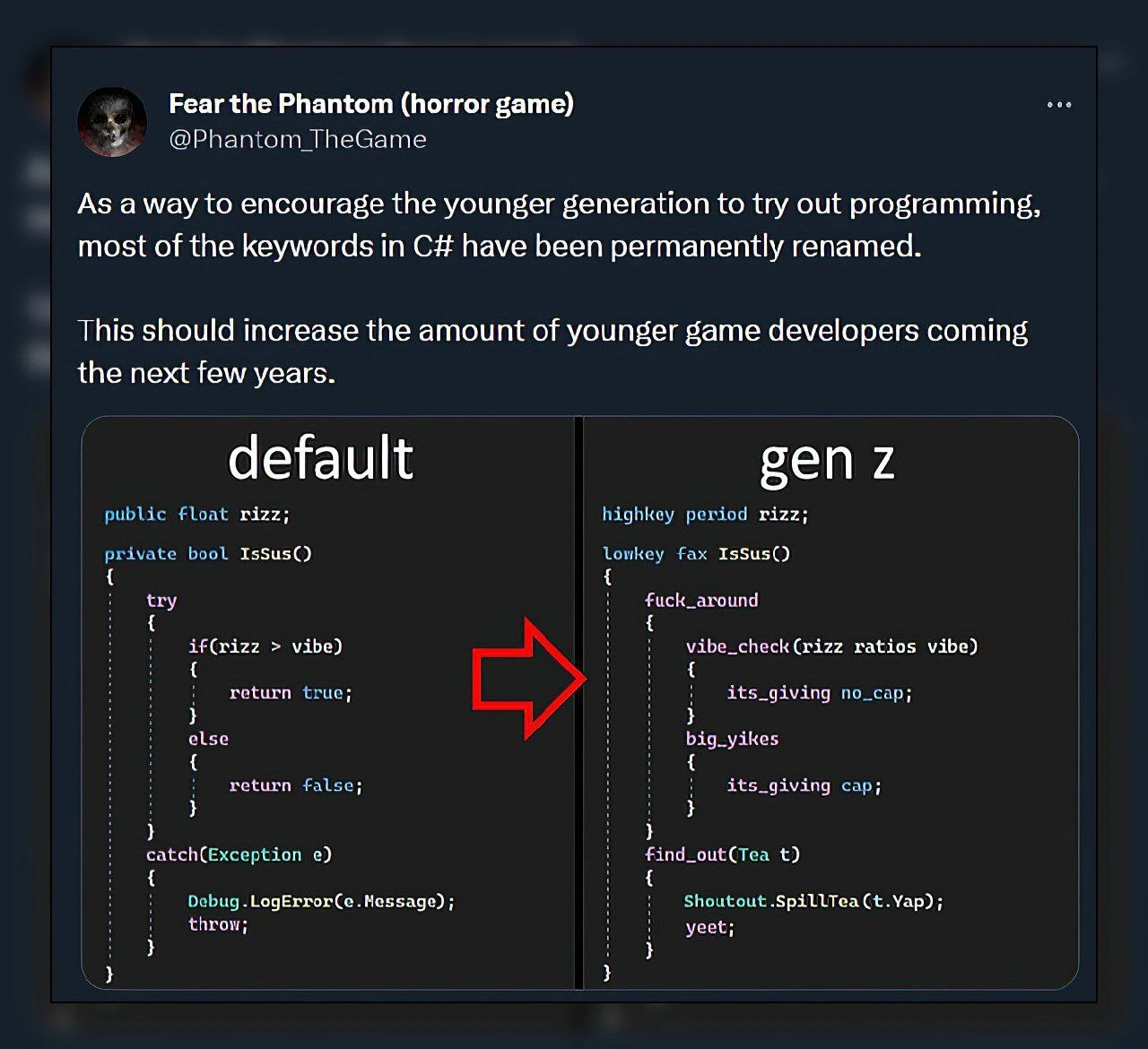
Let’s break down this meme in simpler technical terms. It’s showing a side-by-side comparison of normal C# code (on the left, labeled “default”) and a wacky “Gen Z” version of that code (on the right) where many of the C# keywords and identifiers have been replaced with Gen-Z slang terms. C# is an object-oriented programming language used widely in app and game development (notably with Unity for games). In C#, words like public, private, if, else, try, and catch are reserved keywords. These are special words that have a specific meaning in the language’s syntax. For example, if starts a conditional if-statement, and public is an access modifier that makes a variable or method accessible from other classes. You normally cannot change these keywords – they are part of the language’s fixed vocabulary. The meme humorously suggests renaming them to trendy slang to entice younger programmers. It’s a bit like imagining a version of C# where the language itself speaks in TikTok dialect!

On the left (“default”), the code is standard C# syntax:

  • public float rizz; – This declares a public floating-point variable named rizz. In real slang, “rizz” is a recent colloquial term meaning charisma or charm (popularized on social media), but here it’s just used as a funny variable name. The keyword public means any other class can see and use this rizz variable. The type float means it can hold a decimal number (floating-point precision).

  • private bool IsSus() { ... } – This declares a private method named IsSus that returns a boolean. “Sus” is slang for “suspicious” (from the game Among Us, widely known among Gen-Z). The keyword private means only this class can call the IsSus method. The return type bool (Boolean) means the function will return either true or false. So presumably, IsSus() will check something and tell us true/false – likely “is something suspicious?” given the naming.

Inside the IsSus() function on the left, the code is:

  • A try { ... } catch(Exception e) { ... } block. try/catch is how C# handles exceptions (errors). The code inside the try braces { } is attempted, and if anything goes wrong (an Exception is thrown), the flow jumps to the catch block to handle it. Here, inside try, we see an if/else:

    • if(rizz > vibe) { return true; } else return false;. This means: if the value of rizz is greater than vibe (we haven’t seen vibe defined here, but maybe it’s another float, perhaps a threshold or another variable in this class), then return true; otherwise (else) return false. In plain language, the function is saying “if rizz is higher than vibe, then it is sus (true), otherwise it’s not sus (false).” Exactly what “vibe” is in context isn’t clear – possibly just another numeric value to compare against. The key thing is the use of if/else to decide a boolean result.

    • In the catch(Exception e) part: if an exception occurred in the try block (for example, if vibe wasn’t set and accessing it causes a null reference, or some arithmetic issue), the code does Debug.LogError(e.Message); then throw;. This means it logs the error message (using something like Unity’s debugging logger to print the exception’s message to the console) and then rethrows the exception to propagate it up the chain. throw; by itself in C# rethrows the caught exception. So the error isn’t swallowed; it’s logged and then still allowed to bubble up.

Now, the right side (“gen z” panel) shows the exact same logic, but written with slang substitutes:

  • highkey period rizz; corresponds to public float rizz;. Here, highkey replaces public, and period replaces float. In Gen-Z lingo, saying something is “highkey” means it’s not hidden at all – it’s obvious or you really want everyone to know it, which is a playful match for the idea of a public member (clearly visible to all parts of a program). Period (often said as “periodt” in slang) is used for emphasis, like “end of discussion.” Why use it for float? Possibly because a float has a decimal point (which Americans call a “period”) – a bit of a pun! Or it’s just random sass; either way, period here is acting as the type. So highkey period rizz; means an openly visible decimal number named rizz – just said in a funny way.

  • lowkey fax IsSus() { ... } corresponds to private bool IsSus() { ... }. lowkey in slang means something you’re keeping on the down-low or not bragging about – a fitting analogy to a private method that is hidden from other classes. fax is a play on “facts.” In internet slang, saying “facts” (sometimes humorously spelled fax) means “truth” or “you’re right.” A Boolean (bool) is a truth value (true/false), so using “fax” for the bool type is a pun (True = that’s facts, False = cap i.e. not facts). So a “lowkey fax” is a hidden truth value – i.e. a private bool. The method name IsSus stays the same here.

Now inside the method, the structure mimics the try/catch but with slang:

  • fuck_around { ... } is used where try { ... } would be. This is referencing the meme phrase “fuck around and find out,” implying if you mess around (try something risky), you’ll discover consequences. It’s not something you’d say in polite company, but among Gen-Z (and internet humor generally) it’s a common phrase. Here, fuck_around is acting as the try block opener. It means “attempt this code, we’re gonna see what happens.” It’s pretty on-the-nose: in a try block you do stuff that could go wrong – essentially “mess around and see if we get away with it.” 😂

  • Correspondingly, find_out(Tea t) { ... } stands where a catch(Exception e) { ... } would be. “Find out” is the second half of that phrase – if you mess around (do something reckless), you’ll find out (deal with the results). They replaced Exception e with Tea t – this is layered slang. “Tea” in Gen-Z talk means gossip or the inside scoop (as in “spill the tea” which means “tell me the gossip”). By calling the exception “Tea”, they set up for a pun in the catch body. The parameter Tea t suggests that they’ve created a custom Exception class named Tea (since in C#, catch expects an Exception type). Likely it’s just for the joke – Tea representing the error info as some spicy gossip. t is the variable holding that error.

Inside these blocks:

  • In the try/fuck_around block: we see vibe_check(rizz ratios vibe) { ... } big_yikes { ... }. This is a stylized replacement for the if(rizz > vibe) { ... } else { ... }.

    • vibe_check(cond) is standing in for if(cond). In youth slang, doing a “vibe check” means checking the mood or authenticity of something – here it humorously means checking a condition. So vibe_check(rizz ratios vibe) is the if-condition rizz > vibe. They wrote ratios between rizz and vibe, which is interesting. On the internet, to “ratio” someone (verb) means your reply got more likes than the original post – basically you one-upped them, implying “X is greater than Y” in popularity. Using ratios as a fake operator is thematically consistent with Gen-Z lingo for comparison. So rizz ratios vibe conveys “rizz is greater than vibe” in a slangified way. It’s not actual syntax in any real language, but it fits the meme’s concept. After the condition, the { ... } following vibe_check(...) is the code to run if the condition is true.

    • big_yikes { ... } is what they put for the else { ... } part. “Big yikes” is a slang exclamation when something is very embarrassing or bad. If the vibe_check fails (meaning rizz is NOT greater than vibe), that scenario is a “yikes, that’s not good.” So they labeled the else-block as big_yikes to imply “uh-oh, the condition was false.” This is a humorous label for the fallback case.

    Inside the true-block braces { } after vibe_check(...): we see its_giving no_cap;. And inside the else-block after big_yikes: we see its_giving cap;.

    • The phrase “it’s giving [X]” is a trendy way of saying “it feels like [X]” or “it’s showing [X] vibes.” For example, “it’s giving chaotic energy” means “this is coming across as chaotic.” Here they’ve turned it into what looks like a statement. We can interpret its_giving as a stand-in for the return keyword because it’s producing a result. In context, its_giving no_cap; is used where return true; was in the original code, and its_giving cap; where return false; was.

    • no_cap in slang means “no lie” or “for real” – essentially true. cap means a lie or falsehood. When someone says “That’s cap,” they mean “That’s not true.” So using no_cap and cap here is a direct swap for the Boolean values true/false. So its_giving no_cap; translates to “it’s giving truth” i.e. return true, and its_giving cap; means “it’s giving false vibes” i.e. return false.

    So taken together, vibe_check(rizz ratios vibe) { its_giving no_cap; } big_yikes { its_giving cap; } exactly mirrors the logic of if(rizz > vibe) return true; else return false; just written with a flashy Gen-Z twist: “If we check the vibe between rizz and vibe: it’s giving no cap (true). Otherwise, big yikes: it’s giving cap (false).” It’s a perfect example of SyntaxHumor – the structure is intact, but the words are all swapped for quirky ones.

  • Now in the catch/find_out block: we have Shoutout.SpillTea(t.Yap); yeet; corresponding to Debug.LogError(e.Message); throw;.

    • They invented a class or namespace called Shoutout with a method SpillTea(). This clearly parallels Debug.LogError(). In a modern online context, giving someone a “shoutout” means publicly calling attention to them (like “shoutout to my friend for helping”). Here, Shoutout.SpillTea(t.Yap) plays on that idea: it’s like a dramatized way to say “announce the error.” Spill the tea means to divulge gossip or secret information. An error message is definitely some information about what went wrong. So SpillTea(t.Yap) presumably logs or prints the error details. Why t.Yap? Possibly they replaced the Exception’s Message property with a made-up Yap property on Tea. Yap as a noun can mean “mouth” or as a verb “to yap” means to talk – so t.Yap humorously stands for the error’s message (what the error “said”). It’s a bit of a stretch, but once you see the pattern (Exception->Tea, Message->Yap), it clicks. This is them continuing the gossip metaphor: the error’s message is the “tea” to be spilled.

    • Finally, yeet; corresponds to throw;. “Yeet” is popular slang meaning to vigorously throw or chuck something. If you “yeet” an object, you throw it far away with enthusiasm. It became an Internet meme and a part of youth vernacular. Using yeet to mean re-throwing the exception is just chef’s kiss perfect slang substitution. It’s exactly what a catch block’s throw; does: it throws the error onwards (maybe up to a higher-level handler). So after logging the error, the code does yeet; – rethrow that error and let someone else catch it, essentially.

Putting it all together, the Gen-Z version code in plain English would read something like:

“We got a high-key decimal called rizz. Check if it’s sus: we’ll fuck around (try) doing a vibe check on rizz versus vibe. If rizz ratios vibe, it’s giving no cap (return true). Otherwise, big yikes, it’s giving cap (return false). If something went wrong, we’ll find out with Tea t (catch the exception), spill the tea of t.Yap (log the error message), and yeet (rethrow the error).”

It’s one-to-one the same logic as the left, only coated in Zoomer-speak. The humor is that none of these slang terms are actual C# syntax. If you tried to compile this “Gen Z” code, the compiler would choke on the first word highkey not knowing what it means. This underscores how rigid programming languages are about syntax – unlike natural language, you can’t just substitute words freely. LanguageQuirks aren’t usually this flamboyant in real life!

To clarify the translation between Gen-Z slang code and real C# keywords, here’s a quick reference table of the slang substitutions used:

Gen Z Slang Real C# Keyword/Concept Explanation
highkey public (access modifier) Highkey = openly, for everyone (public visibility)
lowkey private (access modifier) Lowkey = on the down-low (hidden in class)
period float (data type) Period = . (decimal point slang, means a float number here)
fax bool (data type) “Fax” (facts) = boolean truth value (true/false)
fuck_around { ... } try { ... } block “Fuck around” = attempt something risky (try some code)
find_out(Tea t) { ... } catch(Exception e) { ... } block “Find out” = handle the consequences (catch errors), Tea = Exception (error info)
vibe_check(cond) if (cond) “Vibe check” = check a condition (if statement)
ratios > (greater-than operator) “ratios” = is greater than (social media “ratio”)
big_yikes { ... } else { ... } block “Big yikes” = otherwise, that’s bad (else case)
its_giving no_cap; return true; “It’s giving no cap” = return truth (no lie)
its_giving cap; return false; “It’s giving cap” = return falsehood (lie)
Shoutout.SpillTea(t.Yap) Debug.LogError(e.Message) “Spill the tea” = log or reveal the error message
yeet; throw; (rethrow exception) “Yeet” = throw it out (propagate error upward)

As you can see, each slang term has a real programming counterpart. It’s a fun exercise in LanguageQuirks and creativity, effectively creating a mini syntax legend for an imaginary “Gen-Z mode” of C#. This is pure CodingHumor – in reality, no serious language is going to rename core keywords to slang. But the meme exaggerates this idea to make us laugh. Part of why developers find this meme funny is that we do sometimes name things in code with silly nicknames or inside jokes, but we keep the actual language keywords the same. We might call a variable sus or have a function CheckVibes() in jest, but if will always be if. Seeing a tried-and-true keyword like throw turned into yeet is just delightfully absurd.

For a junior developer or someone learning: it’s important to know that keywords are fixed and essential. You can name your own variables or functions with creative names (within the language’s naming rules), but words like if, for, while, class, public are off-limits – they have a special purpose. This meme’s scenario is like a fantasy or parody where an official change was made at the language level (which would be extremely disruptive if real). It highlights how crucial and ingrained the normal keywords are. If you ever see code like the right side, it’s either a joke or maybe a custom preprocessor at play. The meme is a good reminder that while we can joke about syntax, consistency and clarity usually win in software engineering. The code’s maintainers in 5 years might not be up on the latest slang, so it’s best not to actually start writing production code with trendy lingo. 😉 Stick to the defaults (no matter how sus they may seem), and save the GenerationalHumor for comments or chat with your fellow devs.

Level 3: Hype-Driven Syntax

At a senior developer level, this meme is hilarious because it satirizes the idea of chasing trends (vibe_check, no_cap) at the expense of sanity and maintainability. We’ve all seen technology fads and misguided attempts to make coding “cool” to newbies – often dubbed “hype-driven development.” Here, the joke is that someone high up decided the only thing stopping Gen-Z from coding in C# is that the keywords aren’t vibey enough. Spoiler: renaming try to fuck_around likely won’t create a surge of 19-year-old game dev prodigies, but it will create a surge of confused senior devs doing double takes in code review. This is prime DeveloperHumor because it takes a grain of truth (the industry does want to attract new talent) and pushes it to a ridiculous extreme (changing core language syntax as bait). The result is both absurd and too real as a commentary on how out-of-touch some ideas for developer outreach can be.

Why it’s funny: Imagine being a seasoned C# programmer and suddenly reading code that says yeet; in the exception handling. It’s jolting and comical – a collision of two worlds. C# is known for being a fairly conservative, enterprise-ready language. Seeing Gen Z slang in code is like hearing a CEO unironically say “that report was lowkey sus, fam.” It triggers that cringe humor response. There’s a famous meme of Steve Buscemi dressed as a teenager saying, “How do you do, fellow kids?” This code is the programming equivalent – C# trying to dress up in TikTok vernacular to appeal to “the youths.” Seasoned devs find it funny because we recognize the scenario: an attempt at GenerationalHumor that overshoots into silliness. It pokes fun at the eternal gap between young up-and-coming developers and the established conventions (the programming equivalent of “get off my lawn” vs “ok boomer” dynamics, if you will).

From an architectural perspective, the meme underscores a key principle: developer experience is about more than trendy labels. Renaming if to vibe_check doesn’t improve clarity or reduce cognitive load—in fact, it does the opposite. Senior devs have fought hard for clean, self-explanatory code. We use meaningful variable names, add comments, and write documentation to make codebases accessible to newcomers. But we also rely on a common baseline: the language’s keywords and syntax are a given, a stable background vocabulary everyone learns. If every codebase (or every generation of devs) had its own slang for fundamentals, onboarding new team members would be a nightmare. It’s already challenging enough learning a framework’s quirks; imagine also learning that in this project, yeet means throw and big_yikes is how we do else-clauses. Maintaining code over time would be like trying to read old chat logs full of dated slang – “What did ‘no cap’ mean again back in the 2020s?” 😅. The humor has an edge of truth: we’ve all seen code that’s hard to understand because someone was too clever or informal with naming. This meme just cranks that to 11 by making even the syntax an inside joke.

There’s also commentary here about how organizations try to tackle recruitment or education. The tweet hints at “encouraging the younger generation to try programming” by superficial means. Senior folks know that to really engage new developers, you need good teaching, approachable libraries, maybe creative tools – not hacked-up syntax. It’s reminiscent of times when management focuses on appearances rather than substance. (Think of a company rebranding an old product with neon colors and slang to appeal to kids, instead of actually improving it.) The DevCommunities online often joke about such corporate antics: this meme could be seen as roasting the idea of a tech company doing a PR-driven language fork. We find it funny because we can picture the backlash: veteran devs would be up in arms about breaking changes, while the targeted “youth” might actually feel talked down to. Gen-Z devs likely already think current C# is fine; they’d probably roll their eyes at a cringey pandering move like this. In fact, humorously, a truly zoomer-filled codebase might organically use slang in comments or variable names for fun, but they wouldn’t expect the language itself to change. There’s a big difference between communal jargon and official syntax.

On the practical side, a senior dev knows the importance of consistency. We’ve dealt with messy merges and legacy code; the last thing we need is half the team writing try/catch and the other half writing fuck_around/find_out. 😂 The meme’s code sample is a nightmare scenario for a merge request: “Could you change your code to not use yeet? Our coding standards require throw for exceptions.” Even code linters or style analyzers would have to be re-taught what is a keyword. And consider tooling: your IDE’s IntelliSense, syntax highlighting, error messages – all would need updates. It’s an entire tooling ecosystem disruption for the sake of chasing slang. That’s why this is such juicy CodingHumor: it highlights how utterly disproportionate the solution is to the problem. It’s a sardonic reminder that making programming more accessible is great, but there are smart ways (better documentation, interactive tutorials, mentoring) and then there’s… whatever this is, a periodt pun intended.

Finally, from a cultural angle, the joke showcases LanguageQuirks and the untranslatable nature of slang. Slang by definition is constantly evolving. By the time you implemented “Gen Z C#,” Gen Alpha would be laughing at how old-fashioned it is. In technology and in slang, nothing ages faster than yesterday’s cool. Seasoned developers have seen APIs, fads, and even languages come and go; we know stable foundations matter more than flash. So we laugh, and perhaps breathe a sigh of relief that this is just a meme. To quote the meme’s own spirit: if anyone seriously tried this idea, the community would “find out” real quick that when it comes to core language design, it’s giving bad idea – no cap.

Level 4: Reserved Words Rave

At the deepest technical level, this meme imagines a wild rewrite of C#’s grammar, swapping its reserved keywords with Gen-Z slang. In real-world compiler terms, keywords like public, if, or try are part of the language’s context-free grammar – hard-coded tokens that the parser recognizes to structure code. Changing them isn’t just a search-and-replace; it means altering the language specification and compiler implementation. The C# compiler’s lexer would need to identify new tokens like vibe_check or yeet and treat them as it treats if or throw. This is a massive undertaking: every existing codebase, tutorial, and API in the C# ecosystem assumes the standard keywords. Renaming public to highkey system-wide would break backward compatibility on a catastrophic scale – millions of lines of code across the world would no longer compile. It’s one reason programming languages evolve very cautiously. For instance, when new keywords are introduced (like async in C# or yield in other languages), they’re chosen carefully to avoid clashing with existing identifiers, and even then it’s a big deal. Whole committees discuss these changes to ensure good DeveloperExperience (DX) and minimal disruption.

What’s proposed in the joke tweet – “permanently renaming most of the keywords in C#” – is essentially creating a dialect or entirely new language on top of C#. It’s like a domain-specific language (DSL) targeting Gen-Z culture. Technically, one could implement a source-to-source transpiler that takes code with slang (highkey, vibe_check, etc.) and converts it into standard C# before compilation. In fact, the concept isn’t unheard of: there are esoteric joke languages like LOLCODE (which uses meme-speak for keywords) and ArnoldC (which uses Arnold Schwarzenegger movie quotes for control flow – e.g., "GET TO THE CHOPPER" for if). Those languages are built by mapping funny syntax to real operations under the hood. Similarly, you could imagine a preprocessor that maps its_giving no_cap; to return true; or fuck_around { ... } find_out(Exception e) { ... } to a normal try-catch. But crucially, those are novelty languages created for fun, not changes to an existing industrial language. A mainstream language like C# values stable syntax because that predictability is what allows large teams and DevCommunities to collaborate. Code is a communication medium not just to computers but between developers; everyone has to speak the same “language.” Introducing slang into syntax would fragment that shared understanding.

There’s also the matter of parser ambiguity and rules. C#’s grammar defines ifelse blocks in a very specific way. To use vibe_check and big_yikes instead, the grammar productions would need to accept those literally. For example, an if-statement rule might become:

if-statement ::= "if" "(" condition ")" statement ["else" statement]  
              | "vibe_check" "(" condition ")" statement ["big_yikes" statement]

Doubling the grammar like this bloats the language and every tool that works with it (IDEs, syntax highlighters, analyzers) would need updates. And what about the symbol ratios replacing >? That suggests allowing an identifier in place of an operator, which is grammatically funky. Likely, they intend ratios to be a new keyword-operator meaning “greater than,” but normally comparison operators are punctuation, not alphabetic tokens, in C-style languages. It’s a lexical oddball – the compiler would now have to treat a word as an operator. This could conflict with using ratios as a variable name elsewhere. In fact, every new slang keyword might collide with existing identifiers. (If some game code already has a method called vibe_check for checking player mood, suddenly that becomes a reserved word – big yikes indeed!) Managing such collisions and the overall language design gets extremely complex for zero real gain in capability.

From a language evolution standpoint, this is a tongue-in-cheek parody. Serious evolution focuses on adding features (like generics, LINQ, async/await in C#) or possibly deprecating outdated ones over many years – never wholesale renaming. The meme exaggerates a hypothetical where decision-makers prioritize trendiness over technical sanity. It’s basically a hype-driven development nightmare scenario. The humor is that any experienced compiler developer or language architect would find this idea absurd to the point of cackling: it violates the core principles of language stability and backward compatibility. The meme tickles us with an impossible remix of C#’s syntax – a “what-if” that’s equal parts hilarious and horrifying to language purists. It underscores why programming languages stick to plain, predictable keywords: because code must be precise and timeless, not trendy and ephemeral. In short, the compiler doesn’t do vibe checks – it strictly parses tokens, and replacing throw with yeet would quite literally throw the compiler for a loop.

Description

This image is a screenshot of a tweet from an account named 'Fear the Phantom (horror game)' with the handle @Phantom_TheGame. The tweet humorously suggests that C# keywords have been permanently renamed to Gen Z slang to encourage young people to get into programming. Below the tweet text, there is a two-panel image comparing 'default' C# code with a 'gen z' version. The 'default' code shows a simple try-catch block with variables like 'rizz' and a method 'IsSus'. The 'gen z' panel translates this code into slang: 'public' becomes 'highkey', 'private' becomes 'lowkey', 'try' becomes 'fuck_around', 'catch' becomes 'find_out', 'if' is 'vibe_check', 'return true' is 'its_giving no_cap', and 'throw' is 'yeet'. The technical joke satirizes the often-cringeworthy corporate attempts to be 'relatable' by mapping the precise, logical syntax of a programming language to the fluid and context-dependent nature of internet slang. For experienced developers, the humor lies in the sheer absurdity of such a concept and the hilarious (yet sometimes surprisingly fitting) mapping of slang to programming concepts, like 'fuck_around' and 'find_out' for a try-catch block
Comments

30
Anonymous ★ Top Pick The original C# has `try`/`catch`. The Gen Z version has `fuck_around`/`find_out`. Honestly, it's a more accurate description of my entire debugging process
  1. Anonymous ★ Top Pick

    The original C# has `try`/`catch`. The Gen Z version has `fuck_around`/`find_out`. Honestly, it's a more accurate description of my entire debugging process

  2. Anonymous

    Amazing - now the style guide needs a section on whether `yeet;` should end with a semicolon or just throw the entire stack trace across the room

  3. Anonymous

    After 20 years of explaining to stakeholders why 'throw' doesn't mean we're giving up on the project, we finally have 'yeet' - which perfectly captures both the technical action and the emotional state of exception handling in production

  4. Anonymous

    Ah yes, the classic 'fuck_around' and 'find_out' exception handling pattern - finally, a language design that accurately captures the developer experience of production debugging at 3 AM. Though I suspect the real reason Gen Z would adopt this is that 'its_giving_no_cap' is actually more semantically clear than the cognitive dissonance of 'true' returning false in your flaky integration tests

  5. Anonymous

    The real horror: refactoring a microservices monolith where 'vibe_check' replaced try-catch, and outages spill more tea than logs

  6. Anonymous

    Alias 'throw' to 'yeet' and you’ve formally proven your exception handling is fire-and-forget

  7. Anonymous

    Rename “throw” to “yeet” and you’ve turned exception handling into physics - watch SAST, codegen, and every grep script fail the vibe_check while future maintainers go full big_yikes

  8. @M4lenov 2y

    slaps fr

    1. @Sael03 2y

      Tru

  9. @LainIwakura84 2y

    Russian c++.

    1. @NiKryukov 2y

      as the legend says, no one lizard can understand this code

    2. @Nefrace 2y

      I don't know why but "воздать ноль" sounds so funny to me...

    3. @AlexKart20129 2y

      *old_russian

      1. @sylfn 2y

        *legacy

        1. @pnlt_s 2y

          *ancient

  10. @Supuhstar 2y

    https://fxtwitter.com/Phantom_TheGame/status/1746123320204947871?s=20

  11. @Araalith 2y

    Perl did it 20y ago. new - bless exit - die break - last continue - next public - our / local private - my throw exception - confess

    1. @callofvoid0 2y

      communist Array<Item> ItemFactory(Resource res){ Array<Item> items= bless Array<Item>(); while(res != null){ items.add(worker.produce()); } spit items; } capitalist void purchase(Item item){ this.cart.add(item); }

      1. @callofvoid0 2y

        this is not Perl just what I felt like in the moment

    2. @CcxCZ 2y

      You've seen modern slang, now get ready for https://metacpan.org/dist/Lingua-Romana-Perligata/view/lib/Lingua/Romana/Perligata.pm

      1. @Araalith 2y

        SPQR!

  12. @qtsmolcat 2y

    Who took a screenshot of my code

    1. @callofvoid0 2y

      the agent who also has seen your dickpic

      1. @GodAmirF 2y

        ممد در حال تلاش برای گرفتن پریمیوم جدید😂😂😂

        1. @purplesyringa 2y

          please use english in this chat

          1. @GodAmirF 2y

            Ok , im sorry

        2. @callofvoid0 2y

          nope

      2. @qtsmolcat 2y

        Good thing I don't have one then

  13. @frayxrulez 2y

    Basically Swift...

  14. @Saeid025 2y

    Lemme delete the evidence real fast and post some new evidence

Use J and K for navigation