Skip to content
DevMeme
5311 of 7435
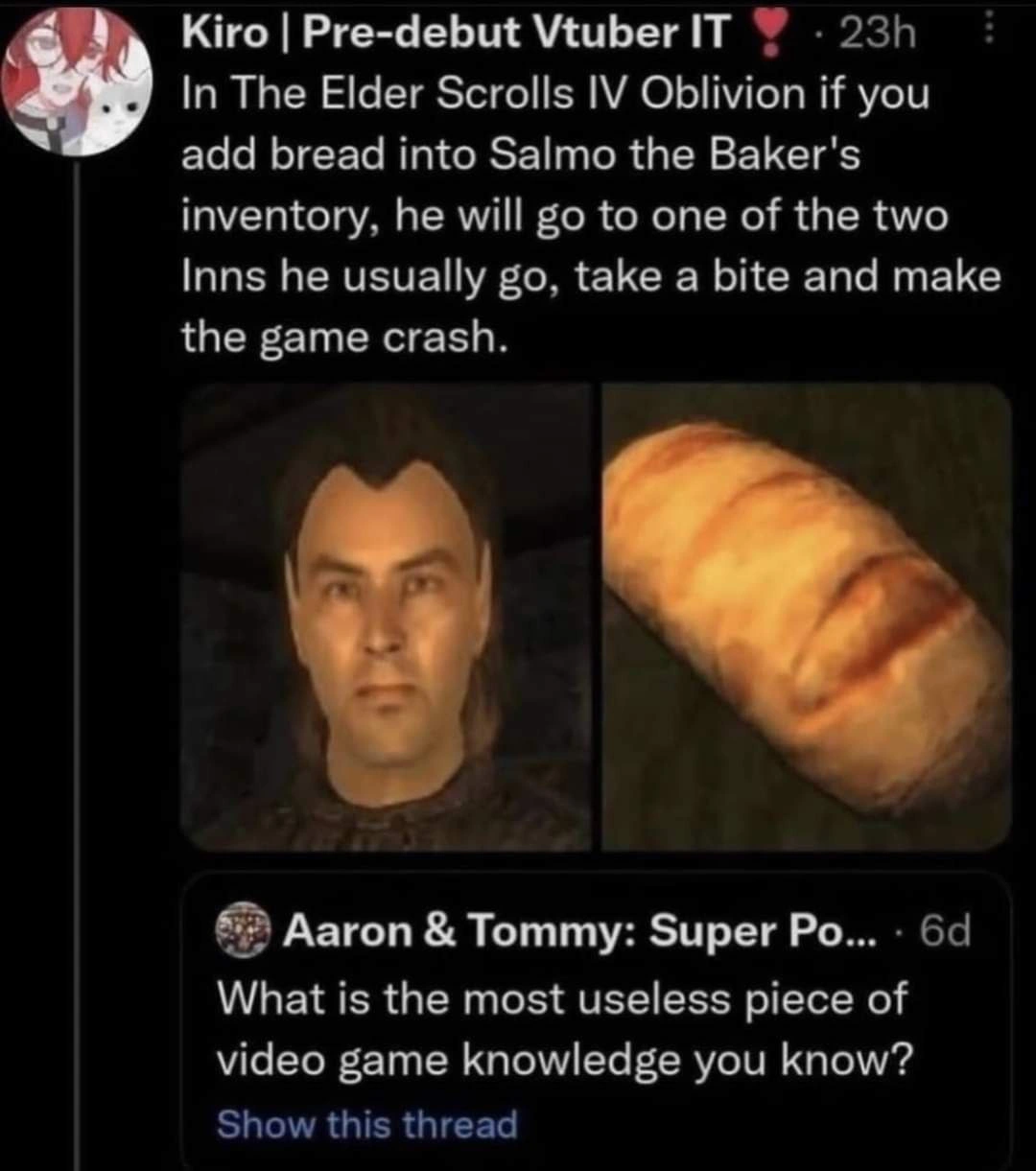
Obscure Game Bug Trivia Crashes Oblivion
Bugs Post #5827, on Jan 17, 2024 in TG

Obscure Game Bug Trivia Crashes Oblivion

Why is this Bugs meme funny?

Level 1: The Bread That Broke the Game

Imagine you’re playing with a huge toy world where little people go about their day. There’s one friendly baker man who normally bakes bread and walks to nearby pretend hotels (inns) to deliver his bread or maybe eat a meal. Now, think of a silly trick: you secretly slip an extra loaf of bread into the baker’s pocket when he isn’t looking. Suddenly, this one sneaky addition confuses the toy world so much that everything stops working! It’s like the entire game says, “😵 I don’t know what to do now,” and just falls apart. The baker heads to the hotel, takes a bite of that surprise bread, and – poof – the game crashes (which is like the game just freezes or closes itself). It’s funny in the same way a magic trick can be funny when it goes wrong: doing something small and unexpected (like giving the baker a loaf he wasn’t supposed to have) causes a big, goofy disaster. People laugh about it because who would think a piece of bread could break a whole video game? It’s a crazy little secret about the game that doesn’t help you win or anything, but it’s so surprising and odd that it’s fun to tell others – a true silly trivia of the gaming world.

Level 2: Fatal Snack Exception

Let’s break down what’s going on in simpler terms. In Oblivion (a popular open-world fantasy game), you have characters called NPCs (Non-Player Characters) who live in the game world and follow schedules. Salmo the Baker is one of those characters – basically a virtual baker in a town. He normally does bakery-related things in the game, possibly delivering bread to inns or selling pastries. Now, the meme describes a bug: if the player somehow adds a loaf of bread to Salmo’s inventory (meaning you give the baker an extra bread item that he wasn’t originally carrying), something very unexpected happens. Salmo will decide “Oh, I have bread now! Time to go to my favorite inn and have a bite.” He then walks to one of the two inns he usually visits and tries to take a bite of the bread. Up to this point, it sounds like a cute realistic detail – NPCs can eat food they have. But then boom! the game crashes completely. By crash, we mean the game stops running abruptly – you might get kicked out to the desktop or see an error message. It’s not a subtle glitch like a graphic bug; it’s the program outright failing.

Why would a mere loaf of bread break a whole game? This happens because of a bug in the game’s code – specifically an edge case the developers didn’t foresee. An “edge case” is a situation that is unusual and not typically encountered during normal play or testing. Here, giving bread to Salmo is something players normally can’t do unless they use cheats or mods (Oblivion has a developer console where testers or savvy players can enter commands to add items to inventories, etc.). So the developers never really designed or tested what happens if Salmo the Baker suddenly has bread in his pocket out of the blue. The result is that when Salmo’s AI (the game’s artificial intelligence routine for characters) sees the bread and tries to execute the “eat bread at inn” behavior, something goes wrong in the code. Perhaps the game tries to play an eating animation that doesn’t exist for him, or it attempts to access some data about that bread item that wasn’t set up properly. In programming, if the game code tries to use something that isn’t there or is not initialized, it can cause a serious error – often called a null reference or a null pointer error (basically the game is looking for an object or data that isn’t present, like reaching into an empty box). When that happens, the program doesn’t know what to do, and it crashes to avoid doing more damage or because it hits a fatal exception it can’t recover from. This specific crash is fully deterministic, meaning it will happen every single time you repeat those steps, because the bug is consistently triggered by that sequence (bread added → Salmo eats → game fails).

For a junior developer or someone new to GameDevelopment, a few key things stand out: First, games have a lot of interconnected systems (AI, inventory, animations, scripting). Bugs often occur at the seams between these systems. Here, the inventory system (where items live) interacts with the AI system (NPC decides to perform an action because of an item) and possibly the animation or scripting system (NPC tries to play an eat animation or complete a scripted event). If one of these systems isn’t expecting a certain state (like that bread being there), it might not handle it properly. That’s what we call brittle code – it works in expected scenarios but breaks easily with any surprise. Robust code would check “Hmm, does Salmo actually have an eating behavior defined? If not, maybe skip that action.” but it seems this check was missing or flawed. The result is the infamous bread-triggered crash.

Secondly, this highlights the importance of testing edge cases and also the reality that not every weird scenario can be tested. Game developers usually test what ordinary players will experience. It’s unlikely a normal player would somehow give an NPC like Salmo extra bread (since the game doesn’t provide a straightforward way to do that). Thus, this bug slipped through. When it was eventually discovered (possibly by a curious player or modder), it became a piece of GamingCulture trivia – one of those “Did you know?” anecdotes people share for fun. It doesn’t ruin the average player’s experience (unless they actively try to do it), so it probably never got patched. But it’s fascinating because it shows how fragile things can be behind the scenes. Even professional software can have these hidden glitches where one odd action causes a meltdown. For game developers and debuggers, hearing about a “bread causing a crash” is both funny and educational: funny because it’s so odd, educational because it reminds us that debugging/troubleshooting often involves thinking, “What weird thing could be happening here?”

To put it another way, the Salmo bread bug is like a small treasure in the world of programming stories. It teaches that when creating complex systems (like a huge open-world game), you have to account for lots of interactions. Miss one, and you get a bug that’s useless but entertaining. It’s also a good reminder to us developers: always consider those edge cases (even the goofy ones), because users (or mischievous players) will eventually stumble upon them!

Level 3: Bread-to-Crash Pipeline

This meme spotlights an edge-case bug in game development where a harmless loaf of bread becomes a digital wrecking ball. In The Elder Scrolls IV: Oblivion, there's an NPC (non-player character) named Salmo the Baker. Normally, Salmo goes about his routine visiting two local inns, likely part of a scripted daily schedule (perhaps delivering bread or grabbing a meal). The tweet claims that if a player artificially adds bread into Salmo's inventory (for example, via a console command or mod), it triggers a bizarre chain reaction: Salmo dutifully travels to one of his usual inns, takes a bite of the bread... and the game crashes. This absurd sequence is funny to experienced devs because it reveals how a seemingly trivial state change can expose brittle scripting and asset pipelines lurking under the hood. The NPC’s AI is deterministic here – given the bread, he will follow a certain script – but that script leads straight into a crash, every time. It’s a gloriously useless piece of bug trivia, emblematic of the unpredictable BugsInSoftware we’ve all seen in complex systems.

From a senior developer perspective, the humor comes with a side of PTSD: it’s a perfect example of an UnusualBugs scenario where some unplanned combination of state triggers a code path nobody anticipated (or tested). This bread-induced crash hints at a CrashReporting nightmare – likely a null pointer dereference or an unhandled exception deep in the game’s engine. Maybe the AI routine calls a function to perform an eating animation or update a quest state that isn’t normally executed for Salmo. If that function expects certain assets or data (like an NPC-specific “eating bread” animation or a valid reference to a food item in a list) that weren’t set up, it might result in an invalid memory access. In a C++ heavy codebase like Oblivion’s Gamebryo engine, an invalid pointer or missing object typically means a segmentation fault – poof, game crash to desktop. The pipeline from adding the bread (data) → NPC AI decision → animation/behavior code → engine core is so brittle that a single unexpected input collapses the whole thing. We’re essentially seeing a minor flaw in the game’s AI behavior scripting or data setup manifest as a 100% reproducible crash.

What makes this meme-worthy is that it’s hilariously specific and entirely real to those of us in GameDevelopment. It highlights how even AAA games can harbor insanely niche bugs: the world simulation is rich enough that one extra loaf in an NPC’s pocket blows it up. Seasoned devs laugh (and wince) because we’ve been there – one innocuous change causing a cascade of failures. It’s the same energy as the classic “but it worked on my machine” or one-line fix that breaks prod. In game dev, NPCs often operate via schedules and item-driven AI packages. Salmo probably has code like if NPC "Salmo" has bread, then go to Inn, play eat animation. That code path clearly wasn’t tested or fully implemented, since Salmo doesn’t normally spawn with bread in his inventory. The result? The moment he tries to carry out his bread-eating subroutine, the game tries to execute an action that wasn’t set up correctly (like attaching a bread object to his mouth or deducting an inventory item that doesn't properly exist) – and kaboom. In more technical terms, a pointer that should point to a bread object or an AI task is likely null or garbage, and the act of dereferencing it triggers an instant crash. A senior dev immediately recognizes this pattern of bug: an edge case slipped through where data and code didn’t align, indicative of a brittle system. The fact that this bug is deterministic (not random) makes it classic Debugging_Troubleshooting lore – it’s not a Heisenbug; it’s a guaranteed bomb if you know the steps, which is equal parts scary and comical.

There’s an underlying commentary on GamingCulture and QA here as well. Why would anyone even try putting bread in Salmo’s inventory? Because gamers love pushing systems to their limits, and developers can’t foresee every crazy thing a player might do (especially in open-world RPGs known for freedom). Bethesda’s games have a reputation for being both marvelously deep and notoriously glitchy. This Oblivion bread crash sits right alongside other legendary quirks (like the giant rat causing a negative skill glitch, or Skyrim’s infamous flying cheese wheels) that testers either missed or deemed too minor to delay shipping. In a professional context, triaging a bug like this would be low priority (“edge case involving external item injection into NPC inventory causes crash” is the kind of bug report that might get closed as WONTFIX if it requires cheat commands to even occur). The meme’s phrasing (“gloriously useless knowledge”) pokes fun at this – it’s a piece of trivial info that won’t help you play the game better, but it’s delightful to know and share. Experienced devs nod in amusement because it underscores how complex and fragile large software systems are. Even the most polished games hide Jenga towers of code – remove or add one tiny block (or loaf) and the whole tower tumbles. It’s a humorous reminder that in software, no bug is too small to exist. And for the cynical veteran coders: of course the crash involves bread and a baker – a true “roll”-out failure, if you will. We laugh, appreciate not having to debug that one, and carry on with our own bug hunts.

Description

A screenshot of a Twitter thread. The top tweet, by user "Kiro | Pre-debut Vtuber IT", responds to a question from "Aaron & Tommy: Super Po..." which asks, "What is the most useless piece of video game knowledge you know?". Kiro's answer details a hyper-specific bug in the game "The Elder Scrolls IV: Oblivion," stating that if a player adds bread to the inventory of an NPC named Salmo the Baker, he will attempt to eat it at an inn, causing the game to crash. The tweet is illustrated with two in-game images: a close-up of the character Salmo's face and a 3D model of a loaf of bread. This meme appeals to developers by highlighting the absurdly specific and often hilarious nature of software bugs, especially in complex systems like open-world games. It's a perfect example of an edge case that likely slipped through QA, resonating with anyone who has ever discovered or caused a bizarre, unreproducible bug
Comments

13
Anonymous ★ Top Pick This is why QA needs a 'chaotic evil' test suite: `assertNotCrashes(npc, BREAD_OF_DOOM)`. Some bugs aren't found, they're achieved
  1. Anonymous ★ Top Pick

    This is why QA needs a 'chaotic evil' test suite: `assertNotCrashes(npc, BREAD_OF_DOOM)`. Some bugs aren't found, they're achieved

  2. Anonymous

    Slip one loaf into Salmo’s inventory, the AI calls take_bite(), derefs a null crumb pointer, and the whole engine faceplants - the Tamriel equivalent of adding a new enum value without updating the switch

  3. Anonymous

    This is the gaming equivalent of discovering that adding a semicolon to line 4,827 of your legacy codebase causes the entire authentication system to interpret all passwords as 'admin123' - completely inexplicable, utterly reproducible, and the kind of edge case that makes you question whether deterministic computing is just an elaborate lie we tell ourselves

  4. Anonymous

    This is the software equivalent of discovering that your distributed system crashes when a specific user named 'Salmo' receives a message containing the word 'bread' - perfectly reproducible, completely absurd, and somehow makes it to production. It's a beautiful reminder that no matter how sophisticated your state machine, there's always that one edge case where giving an NPC carbs triggers a segfault. The real question is: how many sprints would it take your team to prioritize fixing a bug that requires players to deliberately sabotage a baker's diet?

  5. Anonymous

    Insert(bread) -> pathfindTo(inn) -> bite() -> nullptr; the only pipeline where a missing crumb brings down the whole stack

  6. Anonymous

    Turns out “give NPC bread” is an end‑to‑end fuzz test - consumption reenters the AI while it iterates inventory, invalidates the iterator, and Oblivion eats a null pointer for dessert

  7. Anonymous

    Infinite bread exploit meets unhandled NPC bite: Oblivion's elegant stack overflow via crumbs

  8. @vladyslav_google 2y

    Oblivion is an eternal game

  9. @Nemur0 2y

    No one said it's great, but it's forever in our hearts (for many reasons)

  10. @Nemur0 2y

    A good one, actually (but I'm in an annoying fan mode)

  11. @idkwtfits 2y

    That's still so weird to me, honestly. Like, why, don't NPC's eat bread all the time? Why does this specific instance crash the game?

    1. @callofvoid0 2y

      you shouldn't give the baker a piece of bread

  12. @Elapovkirill 2y

    Не's a He's a gluten intolerant.

Use J and K for navigation