C#'s Identity Crisis: Enterprise Darling or Just 'Microsoft Java'?
Why is this Languages meme funny?
Level 1: Being Microsoft Java
Think of it like this: imagine there’s a famous toy building block set (like LEGO) that everyone loves and uses. It’s great for building big castles and also great for teaching kids how to build things step by step. Now imagine a big company, say Microsoft, makes its own version of those building blocks. Their blocks are a lot like the original LEGO – they fit together similarly and you can build the same kinds of castles. Microsoft’s version is also used in lots of big schools and projects, and they’re very proud of it.
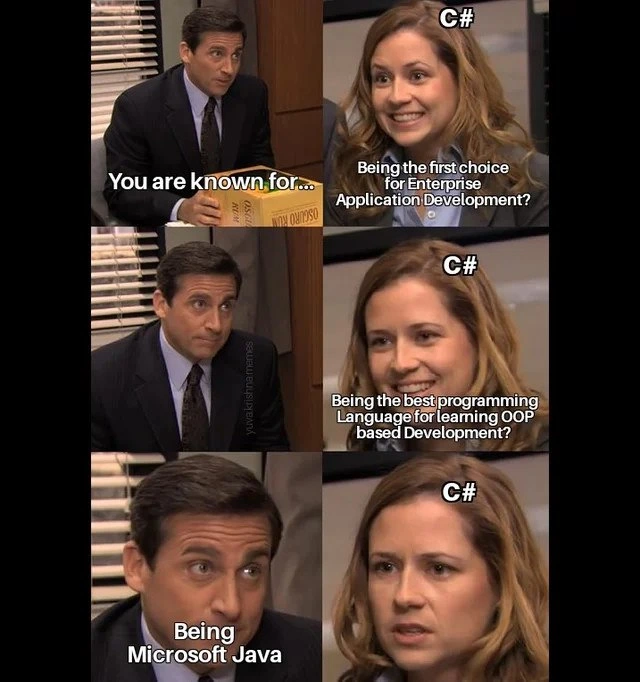
In the meme, Microsoft’s block set (that’s C#) says, “People know me for being the number one choice to build huge castles for companies (enterprise apps), and for being the best set to teach kids how to build things properly (learning OOP)!” These are like the big bragging rights for Microsoft’s blocks.
But then, a person listening just responds, “You are known for… being Microsoft’s LEGO.” 😏 In other words, no matter what cool stuff Microsoft’s blocks can do, folks joke that it’s basically the same as the original LEGO, just with Microsoft’s name on it.
This is funny because it’s a classic “copycat” joke. C# is the programming language made by Microsoft, and Java is an older programming language that was already super popular. C# did a lot of things similarly to Java. It’s as if Microsoft saw Java (the original toy) and said, “Hey, we want one like that too!” So even though C# has its own special pieces and some improved designs, people playfully tease it by saying “You’re just Microsoft’s version of Java.”
The meme uses characters from a comedy show to act this out, making it easy to understand. The emotional core of the joke is the feeling of being seen as an imitator. Imagine you worked really hard to be good at something, but then someone says, “Eh, you’re just doing the same thing as that other person.” It’s a bit teasing, right? Here it’s done in a lighthearted way. So if C# were a person, in this meme she’d be smiling proudly about her talents, and then suddenly looking shocked or annoyed when someone calls her out as “Microsoft Java.” It’s like telling a kid who’s proud of their new drawing that it looks just like a tracing of someone else’s drawing – a playful jab.
In simple terms: C# and Java are like two very similar superheroes from different companies. C# wants to be seen as its own hero, but people often say, “Hey, aren’t you basically that other hero in a different costume?” The humor makes tech folks laugh because it captures how we often compare things in the programming world, and it does so in a way anyone who’s ever been compared to a sibling or a friend can understand.
Level 2: Enterprise Workhorse
Let’s break down the joke in simpler terms. The meme uses a scene from The Office (a popular TV show often used in memes) to illustrate how programmers stereotype C#. On the right side, we have a character labeled “C#” proudly listing what it’s famous for:
- “Being the first choice for Enterprise Application Development” – This means C# is widely used to build big applications for businesses. Indeed, in many companies (especially ones that rely on Microsoft tech), C# is the enterprise workhorse powering internal tools, websites, and business software on the .NET platform. If you’ve ever used a large company’s website or a bank’s online system, there’s a good chance some of it was written in C# or Java. C# has a reputation for being stable, well-supported, and great for these large-scale, professional projects.
- “Being the best programming language for learning OOP based Development” – OOP stands for Object-Oriented Programming, a style of coding where you organize your code into “objects” (like little virtual machines representing things or concepts). C# is often recommended for learning OOP because it was designed with OOP principles from the ground up. When beginners learn C#, they get exposed to classes, objects, inheritance (where one class extends another), and other OOP concepts in a very structured way. (Java has a similar reputation in academia – many intro programming courses use Java for the same reason.) So C# is boasting that newbies can pick up solid OOP skills with it.
So far, these descriptions make C# sound like a superstar: a champion of enterprise development and a teacher’s pet for OOP lessons. Many developers indeed respect C# for these strengths. DotNet (the framework around C#) provides a huge library and tools like Visual Studio, which have long made enterprise dev life easier on Windows. And if you started programming with C#, you probably got a thorough grounding in OOP by making classes for everything from Car and Animal to more complex designs.
Now, the meme’s humor comes from the last panel, where instead of another glowing trait, the man on the left delivers the punchline: “Being Microsoft Java.” This is the comedic twist. Essentially, he’s saying: “All those things you brag about? People just see you as Microsoft’s version of Java.” Java is another very popular enterprise and OOP-focused programming language (created by Sun Microsystems in the mid-90s). It’s so influential that C# looks strikingly similar to Java in many ways. When Microsoft created C#, they took a lot of inspiration from Java’s syntax and concepts. For example, both languages use curly braces {} to group code, both have a garbage collector (which automatically frees up memory so programmers don’t have to manually do it), and both compile down to an intermediate bytecode (Java runs on the JVM, C# runs on the CLR). In fact, early on, some developers half-jokingly called C# “Java with Microsoft-specific features.”
So the meme is highlighting a common community joke: no matter what C# achieves, some folks will always think of it as a copycat of Java. It’s like how in pop culture, a spinoff show or a remake movie might be good on its own, but people keep comparing it to the original. Here, Java is the original that came first, and C# is the remix. The tag LanguageComparison fits perfectly – it’s literally comparing two programming languages and poking fun at their similarities. And the RelatableDeveloperExperience comes from how often programmers have seen (or engaged in) debates over “Java vs C#” on forums or at work.
To a junior developer or someone new to coding, it helps to know:
- C# (pronounced “see sharp”) is a language developed by Microsoft around 2000, primarily for its .NET Framework. It’s used in everything from Windows desktop applications to web services and game development (e.g., in Unity game engine).
- Java is a language developed by Sun (now owned by Oracle) in the 1990s. The slogan was “write once, run anywhere” because Java code runs on any system with a Java Virtual Machine. It’s heavily used in large-scale systems (banks, Android apps, etc.) and taught in many computer science courses.
- Both languages enforce OOP paradigms: you typically code in terms of classes and objects. If you learned one, the other feels very familiar. For instance, a
Studentclass with fields and methods in Java will look almost the same in C#, just with tiny differences (likeSystem.out.printlnin Java vsConsole.WriteLinein C# for printing text).
When the meme calls C# “Microsoft Java,” it’s a lighthearted way to say “C# = Java (but made by Microsoft)”. It doesn’t mean they are exactly the same (they do have differences and each has unique features), but it captures the feeling that Microsoft saw Java’s success and said, “Let’s create our own version for the Windows world.” This is actually historically true: Microsoft once had a product called J++ (a Java implementation that integrated with Windows), but after legal disputes with Sun, they pivoted to develop C# from scratch – which ended up looking a whole lot like Java.
For a junior dev, understanding this joke helps you see how tech communities often have inside jokes about languages and tools. Just as sports fans have friendly rivalries, programmers too have fun arguing over languages. C# and Java are often compared because they target similar domains. It’s common to hear someone quip, “Oh, C#… that’s basically Java if Microsoft ran it,” especially from a Java developer in jest. And conversely, a C# dev might tease Java for being slower to adopt new features. It’s a cycle of one-upmanship, all in good fun. The you_are_known_for_meme format is used here to set up C# as this proud, accomplished figure and then gently knock it down a peg by reminding everyone of that decades-old comparison. If you’ve ever been the new kid who’s compared to the star student from last year, you know the feeling — that’s C# in this meme, proudly stating its qualities and then hearing, “Yeah… but you’re basically just the other kid in a different uniform.”
Level 3: Java’s Heir Apparent
In this meme, characters from The Office act out a familiar developer joke about C# and its reputation. The suited man on the left prompts, “You are known for…”, and the woman labeled C# excitedly lists her accolades: “Being the first choice for Enterprise Application Development?” and “Being the best programming language for learning OOP based Development?”. These are indeed well-known csharp_stereotypes: C# often carries the banner as a reliable enterprise_language and a shining example of OOP done right. In countless corporate IT departments, C# (with the .NET framework) is the go-to for building robust business software — think payroll systems, inventory management, banking apps, you name it. And when it comes to teaching classic Object-Oriented Programming principles, C#’s structured, strongly-typed nature makes it a popular choice in textbooks and online courses (rivaling Java in the “let’s learn OOP” beginner category).
However, the real punchline lands in the final panel: the man on the left breaks the fourth wall with a deadpan stare, and our C# character is left speechless as the truth is revealed — “Being Microsoft Java.” 😅 This zinger hits on an inside joke in the programming world. Despite all of C#’s proud achievements in enterprise and education, developers often quip that C# is basically Microsoft’s clone of Java. It’s a playful jab from the LanguageWars saga: back around the early 2000s, Microsoft introduced C# as part of its .NET initiative, and its resemblance to Java was no coincidence. Syntax with curly braces and semicolons? Check. Garbage-collected runtime? Check. Similar approach to class libraries and JIT compilation? Check. Sun Microsystems (Java’s creator) even sued Microsoft in the late ’90s over their modified Java (remember Visual J++?), prompting Microsoft to say “Alright, we’ll make our own language” – and C# was born. The meme’s humor is relatable humor for seasoned devs because it echoes this history: C# might tout its enterprise pedigree and clean OOP style, but to many, it will always look like “Java with a Microsoft badge.”
Over the years, C# has grown into a distinct powerhouse with its own innovative languagefeatures (LINQ for data querying, first-class events, async/await for concurrency, etc.), and Java has evolved too, often borrowing ideas right back (lambdas, anyone?). But the community love to rib each other with simplifications. Calling C# “Microsoft Java” is a tongue-in-cheek way of saying, “Sure, you’re great – but we see where you came from.” It’s like a veteran dev gently teasing that fancy new framework as “basically just a rehash of an old one.” The meme format itself – the “You Are Known For” setup – exaggerates C#’s proud self-image only to knock it down with a blunt one-liner. For those of us who’ve lived through the language wars of Java vs. C#, it’s a wink to the past and a chuckle at how each new generation of tools often stands on the shoulders of its predecessors (while pretending it invented the whole idea).
To drive home just how similar these two languages can look, here’s a quick comparison of their Hello World programs side by side:
// C# Hello World
using System;
class Hello {
static void Main() {
Console.WriteLine("Hello, World!");
}
}
// Java Hello World
class Hello {
public static void main(String[] args) {
System.out.println("Hello, World!");
}
}
Notice the resemblance? Both define a class Hello with a Main method, use System libraries to print out text, and end lines with semicolons. Syntactically, C# was designed to feel very comfortable to Java (and C/C++) developers. This similarity is exactly why the meme’s punchline lands so well. It’s poking fun at the relatabledeveloperexperience of looking at C# code and getting déjà vu if you’ve seen a lot of Java code. It’s all in good humor – in reality, C# isn’t just a copy; it’s more like a clever remix produced by Microsoft’s dev team. But the DeveloperHumor here comes from reducing C# to that one irreverent line: “Being Microsoft Java”. For experienced devs, it’s a friendly roast of C#’s origin story and its enduring rivalry with Java in the enterprise world. The meme cleverly captures how languagecomparison discussions often go: every language is “known for” something, but any proud claims can be undercut by a snarky one-liner from someone who remembers the history.
Description
A six-panel meme using the 'You are known for...' format from the TV show 'The Office.' In the left panels, Michael Scott is interviewing someone. In the right panels, Pam Beesly is labeled 'C#.' In the first row, Michael says, 'You are known for...' and Pam (as C#) eagerly suggests, 'Being the first choice for Enterprise Application Development?' In the second row, Michael looks unconvinced, so Pam tries again, 'Being the best programming Language for learning OOP based Development?' In the final row, Michael delivers the punchline with a deadpan expression: 'Being Microsoft Java.' Pam's face falls in disappointment. The meme humorously captures the long-standing joke in the developer community about C#'s origins. Created by Microsoft, its syntax and architecture were heavily inspired by Java, earning it the early, and evidently sticky, nickname 'Microsoft Java.' The humor lies in the contrast between how the C# community views its modern strengths and this reductive, historical label it can't seem to shake

Comments
16Comment deleted
C# has spent 20 years trying to escape the 'Microsoft Java' label, while Java has spent the last 15 years trying to escape Oracle
C# keeps flexing its new records and Span<T>, but the 500-project “Enterprise.Core” solution in prod still dies nightly on an unhandled NullReferenceException in Utils.Helper.HelperUtil
C# is what happens when you spend 20 years building genuinely excellent tooling, async/await patterns that everyone copies, and a cross-platform runtime, only to have your entire identity reduced to "remember when Microsoft got sued by Sun?"
C# developers will passionately defend their language's innovations - LINQ, async/await, pattern matching - but deep down, they know the 'Microsoft Java' label stings because it's historically accurate. Anders Hejlsberg literally left Borland (where he created Delphi) to build what Microsoft needed: a Java they could control after Sun rejected their J++ extensions. The irony? C# has arguably evolved faster than Java over the past decade, yet it still can't shake the 'inspired by' asterisk in its origin story. It's like being the talented sibling who's forever introduced as 'you know, the one who's like their older brother but with better features.'
Java laid OOP foundations for enterprise empires; C# just swapped XML hell for LINQ elegance and called it 'productive'
Twenty years later we deploy ASP.NET microservices on Linux with Span<T> and records, yet procurement still files it under 'Microsoft Java'
C#: the enterprise default - where a simple SELECT travels through IRepository<T>, UnitOfWork, Service, Controller, DTO, AutoMapper, and a ConfigureAwait(false) sprinkled for good luck
nothing to add here.. Comment deleted
Well it is Microsoft's Java 2.0, because they also had J# Comment deleted
yeah Comment deleted
So many of these fucking beggars Comment deleted
Fuck Comment deleted
@RiedleroD install report system pls Comment deleted
pinging me is no different than reporting a user just a shame I was sleeping though, so pinging @ yuki0iq in the same message is more effective. Comment deleted
done. Comment deleted
that's great! thanks Comment deleted