Anatomy of a Backend Developer: A Study in Caffeination and On-Call Trauma
Why is this Backend meme funny?
Level 1: Always On Guard
Imagine a night-time security guard who watches over a big park while everyone else sleeps. This guard drinks a lot of coffee to stay awake. They carry a loud alarm that can go off anytime if there’s trouble – maybe a fire alarm or a walkie-talkie that calls them if something bad happens. They’ve done this job for a long time, so they can even sense when something bad might be about to happen. For example, if one of the park’s gates was left open or if a group of people plan a surprise event in the park, the guard kind of gets a feeling: “Hmm, that might cause a problem later.” They really hate being interrupted for silly reasons, because it distracts them from keeping an eye on the important stuff. And they feel like they carry a heavy weight of responsibility – as if every visitor’s safety is a big iron ball chained to their leg that they must drag around. If anything goes wrong in the park, they feel it’s on them to fix it and protect everyone.
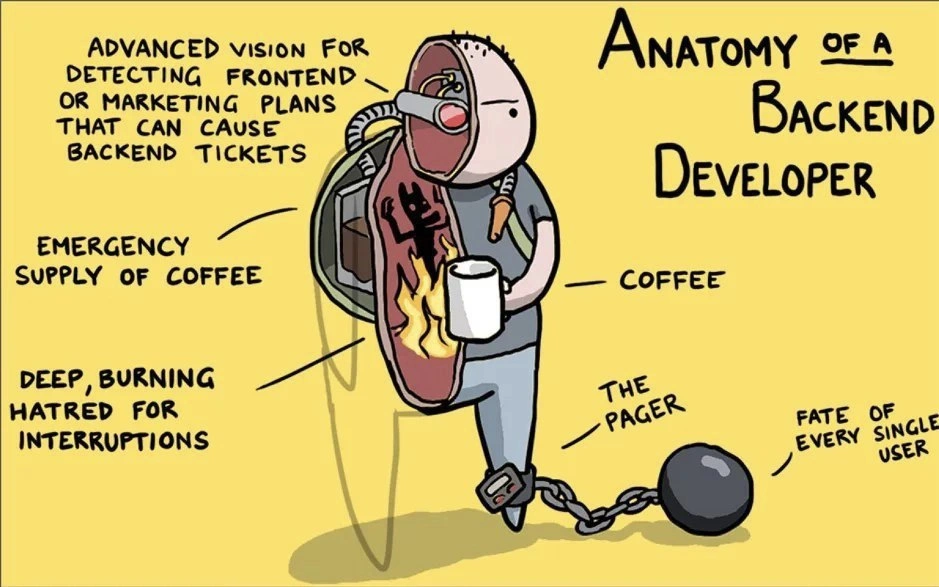
Now, think of a backend developer like that guard. They are always on watch to make sure a website or app is running fine for all users. The coffee helps them stay alert, the pager (alarm) notifies them if the system breaks, and they feel responsible for all the users (like our guard feels for all the park visitors). They can even predict problems (like when another team plans something that might crash the site) because they’ve seen it before. They don’t like random distractions (it’s like someone needlessly yelling for the guard’s attention while he’s scanning the security cameras). The meme draws this in a funny way: showing the developer with coffee inside them, an alarm pager on them, and a ball-and-chain of user fate. It’s a joke, comparing a developer to an over-tired guardian who’s powered by coffee and always ready to save the day (or night). Even if you’re not technical, you can laugh at the idea of someone literally fueled by coffee and chained to their duty – it’s like a cartoon superhero who stays awake all night to make sure everyone is okay, and complains if you bug them for no reason!
Level 2: Always On Call
If you’re a junior developer or someone new to Backend Development, this cartoon might look silly, but each label actually points to a real aspect of a backend engineer’s life. Let’s break down the terms and ideas so it all makes sense:
Backend vs. Frontend: First, know that a backend developer works on the parts of an application that users don’t directly see – things like servers, databases, and application logic. If an app were a restaurant, the backend is the kitchen: food is prepared there out of sight. A frontend developer works on what the user interacts with – the visuals and interface (like the dining area where customers sit and see the menu). In tech terms, the frontend is built with things like HTML/CSS and JavaScript in a web browser, or UI components in a mobile app. The backend is built with languages and frameworks that run on a server (like Java, Python, Node.js, databases, etc.). They’re different roles, but they collaborate. Now, the meme jokingly implies a bit of a love-hate dynamic: frontend or marketing folks often come up with ideas that sound simple on the surface but can mean a lot of hidden work (or problems) for the backend.
“Advanced vision for detecting frontend or marketing plans that can cause backend tickets”: This long label in the cartoon is saying our backend dev has a special ability to foresee problems. A “ticket” here means an issue report or task (commonly tracked in systems like Jira or GitHub issues) – basically work items usually created when something breaks or a new feature is needed. So the dev can detect plans from the frontend team or marketing team that will result in new issues for the backend to handle. Why would a marketing plan cause backend issues? Imagine marketing decides to offer a huge discount to all users at once, or launches an ad that suddenly brings a million people to your website – the backend servers might get overloaded. Or a frontend change might make dozens of extra calls to the server that weren’t there before. An experienced backend engineer has seen this happen before, so they develop a sort of radar for it. It’s a joking way to say “they can predict when someone else’s decision will create more work or problems for them.” In reality, this isn’t magic; it comes from experience and sometimes a bit of cynicism (“we added what feature without telling backend? Yeah, that’s gonna blow something up.”). The cartoon puts it as an anatomical feature – like they grew an extra eye for it – which is just for humor.
“Emergency supply of coffee” (and Coffee in general): Developers and coffee are almost a cliché at this point. The meme highlights it strongly. Coffee, for many programmers, is the daily fuel that keeps them going. An emergency supply means the developer always has coffee ready, especially when they’re tired or facing a crisis. Think of coffee as the equivalent of a phone charger for a developer’s brain – when energy is low, you plug in with caffeine. In the cartoon, the inside of the developer shows a tank of coffee, implying they’ve got it in their system at all times. And the character is holding a mug too. Why so much coffee? Because backend work can involve late nights and brain-draining debugging sessions. If a server goes down at 2 AM and you have to wake up to fix it, a strong cup of coffee is your best friend. It’s pretty common in tech office culture to have coffee machines always running, and you’ll see developers with funny mugs or a constant rotation of espresso shots. The meme playfully exaggerates it (two coffee labels!) to make sure you catch that “yes, coffee is basically life juice here.” So, coffee dependency is a real thing in developer culture – not every dev drinks coffee, but a lot do, and it’s joked about as if systems would crash without it.
“Deep, burning hatred for interruptions”: This is a comedic way to say “the developer really dislikes being interrupted while working.” And it’s true. When a developer is coding or troubleshooting, they keep a lot of context in their mind – variables, functions, system states, etc. An interruption (someone asking a question, a meeting, a phone call) forces them to drop all those thoughts. Picture reading a complicated book and someone continuously stops you to talk – you’d be annoyed because you lose track of the plot. Similarly, developers need concentration, and interruptions make them lose their “flow” (their rhythm and full focus on the problem). The cartoon dramatizes this by showing it as a burning fire inside the dev. It suggests that the hatred (strong dislike) is fiery and intense. Of course, a real person might not literally “burn” with anger, but many developers do feel frustrated when they can’t get a stretch of quiet time to solve a problem. In fact, it’s common in offices for developers to wear headphones or even put up a little sign like “Deep in code, please knock” to avoid interruptions. The reason it says deep hatred is that it’s not a mild annoyance; frequent interruptions can be one of the most stressful parts of the day for someone writing code, especially under deadline or under pressure from an ongoing issue. So the meme is spot-on that a backend dev (especially one dealing with delicate, breakable systems) really values being left alone to focus – and has some choice words for anything that needlessly disturbs that focus.
The Pager (on-call duty): The cartoon shows a device labeled “The Pager” attached to the developer, which is connected to that big ball-and-chain. Historically, a pager is a small electronic beeper that was used to alert people (doctors, firefighters, and yes, IT staff) that they were needed urgently. In modern tech, when we say “pager” we often mean the phone or alert system used for on-call notifications. On-call duty means it’s your turn to be the person who responds if the servers or website have a problem. Many teams have an on-call rotation – say, each developer takes a week where if something breaks, they’ll get a text or call (the “pager alert”) and must respond, even if it’s the middle of the night or over the weekend. So the pager in the meme symbolizes that this developer is carrying that responsibility. It’s chained to them, implying they can’t escape it. It might also be referencing a service like PagerDuty (a popular tool that manages on-call alerts) – some people colloquially say “I got PagerDuty” meaning “I got an alert I have to handle.” Being on-call can be stressful: imagine you always have to keep your phone volume up at night and have a laptop nearby, just in case. Even if nothing happens, you might sleep lightly worrying “what if I get paged?” The meme makes it funny by literally showing the pager as part of the person’s body (like they live with it attached). Also, note that the developer’s expression in the cartoon is quite tired and deadpan – pretty fitting for someone who’s been woken up by that pager one too many times! In real life, companies try to rotate on-call duties so no single person burns out, but during your shift, you really are tethered to the job. The phrase OnCallLife in the tags refers to this lifestyle of always being ready to handle a production emergency.
“Fate of every single user” ball-and-chain: Here the cartoon shows a heavy iron ball, the kind prisoners in old cartoons have on chains, labeled “Fate of every single user,” attached to the developer’s leg. This is symbolic. It means the developer feels responsible for all the users of the system. The backend is usually critical for the application – if the backend database, for example, goes down, it doesn’t just affect one user, it affects everyone trying to use the app or site. So backend developers (and SREs) carry the weight of knowing that their work (or mistakes) can impact every customer. The ball-and-chain imagery is saying they are chained to that responsibility. They can’t just ignore an issue, because real users are on the line. It’s a burden that’s always attached to them as long as they have that job. In a less dramatic sense, this is about accountability: if something breaks in production, the buck stops with the backend team to fix it and save the day for all users. That can feel heavy. Many developers joke about this pressure, like “don’t push that change on Friday, the users (and my pager) will make me regret it.” So the cartoon takes that feeling of a heavy responsibility and makes it an actual heavy object dragging behind the person. If you’re new to this field, it might sound intimidating – and indeed, having a whole system’s user base depending on you is a bit scary – but it’s also why backend work can be high-stakes and important. The humor makes it lighter by poking fun at how dramatic it can feel internally, like “I’m carrying the world on my ankle.”
Why Frontend/Marketing “cause” backend tickets: You might wonder, do frontend devs or marketing folks really cause problems? It’s not that anyone intends to cause issues, it’s that each team focuses on their own goals. The frontend team might be eager to implement a cool feature that animates something every time the user clicks – not realizing that triggers a flood of calls to the server. Or marketing might promise “real-time stats” for users in a campaign, not knowing the backend isn’t optimized for that and will generate errors under load. These things end up as “backend tickets” meaning the backend team has to do extra work or fix breakages. In an ideal world, all teams communicate early and plan capacity, but in reality, tight deadlines and siloed workflows mean backend devs often feel like the last to know about things that dramatically affect their work. That’s why an experienced backend dev gets a bit anxious when they hear “Hey, we’re launching this huge new thing tomorrow!” because they’re thinking “Uh oh, did we check if our servers can handle that?” The cartoon exaggerates it as a superpower, but it is true that experience gives developers pattern-recognition: they remember previous incidents (“last time Marketing did a flash sale, the site went down; not again!”) and thus can predict pain points. This part of the meme is a playful jab at inter-team relationships. It’s common in tech humor to have a light rivalry: frontend devs tease backend devs for making boring APIs, backend devs tease frontend devs for making heavy pages – and everyone teases Marketing for promising things yesterday. It’s all in good fun (mostly), and this meme is a visual representation of the backend perspective in that ongoing cultural joke.
On-call life and PagerDuty alerts: The tags mention OnCallDuty and PagerDutyAlerts, reinforcing that a big theme here is the life of an on-call engineer. If you haven’t been on-call, picture it like being a firefighter: you might be at home or out, but you have a radio (or phone) on you. When an alarm comes through, you drop everything and respond. The difference is instead of a burning building, it’s a server or website that’s “on fire” (failing). That’s why the developer in the image looks tired and is literally chained to an alert device. Those alerts (PagerDuty or similar) often come with loud, jarring ringtones to wake you from sleep. Many devs have anecdotes like “I once had 5 PagerDuty alerts in one night, I practically slept under my desk” or “I still get tense when I hear that particular alarm sound.” It’s almost a rite of passage in DevOps or backend roles to handle a late-night incident. The meme wraps all that stress into a single picture. But importantly, companies also emphasize things like post-mortems and improvements to make on-call sustainable – the meme intentionally overlooks those for the sake of the joke. In reality if a team is managed well, they try to spread the load, automate fixes, and only wake people up for truly dire emergencies. Still, every backend dev can relate to the scenario of being paged at an inopportune time at least once. It’s like a storm cloud always on the horizon – usually you have quiet nights, but when it rains, it pours (and you better have that coffee ready!).
In summary, this “Anatomy of a Backend Developer” meme takes a bunch of insider concepts and exaggerates them into a funny cartoon. For a newcomer:
- It shows how a backend dev is always on alert (that pager and vision for trouble).
- They consume coffee as if it’s a basic need (because often it feels like it is).
- They really value focus and get frustrated by constant distractions.
- They hold a lot of responsibility for the system’s users, which can feel like a heavy weight.
- And they’ve learned to be a bit cautious (almost paranoid) about changes coming from other teams, due to past experiences.
It’s both a humorous take and a bit of a cautionary tale. If you go into backend roles, especially in production engineering or DevOps, you’ll probably find yourself in similar situations – maybe not as cartoonish, but close enough that this meme will make you chuckle. It basically says: “Here’s what it’s like inside the mind (and body) of that backend person who keeps everything running.” And as over-the-top as it looks, there’s a grain of truth in every label!
Level 3: Chained to Prod
This darkly comedic anatomy cross-section of a backend developer lays bare the painfully real life of maintaining servers and carrying production on your shoulders. Each labeled “organ” is a tongue-in-cheek reference to what keeps backend engineers going (or what keeps them up at night). Seasoned developers nod knowingly at each part because it satirizes the exact burdens and behaviors they’ve developed after enough 3 A.M. firefights. Why is it funny? Because it’s 100% true in a twisted way:
Advanced Vision (for Frontend/Marketing Mayhem) – Over years of battling midnight outages, a backend dev develops a sixth sense for incoming trouble from other teams. The cartoon’s label “advanced vision for detecting frontend or marketing plans that can cause backend tickets” is a perfect exaggeration. It’s saying the dev can smell disaster before it happens. In real life, experienced backend engineers often predict how a seemingly innocent frontend feature or an ambitious marketing campaign might wreak havoc on the servers. For example, if Marketing decides to offer a one-day 50% off sale to every user, the backend dev’s eye starts twitching, foreseeing a traffic tsunami and database meltdown. Likewise, when a frontend dev says “we’ll just call this API every second to check for updates,” the backend veteran involuntarily shudders – they know that could flood the logs or blow past rate limits. This frontend vs. backend dynamic is played for laughs here, but it’s grounded in reality: backend devs often end up scrambling to fix issues created by upstream changes that nobody thought to run by them. That “vision” isn’t literal X-ray goggles – it’s accumulated wariness. After you’ve been paged enough times because “someone pushed a change on Friday 5 PM” or “Marketing didn’t tell us their ad would bring 10x traffic tonight,” you start to anticipate these scenarios like a weathered fortune teller of system outages.
Coffee as Life Support – Notice how coffee is mentioned twice in the diagram (“Emergency supply of coffee” inside the torso, and a mug labeled just “COFFEE” in the hand). That’s not redundancy – that’s emphasis. Caffeine is basically a backend developer’s primary fuel, a core dependency in their personal runtime environment. After consecutive late-night deployments and dawn pager alerts, you’ll find your friendly neighborhood SRE guzzling espresso shots just to achieve baseline human functionality. This part of the meme hits on a classic piece of DeveloperHumor: programmers run on coffee. The CPU of an application needs electricity; the CPU of a developer apparently needs caffeine. By drawing a literal tank of coffee inside the dev, the meme jokes that coffee isn’t just a beverage, it’s an internal organ at this point – as critical as a heart or lungs for keeping the coder alive. It’s funny because most senior devs have the “coffee = code” equation as a lived experience. They keep a stash of beans or a preferred brew method (French press, anyone?) within arm’s reach. And during a production outage, you better believe that “Emergency supply of coffee” kicks in – it’s either that or collapse face-first on the keyboard. The double-label here implies that even extra coffee is barely enough. It’s a gentle roast (pun intended) of tech culture’s coffee dependency: we joke that if caffeine were to ever go extinct, half the tech industry would miss their sprint stand-ups from oversleeping.
Deep, Burning Hatred for Interruptions – Here the meme gets spicily honest. It claims our backend dev has a “deep, burning hatred for interruptions,” complete with a depiction of flames in their gut. This is humorous hyperbole for a very real phenomenon: developers loathe being disrupted mid-flow. In a complex backend system – maybe juggling threads, database transactions, or microservice calls – a programmer’s mental model is fragile. Getting interrupted (say by someone asking “Hey, got a minute?” or a sudden Slack message, or another random task) is like yanking the power cord out of a server – everything crashes to a halt. That “burning hatred” is the visceral frustration devs feel after the tenth context switch of the day. In more polite terms, interruptions break focus and context, which are critical for solving hairy problems. There’s even legendary blog posts and talks in developer culture about the cost of context-switching and why programmers often have a “Maker’s schedule” that values long uninterrupted periods. The meme just dials it up to 11 by turning that into an internal organ of anger. Seasoned backend devs laugh (and cry a little inside) at this because they’ve all experienced the scenario: you’re knee-deep in debugging a production issue, logs open, stack traces in your head, and someone from another team strolls over with an unrelated request. The inner reaction is indeed a roaring dragon of irritation (even if outwardly you just force a polite smile). It’s darkly funny because it’s drawn as literal heartburn – likely fueled by coffee and sleeplessness – symbolizing how constant interruptions are almost physically painful. In the OnCall lifestyle, interruptions aren’t just annoying, they’re inevitable – pager alerts being the ultimate unwanted interruption. So the hatred is real, even if it’s (hopefully) not personal hatred toward any one interrupter. It’s more like a reflexive “please, world, not now!” that every dev has felt.
The Pager (On-Call Albatross) – Ah, the pager – two tiny words that can send a shiver down any ops person’s spine. The meme shows a pager hanging at the developer’s side, which is chained to that heavy ball labeled “fate of every user”. This is referencing the classic concept of being on-call. Back in the day, on-call engineers literally carried beepers that would go off if something broke in the middle of the night. Today we have fancy apps (hello, PagerDuty 👋) that send push alerts or phone calls, but we still often say “the pager” for tradition’s sake (and perhaps because “the smartphone notification that ruins your sleep” doesn’t have the same ring to it). The cartoon literally chaining the pager to the dev is a brilliant visual metaphor: being on-call can feel like you’re never free. It’s an electronic leash. You might be at dinner, at a movie, or trying to catch some Z’s, but in the back of your mind you’re always braced for that sudden BEEP BEEP or 911 page. Experienced backend folks joke about having PTSD from certain alert sounds – the default PagerDuty ringtone can make their heart skip a beat. The meme captures this anxiety by showing the pager as a physical part of the developer’s being, something they can’t put down. And indeed, many teams require the on-call person to carry the phone/pager at all times. This creates a kind of perpetual low-level stress; you can’t stray too far mentally or physically, because you must be ready to dive into an incident at any moment. The humor here is in how over-the-top but accurate it feels: the developer is literally depicted as a prisoner chained to the pager (notice the shackle on the ankle). Any seasoned SRE reading this has probably canceled or rearranged personal plans at least once due to on-call duty. It’s funny in the “laugh so you don’t cry” way – we recognize the absurdity of living life hinged on a little device’s whims, but we accept it as part of the job of keeping systems reliable.
The Ball and Chain of User Fate – The heaviest imagery in the cartoon is that iron ball labeled “Fate of every single user” clamped to the dev’s leg. This dramatizes the responsibility a backend engineer carries for the product’s uptime and functionality. If the backend goes down, every user of the app or service is affected – logins fail, data can’t load, maybe the entire site/app becomes unusable. Frontend glitches might annoy a user or two, but a backend failure is often an equal-opportunity disaster for the whole user base. Thus, backend devs genuinely feel the weight of all users relying on them. The cartoon makes that weight a literal ball-and-chain, like something out of a prison scene, to satirize how tied-down and heavy this duty can feel. It’s also a nod to the idea that you can’t just walk away from a critical production issue – just like a convict can’t outrun a ball-and-chain. Until the problem is fixed, you are bound to the system and the users. This is comedic exaggeration, of course; no one is actually dragging a 50kg iron ball into the office. But emotionally, that’s sometimes exactly how it feels during a high-stakes outage: “If I screw this up, all our users suffer, and maybe the company loses money or trust.” That’s a lot of pressure at 3:00 in the morning when you’re bleary-eyed and debugging a null pointer exception that’s taking down the service. The phrase “guarding every user’s fate” from the title sums it up – backend devs are the guardians of the system’s reliability, and when you internalize that role, you carry a mental burden for every transaction, every customer, every piece of data. The meme gets a laugh by depicting that burden as comically oversized chains. It resonates with senior devs because many of us have had those moments thinking, “If I deploy a bad fix, literally millions of people might experience errors – gulp!” It’s a mix of pride (being entrusted with that) and constant low-level anxiety, which the humor helps to defuse.
DevOps and the Cult of On-Call – Underneath the jokes, this meme is also poking at the modern DevOps culture shift where developers are also operators. “You build it, you run it” means backend engineers don’t just write code in isolation – they also monitor it in production, respond to incidents, and worry about uptime. This has blurred the lines between pure developers and ops engineers, creating the hybrid role often filled by SREs (Site Reliability Engineers) or simply senior backend folks who rotate on-call duties. The cartoon encapsulates this by combining coding staples (coffee, focus) with ops staples (pagers, being alert to issues) all in one poor stick-figure soul. It highlights an unsaid truth in many tech organizations: the backend team and SREs are the last line of defense. When something goes wrong at 2 AM, it’s not the marketing team or the CEO getting out of bed – it’s that engineer holding the pager. And when product or marketing decide to launch something flashy, it’s the backend team that quietly checks “okay, but will our database survive that?” The humor lands because it’s an exaggerated acknowledgement of those dynamics. Every label on that cartoon is basically an inside joke for “the stuff we gripe about in the break room or on Slack after a rough week.” It’s making light of the on-call life, the coffee addiction, the borderline paranoia about others’ changes, and the grouchiness about being disturbed – all coping mechanisms and side-effects of being responsible for production. Seasoned devs laugh because they’ve either been that person or sat next to that person. It’s camaraderie through dark comedy: “Haha, look at this poor backend dev with his coffee IV and pager-shackle… oh wait, that’s basically me during last week’s incident.” The meme’s exaggeration is therapeutic – it’s saying “we know this job is tough and ridiculous sometimes, but at least we can joke about it together.” With a bit of sarcasm, it honors the often invisible work that goes into keeping systems running while gently ribbing the backend/SRE anxiety that comes with it. In short, “Inside a backend developer” you’ll find equal parts caffeinated blood, wired nerves, and an ever-vigilant mind – a mix that every battle-hardened on-call engineer can relate to, and that’s exactly why this meme hits home.
Description
A cartoon illustration on a yellow background titled 'Anatomy of a Backend Developer.' The image depicts a character in a cutaway view, revealing their inner workings. Various parts are labeled to humorously represent the life of a backend engineer. An 'ADVANCED VISION' eyepiece is for 'DETECTING FRONTEND OR MARKETING PLANS THAT CAN CAUSE BACKEND TICKETS.' Inside the torso, there's an 'EMERGENCY SUPPLY OF COFFEE' and a depiction of a devil surrounded by flames, labeled 'DEEP, BURNING HATRED FOR INTERRUPTIONS.' The developer holds a mug of 'COFFEE' and is shackled by the ankle to 'THE PAGER,' which is chained to a large ball representing the 'FATE OF EVERY SINGLE USER.' This meme resonates with experienced developers by personifying the pressures of the role: the constant need to anticipate problems caused by other teams, the reliance on caffeine, the critical importance of uninterrupted focus (flow state), and the immense, burdensome responsibility of being on-call for systems that affect all users
Comments
9Comment deleted
The only thing missing is a dedicated organ for parsing YAML and a vestigial one for 'optimism during release windows.'
We’re basically distributed systems: caffeine for write throughput, sleep for eventual consistency, and the pager for when Marketing’s midnight A/B test blows the tail-latency budget
The real irony is that after 15 years of optimizing database queries to save milliseconds, you realize the biggest bottleneck in the system is the 3-hour meeting about whether to use tabs or spaces in the frontend code you'll never touch
The anatomical accuracy is striking - note how the pager is correctly depicted as a ball and chain rather than an organ, since it's an external parasitic attachment that feeds on sleep cycles and weekend plans. The 'advanced vision' for detecting scope creep is particularly well-evolved in senior backend engineers, often developing after the third time a 'simple frontend change' cascaded into a database migration, cache invalidation strategy, and distributed transaction saga
Backend vision: outperforms distributed tracing by detecting frontend scope creep at light speed, yet pagers enforce perfect availability partitioning
After enough pager rotations you develop a sixth sense for minor frontend tweaks that quietly bypass the cache, hammer the write path, drain the error budget, and cost exactly three coffees per nine
Backend anatomy: HA coffee, interrupt allergy, PagerDuty ankle monitor - because every “small frontend tweak” nukes the cache and chains our SLOs to the fate of every user
no brain in him, ironic Comment deleted
Brain resources moved to cloud Comment deleted