A Java Developer's Casting Call
Why is this Languages meme funny?
Level 1: The Gift Wrap Analogy
Imagine you ask a friend for a simple favor, like handing you a book. Instead of just giving you the book directly, your friend puts the book in a box. Then they put that box inside another box. Then into another box... and they do this a dozen times. You now have to open one box after another, again and again, to finally get to the book. You’d probably laugh and say, “Why on earth did you make it so complicated?!”
That’s exactly the joke here. In this meme, the C programmer thinks the Java programmer writes code in a needlessly complicated way – as if every simple step is wrapped in many layers (like those many boxes). All those parentheses and words in the code are like the extra boxes around the book. In reality, a Java programmer wouldn’t wrap something that many times, but from an outsider’s perspective it can look like they do. The extra semicolons are like your friend not only using too many boxes, but also tying a bunch of unnecessary knots on each box for no reason – it’s just over-the-top. The humor comes from this exaggerated image: taking something straightforward and adding a bunch of needless steps to the point of absurdity. Both friends (the C and Java programmers) ultimately achieve the task, but one imagines the other doing it with far more fuss and fiddling. Seeing those extra layers makes us giggle because we all know someone who overcomplicates things, right? In the end, the meme is a playful way of saying, “Java folks, you wrap everything up way too much!” using a silly over-wrapped piece of code as the punchline.
Level 2: Why So Many Casts?
Let’s break this down in simpler terms. We have two programming languages in the ring: C and Java. Each has its own style and rules. The meme is basically saying, “C programmers imagine Java code is ridiculously complicated.” The code snippet shown looks super messy: it’s full of parentheses and words in parentheses – those are type casts – and an absurd number of semicolons at the end. If you’re newer to coding, you might be puzzled: what is all this casting and what do semicolons even do?
First, what’s a cast? In programming, casting is when you tell the computer to treat a value as a different type. Think of it like converting or labeling something differently. For example, in C if you had a double number and you needed an integer, you might cast it like (int) myDouble to drop the fraction part. In Java, casting often happens with objects. Java is a language where you create classes (blueprints for objects) and often deal with references to these objects. If you have a general reference, say an Animal variable, but you know it’s actually pointing to a Tiger object, you can cast it to Tiger to access tiger-specific stuff. But Java will make you check that first using instanceof (which asks “is this object an instance of this class?”), to avoid mistakes.
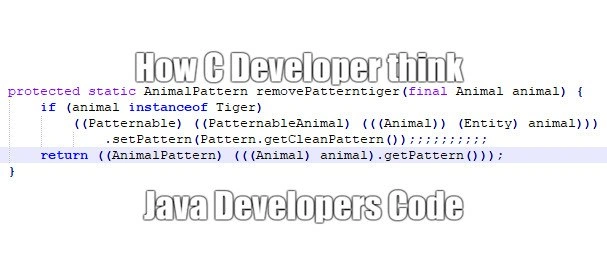
In the snippet, they have if (animal instanceof Tiger) – that’s Java’s way of saying “if this animal is actually a Tiger...”. Inside that if, they then cast the animal to a bunch of types: (Entity), (Animal), (PatternableAnimal), (Patternable). This is definitely weird looking. Normally, if animal is a Tiger, you might just cast it once to either Tiger or to an interface that Tiger implements. Doing multiple casts in a row like ((PatternableAnimal) ((Animal) (Entity) animal)) is like repeatedly telling the compiler “No really, trust me, it’s this type… okay, now trust me again, it’s also this other type.” It’s redundant because if animal is a Tiger, it is already an Animal (by inheritance) and maybe already a PatternableAnimal if that’s an interface Tiger implements. You don’t have to step through each one explicitly – one cast to the final thing you need would do. The meme is exaggerating to be funny, pretending that a Java developer would be ultra-cautious or clueless enough to wrap an object in every type it could possibly be. Type_cast_overload, indeed!
Now, why would any Java code need even one cast? Imagine classes like this: Animal is a general class, and Tiger is a subclass of Animal. Maybe there’s an interface Patternable that says “this thing has a pattern (like stripes) that you can set or clean.” If only some animals have patterns (like tigers have stripe patterns but maybe other animals don’t), you wouldn’t put that method in every Animal. Instead, you’d have Tiger implement Patternable. Here’s a more normal snippet of Java for that scenario:
Animal animal = new Tiger(); // we have an Animal reference to a Tiger object
if (animal instanceof Patternable) {
Patternable p = (Patternable) animal; // cast Animal to the Patternable interface
p.setPattern(Pattern.getCleanPattern()); // remove the pattern (stripes) from the tiger
}
We check if animal is Patternable (in this case, Tiger is, so it’s true), then cast it to Patternable so we can call the setPattern method. This is a typical use of casting in Java – you only do it when you have a general reference but need something specific that the general type doesn’t know about. It’s like saying: “I know you’re treating this creature as an Animal, but trust me, it’s specifically a Patternable thing, so let me do pattern-related operations on it.”
In C, you wouldn’t see code like this because C doesn’t have classes and interfaces the same way. If you were writing something similar in C, you might just have a function like removePatternTiger(animalPtr) which specifically expects a Tiger struct pointer. Or you might have a field in a struct indicating the type (like animal->type == TIGER), and then you cast a generic pointer to a Tiger pointer when needed. But it’s much more manual; you don’t have a built-in instanceof. You, the programmer, keep track of what type things are. So from a C programmer’s perspective, all this instanceof and multi-casting in Java looks overly fancy. It’s like extra guard rails and hoops to jump through that they aren’t used to.
Now, about those semicolons (;). Both C and Java use the semicolon to mark the end of a statement (like the end of a sentence). Normally, you put one semicolon at the end of each command. Writing ;;;;;;; is like writing a bunch of empty statements. It doesn’t do anything, but it’s allowed syntax. For a newcomer, seeing multiple semicolons might be baffling – you might think it’s a mistake. And that’s exactly the point in the meme: it is a mistake (or rather, it’s intentionally silly). No sane Java developer ends a line with seven semicolons in real code. One semicolon does the job; the extras are just empty statements that the computer will ignore. The meme is showing how a C dev imagines Java code, implying that maybe Java folks are so used to typing ; that they just keep hammering them out. Or perhaps it’s hinting, “Java code has so much unnecessary stuff, look, they even have unnecessary semicolons!” It’s a visual gag – even if you don’t know the exact rules, you can tell those extra ; are superfluous.
Let’s touch on readability. The term spaghetti code is used when code logic is tangled and hard to follow, like a pile of noodles. This Java snippet in the meme is a great example of a readability_nightmare: you have to wade through many parentheses and casts to understand what it’s doing. Each cast is wrapped in parentheses, and they nest inside each other. If you’ve never seen this before, it’s really confusing. Even if you have, it’s still annoying to decipher. A junior dev might look at that and go, “Is Java really that complicated to do something so simple?” The answer is: not usually! The meme is exaggerating to be funny. Real Java code can be wordy, yes, but it wouldn’t normally chain casts like converting animal to (Entity) to (Animal) to (PatternableAnimal) to (Patternable) all in one go. That’s the joke – it’s portraying Java as if every line of code is drowning in pointless conversions and type declarations.
Lastly, let’s talk about the culture behind this meme. This is a LanguageWars joke – friendly (sometimes not-so-friendly) rivalry between programming languages. The tags like c_vs_java and DeveloperHumor give it away: it’s meant to poke fun. C developers might tease Java developers saying, “You guys need a whole novel of code and checks to do what I can do in one line!” And Java folks might joke back, “Yeah, but your one line might crash – ours will run on any machine safely.” When you’re starting out, it’s good to know these are just stereotypes and fun. Every language has its pros and cons. Java code isn’t really all casts and semicolons – in fact, Java tries to avoid casts where possible by using polymorphism and, since 2004, generics (which let you write code without needing to cast when using collections, for example). Meanwhile, C code can get very complex in other ways (think pointer arithmetic or manual memory management bugs). But within developer communities, it’s common to jest about these differences. This meme chooses a clear visual gag: an overly complex Java snippet labeled as “How C Developer think Java Developers Code.” Anyone who’s struggled with reading others’ complex code (in any language) can relate to the frustration and humor here.
In short, to a junior dev: the meme is showing an absurdly over-engineered piece of Java code through the eyes of a C programmer. It highlights concepts like casting and type-checking (Java’s way of ensuring an object is what you expect) versus C’s more straightforward but risky approach. And it uses the exaggeration of many casts and semicolons to emphasize the point. Once you understand what casts do and how semicolons work, you can appreciate why this picture is funny – it’s taking normal things (casts, type checks, end-of-line semicolons) and using way too many of them, which is both silly and a jab at Java’s expense. Remember, good code in any language wouldn’t look this convoluted; that’s why it makes us smirk!
Level 3: When Abstractions Attack
At a more practical level, this meme nails a classic LanguageComparison joke: the C vs. Java mindset. Seasoned developers have seen this play out in countless flame wars and team discussions. The C developer (especially an old-school, systems programming kind of person) often prides themselves on writing lean, straightforward code – you have simple data structures, you operate directly on memory, and you avoid unnecessary fluff. In their world, needing a dozen classes just to define a simple behavior is overkill. So when a C dev imagines how a Java dev writes code, they picture something exactly like this snippet: every little action wrapped in layers of classes, interfaces, and conversions, with endless boilerplate and ceremony. It’s the stereotype that Java developers can’t even call a function without over-engineering it into an object-oriented monstrosity (here we literally see an Animal that’s also an Entity, a PatternableAnimal, a Patternable, an AnimalPattern… it’s like a zoo of abstraction for one poor tiger 🐯).
From a senior Java developer’s perspective, the humor cuts both ways. On one hand, they recognize the grain of truth: Java, especially “Enterprise Java” of the late 90s and early 2000s, had a reputation for being verbose and overly abstract. This was the era of Design Patterns mania – everyone was reading the Gang of Four book and trying to implement factories, adapters, and decorators for even trivial tasks. It led to infamous satire projects like Enterprise FizzBuzz, where a simple “fizzbuzz” logic (printing numbers with certain rules) was implemented with absurd levels of abstraction and dozens of classes. Looking at the meme’s code, a senior dev might chuckle remembering that phase: “Yep, I’ve seen methods that looked like that, where you have to jump through five interfaces to get anything done.” The class and interface names here (Patternable, PatternableAnimal, AnimalPattern) sound exactly like something from an over-engineered codebase where an architect decided every concept needs its own interface and naming suffix.
On the other hand, any experienced Java developer will also tell you that this is not normal or idiomatic Java! The meme is funny because it’s a wild exaggeration – a straw man. In reality, if we needed to “remove a pattern from a Tiger,” a decent Java program might have a method in the Tiger class or a single interface like Patternable that Tiger implements. You’d then simply do:
if (animal instanceof Patternable) {
// We know it's an animal that has patterns
Patternable patternedAnimal = (Patternable) animal;
patternedAnimal.setPattern(Pattern.getCleanPattern());
}
One cast, done. More likely, you’d design the classes such that you don’t even need to check type explicitly – perhaps Animal could have an optional pattern property and Tiger handles it internally. The DeveloperExperience_DX best practice in Java is to rely on polymorphism (i.e., calling methods that are overridden in subclasses) rather than doing a lot of instanceof checks and casts. In fact, seeing a chain of instanceof conditions in Java code is a red flag that you might be subverting your own class design. It’s often mentioned in clean code talks that “if you’re constantly downcasting, you probably missed an abstraction.”
So why do C devs joke that Java is like this? It comes from encountering or hearing about real-world spaghetti code in large enterprise Java projects. Picture a huge legacy codebase at a big corporation: it’s Java, but written by dozens of developers over many years. They’ve piled on layers of abstraction (maybe there was a framework du jour, or a zealous architect who loved interfaces). The result can indeed be a readability_nightmare for someone new or someone used to procedural C. You might open a single Java method and find it bouncing through multiple class casts or converting between types just to get a job done, plus a lot of fluff like logs and null checks and yes, semicolons aplenty. The meme exaggerates it to comic effect, but it resonates because many of us have seen a method or bug fix that spiraled out of control with casts. A senior dev might recall, with a mix of humor and horror, debugging something where an object was passed through a chain of collections and APIs, needing cast after cast to retrieve the actual useful thing inside. It’s funny because it’s a bit true – especially older Java code (before generics and streams) often had verbose casting patterns (e.g., pulling objects out of a pre-Java5 List gave you Object that you had to cast to what you actually put in).
Now consider the cultural aspect: c_vs_java. C and Java come from very different philosophies. C was born in the 1970s to write operating systems (Unix) with minimal overhead – it’s all about getting close to the metal. Java was born in the mid-90s with a slogan “write once, run anywhere” and safety in mind – it runs on a virtual machine, manages memory for you, and encourages writing everything as an object. C devs often value control, ; they manage memory manually and every byte and CPU cycle counts. Java devs value reliability and maintainability; they tolerate a bit of overhead because the JVM and the type system catch a lot of mistakes. These values sometimes clash in humorous ways. To a C programmer, seeing something like ((AnimalPattern)((Animal) animal).getPattern()) is hair-pulling – “Why on Earth do you need to wrap a simple operation in so many layers? Just get the data and change it!” It feels like watching someone walk in circles to grab a tool that’s right in front of them. Conversely, to a Java programmer, a C dev’s code might look scary: no safety rails, just raw pointers and casts that could go very wrong if you blink. Each side thinks the other is a bit crazy. This meme is squarely from the C dev’s sarcastic viewpoint: it’s making fun of Java by illustrating it at its most ridiculously over-engineered.
The line with ;;;;;;; (seven semicolons in a row) is a punchline on top of the punchline. Every C and Java dev knows that you end statements with a semicolon – it’s an ingrained habit. But multiple semicolons in a row? That’s either a typo or someone blindly slapping the keyboard. In reality, writing extra semicolons is usually harmless (the compiler ignores them as empty statements), but it looks absolutely wrong. It hints that the code may have been written by a confused developer who just kept hitting ; to appease the compiler’s errors (“maybe another semicolon will fix it!”). It’s the textual equivalent of nervous stuttering in code. Senior engineers have probably seen weird things like that in production – maybe not eight semicolons, but definitely superfluous junk that got left in. It gives the meme that extra spice, implying Java devs write not just verbose code, but also litter it with pointless syntax noise. Again, not fair to good Java developers, but fairness isn’t the point – the humor is in the outrageous caricature.
In summary, this level (the senior engineer view) recognizes the inside joke: it’s about DeveloperHumor and language stereotypes. We laugh because we’ve been in those trenches where one team swears by C’s simplicity and another swears by Java’s structured approach. We’ve seen perfectly fine abstractions as well as absurd over-abstractions. The meme takes the absurdity, cranks it up, and slaps a label “How C Developer think Java Developers Code” on it. And every experienced dev chuckles, because we’ve all met that one piece of code (or that one colleague) that made us go, “Are they really casting it again?!” For the seasoned folks, it’s a lighthearted reminder of the extremes we try to avoid – either extreme of too low-level or too abstract can become a maintenance headache. Here, obviously, the target is Java’s extreme: a flamboyant display of unnecessary casting that lampoons what happens when abstraction attacks your codebase.
Level 4: Cascading Casts Conundrum
Deep down, this meme highlights a type system mismatch and the rituals each language uses to enforce it. In Java, every object carries a runtime type tag (think of it like an ID card for its class). When you do a cast in Java – for example, casting an Animal reference into a Tiger – the Java Virtual Machine actually checks at runtime that the object really is a Tiger. If it's not, Java throws a ClassCastException to stop you from treating a duck as a tiger. This is part of Java’s strong type safety guarantees: the language goes the extra mile (and some extra CPU cycles) to ensure an object is never misused as the wrong type. Each explicit cast in Java is essentially asking, “Hey JVM, please confirm this animal is actually a PatternableAnimal (and by the way, also a Patternable entity) so I can call setPattern on it.” The humor in the meme’s code is that it performs a whole matryoshka doll of casts – wrapping the poor object in layer after layer of type checks – which is absurd because a single well-placed cast (or better, a more sensible design) would suffice.
By contrast, C lives in a simpler, more blunt world of types. A cast in C is purely a compile-time directive with no runtime check at all. It’s the programmer saying, “Trust me, I know what I’m doing,” and the compiler replying, “Alright, it’s all on you.” If you cast a pointer to a different type in C, it just reinterprets the bits with no questions asked. There’s no built-in notion of class hierarchies or instanceof in C – that’s a concept from object-oriented type systems like Java’s. So while Java does dynamic type checking, C does zero checking on casts beyond compile-time warnings. This means C developers are used to casts being both rare and straightforward – perhaps converting a float to an int or treating a blob of memory as a struct of a certain type – but each cast in C is a bit of a daredevil act (if you’re wrong about the data’s real type, you can get wild behavior or crashes, and the program won’t warn you).
Now, about that cascade of casts in the meme: it’s riffing on how Java’s design encourages using lots of specific types and interfaces. Java is a nominally-typed language: an object’s class is its identity, and you must explicitly convert between types that aren’t in the same lineage. If Tiger implements interfaces like PatternableAnimal and Patternable, an object of compile-time type Animal has to be cast step-by-step (or directly to the desired interface) to access those interface methods. In theory, you could cast directly to Patternable in one go – the extra (Animal) or (Entity) casts are redundant from the compiler’s perspective – but the meme imagines a paranoid or misinformed coder casting through every possible type layer, just to be sure. It’s like invoking every ancestor class and interface in some ritual incantation until the JVM is finally convinced it can call .setPattern(). This sequence drips with overkill, and any compiler or seasoned Java dev would shake their head at the unnecessary gymnastics.
Those bizarre ;;;;;;; at the end of the line are also a little in-joke on language syntax. In C, C++, and Java, a lone semicolon by itself is basically an empty statement – a do-nothing placeholder. You can actually write a whole row of semicolons ;;;;;;;; in your code, and while it looks crazy, the compiler will shrug and treat each as “do nothing; move on.” The meme cranks this up to eleven to satirize how outsiders view Java: they imagine Java folks typing a lot of pointless boilerplate and terminators. It’s poking fun at Java’s verbosity – historically, Java did require more ceremony (like lots of getters, setters, and generally more lines of code to accomplish things) compared to C’s terse style. The multiple semicolons don’t serve any purpose except comedic exaggeration, but they symbolically represent all the extra keystrokes and boilerplate often associated with Java.
On a software design level, casting an object through many types like this is actually considered a code smell. It violates the spirit of polymorphism – one of the core tenets of Object-Oriented design – which says that an object of a superclass (like Animal) should generally be usable as is without needing to know its specific subclass. The fact that the code must check instanceof Tiger and then cast to use Tiger-specific or Patternable-specific behavior suggests the class hierarchy wasn’t designed to handle that behavior abstractly. In a well-designed system (thanks to the Liskov Substitution Principle), we’d perhaps have an abstract AnimalPattern behavior or a method in Animal (or a Patternable interface that Animal could implement when appropriate) so that we don’t need explicit casts at all. The meme’s fictional code is a tongue-in-cheek portrayal of what happens when abstractions break down: you end up with cumbersome checks and casts, effectively treating an object differently based on its real type – which is exactly what good OO design tries to avoid. It’s a reminder that while Java’s static type system is aimed at clarity and safety, if you find yourself writing code like this, you’re probably fighting the type system rather than working with it.
So, this readability nightmare of nested parentheses and casts is not just random gibberish – it’s reflecting real type-casting mechanics under the hood. Java’s runtime type checking and C’s lack thereof come from deep decisions in language philosophy: Java opts for safety and OOP purity (every object knows its type, and the system won’t let you misuse it without an explicit cast and check), whereas C opts for “you’re on your own” flexibility (treat this bytes as whatever type you want, just don’t segfault!). The result? To a C veteran, Java’s safety net can look like over-engineered scaffolding, and to a Java veteran, C’s freedom can look like a recipe for disaster. The meme exaggerates the former to get a laugh: it’s type_cast_overload taken to a ridiculous extreme, a language war caricature of how Java code might appear through the cynical lens of a low-level C guru.
Description
The image displays a snippet of Java code under the heading 'How C Developer think' and above the footer 'Java Developers Code'. The code itself defines a method 'removePatterntiger' that takes an 'Animal' object. The core of the humor lies in the ridiculously verbose and nested type casting: '((Patternable) ((PatternableAnimal) (((Animal)) (Entity) animal)))'. This line is followed by an excessive number of semicolons (';;;;;;;;;'). The meme satirizes the stereotype of enterprise Java being overly complex, verbose, and reliant on deep, often convoluted, inheritance hierarchies and design patterns. The text 'How C Developer think' is likely a misdirect or a clumsy attempt to contrast this with the perceived simplicity of C, but the punchline is firmly aimed at the verbosity and over-engineering often associated with Java development culture

Comments
21Comment deleted
That's not real enterprise Java. A proper implementation would first pass the object through an AnimalToPatternableAnimalAdapterFactory before attempting a cast
We promised the auditors every critical path had type safety; the C dev opened removePatternTiger(), counted seven explicit casts, and said, “congratulations, you’ve reinvented void* with runtime penalties.”
The real pattern here is how C developers implement 17 layers of abstraction to remove a Tiger, while Java developers just let garbage collection eat it during lunch break
This perfectly captures the Java architect who read the Gang of Four book once and decided every animal needs to implement Patternable, PatternableAnimal, Entity, and Animal interfaces - because clearly, a simple Tiger.removePattern() would violate seventeen SOLID principles they can't quite remember. The eight extra semicolons are there to ensure the garbage collector knows they're *really* done with that statement
In C you cast to hush the compiler; in Java, thanks to type erasure, you cast after instanceof to reassure it - then prod ships a ClassCastException. Polymorphism was cheaper than all those parentheses
If your Java needs a cast ladder this tall, Liskov’s already broken and the compiler has delegated to runtime - see you at ClassCastException o’clock
C devs cast and conquer; Java devs summon a protected final PatternFactory just to peek at the tiger
> ));;;;;;;;;;; Comment deleted
we kinda sometimes have to, to some extent Comment deleted
we need image of c developer code from java developers view Comment deleted
BufferAbstractFactory Comment deleted
mov aex, bex je cx Comment deleted
int main(int argc, char** argv) { asm { MOV EAX, argc XOR EAX, argv MOV &argc, EAX } return argc; } 👌 Comment deleted
Isn't that so? I've got used to the pain of C and honestly don't like to waste my time resolving java dependencies (though my idea might be immature and my java experience is limited) Comment deleted
In addition to the fact that java OOP is FILLED with patterns Comment deleted
Servant of Mr Mahyar Comment deleted
Your wish is my command Comment deleted
And what c-dev is wrong about? Comment deleted
How Java devs actually code: *literally the same pic* Comment deleted
is this a char (*(*x())[5])() reference? Comment deleted
its more like Java Comment deleted