Skip to content
DevMeme
3601 of 7435
Big Tech Alternatives Exist, But Are We Listening?
OpenSource Post #3938, on Nov 16, 2021 in TG

Big Tech Alternatives Exist, But Are We Listening?

Why is this OpenSource meme funny?

Level 1: Right Under Your Nose

Imagine a kid sitting at home complaining, "I have nothing to play with," even though their room is actually full of toys. The kid's friend gets a bit annoyed and says, "Oh really? Nothing to play with, huh?" Then the friend starts opening the toy chest, looking under the bed, pulling games out of the closet, even reaching behind the couch – each time revealing another toy that was there all along. Suddenly there's a whole pile of action figures, puzzles, and games on the floor that the kid had completely forgotten about. The kid is astonished, but the friend just smirks and says, "See? You had lots of options around you!"

That’s exactly what's happening in this meme. Patrick is the kid whining that there's no alternative, and SpongeBob is the friend who proves him wrong by finding all those hidden options. It's funny because it reminds us that sometimes we think we have no choices, when really we just haven't looked in all the corners and under all the rugs. The solutions were right there waiting to be found – someone just needed to point them out.

Level 2: Meet the Open Alternatives

This SpongeBob meme might look goofy at first, but it's actually giving a tour of open-source alternatives to Big Tech products. In simple terms, open-source software is code that anyone can inspect, modify, and freely use. Instead of a huge corporation controlling it, people all around the world collaborate to make these tools and share them. Many open-source projects let you self-host your own service, which is like running your own mini-version of a Google or Facebook product on a server you control. SpongeBob is basically showing that for every big tech service someone complains about, there’s a community-made version hidden nearby. Let’s break down what he finds in each scene:

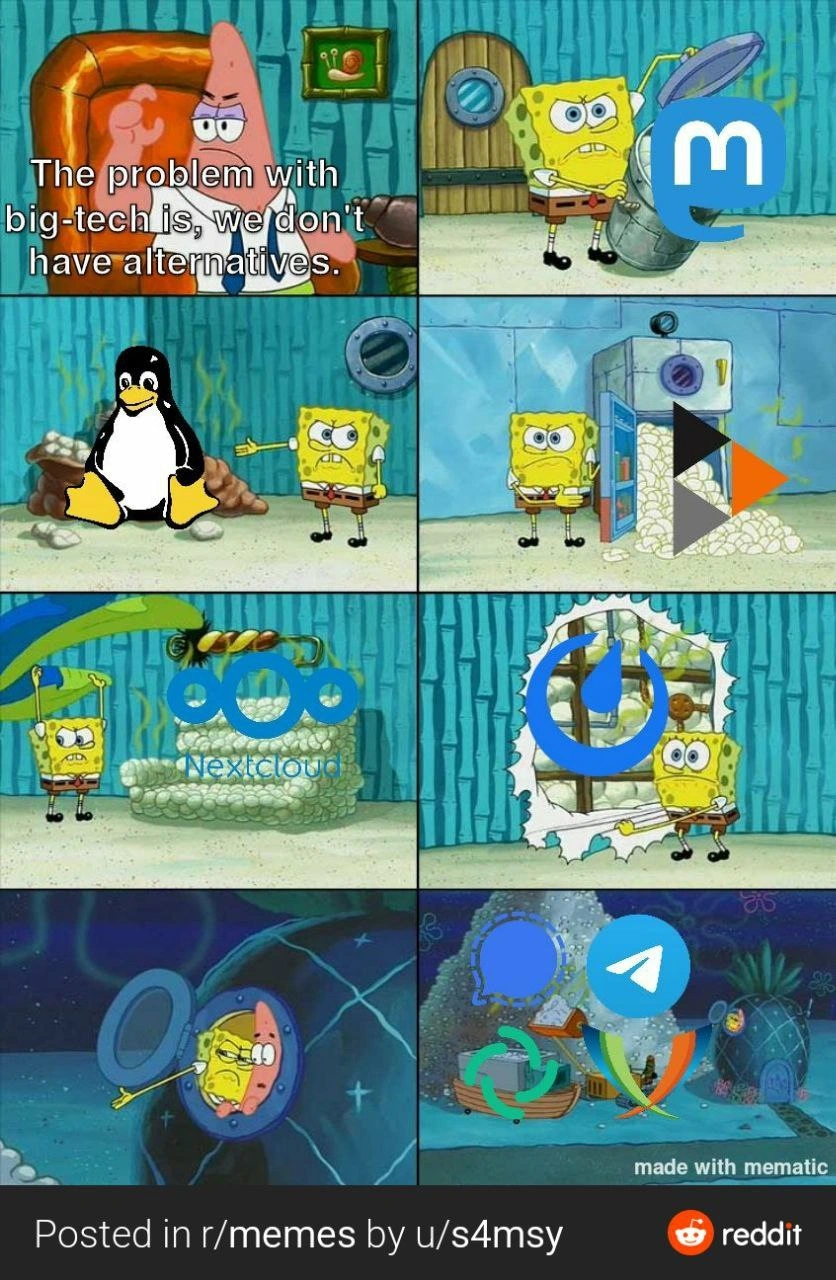
  • Mastodon – That blue "M" SpongeBob pulls out of the trash can is the logo of Mastodon. Mastodon is a social network a lot like Twitter. The big difference is Mastodon is decentralized. There's no one single Mastodon website or company; instead, anyone can run a Mastodon server (called an instance). Users on one instance can follow and talk to users on other instances because all those servers connect to each other in a larger network called the Fediverse. Think of Twitter as one huge global chat room owned by a company, whereas Mastodon is more like lots of smaller community chat rooms that are all connected. If you join one Mastodon server, you can still interact with people on another server – kind of like how email works (Gmail users can email Yahoo users, and vice versa). When SpongeBob pulls Mastodon out of a trash can, it's a cheeky way of saying "Hey, what you thought was garbage or didn't even consider, might actually be a great Twitter alternative."

  • Linux – The cartoon penguin under the rock is Tux, the mascot of Linux. Linux is an operating system, which is the basic software that runs your computer (like how Windows or macOS do). Linux is completely open-source and has been around for 30 years. It's the backbone of a lot of the tech world (most servers and even Android phones run on Linux under the hood), even if regular desktop users don't always see it. By pulling Linux out from under a rock, the meme jokes that if you think there's no alternative to Windows or Mac, you just haven’t looked hard enough. Linux has many versions (called distributions or "distros" like Ubuntu, Fedora, etc.) that anyone can download and use, usually for free. It's a bit of a running joke-slash-point-of-pride among developers that Linux is always there as the rock-solid alternative, quietly powering the world (and also literally hiding under a rock in this scene!).

  • PeerTube – In the closet overflowing with bubbles, SpongeBob reveals a logo with a play button shape (orange, gray, and black). That's PeerTube. Imagine YouTube, but nobody owns it outright. Instead of one huge site where everyone uploads videos, PeerTube is a network of many small video-hosting servers. Each server might be run by a different person or organization (for example, a university or a hobby group could run their own). These servers can also share videos with each other. PeerTube uses the same kind of federation idea as Mastodon, so a user on one PeerTube server can watch or even follow channels on another server. It even uses peer-to-peer technology (similar to torrents) to let viewers help share the video content, which is why the closet in the meme is spilling over – it's symbolizing that the content distribution is spread out among viewers and servers, not bottled up in one place. So, if someone says "There's no alternative to YouTube," SpongeBob would point to that closet and say "actually, check out PeerTube!"

  • Nextcloud – Under the rug, SpongeBob uncovers a blue logo with interconnected O's – that's Nextcloud. Nextcloud is basically your own private cloud service, like a do-it-yourself Google Drive or Dropbox. It's open-source software that you can install on a server you control (it could be a rented server online or even a spare computer at home). Once it's set up, you can upload files, share them with friends, stream your music, keep a calendar, and even collaborate on documents – all very much like the experience you'd have with Google’s G Suite, but totally under your control. By hiding Nextcloud under a rug, the meme suggests people often overlook it. Many folks say "I have to use Google Drive because I need to share files," not realizing that Nextcloud could let them do that without handing their data to Google. It might require a bit more work to set up, but for developers or businesses concerned about privacy, Nextcloud is a popular alternative. SpongeBob lifting the rug is like him shouting, "Look here! You can have your own cloud!"

  • (Mysterious Blue Power Button) – In one panel, SpongeBob literally saws through the wall to reveal a big blue circle with a power-button symbol. This one is a bit of an inside reference. It likely represents one of the many lesser-known self-hosted services or server tools out there (the exact logo might be recognized by hardcore self-hosting fans – it resembles the icon for a project like Home Assistant or OpenMediaVault, tools for running your own home server). But even if you don't know the exact name, the point is clear: SpongeBob had to break through a wall to show yet another alternative hiding back there. It's saying "there are even more open-source projects behind the scenes that you might not have heard of." Essentially, for almost any software need, if you knock down a few walls, you'll find some open-source project trying to fill that space. This could range from running your own password manager, to hosting your own maps service, or setting up your own video conferencing server. The meme is winking at the audience here: there's always one more alternative around the corner.

  • Signal, Telegram, Element/Matrix – In the final scene, night has fallen and SpongeBob is poking out of a porthole while icons float above various houses. These are logos for messaging apps that serve as alternatives to the usual big tech messengers. The blue icon with a white speech bubble outline is Signal, the paper airplane is Telegram, the green intertwined circle is Element (which is a client app for the Matrix protocol). This scene is referencing alternatives to things like WhatsApp, Facebook Messenger, or iMessage. Signal is an open-source app focused on privacy – all messages are end-to-end encrypted, and it's run by a nonprofit. Telegram is not fully open-source on the server side, but it's an independent messaging platform very popular in tech communities and places where people want to avoid Facebook's ecosystem. Matrix is an open protocol for real-time chat; you can think of it like a decentralized Slack/Discord. With Matrix, you can run your own server (your own "house" in that neighborhood) and still have your server communicate with other Matrix servers so that people on different servers can chat in the same room. The image of the houses with different icons in the sky shows a whole neighborhood of separate messaging services coexisting, each lighting up its own house. It's a metaphor for decentralization: instead of one big apartment building owned by, say, Facebook where everyone lives (all users under one roof), you have many individual homes that all connect through the community. SpongeBob showing these at night is like him saying, "Even when it looks dark and you think there's no one else out there, look up – there's a bunch of signals and messages flying around on their own networks."

For someone new to development or not deeply into tech yet, all these names and logos might be unfamiliar. But that's exactly the meme's point: there’s a whole world of tech options outside the popular commercial ones. Each alternative exists because people – often developers and hobbyists – wanted more freedom or privacy or customization than the Big Tech versions offered, so they built their own. Discovering these can feel like finding secret treasure. If you've only ever used the mainstream tools, learning about open-source alternatives is likeopening a door to a parallel tech universe. You might think you have to use Gmail/Google Docs because that's what everyone uses, or stick with Windows because it came with your PC, or tolerate YouTube ads because "where else would I watch videos?" But then someone shows you Nextcloud, or Linux, or PeerTube, and it dawns on you that you actually have choices. It's kind of empowering! Devs especially love this because it means they can tinker, self-host, and tailor services to their liking. There’s even a whole community vibe around it: sharing links, scripts, or tips to get these alternatives running (the dev communities behind these projects are super welcoming to newcomers). The meme is basically SpongeBob giving you a heads-up that if you ever feel stuck with whatever a big company provides, remember to peek under the rug or in the closet – chances are an open-source alternative is hiding there, waiting for you to discover it.

To sum up the parallels in simpler terms, here’s a quick comparison of the big tech services versus the alternatives SpongeBob is revealing:

Big Tech Service Open-Source or Independent Alternative (from the meme)
Twitter (social networking) Mastodon – a federated social network (many servers instead of one)
YouTube (video platform) PeerTube – decentralized video sharing (many servers + P2P)
Google Drive/Dropbox (cloud storage) Nextcloud – self-hosted cloud storage & collaboration
WhatsApp/Facebook Messenger (chat) Signal, Telegram, or Matrix/Element – private or federated messaging
Windows/macOS (operating system) Linux – open-source operating system (many distributions)

Each pair shows how, for nearly every major product from a big company, there's an alternative made by the community. You might have to put in a bit more effort to use some of them (for example, setting up your own server or convincing your friends to switch apps with you), but they're out there and improving all the time. This meme basically reassures a junior developer (or any curious user) that if you ever feel stuck with a Big Tech tool you don't like, just remember SpongeBob running around revealing option after option – there's probably an open-source project or a smaller service that can do the job. It’s an invitation to explore and not feel locked in by the big names.

Level 3: Hidden in Plain Sight

Patrick: "The problem with big-tech is, we don't have alternatives."

That on-screen lament by Patrick (wearing a tie, as if he's a concerned professional or average user) sets the stage for the meme's satire. The humor comes from SpongeBob’s over-the-top response: as soon as someone claims there's no alternative to the Big Tech giants, SpongeBob springs into action, dramatically unearthing a whole hoard of open-source goodies that were right under everyone's noses. Each panel escalates the joke: alternatives literally pop out of the trash can, from under a rock, out of the closet, beneath the rug, even behind the walls. This exaggerated scavenger hunt is funny because it parodies what happens in developer communities all the time. One person sighs, "We’re stuck with [Big Tech Service]," and immediately an enthusiastic open-source fan (our SpongeBob here) retorts, "Actually..." and proceeds to list a dozen alternatives as if pulling them from thin air.

The meme brilliantly plays on idioms and shared tech experiences. Patrick saying there's no alternative suggests he's been living under a rock – and sure enough, SpongeBob lifts a rock to reveal Tux, the Linux penguin, hiding there. It's a literal and figurative jab: if you think there's no alternative to Windows or macOS, you must have been ignoring (or living under a rock regarding) Linux, which has been around forever. Next, SpongeBob pries open a trash can to expose the Mastodon logo. This could be a tongue-in-cheek nod to how people often dismiss niche platforms like Mastodon as irrelevant “trash” — but here that "trash" turns out to be treasure. It implies that alternatives might be discarded or overlooked by the mainstream, even though they're perfectly viable. SpongeBob then opens a closet brimming with bubbles and the PeerTube logo, as if a hidden stash of videos pours out. "Coming out of the closet" indeed – a playful way to show PeerTube and its federated video streaming were always there, just not out in the open. Lifting the rug to find Nextcloud riffs on the phrase "sweep it under the rug": self-hosted services like Nextcloud often get swept aside in conversations, overshadowed by big names like Google Drive. Yet, there they are, ready to be picked up by anyone who cares to look. SpongeBob even chainsaws through a wall to unveil a blue power-symbol logo (one more self-hosted project), illustrating how far an open-source enthusiast will go to break down walls and reveal yet another option. By the time he’s poking his head out the porthole in the last panel, we see an entire skyline of alternative messaging icons (Signal, Telegram, Element for Matrix, etc.) hovering above the houses at night. It's as if to say: "Look, there's a whole city of independent services out here!" The setting being nighttime, with only some houses lit up with those icons, winks at the idea that most people are “sleeping” on these alternatives while a few are awake and using them.

From a seasoned developer's perspective, this meme hits home because we've all witnessed or participated in these "alternative exposé" moments. The self_hosting_culture in particular thrives on the mantra, "Why trust Big Tech companies when you can run your own?" There are whole forums, subreddits, and chat groups dedicated to swapping tips on replacing every proprietary service with an open one. Often, as soon as news breaks of a Big Tech mishap – say, Facebook misuses data or YouTube changes its monetization rules – the IndustryTrends_Hype for open-source alternatives kicks into gear. For example, when WhatsApp announced a controversial privacy policy, there was a mass exodus of users and techies urging friends to switch to Signal or Telegram (exactly those messaging icons floating in the final panel). When YouTube cracks down on content or inundates viewers with ads, someone inevitably chimes in, "Have you tried PeerTube or LBRY?" And whenever Twitter users get frustrated with algorithm changes or leadership decisions, the rallying cry becomes "Join Mastodon!" It's practically a ritual in dev communities to remind everyone that open source alternatives exist whenever trust in a Big Tech platform falters. This SpongeBob meme visualizes that ritual in a hilariously literal way.

What makes it especially funny is the predictability and zeal on display. SpongeBob’s frenzied hide-and-seek for FOSS solutions is basically a caricature of the passionate open-source advocate who has a fix for everything. It's simultaneously a point of pride and a gentle self-own for the community: yes, we do tend to have an alternative for every closed platform — and we won't hesitate to drag them out into the open, even if it means metaphorically tearing down a wall. That panel of him with the chainsaw is exactly that vibe: "Oh, you think we're done? Think again, there's always another alternative hidden somewhere!" This resonates with experienced devs because it exaggerates reality only slightly. Many of us have been SpongeBob in real life – eagerly showing friends or colleagues how to move to a FOSS solution – and maybe we've been a bit over-eager at times, pulling out one option after another while the other person looks increasingly overwhelmed.

There's also an underlying truth about why these alternatives often stay "hidden." We know that despite the abundance of options, convincing the world to switch is hard. Alternatives are hidden in plain sight partly because they lack the marketing and polish of trillion-dollar companies. Many everyday users stick with Big Tech services due to inertia, network effects (all their friends are on the big platform), or sheer convenience. A veteran developer might chuckle at the meme with a mix of amusement and frustration: it's funny because SpongeBob is right — those solutions exist — and frustrating because Patrick (symbolizing the average user or even corporate decision-maker) genuinely doesn't seem to see them. Patrick in a tie could be representing a typical businessperson or even a CTO saying "we have no choice but to use BigCorp's product," while SpongeBob is that engineer in the meeting jumping up with an open-source alternative on hand. The dynamic is familiar, almost archetypal in tech circles.

In essence, the meme is both celebrating and poking fun at the depth of the open_source_ecosystem. It tells an insider joke: the claim "we don't have alternatives" gets uttered, and everyone in the know rolls their eyes because, well, there's an app for that, except it's on GitHub rather than the App Store. It's highlighting how rich the landscape of open source culture really is — there's a Linux for every Windows, a Mastodon for every Twitter, a Nextcloud for every Google Drive, and so on. And it’s doing it through SpongeBob’s comic intensity, which amplifies the shared experience and the absurdity. We laugh because it's true, and because we've either been the Patrick (unaware of options) or the SpongeBob (showing them off), or likely both at different times. The final feeling is a mix of tech empowerment ("hey, we really do have lots of choices!") and comedic exasperation ("why don't more people know or care?"). The meme nails that duality, leaving anyone who's spent time in dev communities nodding and chuckling in agreement.

Level 4: The Federation Strikes Back

In the background of this meme is a deep architectural contrast between Big Tech's centralized platforms and the decentralized networks that open-source champions build as alternatives. Big Tech services like Twitter or YouTube typically operate as giant monoliths: millions of users' data in one walled garden, all requests funneling to the company's servers. By contrast, projects like Mastodon and PeerTube embrace a federated model. They implement protocols (like the W3C's ActivityPub for social media) so that many independent servers (instances) can intercommunicate. It's akin to how email works: any SMTP mail server can send/receive messages to any other, because they speak a common language. Similarly, a Mastodon user on one server can follow and interact with a user on another seamlessly, achieving a unified social experience without a central authority. This design decentralizes control and avoids single points of failure. If one server goes offline, the rest of the network still thrives – much like the internet's original distributed intent.

However, federation introduces classic distributed systems challenges. Data consistency becomes eventual rather than immediate. When SpongeBob pulls out all those alternatives, he's also exposing the inherent complexity under the hood: posts or videos gradually propagate across servers, meaning the system prioritizes availability and partition tolerance over global consistency (echoing the CAP theorem trade-offs). For example, a new post on a Mastodon instance eventually reaches followers on other instances via background federation processes. There's no single global database to update, so each node's view of the data converges over time. This resilient design optimizes for uptime and autonomy at the cost of some latency and potential divergence. One server might miss an update if it's temporarily down, then catch up later. In a centralized Big Tech service, by contrast, a post appears everywhere instantly (since it's all under one company's control), but only as long as that one service is functioning and benevolent. The Fediverse (federated universe of social sites) deliberately trades some monolithic efficiency for fault-tolerant freedom.

Another layer of technical ingenuity is in how these alternative platforms handle scale and content delivery. PeerTube, for instance, offloads bandwidth by using peer-to-peer streaming via WebTorrent. When SpongeBob opens the closet to reveal PeerTube (with bubbles spilling out), it's a nod to how PeerTube clients (viewers) themselves help distribute video data – like bubbles spreading – rather than burdening a single central server. It's a clever decentralized strategy: every viewer becomes a node in a swarm, similar to BitTorrent, sharing pieces of the video with others. This approach turns the audience into an ad-hoc content delivery network. It's radically different from YouTube's model, which relies on massive data centers and proprietary algorithms to beam videos to millions. The open-source solution leverages the P2P model to reduce infrastructure bottlenecks and put power in the hands of users' browsers.

Even core services like file storage and messaging reinvent their architecture in the open-source realm. Nextcloud, shown under the rug, isn't a multi-tenant cloud run by a mega-corp, but software you deploy on your own server (or a small provider's) using open protocols like WebDAV for files and CalDAV/CardDAV for calendars and contacts. Technically, it's a classic LAMP-stack web application, but conceptually it gives individuals the same capabilities that Google Drive or Dropbox provide – only self-hosted and isolated per user or organization. This means data consistency and backup become the user's responsibility: each Nextcloud instance is its own mini-cloud. They can even federate with each other for sharing, using standards like the Federated Cloud Sharing API, which again mirrors the pattern of many nodes loosely cooperating rather than one central hub owning all data.

On the messaging front, open alternatives emphasize end-to-end encryption and open protocols as a counter to Big Tech's data silos. Signal (one icon in the final panel) uses the Double Ratchet cryptographic algorithm (part of the Signal Protocol) to ensure only the communicating parties can read messages – not even the server operator can spy on them. This protocol, which employs concepts like perfect forward secrecy and ratcheting keys, has become a gold standard, influencing even Big Tech (WhatsApp famously integrated Signal's protocol for its own encryption). Meanwhile, the Matrix protocol (with clients like Element) takes a federated approach to chat: anyone can run their own Matrix server (homeserver) and still exchange messages with users on other servers. Messages sync across a distributed network of servers, requiring sophisticated conflict resolution. Matrix uses eventual consistency with state reconciliation algorithms (essentially CRDTs and hashing of conversation history) to ensure that even if people are on different servers, their group chat history ends up consistent. It's a distributed consensus challenge: ensuring all participants see the same messages without a central server dictating the truth.

Taken together, the meme's hidden trove of logos is a showcase of architectural paradigm shifts: from centralized, proprietary platforms to distributed, protocol-driven networks. It's a playful reminder that for every closed system, there's an underlying open design where control is distributed among users. These alternatives embody the internet's early ethos of interoperability and user empowerment through technology. What seems like a silly SpongeBob gag actually hints at intricate systems engineering: open standards replace proprietary protocols, community-run servers stand in for corporate data centers, and cryptographic trust supplants blind trust in a company. It’s an ode to the idea that the web can still be a federation of peers rather than an empire of big servers – a truth that’s often hidden in plain sight until someone (or some SpongeBob) lifts up the rug, the rock, or even slices through the wall to reveal it.

Description

An 8-panel SpongeBob SquarePants comic meme format. In the first panel, Patrick Star claims, "The problem with big-tech is, we don't have alternatives." The following panels show an angry SpongeBob presenting various open-source and privacy-focused alternatives, with their logos superimposed: Mastodon (social media), Linux (OS), PeerTube (video), Nextcloud (cloud storage), Jitsi (video conferencing), and a final panel showing Signal, Telegram, Matrix, and Jami (messaging apps) floating by like trash. The meme satirizes the common but often uninformed complaint about the lack of alternatives to dominant tech platforms. It highlights the frustration within the tech community that despite the existence of many robust, open-source options, they are frequently overlooked or dismissed by the wider public, who prefer the convenience of mainstream services

Comments

43
Anonymous ★ Top Pick Users: 'We have no alternatives to big tech!' Devs: *points to a dozen mature, open-source projects* Users: 'Ugh, but I'd have to click a different icon.'
  1. Anonymous ★ Top Pick

    Users: 'We have no alternatives to big tech!' Devs: *points to a dozen mature, open-source projects* Users: 'Ugh, but I'd have to click a different icon.'

  2. Anonymous

    “C-suite: ‘We’re trapped in Big Tech’s walled garden!’ Me, lifting the rug to reveal 40 orphaned Helm charts: ‘Nah, we’re just trapped by whoever volunteers for the 3 a.m. self-hosted pager.’”

  3. Anonymous

    After 15 years of migrating enterprise systems, I've learned that 'no alternatives to big tech' usually means 'no alternatives that come with a vendor to blame when the CEO asks why the system is down at 3 AM.'

  4. Anonymous

    The irony here cuts deep: senior engineers know we have *too many* alternatives - each with its own federation protocol, package manager, and 'slightly different' approach to the same problem. The real challenge isn't finding alternatives to big tech; it's achieving consensus on which alternative to standardize on before someone forks it and creates yet another option. We've gone from 'no alternatives' to 'XKCD 927: Standards' faster than you can say 'systemd controversy.'

  5. Anonymous

    Alternatives exist; what we don’t have is an SLA. Spin up Mastodon/PeerTube/Nextcloud and congrats - you just traded vendor lock-in for pager lock-in

  6. Anonymous

    We’re not short on alternatives - just SOC2 sign‑off, SSO/SCIM, and anyone volunteering to own the pager

  7. Anonymous

    Big Tech monopolies fixed: now your homelab Raspberry Pi is the new SPOF

  8. @boingo00 4y

    eggs

  9. @kimbasan 4y

    🍆

    1. @affirvega 4y

      it "splashes" only in pms

      1. @RiedleroD 4y

        lool didn't know it did that, that's hilarious

  10. @affirvega 4y

    Which word is supposed to be replaced?

  11. @freeapp2014 4y

    Peertube

  12. @freeapp2014 4y

    Activityhub

  13. @RiedleroD 4y

    it does splash in pms - when you click on it

    1. @RiedleroD 4y

      although I'm not sure if all clients support it

  14. @RiedleroD 4y

    I guess the tg devs got some spicy humor

    1. @affirvega 4y

      Some people just want other to see the world burn slapping peach

  15. @doodguy1991 4y

    🍑

    1. @www_qqqqq 4y

      Oh!!!11 Fuck! That was cool!!! Sheeeet...

  16. @doodguy1991 4y

    The problem is there is no good YouTube alternative. Peer to peer doesn't work for small channels

    1. @neanime 4y

      Onlyfans was going to be yt alternative, but we all know what happened

    2. @CcxCZ 4y

      Content distribution isn't the issue, the funding side and discoverability is. And the money handlers just won't smaller players in. Liberapay barely manages.

    3. @QutePoet 4y

      Vimeo is good YouTube alternative.

      1. @RiedleroD 4y

        Vimeo doesn't even have a search function, mate

        1. @QutePoet 4y

          https://vimeo.com/search

          1. @RiedleroD 4y

            wtf okay, since when?

            1. @QutePoet 4y

              Since 2020.

              1. @RiedleroD 4y

                huh

  17. @el_khatto 4y

    We do have alternatives, but some of them are not as good as big tech is yet

  18. @el_khatto 4y

    And then we've also got issues with compatibility between big tech and the alternatives

  19. @el_khatto 4y

    Last year Libreoffice failed to properly save my presentation on 4 different drives, rendering my final year project marked as "Not done"

  20. @el_khatto 4y

    They were trying to open it in PowerPoint 2008

  21. @el_khatto 4y

    Which just didn't work for some reason

  22. @el_khatto 4y

    And I wasn't allowed to connect my laptop on which I made the presentation to the projector, so I had to schedule a different day to show it

    1. @RiedleroD 4y

      bruh

      1. @el_khatto 4y

        Ikr

  23. @TarasPushkar24 4y

    Yeah thats a pain

  24. @Algoinde 4y

    Nextcloud is absolute garbage tho

  25. @Algoinde 4y

    The last time I tried to run it, it ate almost all of the resources on my VDS and was riddled with bugs

  26. @Algoinde 4y

    and don't get me started on the update process

  27. @Algoinde 4y

    which, for example, doesn't let you skip major versions

    1. @p4vook 4y

      Contributions are welcome /irony

Use J and K for navigation