Skip to content
DevMeme
3599 of 7435
Black Mirror Was a Documentary, Not a Roadmap
AR VR Post #3936, on Nov 16, 2021 in TG

Black Mirror Was a Documentary, Not a Roadmap

Why is this AR VR meme funny?

Level 1: TV Predictions Come True

Imagine you watched a TV show or cartoon where people in the future spend all day in a pretend video game world. In that story, everyone has a funny little cartoon character version of themselves, and the whole thing feels kind of scary or silly because it’s a warning that maybe this isn’t a great way to live. Now, ten years later, a real-life famous tech person comes out and says, “Ta-da! We made a new virtual world and you can be a cartoon version of you and hang out by a fake lake with friends online!” It’s almost exactly like what you saw in that old TV episode. You’d probably laugh and think, “Wait, I saw this on TV… is it actually happening for real?” It’s funny in a weird way because usually TV sci-fi ideas stay fiction, but here one of them is coming true right in front of us. It’s like a make-believe idea escaping the TV and popping up in real life. People find it both cool and a bit spooky – kind of like if a storybook about a crazy future started actually coming true. That mix of surprise and “uh-oh, maybe that TV show was onto something!” is why this comparison makes us smile.

Level 2: Hype vs Reality 101

Let’s break down the key concepts and why this meme resonates in the developer community. First, VR (Virtual Reality) is when you wear a headset and are fully immersed in a computer-generated world. Everything you see and hear is virtual. AR (Augmented Reality), on the other hand, layers virtual things onto the real world (like Pokémon GO putting cartoon creatures on your phone’s camera view). In this meme, we’re dealing with VR: both the 2011 scene and the 2021 demo involve fully digital environments (VirtualReality). The term Metaverse in 2021 became a huge buzzword in the tech industry. Originally coming from a 1990s sci-fi novel, “metaverse” now means a shared virtual space where people can interact via digital_avatars – essentially a big VR world that could also include AR elements. When Facebook rebranded to Meta and showed off their vision of people hanging out, working, and playing in VR, that was them saying: “We want to build the metaverse.” Developers heard this and thought, “Okay, so we’re really doing this ‘virtual world’ thing… again.”

Now, Black Mirror is a TV series that many techies watch. Each episode tells a separate sci-fi story about technology and its unintended consequences. It’s basically speculative fiction that often feels uncomfortably plausible. Season 1 Episode 2, which the meme references, imagined a future where people spend all day in a hi-tech facility earning points and living through screens. They have avatars (digital characters) that represent them, especially when they appear on virtual shows or interact socially. The points (merits) are like a satirical take on how everything becomes a game or how social media likes/points might run our lives. In that 2011 show, the avatar of the main character is very simplistic – kind of like a video game character with basic graphics, because it’s a controlled, artificial world. Sound familiar? It’s very close to what VR platforms actually looked like at the time and, humorously, still look like in 2021.

So, fast forward to 2021. Mark Zuckerberg (the CEO of Facebook, which is now called Meta) did a big presentation about the future of social technology. In that demo, he and others appeared as avatars in various virtual settings – one of them being this scenic Horizon Worlds environment with a lake, mountains, and even a virtual fireplace. Horizon Worlds is basically Meta’s VR app where you can create a cartoon version of yourself and meet other people’s cartoons in virtual rooms. The meme’s lower panel shows Mark’s avatar – a clean-cut cartoon version of him, notably wearing a quirky black skeleton outfit (because why not, it’s a virtual you). If you look closely or recall the viral images, these avatars didn’t have legs. That’s not a mistake; early VR systems often only show from the waist up, because current VR hardware (like the Oculus Quest controllers) tracks your head and hands, but not your feet. It’s hard for the software to guess leg movements correctly, so the developers just leave floating torsos to avoid weird glitches. This became an instant joke on the internet: the “future” Metaverse, yet our digital selves don’t even have legs! Developers who work on games/VR understood the technical reason (tracking is hard), but it still was a funny reality-versus-expectation moment.

Now, why compare these two images? The top is fiction from 10 years earlier, the bottom is real and recent. The comparison highlights a TechHistory lesson: sometimes what we imagine in sci-fi ends up happening, but often with a twist of TechHumor when it actually arrives. In 2011, seeing that Black Mirror episode, you might think “wow, that’s wild, but it’s just made-up.” By 2021, we literally have a tech billionaire saying “Welcome to the metaverse, here’s my cartoon body by a fake campfire.” Many developers find this both exciting and a bit cringe. Exciting, because building immersive worlds is a cool technical challenge – it involves computer graphics, networking, new user interfaces, etc. But cringe (embarrassing) because the big promise (“the future of the internet!”) came with graphics and ideas that looked outdated or unoriginal – almost like they copied a TV show without addressing the why that might be a bad idea. It reflects a TechHypeCycle: big ideas are hyped up (lots of marketing, everyone talking about how VR will change life), then early versions come out and they’re… underwhelming. This doesn’t mean VR won’t improve; it likely will, just as smartphones and the web did. But it reminds young developers that hype should be taken with a grain of salt. Initial implementations often fall short of the slick concept videos.

Let’s talk about avatar fidelity (how realistic or high-quality the avatars look). There’s a debate in VR development: should avatars be very realistic, resembling a live video of you, or should they be stylized and cartoony? High realism might sound great, but it’s extremely hard to do in real time. You’d need excellent 3D scans of people, motion capture for every facial expression and body movement, and massive graphics power to render that without lag. If it’s almost realistic but not perfect, it can feel creepy (that’s the “uncanny valley” effect – when something looks almost human but has something off that weirds people out). On the other hand, cartoon avatars are easier to render and avoid that creepy factor, but they can break the immersion or seriousness of a meeting if they look too silly. In the Black Mirror scene, the avatar is intentionally simplistic – it was a commentary on how people lose their personal identity in that world. In the 2021 Metaverse demo, the avatars are simplistic out of necessity (and maybe design choice) – to make the social VR experience technically feasible and universally approachable. As a new developer, it’s useful to understand this compromise: sometimes the cool idea (realistic virtual you in a virtual world) has to be scaled down due to technical limits. So we end up with floating cartoon torsos and basic facial expressions, at least for now.

The meme also touches on the gap between futuristic marketing and actual implementation. For example, the concept video for Meta’s metaverse might show slick avatars playing holographic games on a coffee table, or teleporting to a virtual concert with realistic performers. The reality in early development stages is usually much simpler: laggy interactions, graphics glitches, and lots of “mute yourself, I can’t hear you” moments – basically, more akin to a Zoom call with cartoons. Every junior dev learns that the first version of any project is a rough draft compared to the polished vision. It’s like when you first code a game: you imagine this epic, beautiful world, but your first build is a grey cube moving on a plane. Here, the “epic vision” was the metaverse future; the first build is cartoon Mark at a virtual lake house. Seeing those side by side is both educational and amusing. It reminds us to stay humble about version 1.0 of anything.

Finally, there’s a cultural lesson: tech ideas tend to cycle. If you’re new to the industry, you might not remember, but older devs will tell you about Second Life (an online virtual world from 2003 where people used avatars to socialize and even do business) or the hype around virtual worlds in the late 2000s. There were even media stories back then about virtual real estate and concerts – very similar to what we hear about the metaverse now. Those earlier efforts had a lot of the same ingredients: avatars, virtual spaces, even primitive VR support. They didn’t take over the world as predicted, but they evolved into other platforms (like today’s multiplayer games or VR chat apps). So the pattern is: an idea gets hyped, then reality humbles it, then time passes, technology improves, and the idea comes back in a new form. Knowing this, you as a developer can appreciate the meme’s wink: “Here we go again with the virtual world hype.” It doesn’t mean you shouldn’t be interested or work on it – just keep your expectations realistic and maybe watch some Black Mirror for insight! After all, today’s TechHumor about VR might be tomorrow’s serious architecture discussion in your project meeting.

Level 3: Dystopian Déjà Vu

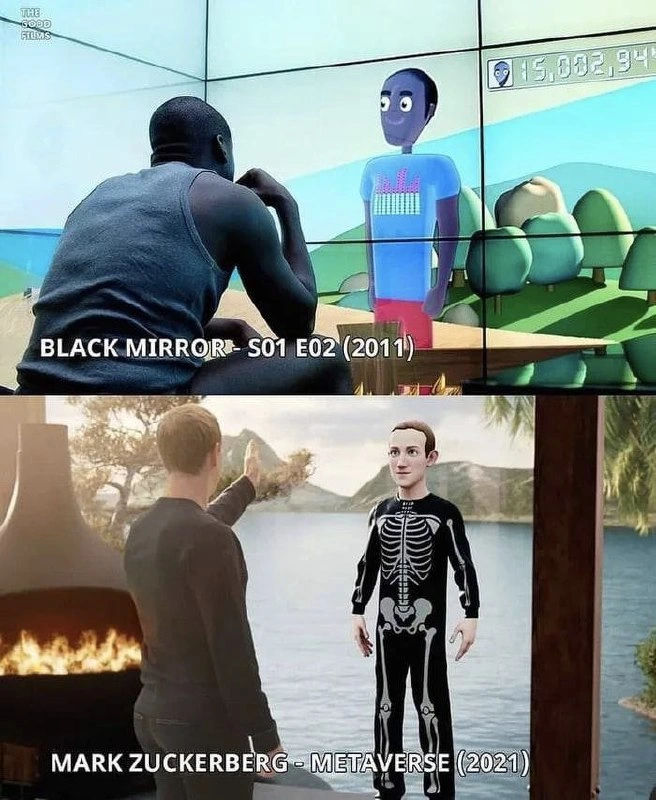
In the top panel, we see a scene from Black Mirror Season 1 Episode 2 (“Fifteen Million Merits”, 2011). A character crouches before a wall of screens, facing his digital avatar – a low-poly cartoon figure in a pixelated T-shirt. There's even a game-like counter in the corner showing a whopping number of merits (15,032,94…). In the bottom panel, fast-forward to 2021: Mark Zuckerberg is presenting his Metaverse vision (the famous Facebook/Meta VR demo) with his cartoonish avatar in a virtual lodge by a lake. The meme screams “Hey, haven’t we seen this before?!” to anyone in tech. It’s a serious case of sci-fi déjà vu, as a sci_fi_prediction from 2011 is literally mirrored in a real product announcement a decade later. For veteran developers and tech observers, this juxtaposition is equal parts hilarious and eerie – the Black Mirror scenario meant as dystopian fiction is now essentially an IndustryTrend pitch deck for the next big thing in AR/VR.

Why is this funny? Because Black Mirror is known for its dark, cautionary tales about technology’s impact – the kind of show that makes you go “oh man, I hope we never build that.” In that S01E02 episode, society is trapped in a computer-mediated world: people live in tiny rooms surrounded by screens, their every move gamified with points (the “merits”), and they interact through crude avatars. It’s a dystopia where reality and virtual life blur in a depressing way. Now here comes 2021, and one of the world’s biggest tech CEOs essentially says, “We’re all going to hang out in a virtual world as avatars – it’s the future!” The meme highlights this irony: a dystopian fiction has morphed into developer reality. That bold white text compares BLACK MIRROR – S01E02 (2011) to MARK ZUCKERBERG – METAVERSE (2021), as if the latter is an episode title of its own. The joke lands because seasoned devs immediately recognize the visuals and vibe: low-poly cartoon avatars, immersive screens, a big number on the display – it’s as if Zuckerberg’s team used Black Mirror’s production design as a spec. This kind of too-close-for-comfort resemblance makes tech folks chuckle and shiver.

The humor also pokes at the perennial TechHypeCycle surrounding VR and the “metaverse.” We’ve been promised immersive digital worlds for decades, and sci-fi books and shows (from Snow Crash in 1992 which coined “metaverse,” to Black Mirror and Ready Player One) have predicted both the awe and the pitfalls. By 2021, Facebook renaming itself to Meta and demonstrating “Horizon Worlds” felt like life imitating art – the cautionary kind of art. Developers who follow IndustryTrends_Hype saw this coming: we know the pattern where futuristic marketing glosses over today’s technical limits. In Zuckerberg’s much-publicized demo, his avatar famously had no legs (just a torso and arms floating around) and a cartoon face. That’s a far cry from the hyper-realistic, full-body VR ideals we might have imagined by now. It’s Avatar Fidelity 101: the digital_avatars in current VR are kept simple because rendering photo-real humans with today’s hardware, without dipping into the uncanny valley or causing VR sickness, is extremely hard. So when we see the 2021 avatar looking just as cartoonish as the 2011 TV version, it’s comically underwhelming. A decade of tech advancements, billions of dollars in R&D – and the result still looks like a Wii character on holiday. The meme winks at developers: so much hype, yet here we are, essentially reimplementing what a dystopic satire envisioned with about the same graphic quality.

“Black Mirror was meant as a warning, not a roadmap.” – Every tech veteran, watching the Metaverse demo.

Beyond the visuals, there’s an undercurrent of cynicism shared by many devs. The TechHistory context gives the joke depth. We remember earlier rounds of VR/virtual world mania: the 90s had clunky VR arcades and VRML on the early web; the 2000s saw Second Life where companies rushed to open virtual offices; the mid-2010s had Oculus Rift, VR Chat, and Pokémon GO’s AR craze. Each time, the hype promised a revolution in how we live and interact. Each time, reality set in: hardware was clunky, user adoption stayed niche, graphics were rudimentary, or people simply didn’t want to spend 24/7 as legless cartoons. This meme’s two panels sum up that hype vs. reality cycle perfectly: grandiose Sci-Fi Prediction on top, pragmatic dev implementation on the bottom. It’s like the meme is saying, “Remember that dark futuristic show from 10 years ago? Well... surprise! We basically deployed it to production.” Developers who’ve survived a few hype cycles can’t help but smirk at how on-brand this is for Big Tech. It also hits close to home: building the metaverse isn’t just a fun weekend project – it’s a massive endeavor with so many unsolved problems (from rendering millions of polygons in real-time to moderating a virtual society). Yet the marketing makes it seem glossy and inevitable. The resulting dissonance is meme gold.

To really spell it out, here’s a head-to-head comparison that the meme implies:

Black Mirror (2011, fiction) Meta’s Metaverse (2021, reality)
Dystopian sci-fi scenario – a warning about digital escapism. Utopian tech demo – selling digital immersion as a dream.
Users in tiny rooms glued to screens, living via avatars. Users (potentially) in living rooms wearing VR headsets as avatars.
Avatar style: low-poly, cartoonish; basic expressions. Avatar style: low-poly, cartoonish; legs (none); basic expressions.
Points economy: “15 million merits” as life currency. Likely economy: likes, in-app purchases, maybe crypto/NFT? (Tech hype loves new currencies).
Audience reaction in 2011: “Hope this never becomes real.” Developer reaction in 2021: “Uh-oh, it’s becoming real… and it looks the same!” 😅

It’s a cheeky reality check. The meme isn’t just laughing at Meta or Zuckerberg personally; it’s laughing at the situation we’ve created in tech. We’re literally building things that were once shown as satirical exaggerations. For a developer, it raises thoughts like: Are we sure this is a good idea? and Haven’t we learned from those stories? There’s also a bit of pride or excitement hidden in there, because hey, sci-fi becoming real means we are advancing tech – just maybe not in the sleek, idealized way writers imagined. Instead of Black Mirror’s grimdark mood lighting, we have cheery corporate presentations – but the core concept is uncannily similar. This alignment of fiction and reality gives the meme its punch. The next time you see a wild gadget on a Netflix show and think “nah, that’s too crazy,” remember this meme – developers might just be coding away to bring that exact crazy idea to life (for better or worse). In short, the meme tickles our TechHumor bone by showing how the TechHypeCycle sometimes leads us right into a Black Mirror episode – with Zuck as the surprise guest star.

Description

A two-panel comparison meme. The top panel features a still from the television show 'Black Mirror,' specifically the episode 'Fifteen Million Merits' (S01 E02), dated 2011. It shows a character in a dark room looking at a screen displaying a simplistic, cartoonish avatar in a vibrant, virtual world. The bottom panel shows a widely circulated image from Mark Zuckerberg's 2021 presentation of the Metaverse. In this image, the real Zuckerberg is gesturing towards his own digital avatar, which is depicted with a similarly cartoonish and graphically simple style, wearing a skeleton costume. The meme's humor is derived from the striking and unsettling similarity between the dystopian fiction from a decade prior and the real-world technological ambition of a major corporation, implying that what was intended as a warning was interpreted as inspiration
Comments

9
Anonymous ★ Top Pick Zuckerberg saw a cautionary tale about digital enslavement and thought, 'Let's build that, but make sure the avatars have legs... eventually.'
  1. Anonymous ★ Top Pick

    Zuckerberg saw a cautionary tale about digital enslavement and thought, 'Let's build that, but make sure the avatars have legs... eventually.'

  2. Anonymous

    The real Black Mirror twist is that after twelve years the only thing we’ve taken from PoC to prod is a multi-region Kubernetes bill - avatars are still legless so we can hit the 20 ms motion-to-photon SLA

  3. Anonymous

    The real horror isn't that Black Mirror predicted the Metaverse - it's that after 10 years of technological advancement, Zuck's $10 billion avatars still look worse than a dystopian TV show's budget CGI warning about the dangers of virtual escapism

  4. Anonymous

    When your 2011 dystopian sci-fi show accidentally sets higher rendering standards than a $10 billion metaverse project a decade later - turns out the real Black Mirror episode was the product roadmap we shipped along the way. At least the skeleton avatar honestly represents what's left of Meta's VR ambitions after burning through their market cap

  5. Anonymous

    Black Mirror wrote the RFC; Meta shipped the MVP - same low‑poly avatars, but now the dystopia is KPI‑driven, A/B tested, and streaming into a data lake

  6. Anonymous

    Black Mirror nailed the metaverse UX in 2011; Zuck just deployed it with zero LOD improvements or shader upgrades

  7. Anonymous

    Black Mirror wrote the PRD; a decade later we shipped the MVP - polygons slashed to meet the GPU budget, ‘presence’ promoted to an OKR, and dystopia rebranded as product‑market fit

  8. @semjonsona 4y

    Similarity: 💯%

  9. @QutePoet 4y

    I think Facebook is more experienced in 2D, than in 3D.

Use J and K for navigation