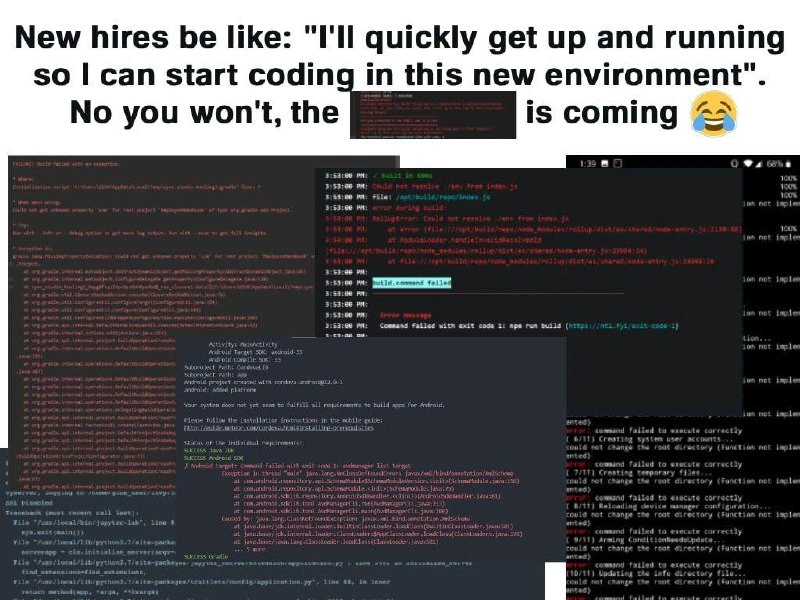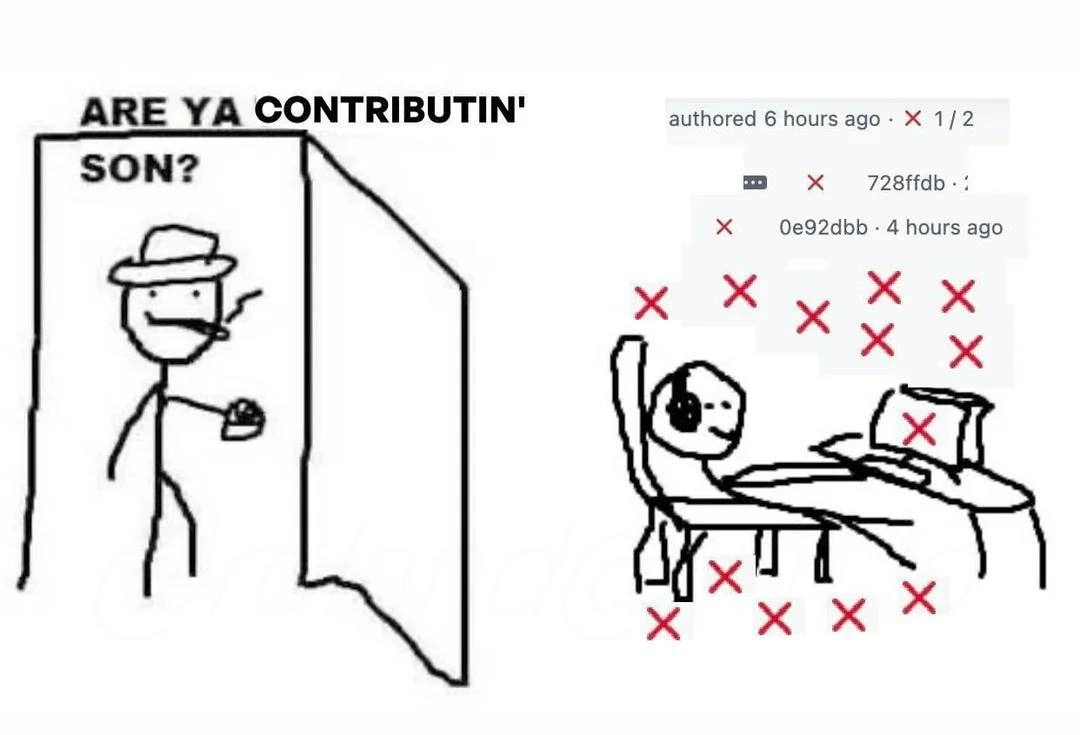
The Walk of Shame After Breaking the Main Branch
Why is this BuildSystems CICD meme funny?
Level 1: Everybody’s in Trouble
Imagine you’re in class at school, and one kid in the class breaks a rule or makes a big mistake. The teacher gets upset, and instead of just telling that one kid, the teacher announces to the whole class and even sends a note home to everybody’s parents about what happened. Yikes! Now every student and every parent knows something went wrong, and everyone feels on edge. Even the kids who did nothing wrong feel a bit scared and annoyed: “Who messed up and got us all in trouble?” The kid who actually made the mistake feels absolutely awful – like their heart is pounding, and they’re afraid they’ll be blamed by everyone.
This meme is just like that, but in a software team. One programmer’s code had a bug (a mistake), and a computer system (like the strict teacher in this story) told the whole team about it by sending out a big group email. The picture from Squid Game shows a man looking really frightened with lots of other people standing around worried too. It’s a funny way of saying: “Uh oh, one of us messed up, and now we’re all finding out at the same time – this is tense!” Of course, nobody is actually in real danger, and nobody’s actually getting punished like in a scary game show. But it feels uncomfortable, and that’s why it’s funny. It’s exaggerating that nervous feeling you get when a small mistake suddenly becomes a big public deal. In simple terms: one person’s slip-up made everyone uneasy, and the meme jokes that it’s as dramatic as a survival game (even though it isn’t really). It’s a way for developers to laugh at how over-the-top our reactions can be when a little error happens at work and everyone finds out together.
Level 2: Broken Build Broadcast
Alright, let’s break down what’s really happening in this meme in more straightforward terms. In a software team, developers use Continuous Integration (CI) systems (like Jenkins, CircleCI, or GitLab CI) to automate the process of building and testing code. Think of CI as a robot butler that continuously checks the code for problems. Every time someone writes new code and merges it into the main project, the CI robot compiles the code and runs a suite of tests (this whole process is the BuildPipeline or BuildProcess). If everything is good, the build passes (often shown in green). If something is wrong – say the code doesn’t compile or some tests fail – then we say “the build failed” (usually shown in red). A build failure basically means there’s a bug or error that needs fixing before the project can move forward safely.
Now, companies often set up notifications for these build results. A common (if slightly old-school) setup is that whenever the build fails, the CI system will send an email alert to a predefined list – sometimes that list includes the whole development team. That’s what “everyone gets a mail” refers to. Imagine you have 50 developers on a project, and they’re all on a mailing list called [email protected]. The CI server is configured to send a “failing build alert” to that email whenever something goes wrong. So as soon as the build turns red, boom, an email goes out to [email protected], and all 50 developers see a message like: “Build #1234 failed: Error in module X. Investigate ASAP.” This is supposed to help everyone stay informed. In theory, it means whoever caused the problem will see it and fix it quickly, and everyone else is aware of the hiccup.
But in practice, this can turn into notification_spam. If builds fail often, or if the alert isn’t actionable for most people, it just clutters inboxes. Developers start to dread seeing those subject lines pop up, especially if it’s not their fault. It’s a bit like a group chat that pings everyone even when only one person is needed – after a while, people get annoyed or start ignoring it. That’s where the frustration (DeveloperFrustration) comes in. The meme exaggerates this by comparing it to Squid Game, a TV show famous for its high anxiety and dire consequences. In Squid Game, if you mess up in a game, you’re not just scolded – you’re eliminated from the game (in a rather permanent way). Of course, in real-life software development, nothing so terrible happens if your code breaks the build! But emotionally, especially if you’re new, it feels really bad. You might blush or get that sinking feeling in your stomach, knowing that everyone just got notified about your mistake. That’s build_fail_anxiety – the nerves and stress when you realize you might have broken something that the whole team cares about.
Let’s talk about the image in the meme. It’s a scene from Squid Game: lots of players in matching green tracksuits standing in a tense, dark environment. They all look worried. One guy in the front has this extremely anxious, about-to-cry facial expression. In the meme, that guy represents the developer who broke the build (or exactly how any developer feels the minute a failure email hits the whole team). The people behind him – their faces blurred – represent the rest of the team. They’re all affected (everyone got the email blast), but their identities are blurred maybe because, in that moment, nobody wants to be recognized or maybe to symbolize that it could have been any of them. The whole team is standing there like, “Uh oh, what now?” The caption at the top says, “when the build fails and everyone gets a mail”. It’s describing that exact situation: code’s broken, and an email went out to everyone about it. The Communication here is basically an overzealous email notification system. Instead of calmly notifying just the responsible person, it’s shouting to the whole room.
For a junior developer or someone who hasn’t experienced this: picture working on a group project. You submit something that accidentally breaks the project (maybe your part of the code has an error). Now imagine an automatic system sends a message to the whole team or class saying “The project build is broken, please fix it.” It would be pretty embarrassing, right? Everyone knows something went wrong, and they know it might be because of the latest changes – which points fingers implicitly at whoever made those changes (possibly you). In a healthy team, this is addressed without blame: they fix it together or the person who caused it quickly fixes it. But it’s still not fun to be under that spotlight. And if you’re on the receiving end of these emails and it wasn’t your code this time, it can still be irritating because it interrupts your work. You’re thinking, “Ugh, what broke now and who broke it?”
This meme is very relatable in tech circles because a lot of us have worked with BuildAutomation systems that err on the side of oversharing. We’ve all seen that “Build failed” email or Slack notification pop up at the worst times. It’s a mix of DevOps_Humor and DeveloperHumor because it points out an everyday absurdity in our workflow. The Squid Game reference just amplifies it – it’s saying, “Doesn’t it feel like life-or-death when that happens?” We chuckle because, yeah, it sorta does in the moment, even though we know it’s not. And maybe we also laugh at ourselves for being so dramatic about a mere software bug. In summary, the meme is explaining: when one developer’s mistake triggers a red build, the system notifies everyone, and suddenly the entire team is caught in this moment of shared dread and irritation – kinda like contestants in a nerve-wracking game. It’s a humorous take on BuildFailures and team communication gone wrong.
Level 3: Red Light, Green Build
When a Continuous Integration (CI) build fails and blasts an email to the whole team, it feels like a high-stakes elimination round for developers. The meme captures that perfectly by invoking Squid Game’s do-or-die vibe. Instead of contestants in mortal peril, we have anxious developers in a CI/CD pipeline. The image shows rows of identically clad participants (think dozens of devs on the project), with one man up front looking absolutely terrified. That poor guy might as well be the developer who committed the last code change – the one that broke the build. Everyone’s faces in the background are blurred, which hilariously reflects how, in a large team, individual identities fade into the crowd until something goes wrong. The moment the build turns red, all eyes (and inboxes) focus on the unlucky soul at fault. It’s a modern office twist on “red light, green light”: when the build is green, life is good; when it’s red, someone’s about to get metaphorically shot in the back.
In a well-tuned CI pipeline, a failing build is supposed to be a team issue, not a personal firing squad. Historically, continuous integration practice says “stop everything and fix the build” when it breaks. It’s similar to an assembly line stopping if a defect is found – you don’t keep producing bad product. Early CI tools and agile coaches encouraged loud, visible alerts for broken builds. That’s why many build systems are configured to send out a mass failing_build_alert. The intention is good – to raise the flag and get everyone mobilized to fix the problem quickly. But often the result is a notification_spam nightmare. One misconfigured test and suddenly the entire engineering mailing list gets a flashing neon email_blast saying “BUILD FAILED 😱!”. It’s the digital equivalent of a fire alarm going off because someone burned toast in the kitchen. Sure, something’s technically wrong, but does everyone in the building need to drop what they’re doing?
At scale, this turns into a running joke (and headache) for DevOps and SRE folks. They know the alert fatigue it creates. When everyone constantly gets emails about broken builds, those alerts start to become noise – just like car alarms that no one runs to check. Experienced developers have seen this pattern so many times it’s practically an industry anti-pattern. Instead of a blameless culture where issues are calmly addressed, the team ends up with a culture of team_wide_blame and anxiety. The meme’s Squid Game reference isn’t just for laughs – it highlights that sense of dread. Breaking the build feels like stepping on a landmine: you’re about to be “eliminated” in the eyes of peers (or at least suffer some withering glares in chat). The humor is that developers know a failing test isn’t life or death, but it sure can feel like a public execution when the CI server plays judge, jury, and email executioner.
From an operations perspective, this scenario is a communication failure as much as a build failure. Modern DevOps best practices suggest alerts should be routed to the people who can act on them (e.g. the commit author, or an on-call engineer if it’s a critical pipeline). Blasting everyone’s inbox with a broken_ci_pipeline notice is usually counterproductive. But legacy habits die hard. Many teams inherit a decades-old BuildProcess config that CC’s the entire department by default, and no one bothers to change it until it becomes a running gag. It’s the same logic as CC-ing your boss on every little issue “just in case” – it creates more stress than accountability. Some managers even like the “everyone gets a mail” policy because they think it pressures developers into not breaking things. In practice it just pressures developers into rolling their eyes and creating email filters.
To seasoned engineers, each element of the meme hits home: the BuildPipeline turning red (just like the giant Squid Game doll’s eyes turning red on movement), the automated ci_notification_email (“player 123 eliminated – build #456 failed”), and the whole team collectively sweating because they know what’s coming. We joke that “the code passed on my machine, I swear” but now it’s failing in CI and the build_status_red alert might as well be a siren. The truth is, nobody enjoys being spammed for a coworker’s mistake, and nobody enjoys being the one who caused it. It’s a shared anxiety that bonds developers – gallows humor at stand-ups about who broke the build this time. This meme exaggerates that feeling by comparing it to a lethal contest, and that dark humor is what makes it so spot-on.
To really drive the point home, here’s how such a CI configuration might look in code form (with a bit of cynical commentary):
pipeline {
// ... (build steps omitted)
post {
failure {
// Jenkins declares: build failed!
// Send an email to the entire dev team (because why not share the pain?)
emailext(
to: '[email protected]',
subject: "[CI] Build ${env.BUILD_NUMBER} is red 😱",
body: "Whoever broke it, please fix it. Everyone else, sorry for the spam!"
)
}
}
}
In this snippet, whenever the build fails, the failure post-action triggers an email to [email protected] (which presumably forwards to all developers). The subject line flags that the CI build is red (failed) – we even threw in a scream emoji for drama – and the body basically says “Fix it, and apologies for the noise.” This is exactly the kind of setup that leads to the Squid Game scenario: one person’s mistake, one pipeline’s failure, and a mass_notification goes out to the whole group.
Why is this funny? Because it’s true enough to hurt a little. The Squid Game analogy is an exaggeration, but not a huge one, for how tense and overly dramatic a simple BuildFailure can feel in a company with bad CI notification settings. In the show, one player’s wrong move spells doom; in development, one developer’s wrong commit spells an email doom-scroll for everyone. The stakes aren’t life and death, but when you’re the person who broke something, with all your peers immediately aware, your nervous system doesn’t fully grasp the difference. The meme pokes fun at that over-the-top tension. Seasoned devs laugh because they’ve lived it – clutching their coffee as the BuildAutomation system plays grim reaper, praying “please don’t let that failed build be from my code.”
Description
This meme uses a poignant close-up of the main character, Seong Gi-hun, from the TV series 'Squid Game,' looking distressed, tearful, and beaten. The text overlay reads, 'when the build fails and everyone gets a mail.' The image effectively captures the intense feeling of shame, panic, and public failure a developer experiences when their commit breaks the main build, triggering an automated notification to the entire engineering team. For senior developers, this is a deeply relatable moment of vulnerability. It humorously equates a common, though stressful, professional mishap with the life-or-death stakes and emotional turmoil of the show, highlighting the disproportionate anxiety that can come with collaborative coding and automated continuous integration systems
Comments
9Comment deleted
That 'build failed' email is the modern equivalent of the town crier announcing your syntax error to the entire village
Microservices: decoupled at runtime, perfectly coupled in the “build failed” CC list - one red pipeline and 300 engineers check Outlook to see if they’re Player 456
The only thing worse than breaking the build is when Jenkins decides to CC the entire org chart, including that VP who still thinks 'continuous integration' means checking email every 5 minutes
That moment when your 'quick fix before lunch' triggers the CI/CD pipeline failure email to the entire engineering org, and you realize you forgot to run the tests locally. Now you're frantically checking Slack to see if anyone's noticed yet, while your terminal is still showing 'git push --force origin main' from 30 seconds ago. The real tragedy isn't the broken build - it's knowing that your commit hash will live forever in the team's 'Hall of Shame' Confluence page, right next to that time someone accidentally deployed to production on a Friday at 4:45 PM
Nothing says mature CI like notify_on_failure: all; a perfect way to turn one red build into an org‑wide bystander effect while the author reruns flaky tests locally
CI/CD's reply-all feature: turning one dev's dep hell into the team's morning entertainment
If your CI emails the whole org when main goes red, congrats - you’ve built outbox‑driven blame propagation with O(n) responders and zero ownership
more squid game memes please these are great Comment deleted
🌚 Comment deleted