The Hidden History of a Single JPEG
Why is this TechHistory meme funny?
Level 1: Picture with a Secret
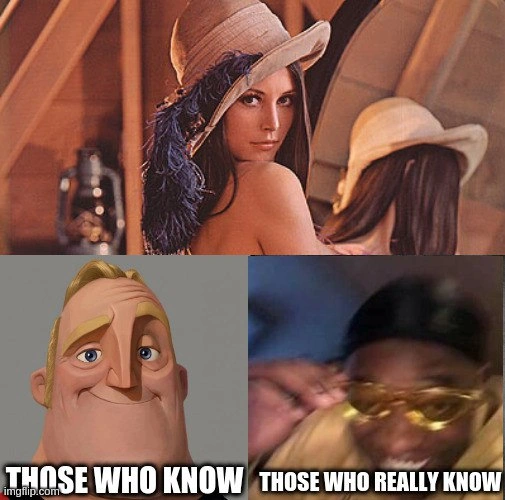
Imagine your teacher always uses the same pretty picture in class to show how to do cool picture tricks on the computer. It looks like a nice lady with a fancy hat, and everyone just thinks, “Oh, that’s a neat example picture!” That’s like the first panel: those who know just see a familiar friendly image.
Now pretend one day you find out a surprising secret: that pretty picture actually came from a very grown-up magazine, not something meant for school at all. Suddenly, the picture feels different because you know where it’s from. You might be a bit shocked or make a “yikes!” face. That’s the second panel: those who really know have the secret background story, and it changes how they feel when they see the picture.
So why is this funny? It’s like if a popular nursery rhyme you sing turned out to have a really weird or spooky origin story – once you learn it, you can’t help but go “Whoa, really?!” In the meme, the character’s happy face turns into a startled face because of the hidden truth about the picture. It’s showing how the same picture can seem totally normal until you learn its secret past. Then you either laugh or gasp knowing what’s really behind that innocent look. It’s a silly way to say: sometimes in technology (and in life), there’s more to something familiar than meets the eye!
Level 2: Not Just a Pretty Face
Let’s unpack this meme for those newer to the scene. The top image is a famous test picture known simply as “Lena.” In many graphics programming and computer vision tutorials, you’ll see this portrait of a woman with a stylish hat. It’s basically the “standard example” for trying out image processing techniques – like a default go-to picture to run your code on. Why Lena? The photo has a nice mix of smooth areas, detailed patterns, and sharp edges, which is great for testing things like blurring, sharpening, or compression. For instance, if you write an algorithm to make images clearer or to compress them into JPEG format, you might feed it the Lena image to see how well it preserves the feather details or the texture of her hat. In short, Lena became a benchmark image – a common reference used to compare algorithm results across research.
Now, the meme’s joke comes from where this picture actually comes from. Many people recognize the Lena image from class or textbooks, but those who really know its history often react with shock or an “oh wow…seriously?” kind of face. That’s exactly what the bottom-right panel shows – a character looking disturbed, labeled “THOSE WHO REALLY KNOW.” It turns out Lena’s photo wasn’t taken for a science project at all; it was originally a Playboy centerfold from November 1972. A centerfold is the large poster-like photo in the middle of a magazine (in this case, a men’s magazine known for adult content). Back in the early 1970s, a group of university researchers needed a test image and ended up scanning this particular magazine photo. They only used the top part (showing the model’s face and shoulders, nothing explicit), and that cropped 512×512 pixel section became incredibly famous in the tech world. At the time, there wasn’t a huge library of digital images available, so using a high-quality magazine photo was a quick solution. They likely chose it because it was at hand and had good variety in content – and perhaps because it was more fun than a picture of, say, an apple or a building!
For years, most people in image processing didn’t even question it – Lena was just a convenient example image. Professors would show it on slides, and students would implement filters on it. The top-left of the meme (the normal Mr. Incredible with “THOSE WHO KNOW”) represents folks who have that casual familiarity: “Oh yeah, that lady in the sample image, I know her, that’s Lena.” It’s just part of the meme culture in programming and research to reuse classic examples.
The twist (and the humor) comes with the insider knowledge of the origin. When you find out “Lena” was scanned from a Playboy magazine, it can be surprising or even uncomfortable — especially in professional or academic settings where such content is unexpected. That’s why the bottom-right panel (with the same character looking horrified and the caption “THOSE WHO REALLY KNOW”) is used. It represents the moment of realization: “Wait, that famous demo picture is actually from a Playboy model?!” The difference in reaction is the key: one panel is blissfully unaware of any controversy, and the other has seen the light (and maybe wishes they could un-see it).
This also ties into a real ethical dataset debate in the tech community. Nowadays, people question whether it’s appropriate to keep using this image. Times have changed since 1973, and what once seemed harmless now raises issues. For example, there’s the matter of consent and context: the model (her name is Lena Söderberg) posed for a magazine, not knowing her image would be used in thousands of technical papers. There’s also the issue of professionalism and inclusion: some argue that having a Playboy image as the default in classrooms and conferences could make some folks uncomfortable or send the wrong message in today’s more diverse field. As a result, some educators and researchers have started opting for other standard images (like photos of peppers, Mandrill the baboon, or the cameraman image – all classic alternatives) to avoid this controversy.
Finally, the meme format itself – “Those Who Know vs. Those Who Really Know” – is a popular one online. It’s often used to joke about any topic where having more background info can totally change your reaction. In this meme, Mr. Incredible (a character from The Incredibles movie) is shown normally on the left, and then a spooky, stressed version of him on the right. This exaggerated contrast is a common way to visualize the difference between simple knowledge and deeper, possibly unsettling knowledge. So if you’re new to MemeCulture: the side-by-side panels with captions imply a before-and-after of learning a secret. And in our case, the secret is the surprising source of the Lena image, a little piece of TechHistory that can make a newcomer’s eyes go wide.
To sum up: the meme is poking fun at the difference between just recognizing a famous tech image and knowing the full story behind it. It’s a friendly little history lesson wrapped in humor. Now you’ll be “in the know” too – just hopefully without getting that thousand-yard stare of the bottom-right Mr. Incredible!
Level 3: Iconic Image, Ironic Origin
In the pantheon of ComputerGraphics and image processing lore, no test image is more legendary than “Lena.” If you’ve dabbled in ImageProcessingAlgorithms, you’ve almost certainly encountered this 512×512 pixel portrait: a woman in a feathered hat gazing over her shoulder. It’s a fixture in countless research papers, textbooks, and demo code. At first glance, it’s just a conveniently challenging picture for algorithm benchmarking – detailed textures (that feather boa), smooth gradients (her cheek), and crisp edges (the hat brim) all in one photo. Those who know this image treat it as a nostalgic baseline for filtering, compression, and computer vision tasks. In fact, Lena is as ubiquitous in graphics circles as the “Hello World” string is in programming.
But those who really know can’t see Lena without recalling the scandalous back-story. The warm studio portrait in that innocent test image was literally clipped from a 1972 Playboy centerfold. Yes, Playboy – the adult magazine – Miss November 1972 to be precise. The image was first scanned in 1973 by early vision researchers who, legend has it, needed a eye-catching photo to test their algorithms (and someone had the magazine handy). The top part of the model’s photo was digitized (with a drum scanner the size of a washing machine) and accidentally birthed one of tech’s most enduring inside jokes. Over the decades, using Lena became a quirky tradition in TechHistory: academic conferences and journals printed this former pin-up in decidedly non-pin-up contexts, from papers on wavelet transforms to demos of the latest retina display.
The humor of the meme lies in that gap between casual recognition and full historical awareness. The top panel’s Mr. Incredible confidently represents any student or developer cheerfully saying, “Oh yeah, that classic Lena test image – great for demos!” Meanwhile, the bottom panel’s dark, distressed Mr. Incredible embodies the seasoned graphics veterans who know exactly where that image originated (and perhaps regret having once explained it to a room of shocked colleagues). The juxtaposition is painfully funny: it’s the difference between a simple CS_Fundamentals example and the “wait…our canonical example came from Playboy?!” revelation. For those in the know, Lena’s origin is both a badge of TechNostalgia and a bit of an awkward secret. After all, how often does a HistoricalContext lesson about a standard test dataset involve a Playboy model sneaking into academia?
Beyond the initial chuckle, there’s a deeper layer of industry reflection here. The ethical_dataset_debate around Lena has heated up in recent years. What started as a half-serious lab tradition is now reconsidered under modern standards of inclusion and consent. Many computer_vision_benchmarks still quietly include Lena out of habit, but some researchers today feel a slight cringe using a decades-old centerfold to teach or test algorithms. It raises thorny questions: Are we perpetuating outdated norms by clinging to this one image? Should tech’s favorite test photo retire gracefully? The meme’s “Those who really know” face isn’t just amused – it’s a bit haunted by the realization that something as innocent as a default sample image carries baggage from a very different era of tech culture.
Through the witty Mr. Incredible contrast, the meme nods to all the graphics programmers and computer-vision researchers who’ve experienced that exact moment of enlightenment. It’s a shared professional rite of passage: first you learn about convolution and JPEGs using Lena’s lovely face, and later you learn you’ve unwittingly been staring at a Playboy model in every homework assignment. Surprise! The result is equal parts hilarity and mild dismay – a perfect concoction for DeveloperHumor. This post, tagged under Graphics and TechHistory, captures that duality beautifully. It’s an insider chuckle that says: “We’ve all been Mr. Incredible at some point – happily using the Lena image, until we dug a little deeper and went a bit pale ourselves.”
Description
A three-panel meme using the 'Those Who Know' format to comment on a piece of computer science history. The top panel displays the 'Lenna' image, a famous standard test image used for decades in image processing research. The bottom-left panel features a slightly smiling but troubled Mr. Incredible with the caption 'THOSE WHO KNOW,' representing people who recognize it as the classic CS test image. The bottom-right panel shows a blurry, intense close-up of a man peering over yellow glasses with the caption 'THOSE WHO REALLY KNOW,' representing those with deeper knowledge. For senior engineers, the joke has layers: 'knowing' is recognizing the Lenna test picture. 'Really knowing' is being aware of its controversial origin as a cropped image from a 1972 Playboy magazine centerfold, a fact that has sparked years of debate in the tech community about ethics and sexism
Comments
25Comment deleted
A junior recognizes the Lenna image from their compression algorithms class. A senior recognizes it and immediately checks the company's image asset policy
Deleting lena.tiff to satisfy compliance triggered 300 failing tests - turns out our real legacy dependency was 512×512 pixels of technical debt
The three stages of understanding any system: 'It's just a CRUD app', 'Well, there's some complexity in the caching layer', and finally 'We have 47 different date formats because of a migration from 2003 and if you touch that regex the entire billing system catches fire.'
This perfectly captures the moment when you realize that 'works on my machine' is just the tutorial level, and production is the Dark Souls boss fight where the database has opinions, the cache lies to you, and that 'temporary' workaround from 2015 is now load-bearing infrastructure that nobody dares touch
Everyone recognizes Lenna; the seniors ask for SSIM on Mandrill, Peppers, and a production JPEG - after you fix the OpenCV BGR->RGB bug and rerun with more than one seed
If your codec tops the leaderboard on the feather‑hat 512×512 but face-plants on user uploads, congrats - you’ve reinvented “Works on My JPEG” with a PSNR dashboard
Those who know follow SOLID religiously; those who really know violate S for shippable code on deadline
Explanation? Comment deleted
+1 Comment deleted
+1 Comment deleted
Lenna or Lena is a standard test image widely used in the field of image processing since 1973. It is a picture of the Swedish model Lena Forsén Comment deleted
OpenCV Comment deleted
what??? Comment deleted
https://www.theatlantic.com/technology/archive/2016/02/lena-image-processing-playboy/461970/ Comment deleted
Awesome! Comment deleted
newfags Comment deleted
Леночка Comment deleted
translate please Comment deleted
feel old yet? Comment deleted
lol Comment deleted
Source pls Comment deleted
just reverse image search on yandex Comment deleted
Codex staging smoke immediate publish 1782861981662 Comment deleted
Just admin testing something Comment deleted
Codex staging lifecycle anchor smoke 1782865518 Comment deleted