When your ‘free pen-test’ turns production into a DDoS demo
Why is this Security meme funny?
Level 1: Too Many Helpers
Imagine you have a nice little treehouse that you built, and you want to see how strong it is. Instead of just asking one expert (like a parent or a builder) to check it, you invite every kid in the neighborhood to come at the same time and see if they can find any weak spots. You think, “Hey, this will be a great free test of my treehouse!” Now suddenly, 284 kids show up in your backyard, all climbing on the treehouse, jumping, pulling, and poking everywhere. What do you think happens? The treehouse starts shaking and cracking from all that chaos. It might even break completely because so many children are messing with it at once.
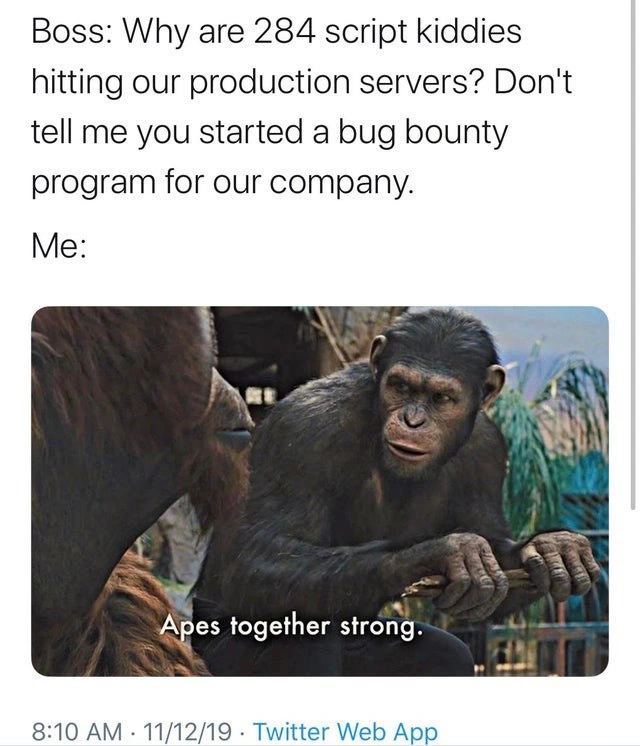
In this story, the boss is like the parent who comes outside and yells, “Why on earth are there hundreds of kids attacking the treehouse? Did you invite them?!” The developer is the kid who did invite them, standing there with a proud but nervous smile. Instead of answering, the kid just points at a scene from a movie where a bunch of apes band together and says, “Apes together strong!” – which is a funny way of saying, “Look, all of us together can really put the treehouse to the test!” The joke here is that the kid thought getting a big group to help would make the treehouse test super strong, but actually it just caused a big mess. The parent is upset because the treehouse (which was perfectly fine for regular use) is now damaged by the huge crowd. The kid finds it a bit cool that so many came to help, but everyone else is like, “This was a terrible idea.” It’s funny (and a little silly) because sometimes trying to help in the wrong way can actually cause a problem, especially if you invite too many helpers at once.
Level 2: Bug Bounty Backfire
A bug bounty program is when a company says, “Hey hackers, if you find a security hole in our system and tell us, we’ll reward you.” It’s like a challenge to find bugs or vulnerabilities, usually done in a controlled, permission-based way. In a well-run bug bounty, the company sets rules (what’s allowed, what’s off-limits) and often uses a special platform. Only trusted security researchers participate, and everyone is careful not to hurt the live product. It’s a win-win: the company improves security, and researchers (ethical hackers) get recognition or money.
In this meme though, the developer basically started a bug bounty without permission – an unsanctioned one. When the boss says “Don’t tell me you started a bug bounty program for our company,” it means the higher-ups had no idea. The developer likely announced somewhere online, “Hey, come test our site for weaknesses!” thinking it would be a free pen-test (short for free penetration test, which is a professional hacking simulation to find vulnerabilities). The big mistake? They let random people test the production servers directly. Production is the live environment – the real website or service that customers use. You normally protect it very carefully. Inviting strangers to attack production is playing with fire.
Now, who showed up to this open invite? Script kiddies – about 284 of them, as the meme jokes. A script kiddie is a slang term in cybersecurity for a beginner hacker who doesn’t necessarily understand all the details but has downloaded a bunch of hacking scripts or tools. Picture a kid with a fancy power tool they barely know how to use – they just point it and pull the trigger. Individually, a script kiddie might poke around a site without causing too much harm beyond maybe a few error logs. But here we have 284 of them simultaneously hitting the site. They’re probably running scanners, automated scripts, trying common exploits – all at the same time. That sudden rush of traffic and weird activity is very similar to a DDoS attack. DDoS stands for Distributed Denial of Service. That’s when lots of computers (distributed around) flood a server with so many requests that real users can’t get through – the server is too busy or even crashes. In this case, each script kiddie is like one source of attack; together they accidentally form a DDoS swarm. The production servers struggle under this unexpected load, and alarms go off.
So, the boss is freaking out, basically asking, “Why are all these random kids with scripts attacking us out of nowhere?” From an operational standpoint, this looks like a massive SecurityIncident – possibly a malicious attack. The on-call engineers (the folks who have to respond to production issues at any hour) likely got paged because the monitoring systems detected unusual spikes or errors. It’s a ProductionIssue of the worst kind because it’s self-inflicted and chaotic. The boss immediately suspects the truth: the developer started a bug bounty without approval, turning the live site into a playground for would-be hackers.
The developer’s response in the meme is just an image – two CGI apes from the movie “Rise of the Planet of the Apes” – with the subtitle “Apes together strong.” This is a well-known meme phrase. In the movie, it’s a powerful moment of the apes uniting. Online, people use “apes together strong” humorously to mean “we’re banding together to do something.” Here, the developer is cheekily comparing the crowd of 284 amateur hackers to a troop of apes who have joined forces. He’s essentially saying, “Yep, I rounded up a bunch of people to work together (to test our security). Look how strong we are together!” It’s a proud but very tongue-in-cheek response – because obviously this “strength” is also what’s overwhelming the system. The humor comes from the contrast: the boss sees a disaster, while the developer is grinning like he’s accomplished something by leveraging sheer numbers.
In simpler terms, the developer tried to cheaply improve security by letting a crowd have a go at breaking the system. But without proper planning, that just caused a backfire. Instead of a helpful security report, they effectively got a mini denial-of-service demonstration. It’s like trying to fix a small leak by opening the floodgates. Everyone else in the company now has to deal with the mess (investigating logs, blocking IPs, calming the boss), while the developer memes about “united we stand.” It’s funny in hindsight because it’s a textbook example of good idea, bad execution: the intention to improve security was good, but the way it was done caused more harm than help.
Level 3: Open Season on Prod
This scenario is a darkly comic lesson in security gone wrong. A developer, eager for a "free" security audit, essentially declared open season on the company’s live systems – and the Internet responded. Suddenly, 284 script kiddies are swarming the production servers. In security lingo, "script kiddies" are novice hackers who run pre-existing scripts and tools to find vulnerabilities. Individually they’re more nuisance than threat, but unite 284 of them and you’ve basically summoned a DIY botnet. The result? An accidental DDoS (Distributed Denial of Service) against your own infrastructure, courtesy of a well-intentioned but very misguided bug bounty. It’s the OnCall nightmare you never want: an onslaught of low-skill attacks generating high volumes of traffic, tanking performance and triggering a flood of production alerts.
The boss’s alarmed question – “Why are 284 script kiddies hitting our production servers? Don’t tell me you started a bug bounty program for our company.” – reveals everything. This was an unsanctioned bug bounty, launched without management approval or proper safeguards. In a seasoned engineer’s eyes, that’s like dangling raw meat in front of piranhas. Proper bug bounty programs are coordinated and scoped; you don’t just tweet “Hack us, please” without expecting chaos. But here the developer did exactly that, essentially outsourcing a penetration test to the masses. Pen-tests (penetration tests) are normally done by skilled professionals in controlled conditions. Skip those controls, and you’ve crowd-sourced a distributed stress test on your prod systems. It’s the Planet of the Apes approach to security: rally a horde and hope for the best.
The meme brilliantly pairs this corporate fiasco with the Rise of the Planet of the Apes reference. The reaction image shows Caesar the ape saying “Apes together strong.” The developer (like Caesar rallying his primate army) is smugly implying that a united crowd is powerful. And indeed, powerful they are – just not in the way the boss hoped. All those “apes” (hackers) together created a strong denial-of-service effect. The humor hits home for anyone who’s dealt with ProductionIncidents: it’s a facepalm moment where a well-meant idea backfires spectacularly. The dev got a free pen-test, alright – complete with free exploits, free traffic floods, and a free demo of how to crash a site. As the on-call team scrambles to distinguish real traffic from mischievous scans, the developer’s proud grin says, “Yes, I did this – and look how mighty our testers are!” Meanwhile, the boss (and every seasoned ops engineer) is groaning, because cleaning up this Production Firefighting mess just became their problem.
To put it in perspective, here’s the difference between a proper bug bounty and what happened here:
| Official Bug Bounty 🛡️ | Unplanned "Free Pen-Test" 🐒 |
|---|---|
| Scope defined (test specific systems or features) | No scope – entire prod environment is fair game |
| Coordinated with ops/security teams beforehand | Surprise swarm attacks at 3 AM, catching everyone off-guard |
| Vetted ethical hackers & clear rules of engagement | Anyone with a script and an appetite for chaos hops in |
| Traffic is monitored & rate-limited to avoid disruption | Uncontrolled traffic spike – basically a volunteer DDoS |
| Issues found are triaged in an organized way | Inbox flooded with random crash reports and dubious bug claims |
In short, the developer skipped the “responsible” part of responsible disclosure. Instead of hiring professionals or setting up a safe sandbox, they unleashed a pack of amateurs directly on production. The phrase “free pen-test” sounds enticing – who doesn’t love free? – but in practice it was free the way a puppy is free: it comes with hidden costs. The cost here is a destabilized site and a very unhappy boss. Seasoned security folks will tell you: a SecurityIncident in production is never free. You either pay upfront for prevention or later in incident response. In this meme’s story, they’re paying in stress and overtime.
And still, the developer sits there meme-ing it up with “Apes together strong,” like it’s a victory. That’s the acerbic punchline: he’s proud of rallying a legion of testers (the Planet of the Apes reference makes it explicitly a legion of primates), inadvertently proving that if you gather enough low-tier hackers, they can definitely bring even a strong system to its knees. It’s a comical cautionary tale: crowd-sourced security without limits will quickly turn into crowd-sourced chaos. The rest of us watching can only shake our heads and mutter, “We’ve seen this movie before – and it doesn’t end well for the humans running prod.”
Description
The meme is styled as a tweet. Top text in black on white reads: “Boss: Why are 284 script kiddies hitting our production servers? Don't tell me you started a bug bounty program for our company. Me:”. Below, a reaction image from the film “Rise of the Planet of the Apes” shows two CGI apes crouching side-by-side; the overlaid subtitle says “Apes together strong.” The overall visual juxtaposes corporate concern with the developer’s proud yet dubious grin at unleashing a crowd-sourced security swarm. Technically, it riffs on the unintended side-effects of launching an unvetted bug-bounty - sudden spikes in traffic, low-effort exploit attempts, and on-call chaos for the ops team
Comments
6Comment deleted
Sure, the CVE count just went exponential - but hey, marketing calls it ‘community engagement at scale.’
Nothing says "we take security seriously" quite like accidentally turning your production environment into a free penetration testing certification exam for everyone who owns a copy of Metasploit
Nothing says 'defense in depth' quite like accidentally crowdsourcing your penetration testing to every Kali Linux tutorial graduate on the internet. At least you're getting real-world threat modeling data - turns out your attack surface is exactly 284 script kiddies wide
Nothing like an open-scoped bug bounty pointed at prod to reveal the real bottleneck: the SIEM's events-per-second license
Bug bounties on prod: where script kiddies upgrade from Metasploit tutorials to your SRE pager's highlight reel
Starting a bug bounty without a VDP, WAF, rate limits, or triage SLAs is just crowdsourced DDoS with paperwork - and your error budget is the first confirmed vulnerability