The 20-Minute Context Wipe
Why is this DeveloperProductivity meme funny?
Level 1: Where Did I Leave Off?
Think about reading your favorite storybook. You’re in the middle of a chapter, really into it, and then you take a short break – maybe you go get a snack from the kitchen. When you come back to the book, you might have forgotten what was happening in the story. You have to flip back a page or reread a few paragraphs to remember who the characters are and what they were just talking about. This meme is saying the same thing, but with computer code instead of a storybook. Coding is like telling a really detailed story to a computer, and a programmer has to keep track of a lot of little details in their head as they write that story. When the person in the meme says, “I’ve never met this code in my life,” they’re joking that after just a short break, the code feels totally new to them – almost like someone swapped their book while they were away.
It’s funny because we’ve all experienced that “What was I doing again?” feeling. Imagine you walk into a room and suddenly forget why you went there. Or you pause a video game, and when you unpause, you have to remember what the mission was. In this case, the programmer took a 20-minute coffee break to relax, basically saying “I need to clear my mind for a moment.” But the joke is that they cleared their mind so well that they cleared out the important stuff too! Coming back, they look at their work and it’s as if their brain has hit the reset button. They don’t recognize the code, just like you might not recognize where you left off in the story. It captures a feeling of confusion in a very exaggerated, comical way. The person knows logically that they wrote the code, but in that moment of returning from the break, it feels like someone else must have written it because they can’t remember any of it. We find that funny because it’s true – our brains can be forgetful if we break our concentration, even for a little while. And for developers, it happens so often that it’s become a lighthearted shared joke: even a tiny coffee break can make your own code look like a stranger’s.
Level 2: Mental Cache Misses
Let’s break this down in simpler terms. Imagine your brain is like a computer that was fully focused on your code. You had a bunch of important details loaded up in your short-term memory: what function you were in, what bug you were tracking, the value of that variable, etc. This is your mental "working set" – all the pieces of the problem you’re actively using, kind of like files laid out on a desk while you work. Now, when you "take a break to clear your head", you’re essentially telling your brain, “hey, we’re not using this stuff right now.” In computer terms, you’re performing a context switch – switching from the “coding” task to the “break” task. Just like a computer swaps out one process for another, your mind shifts to thinking about something else (making coffee, stretching your legs, maybe checking your phone). During that switch, your brain might flush (remove) the information that was only needed for coding, as if it were cleaning up to make space. This is analogous to a computer’s cache clearing out old data when you start a new task. A cache in computing is a small, super-fast storage that keeps recently or frequently used data handy so you don’t have to fetch it from slower memory. While you were coding, your brain had a “cache” of the code’s details. But after a 20 minute break, those details weren’t “recent” anymore, so your brain’s cache dumped them.
When you come back from the break and try to resume coding, you experience a cache miss – that moment when the thing you expect to be in your memory just isn’t there. In everyday terms, it’s like returning to a paused movie and realizing you forgot the plot, so you have to rewind a bit. Here you sit down, look at the code, and go “Wait, what was I doing?” The specific joke in the meme is that the person looks at their code and thinks “I’ve never met this code in my life,” as if the code is completely unfamiliar. Of course, 20 minutes ago it was intimately familiar! That’s the brain_cache_miss effect: your brain’s short-term memory failed to recognize what should have been recognizable, because it got overwritten by unrelated thoughts (coffee, conversations, etc.).
The meme also mentions a “full brain GC pause.” Garbage Collection (GC) is a concept from programming where the system automatically frees up memory that a program is no longer using so that you don’t run out of memory. A GC pause usually means the program stops for a moment to do this clean-up. If your brain does a “GC” when you step away, it’s like your mind said, “Alright, not using this code info now, let’s clean it out.” This is great for freeing up mental resources (so you can relax about work during the break), but not so great when you return, because now you have to reload everything. It’s similar to closing a bunch of browser tabs to free up RAM; later, when you need them again, you have to reopen and reload each tab. The term cold start (or here cold_code_rehydrate) refers to that slow restart when nothing is cached or pre-loaded. Think of how a computer program or a game takes longer to start the very first time (cold start), but if you open it again soon after closing, it loads quicker (warm start) because stuff is still in memory. Coming back from a break is like a cold start for your brain on that code. You cleared your head (closed the program), and now opening it again is slow – you have to rehydrate all those details from scratch by scanning through the code and recalling your last steps.
There’s also a mention of page faults and paging in the context tags (like cognitive_page_fault). In an operating system, memory is managed in chunks called pages, and a page fault happens when a program tries to access data that isn’t in RAM (fast memory) because it got moved to disk (slow storage) to save space. The system then has to load that data back into RAM, which takes time. A cognitive page fault is a cute way to say your brain had offloaded the code info (as if to “disk” – maybe your long-term memory or not at all) and now has to retrieve it. It’s that hiccup moment of “Hold on, let me pull this info back... ah, got it.” You might flip through your code or recall a mental note, effectively paging the information back into your active mind. Until you do, you can’t proceed, much like a program can’t continue until the needed memory page is loaded.
Flow state is another term used here. This refers to a state of deep focus where you’re “in the zone.” In flow, a developer can make quick progress because everything they need to think about is right there in their head, and they’re not getting distracted. A flow_state_eviction means getting kicked out of that zone. Interruptions – even self‐imposed ones like a coffee break – are the fastest way to lose flow. That’s why developers often complain about meetings or pinging them on chat; it’s not the 5 minutes of talking that’s the issue, it’s the fact that regaining that intense focus can take much longer. When the meme says a 20-minute break caused a full brain reset, it’s describing exactly this: you left the flow, and you have to painstakingly find it again.
In simpler developer productivity terms, this scenario is a classic productivity killer. It’s highlighting a part of Developer Experience (DX): how the work environment and habits affect a developer’s efficiency. Here the habit of taking a short break ironically hurts efficiency because of the ramp-up cost afterward. Of course, breaks are also healthy and necessary – no one can code nonstop forever. But every programmer has felt that frustration when a “quick break” or a tiny distraction ends up derailing their progress far more than expected. It feels silly (“How could I forget what I was just doing?!”) but it’s completely normal. Our brains aren’t compilers; they don’t keep an infinite stack of what we were doing without active effort. If you’ve ever come back from vacation and opened up a project only to feel totally lost, this is the mini version of that. Even a coffee break can do it, as the meme jokes. The bottom line: context switching – jumping between tasks or taking interruptions – comes with hidden costs. This meme puts a humorous spin on one of those costs: the cost of reloading your mental context. It’s saying, “We’ve all been there – stepped away for a bit, came back, and went ‘Uh… what is all this?’” with a laugh, because every developer can relate to that memory fog after a break.
Level 3: Context Switching Costs
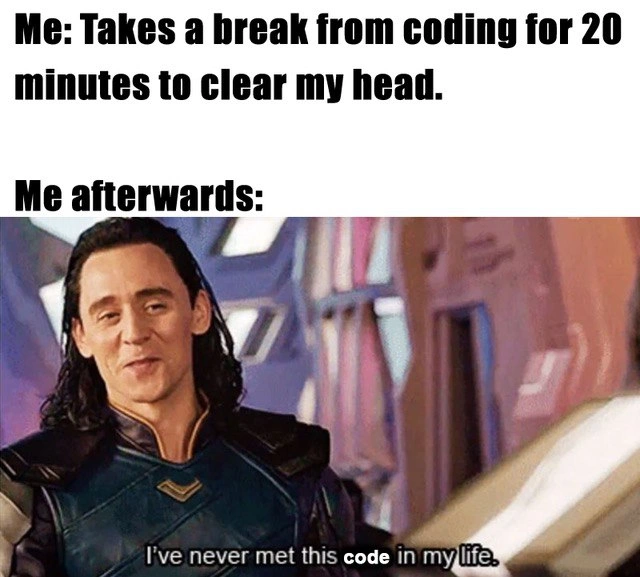
For seasoned developers, this meme hits dangerously close to home. It captures that all-too-familiar scenario: you step away from your desk for a “quick” 20-minute coffee break to clear your head, and you return only to find yourself staring at your own code as if it’s a foreign language. The top panel sets up the expectation (“Me: Takes a break from coding for 20 minutes to clear my head.”), and the bottom panel delivers the punchline (“Me afterwards:”), showing a bemused Asgardian character (a nod to a famous movie scene) claiming, “I’ve never met this code in my life.” That reaction – coming back from a short break and feeling utterly lost in code you were just editing – is a universally relatable dev experience. It’s a moment of developer frustration so common that it’s basically a running joke in the programmer community. We laugh, perhaps a bit bitterly, because we’ve all been that developer, returning from lunch or an impromptu meeting, only to grapple with a sudden bout of source-code amnesia.
Why is this so funny? Because it’s painfully true. The humor here is a mix of self-deprecation and shared suffering. In the meme image, the character’s confident smirk and denial (“I’ve never met this code...”) exaggerate how alien our own work can feel after a mere 20-minute context switch. It satirizes the brain_cache_miss that occurs when we lose our flow state. Flow state is that almost euphoric zone where you’re fully immersed in the task – in coding, it means you have all the relevant pieces of the puzzle loaded into your mind, from the function names to the logic path you were tracing. While in flow, you move swiftly through code; you’re holding the entire stack of what you’re doing in your head. But the moment this state is interrupted – say, by a coffee break, a Slack notification, or a co-worker asking a “quick question” – you risk a flow_state_eviction. All those delicate mental pointers and TODOs you were juggling can fall right out of your short-term memory. Senior devs know that context switching is costly. The industry has long lamented how interruptions or multitasking can destroy productivity, and this meme gives a very pointed example of that cost: the cold start penalty every time you resume work. It’s essentially making fun of the cold_code_rehydrate process: you have to re-read code, scroll through the file, maybe retrace your last steps in a debugger log, just to reload the state that was previously at your fingertips. In other words, you must rehydrate the context from scratch, because it “paged out” when you took that break.
Picture a real-world scenario: you’re neck-deep in a complex function or debugging session. You decide, “Alright, quick breather, I’ll go get some coffee.” You leave your desk, maybe chat briefly about the weather or yesterday’s game (new information incoming!). Your brain, grateful for a rest, starts flushing the stack of code-related thoughts that were hogging your mental CPU. After all, it assumes you’re done with that task for now. Fast-forward 20 minutes: coffee in hand, you sit back down and think, “Now, where was I?” You scroll a bit and see a variable foobar and a function call chain that should ring a bell… but nope. It’s like reading someone else’s code. Your cognitive context got swapped out so hard that you might as well be looking at it for the first time. This is the cognitive_page_fault the meme hints at: your brain tries to retrieve the meaning of foobar from memory and gets a blank stare in return, forcing you to seek that info from an external source (the code itself, documentation, or maybe your notes). That’s the mental equivalent of a page fault in an operating system, where the system has to fetch data from disk because it wasn’t in RAM. Here, you have to fetch understanding from the source code because it’s no longer in your head.
From a developer experience (DX) standpoint, the meme underscores a key issue: the hidden tax breaks and interruptions impose on productivity. It’s tongue-in-cheek, but think about it – those 20 minutes of rest might cost you another 10-20 minutes of ramp-up time when you return. You cleared your head alright, perhaps a little too thoroughly! Every senior engineer has developed coping mechanisms for this. Some will scribble down a quick note before stepping away (“Remember: fix off-by-one in loop, check null on userInput!”) acting like a breadcrumb trail for their future self. Others try to break only at natural stopping points (e.g., after finishing a function or a major piece of logic) to minimize the lost context. And many just sigh and accept the cold reboot feeling as an occupational hazard – hence the rueful humor. It’s a relatable dev experience because even the best of us can’t fully avoid it. We’ve opened up a file we last touched yesterday (or heck, 20 minutes ago) and muttered, “Who wrote this mess?” only to realize with embarrassment it was us. This meme exaggerates that feeling by using a well-known movie line for comic effect, but the core truth resonates deeply in developer culture.
The specific phrasing “I’ve never met this code in my life” is a play on a famous line from the Marvel universe (the character in the image is the trickster god who definitely knows the person he’s claiming not to know). In the film it was a comedic denial, and here it’s repurposed as if the developer (or their brain) is denying any acquaintance with the code they themselves wrote. It’s funny because, as absurd as it sounds, that disconnection is exactly what it feels like after a context switch. There’s an implicit nod to imposter syndrome too – that uneasy notion of “did I really write this? I don’t even understand it right now, so maybe I’m not as competent as I thought.” But primarily, it’s poking fun at the mental gap created by context switching. Seasoned devs have war stories of losing hours this way: a “quick break” turns into an afternoon of trying to reconstruct what you were doing before the break. Or a two-minute outage call at 3 PM causes a flow_state_eviction so severe that by 3:10 PM you’re digging through commit history to remind yourself where you left off. It’s a shared joke that underneath carries a bit of a warning: guard your focus time jealously, because even small interruptions carry a hefty price in cognitive load. This meme, with its simple two-panel setup, encapsulates the irony that sometimes clearing your head literally clears it of everything useful. As a result, you come back as a stranger to your own project, echoing the Asgardian’s amused detachment: “I’ve never met this code in my life.”
# Pseudocode of the developer brain during a context switch
def work_on_code():
context = load_context() # load relevant code context into "fast memory"
focus_mode = True
while focus_mode:
make_progress(context) # work with context loaded
# Developer takes a short break
work_on_code()
take_coffee_break() # context goes idle... potential garbage collection of brain memory
# ...time passes, brain starts freeing "unused" context...
return_to_desk()
def resume_coding():
if context not in brain_cache: # Uh-oh, context was flushed!
context = load_context() # re-load from scratch (cold start)
make_progress(context) # resume work (with some delay to get back in groove)
resume_coding()
# Output: "I've never met this code in my life." (Brain trying to recall context)
In the above tongue-in-cheek pseudocode, when take_coffee_break() is called, the previously loaded context might be deemed unused and get purged from the brain_cache. When the developer returns (resume_coding()), the code checks and finds that context is no longer in the cache – triggering a full reload of context from source (like re-reading your code or notes). Only after this rehydration can progress continue. This is a lighthearted way to visualize why, after even a short break, a programmer often needs a few minutes to regain their stride. It’s not that we literally forget everything in 20 minutes; it’s that the mental index to that information was temporarily misplaced. The meme mocks this phenomenon brilliantly, reminding us that the struggle of context switching is real – and collectively shared by developers everywhere.
Level 4: Stop-the-World Coffee Break
At the deepest technical level, this meme highlights an analogy between human cognition and computer memory management. In computing, a "stop-the-world" garbage collection (GC) pause halts a program to reclaim memory, much like how a sudden coffee break can halt your train of thought and reclaim your mental "RAM" for other tasks. Modern runtime systems (e.g. the Java Virtual Machine) perform GC to automatically free unused objects, but a full GC is expensive: it momentarily freezes all threads, clears caches, and sweeps through memory. The meme quips that a 20-minute break triggers a similar mental GC pause – your brain’s background process decides to flush out the "garbage" (unfortunately including the useful code context you had loaded). The result? Returning to your work feels like a cold start after a complete memory cleanup. It’s as if the working set of your code (the specific functions, variables, and logic you were actively juggling in your head) got evicted from the cache. All those pointers and details you held in short-term memory were collected and thrown away as “garbage” because you weren’t actively using them during the break. The meme caption “I’ve never met this code in my life” perfectly captures the outcome of an over-aggressive mental memory reclamation – your brain essentially performs a mark-and-sweep on your thoughts, and accidentally sweeps away the critical bits needed to recognize your own code.
This invokes the classic hard problem of cache invalidation in computer science. We know that one of the notorious jokes in computing is: “There are only two hard things in Computer Science: cache invalidation and naming things.” Here, our mental cache (the ultra-fast but tiny memory of what you’re doing right now, analogous to a CPU’s L1 cache) has been invalidated by the context switch. In hardware terms, consider how a CPU’s caches work: they rely on temporal locality (recently used data stays ready for quick access). A quick break ruins that temporal locality. It’s like a context switch where the OS scheduler swapped out your code-processing thread for a "coffee-drinking" thread. By the time you resume coding, the CPU’s caches (and your brain’s caches) are refilled with unrelated data – the conversation about lattes, a glance at emails, maybe some fresh garbage collected by your subconscious. When you start coding again, none of the instructions or data you need are in the fast cache anymore. Every lookup into your mind’s cache is a miss, forcing a costly fetch from slower memory. In computing, a cache miss means the processor must fetch data from main memory (or worse, disk), incurring a big slowdown. In the brain, a cache miss means you must recompute things or reread the code to rebuild understanding, which is the cognitive equivalent of pulling data off a dusty hard drive. If you’ve ever heard the CPU term cold start, that’s what your brain is doing – a cold code rehydrate. You’re effectively paging the code back into memory from persistent storage (in this case, your long-term memory or the actual source code on disk). This is akin to a cognitive page fault: the information you need isn’t in RAM (recent memory), so your brain has to pause and swap it back in from “disk” (deep memory or external references). Until that happens, you experience latency – those awkward moments of “What was I working on? What does this function do?”
From a computer architecture perspective, the meme’s scenario parallels the penalty of a context switch on modern CPUs. Each time the OS switches tasks, the new task suffers a flurry of cache misses because the previous task’s data displaced the cache lines. The TLB (Translation Lookaside Buffer) and various levels of CPU cache might need to warm up again with the right addresses. In a complex codebase, your mind’s TLB of what classes, modules, and variables are relevant gets flushed when you shift focus. That’s why even a 20-minute context switch (the human kind) has an outsized impact on developer productivity. The flow of execution in your brain’s neural circuits was interrupted, analogous to a pipeline stall in a CPU where instruction decoding has to wait. You’ve essentially lost branch prediction about where your code was going, and now you have to start over, reconfirming the path. There’s even a bit of theoretical computer science humor under the hood: the meme implicitly references how stack frames and locality work. When you’re deep in coding, you’ve built a mental call stack of function contexts and assumptions. Stepping away causes a stack-frame eviction, conceptually similar to unwinding a call stack without returning to it – all those local variables (your mental notes about state) vanish as if the function ended. Resuming work is like calling that function again from scratch with none of the old state preserved. Only global memory (the most ingrained knowledge of the codebase) persists, if you’re lucky. Everything else resides in ephemeral memory that just got garbage-collected.
On a more theoretical note, this highlights limitations of human working memory. Cognitive science often cites that we can only hold roughly 7 ± 2 items in active memory (Miller’s Law), which is comparable to a very small cache size. To manage complex code, we rely on chunking information and continuous reinforcement (re-reading and reminding ourselves) to keep it in that cache. A break disrupts this reinforcement. Psychologically, there’s even something called the “doorway effect” – when you move to a new environment, your brain tends to flush the previous context (an evolutionary trait to help focus on new stimuli). Here the “doorway” was metaphorical (leaving the IDE to get coffee), but the effect is the same: your short-term memory was cleared to make room for ordering a cappuccino and contemplating the universe for a moment. Essentially, you did a full context switch on a cognitive level, and the mind treated the code context as inactive garbage. Our brains, much like computers, have a hierarchy of memory: a fast but tiny short-term memory (like L1 cache), a slower but larger long-term memory (like disk storage), etc. Moving data between these layers is expensive and lossy. Once the code’s details slip from that fast cache, re-loading them from long-term memory (or reconstructing them from external cues like rereading code) is a slow operation. The flow state eviction that senior developers dread is as real as a thrashing CPU that’s spending more time swapping pages in and out than doing actual work. This meme humorously exposes that fundamental constraint: whether silicon or biological, memory management has unavoidable costs. When the brain’s GC runs, just like a computer’s, you pay with a latency spike in your thought process. And thus, what should have been a refreshing break transforms into a mini reboot of your mental machine, complete with awkward cold start latency and the distinct feeling that someone else must have written the code you see before you.
Description
A two-panel meme. The top panel has text on a white background: "Me: Takes a break from coding for 20 minutes to clear my head." and "Me afterwards:". The bottom panel features a still image of the character Loki, played by Tom Hiddleston, from a Marvel movie. He has a slightly smug, disingenuous expression. The subtitled text at the bottom reads, "I've never met this code in my life." This meme humorously captures the universal developer experience of losing mental context after a short break. The complex state required for coding is so fragile that even a brief interruption can make one's own work seem completely foreign, leading to a period of re-acclimatization
Comments
7Comment deleted
The brain's garbage collector is way too aggressive. It sees an unreferenced pointer to a complex feature and immediately frees the memory the second you look at Twitter
My IDE can restore a 2 GB workspace in seconds - too bad my wetware swap-in latency is measured in failed ‘git blame’ queries
Twenty minutes is exactly how long it takes for your brain's garbage collector to deallocate all those carefully maintained pointers to why you thought that nested ternary operator inside a reduce function was a good architectural decision
The cruel irony of software engineering: you need breaks to maintain cognitive function, but taking breaks destroys the intricate mental model you've spent hours building. It's like running `git reset --hard HEAD` on your brain's working memory - suddenly you're staring at your own code wondering if you accidentally checked out someone else's branch. Twenty minutes is apparently the exact threshold where your hippocampus decides 'this context is no longer relevant' and garbage-collects all those carefully constructed variable names, function call chains, and architectural decisions you were juggling. Senior engineers know this pain intimately - we've learned to leave ourselves breadcrumb comments like 'TODO: future me, you were trying to fix the race condition in the event loop, not refactor the entire authentication system' because we know that future-me in 20 minutes might as well be a different person entirely
Cognitive context TTL: 20 minutes - shorter than any Redis cache, triggering instant imposter syndrome on your own commits
Twenty minutes away and my brain's L1 cache ran LRU; now I'm paying a 30-minute cold-start tax to rehydrate the mental stack and rediscover who mutated state in that 'pure' function
Twenty minutes of “clearing my head” is basically a full GC - now I’m using git blame to onboard into code I wrote this morning