The 'Uber for X' Startup Pitch Fatigue
Why is this Entrepreneurship meme funny?
Level 1: Same Idea, Again
Imagine you have a friend who always comes to you with the same kind of idea over and over. One day they say, "I have a great plan: let's start a lemonade stand... but with a twist, we'll deliver the lemonade like those pizza delivery guys!" The next day, they say, "Actually, how about a lemonade stand on wheels, like an ice cream truck?" After a while, you’d probably sigh and think, "This is basically the same idea again and again." You might even cover your ears when they start with "It's like this, but with..." because you know what's coming.
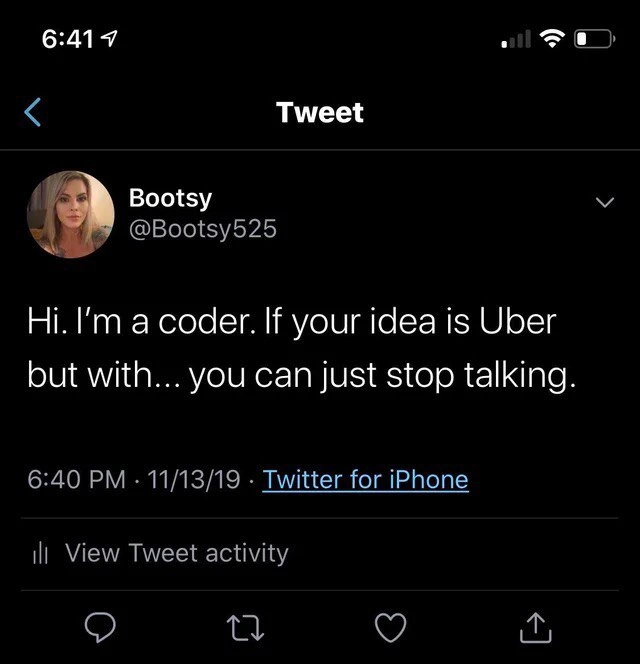
In this meme, a programmer is feeling just like that. A lot of people keep asking them to build apps that are just copies of Uber with a tiny change. It’s like everyone is saying, "Let's do something that’s already been done, but maybe change one little thing and call it new!" The coder is tired of hearing it, just like you’d get tired of hearing the same joke or same idea repeated. So when someone starts pitching "Uber but for [anything]", the programmer wants to press the mute button – which is a funny way to say they just stop listening.
It’s humorous because we can all relate to that feeling: when you’ve heard the same not-so-original idea too many times, you just think, "Oh no, not this again..." The meme is basically the programmer saying, "Please, give me a break. If your big idea is just 'Uber, but with something else', I already know how this goes." It’s a lighthearted way of showing how frustrating and boring it can be to hear the same pitch again and again.
Level 2: "Uber for X" 101
Let’s break down what "Uber but for..." means and why developers react this way. Uber is a famous ride-sharing app that revolutionized how people book taxis using their phone. When someone says "Uber for X", they mean an app or service that copies Uber’s on-demand marketplace model but applied to a different field (X stands for whatever industry or service they have in mind). For example, "Uber for food delivery" was basically the idea behind apps like DoorDash or UberEats – tap a button, and something (food) arrives at your door, just like hailing a ride on Uber. So, "Uber for X" pitches are startup ideas that want to replicate the success of Uber in another domain, like dog walking, laundry, parking, home cleaning – you name it.
Why is this a cliché? Because around the mid-2010s, startup culture saw a huge wave of these on-demand service ideas. Uber’s success made everyone think they could just fill in the blank: Uber for [any service] and boom, a billion-dollar company! It became almost a formula at tech pitch events. Non-technical founders (let's call them stakeholders or idea people) would approach developers with excitement: "I have this great idea, it's like Uber but for [some everyday problem]!" In theory, it’s not a terrible way to communicate the concept – it instantly tells you there will be an app, a two-sided marketplace (like drivers and riders, but maybe cleaners and customers, or chefs and hungry people), and that it’ll work on-demand.
The problem is developers have heard this generic startup idea so many times that it's become a joke. It often signals a lack of originality or lack of understanding of what it takes to build such a thing. To a junior developer or someone new, an "Uber for X" idea might sound exciting – you’re taking a proven model and applying it in a new way. But to an experienced developer, it raises some yellow flags:
- Is it really that simple? Uber’s model works for taxis, but will it work for, say, haircuts or dog grooming? Not every service fits the on-demand app template as neatly as a car ride does.
- Complexity: Building an Uber-like app is hard. You need a backend system that can handle lots of users, real-time tracking of locations, dispatching or matching algorithms (to connect a service provider with a customer quickly), secure payments, and more. This usually means a bunch of different components working together (often built as microservices, which are small specialized applications that communicate with each other). So when someone casually pitches "Uber for X," a developer knows they're actually talking about creating a pretty large, complex system.
- Competition and novelty: So many people have tried "Uber for [whatever]" that if you come with that pitch, a developer might think, "Hasn’t this been tried already? What makes your version special?". There’s a chance the idea isn’t well thought out beyond the one-liner. It can sound like the person is copying a template without a deeper plan.
StakeholderManagement is tough here: the non-technical person might expect the developer to be immediately thrilled and start building the app. But the developer might feel the idea is unoriginal or undercooked. This is where the communication gap shows. The meme shows the coder essentially saying "I’m not interested if you’re just giving me the same old pitch I’ve heard a hundred times." The phrase "you can just stop talking" is a very blunt way to say "I've lost interest." In reality, a developer might not say it out loud (especially not to a potential client or boss), but they might think it. Or they might politely try to steer the conversation to more details: "Okay, so how is your idea different from Uber, what’s the special twist?"
The Twitter screenshot itself also hints at how common this sentiment is. The fact that this tweet exists and people find it funny means a lot of coders out there relate to it. It’s a little bit of an inside joke in the tech community: everyone knows that one person who’s not a coder but has the "next big idea", and it starts with copying a successful app. The developer’s boundary setting here (“I’m a coder, please stop if you start pitching me Uber-for-X”) is a relatable moment of frustration. It says, in effect, "I respect myself enough not to get roped into yet another go-nowhere clone project."
So, in simpler terms: "Uber but for..." has become shorthand for a lackluster, seen-it-before startup idea. Developers, especially experienced ones, often roll their eyes at this because it usually means more work for them to build something that might not succeed, and they've heard it too many times already.
Level 3: Not Another Uber Clone
Seasoned developers have a well-honed radar for generic startup pitches. The instant someone begins with "It's like Uber, but for...", every experienced coder internally cringes. This meme captures that collective DeveloperFrustration. Why? Because in StartupCulture, "Uber-for-X" ideas are the copy-paste business plans of the tech world – overhyped, unoriginal, and often misaligned with reality.
From the senior engineer perspective, hearing yet another Uber-but-for pitch is a signal that the StakeholderExpectations are probably unrealistic. It's industry shorthand for “I have an idea, but no clue about execution.” A developer knows that behind Uber for X lies a laundry list of complex systems to build: real-time GPS tracking, mapping integrations, dynamic pricing algorithms, secure payment processing, driver/passenger matching microservices, rating and review systems, and a global infrastructure to handle thousands of concurrent users. That’s an entire microservice architecture worth of headaches. Building the original Uber took a swarm of talented engineers, years of R&D, and piles of VC funding – not exactly a weekend hackathon project.
Yet non-technical founders and eager MBAs keep coming with these cookie-cutter pitches. It’s practically a trope in StartupHumor:
Idea Person: "I’ve got a million-dollar idea – Uber, but for [random everyday task]!"
Developer: presses mute 🤦
This meme’s humor lies in the communication gap between idea people and builders. The stakeholder/client thinks referencing Uber makes the concept instantly clear and enticing. In their mind, they're tapping into a proven success: "Uber is huge, so Uber-for-dogs will be huge too!" But to the coder, it's a red flag – a sign the speaker might not grasp the nuances or the engineering workload involved. It's IndustryIrony at its finest: the more someone insists "It’s like Uber, but better!", the more the engineer hears "I've done zero homework, please do all the hard parts for me."
There's also a bit of battle-worn cynicism here. By late 2019, uber_for_x_pitches had flooded tech networking events and coffee shop meetups for years. Every developer has heard InsideJokes about "Uber for laundry, Uber for groceries, Uber for dog-walking". Many of those clone startups have come and gone, reinforcing a hard truth: great execution beats great ideas. A pitch that boils down to "We’ll be the next Uber, trust us" tells a veteran dev that the speaker is chasing hype rather than solving a real problem in a unique way. This disconnect in StakeholderManagement leads coders to facepalm and mentally nope out of the conversation. The meme bluntly says what many devs wish they could: "If your whole idea is just 'Uber but with ___', please spare me."
In sum, the humor here plays on a well-known CommunicationGap. It’s an inside joke among tech folks about StartupCulture being stuck in an idea cloning loop. The tweet’s dark-mode, the blunt tone "you can just stop talking", and the instant mute reflex all emphasize how done developers are with these pitches. It's a cathartic, sarcastic eye-roll turned into a one-liner – a way for coders to set boundaries and say "Been there, heard that, not impressed." This combination of tech insider context and jaded honesty is why the meme resonates with so many engineers who have survived one too many "Uber-for-X" meetings.
Description
This image is a screenshot of a tweet from a user named Bootsy. The tweet, posted on November 13, 2019, reads: 'Hi. I'm a coder. If your idea is Uber but with... you can just stop talking.' The visual is simple: white text on a black background, standard for Twitter's dark mode, with the user's profile picture and handle at the top. This meme captures a very specific and widespread sentiment of fatigue among software developers and engineers. It targets the cliché startup pitch format, 'Uber for X,' which became rampant in the 2010s. This formula involves applying Uber's on-demand, platform-based business model to various other industries. For experienced developers, this type of pitch is often a red flag, signaling a lack of originality and a misunderstanding of the immense technical and logistical complexities involved in building a platform like Uber. The tweet humorously and bluntly expresses the exhaustion of being approached with derivative ideas
Comments
7Comment deleted
Every 'Uber for X' pitch conveniently forgets the part where Uber lost billions for a decade before becoming a verb
I’ve added a lint rule to the product roadmap: fail the build if the phrase “Uber but” reaches the PR description
The same people who pitch "Uber but for X" are now pivoting to "ChatGPT but for Y" without understanding that both require solving distributed systems problems they can't even spell
Every senior engineer has heard 'It's like Uber but for [insert random service]' at least a dozen times. The real innovation isn't the platform - it's the developer's ability to maintain a poker face while mentally calculating how many microservices, payment gateways, real-time tracking systems, surge pricing algorithms, and regulatory compliance frameworks they'd need to rebuild just to validate someone's shower thought. Spoiler: it's always more complex than 'just an app.'
'Uber for X' pitches: because every founder thinks geofencing + Stripe solves distributed consensus until the first surge-pricing outage
If your strategy fits after “but with,” it’s a feature flag; network effects, compliance, and unit economics aren’t npm‑installable
If your spec starts with “Uber but for…,” I’m already listing cold‑start, liquidity, routing, pricing, KYC/compliance, payments, trust, and ops under assumptions - aka a weekend app pitched as a three‑year burn