Skip to content
DevMeme
5239 of 7435
AI Merges Brutalist Architecture with a Gothic Cathedral
AI ML Post #5748, on Dec 16, 2023 in TG

AI Merges Brutalist Architecture with a Gothic Cathedral

Why is this AI ML meme funny?

Level 1: The Big Castle Surprise

Imagine you have a big box of plain gray building blocks and you make a little city with them – all the buildings are simple and look the same, kind of boring. Now imagine you also have a fancy castle toy from a fairy tale, all detailed and pretty. If you suddenly put that huge fancy castle right in the middle of your gray block city, it would look really strange and funny, right? That’s exactly what happened in this picture, except a computer did it with real images!

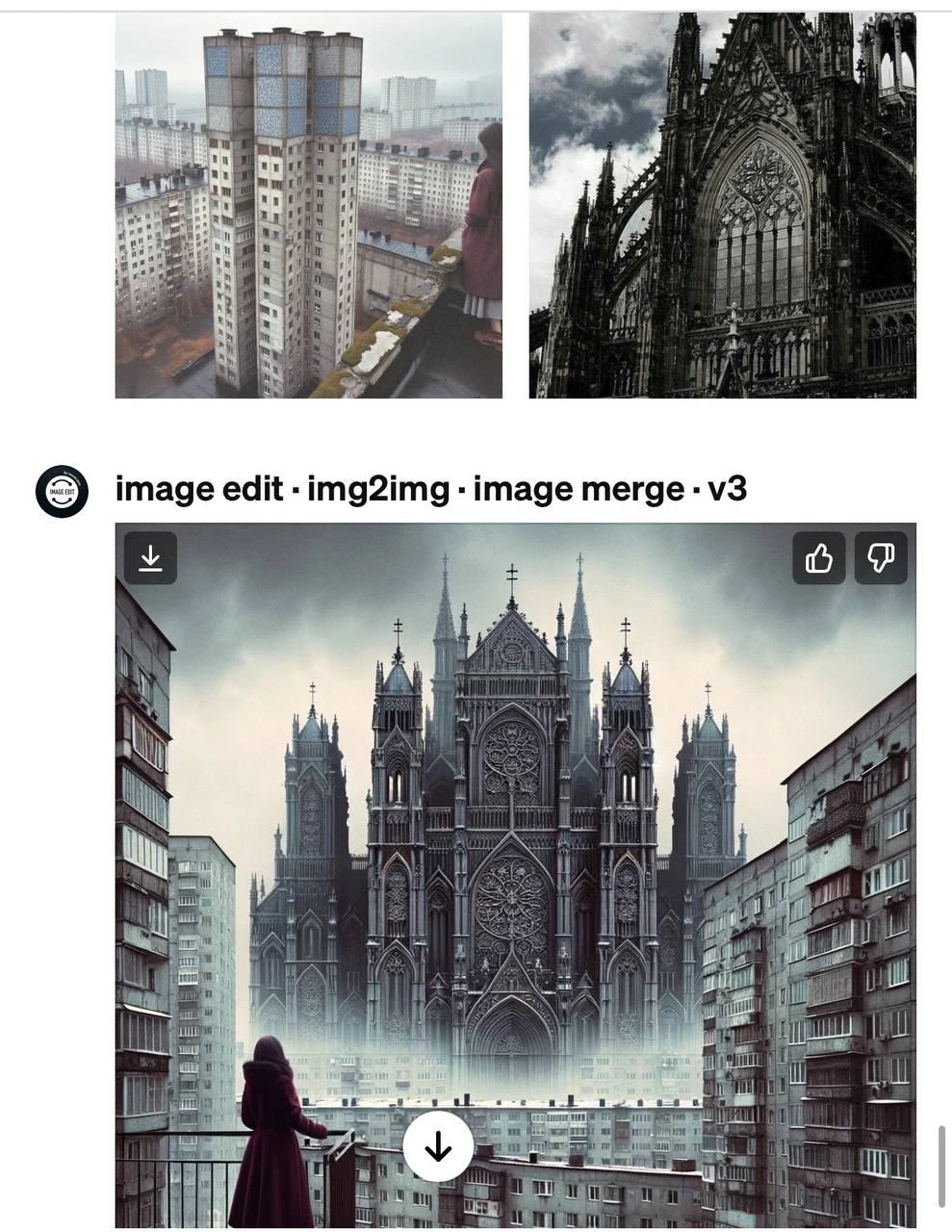
One picture was of some tall, plain apartment buildings (think of these like ordinary LEGO apartment towers). Another picture was of a super fancy old church (like a fairy tale castle with lots of decorations). A special computer program (an AI artist of sorts) took both pictures and tried to mix them into one. The result was a city scene where all those plain apartments are still there, but now a giant Gothic castle (the fancy church) is standing among them, towering over everything! There’s even a tiny person on a balcony looking up at this gigantic castle, as if they’re saying, “Whoa, where did that come from?”

It’s funny because in real life, you’d never see a huge medieval castle stuck in the middle of some 1960s apartment blocks – it’s like mixing two completely different stories or worlds. It’s as if you drew a picture of your neighborhood and then your friend randomly drew a big Cinderella’s castle in the middle of it. The two things just don’t fit together, and that surprise mismatch makes us laugh and go “huh, that’s wild!”. The term “hallucinate” in the meme’s title is a big word meaning “to see something that isn’t really there.” Of course, the computer isn’t really hallucinating like a person might; it just created something that nobody asked for so literally. It’s kind of like if you told someone to combine a tiger and a bicycle in a drawing – who knows what they’d draw? Maybe a tiger riding a bicycle, or a bicycle with tiger stripes. Here the computer decided to put the whole castle into the city scene, which was a very bold (and funny) choice!

So, the big feeling this meme gives is surprise and amusement. We’re amazed that the computer can make such a realistic-looking picture out of two separate ones (the lighting and details look like a real photo!). But we’re also laughing because the content of the picture is so ridiculously fantastical. It’s a bit spooky and a bit magical: a gloomy misty city with a magnificent cathedral that has no business being there. Kind of like a dream where you look out your window and there’s a fairy-tale castle next door. In simple terms: the meme is funny because it shows an AI being creative in a crazy way. It’s as if the AI played a joke by taking a very fancy thing and plopping it in a very plain place. Even a kid can get why that’s silly — it’s like drawing a spaceship inside a barn or a dragon flying over your school. Two things you just don’t expect together, presented with a completely straight face as if it’s real. And that unexpected blend makes us smile and say, “Haha, look at that! Computers do the wackiest things sometimes.”

Level 2: AI Image Mashup 101

So what exactly are we looking at here? This meme is showcasing the quirky outcome of using an AI image editing tool that merges images. Think of Stable Diffusion or similar generative AI tools where you can give the computer some pictures and it will try to create a new picture out of them. The text in the interface, “image edit · img2img · image merge · v3,” hints that the person used a feature often called img2img (image-to-image) with an image merge function. In plainer terms: they had two input images (the top two pictures) and the AI’s job was to combine them into one coherent image (the big picture at the bottom). The top-left input is a photograph of a dull, blocky Soviet-era high-rise building (a classic example of brutalist architecture – buildings that are very plain, boxy, and made of raw concrete). The top-right input is a close-up of a fancy Gothic cathedral facade (Gothic architecture is the polar opposite style: super detailed, ornate, with pointed arches, spires, and decorative carvings, like the famous Notre-Dame or Cologne Cathedral). These two styles normally do not go together at all – one is like a plain LEGO brick tower, the other is like an intricately carved sculpture.

Now, when the user hit “merge,” the AI (likely a stable diffusion model or something similar) tried to make a single image containing elements of both. And oh boy, did it deliver! It produced a foggy city scene where the drab apartment blocks form a ring around an absolutely colossal Gothic cathedral. The cathedral looks like it sprouted right out of the ground where perhaps an apartment building once stood, now towering over all the surrounding buildings. The lone human figure in a burgundy coat standing on the balcony (bottom left of the final image) is from the original photo of the apartments – the AI kept that person in place, which is actually pretty cool because it preserves part of the scene for scale. That person now looks like they’re staring in awe at this gigantic cathedral that wasn’t there before. In a way, that figure is us, the viewers, going “Whoa, what am I seeing!?”

Let’s break down some key terms for clarity:

  • Stable Diffusion: This is a popular machine learning model used to generate images. You give it some input (text descriptions, images, or both) and it generates a new image. It’s called “diffusion” because of how it’s trained to gradually turn noise into clear images – kind of like developing a photo in a darkroom, but with math.
  • img2img: Short for image to image, this means you feed the model an initial image and it will try to create a new image based on it. You can guide it with text or another image. It’s like saying, “Here’s a picture, now paint me a new picture that looks like this one but maybe with some twist.” It’s often used to do things like rough sketches to detailed art, or changing the style of an image.
  • Image merge: In this context, it implies combining two images. Some AI tools let you input two images and will try to blend them together, either by combining their styles or inserting one into the other. Think of it as a very advanced mashup feature.
  • Hallucination (in AI): When we say the AI “hallucinated” the cathedral, we mean the AI invented or introduced something that wasn’t explicitly there. AI doesn’t “know” reality; it just knows patterns from its training data. So sometimes it will add things that seem plausible to it but are not part of the input. For example, if you ask an AI to draw a “cat on a couch” it might hallucinate an extra paw or a weird shadow that looks like another cat, because it’s mixing patterns imperfectly.

What’s funny (and fascinating) about this result is that the AI was asked to combine a boring building and a fancy building, and rather than blending them subtly, it dumped a full-blown Gothic cathedral smack in the middle of the Soviet apartment complex. It’s as if you told it to mix a bicycle with a truck, and it produced a truck with giant bicycle wheels – technically a mix, but not what you imagined. We expected maybe some style transfer – like the concrete apartments getting some Gothic-style windows or arches. Instead we got a literal architectural invasion!

For a newcomer or junior developer playing with such AI tools, this is a classic “oh neat, but huh that’s not what I thought would happen” moment. Imagine you just learned about this cool AI image generator and you feed it two of your photos: one of your apartment building and one of a castle from a vacation. You click merge, expecting maybe a small castle turret on your building, but the AI builds a whole castle that dwarfs your apartment. It’s both impressive and a bit comical. Generative models often require a bit of prompt engineering, which means crafting your inputs carefully. If you don’t give them specific instructions (or even if you do, sometimes), you might get these wild outcomes. That’s why the UI has those thumbs-up/down buttons – the developers of the tool expect that some outputs will be good and some will be pretty off, so they let users give feedback. The download arrow icon means you can save the image if you like it. In the meme image, those icons floating above make it look like a screenshot from a real app (possibly resembling the Midjourney UI or another platform’s interface). It’s showing that this crazy picture came straight out of an AI image editing workflow, not Photoshop or manual editing.

For context, brutalist architecture (the style of the Soviet apartments) is known for being very utilitarian and unadorned. Large prefab concrete panels, repetitive designs, very blocky – the goal was cheap, functional housing, not beauty. Gothic architecture, on the other hand, is all about grandeur and detail – pointed arches, ribbed vaults, flying buttresses, stained glass windows, and lots of ornamentation (think of those beautiful rose windows and gargoyles on Gothic cathedrals). Mixing these two in reality would be an architect’s nightmare (or wild fantasy). The AI doesn’t have a sense of “historic period” or “matching style,” so it just freely mixed them. The humor is partly in that contrast: drab vs. elaborate, modern mass housing vs. medieval masterpiece, all in one city block.

If you’re new to machine learning or these image models, this meme also highlights the idea that AI can be unpredictable. Even though these tools are super advanced, they don’t really understand the way a human does. They’re capable of stunning results, but also wacky ones. And sometimes the wacky ones are the most interesting! Developers often share these kinds of surprising outputs as a way to say, “Check out what I got the AI to do!” It’s both a brag (because hey, it does look cool artistically) and a playful poke at the AI’s limitations. The term AI humor comes from exactly this – when an AI’s mistake or odd creation is entertaining. The tag GenerativeModels and AIHype around this meme indicate the broader context: lots of people are experimenting with these tools, hyping them up, and inevitably laughing when things go sideways.

In summary, the meme is funny-intuitive once you know the basics: it’s showing an example of an AI image generation experiment where the output went in an unexpected, surreal direction. It’s like a demo of “What crazy thing will the AI do if we give it X and Y?” And here the answer was, “It will build a gigantic Gothic cathedral in the middle of a Soviet housing block – because why not?” If you’ve ever used an AI art tool and gotten a result that made you do a double-take, you can definitely relate to this. It’s all part of learning how these new AI tools behave, and it makes for great sharing material.

Level 3: Architectural Fever Dream

For the seasoned developer or ML engineer, this meme hits that sweet spot where powerful technology meets unpredictable outcome. It’s a digital tall tale of what happens when you let a cutting-edge AI tool off its leash with creative tasks. We’ve got two wildly different inputs: a stark, rectangular Soviet apartment block (think cold war-era brutalist architecture, all concrete and no nonsense) and an ornate Gothic cathedral (all spires, intricate stonework, basically the complete opposite aesthetic). The meme’s composite image shows the AI merrily mashing these together: a massive Gothic cathedral rising like Godzilla in the middle of cookie-cutter socialist housing units. It’s the kind of result where an experienced dev chuckles and nods, “Yep, the model definitely hallucinated that one.”

Why is this funny to us? Because it’s a classic case of tooling doing something both brilliant and utterly bonkers. Think of it like when you use an overly smart IDE autocompletion that writes a whole block of code for you, but it’s slightly insane. Here the AI did something visually stunning—technically, the merge is seamless and the lighting/atmosphere are on point (that eerie fog and cohesive color palette!)—yet conceptually, it’s absurd. It’s a fever dream scenario: everything looks plausibly real at first glance, and only after a double-take do you realize there’s a medieval cathedral squatting among 1970s high-rises. That contrast is exactly the punchline. Seasoned devs recognize this pattern from many projects: the system gave exactly what we asked for, not what we actually wanted. We said “merge these images,” and the system, lacking common sense, did literally that in the most extreme way. It’s reminiscent of the programmer joke, “Do what I mean, not what I say.” Well, AI hasn’t quite mastered that yet.

This meme also pokes fun at the current state of AI hype. There’s enormous buzz around generative models like Stable Diffusion, Midjourney, DALL-E, etc., touted as magical art tools that can do anything. But anyone who’s spent late nights tinkering with them (the way old-school devs debug code at 3 AM) knows that these models often produce beautiful nonsense. It’s a shared experience in the AI_ML community: you’re excitedly showing a friend how the AI can edit images with a simple click, you feed it something wild—“Hey, what if I combine a Soviet block with Cologne Cathedral?”—and then you both stare at the screen, equal parts impressed and amused, when the result appears. It’s impressive because the AI really went for it (no half measures, it built an entire fictional mega-cathedral), and amusing because it’s so outlandishly wrong for any practical purpose. It’s the digital equivalent of asking a junior developer to refactor some legacy code and they rewrite the whole module into something flashy that technically passes tests but is nothing like the business intended. 😅

The thumbs-up and thumbs-down icons in the UI are a nice touch in the meme, likely referencing how these AI platforms let users rate outputs or pick the best from a batch. That’s another wink to experienced folks: we know these systems often generate multiple variants and expect the human-in-the-loop to choose the least crazy one. The fact that the depicted output got the download arrow (meaning “yep, I’m saving this masterpiece”) is the cherry on top. It implies the user found this hallucinated cathedral so epic that they want to keep it—perhaps as a trophy of the AI’s spontaneous creativity. In a way, it is a feature, not a bug. This unpredictable creativity is what people secretly enjoy about generative AI. Sure, when you’re on a deadline and need a precise result, an output like this is a facepalm moment. But when you’re experimenting, it’s delightful. It’s like the AI version of an Easter egg or an inside joke.

From a senior dev perspective, there’s also a subtext about merging systems or styles. We’ve all seen what happens when you try to integrate two completely different systems without clear boundaries—it often results in a monstrosity that somehow runs. This image is literally a monolithic monstrosity (pun intended): the classic monolith architecture of a cathedral dropped into a modular modern apartment landscape. It’s as if the AI took two codebases with different design philosophies and merged them. The outcome “works” visually (no errors to speak of, the image is coherent), but it’s architecturally lol-worthy. I can’t help but think of that metaphor in software: “a Gothic cathedral towering over Soviet blocks” could describe some legacy enterprise application that has a sleek modern front-end slapped onto a decades-old backend. The pieces technically interface, but the styles are jarringly mismatched, and anyone who knows the history just shakes their head.

We should also talk about the shared trauma/humor of AI hallucinations. In language models, devs are now familiar with chatbots confidently spouting false info—that’s a “hallucination.” In image models, hallucinations are visual: extra limbs on a person, text that turns into gibberish scribbles, or, say, a random cathedral appearing where it logically shouldn’t. The meme’s title literally uses “hallucinates,” indicating we’re all adopting this term to describe the phenomenon. It’s funny because we anthropomorphize the AI a bit here: the poor thing “thought” a Gothic church belonged in that skyline. Seasoned ML practitioners often joke that these models are a bit like overly imaginative toddlers: they sort of follow your instructions but might add a purple dragon in the sky because, hey, you didn’t say not to and dragons are cool. The lone figure in the burgundy coat on the balcony (apparently kept from the original photo) enhances the humor: we empathize with that figure as if they’re the developer or user, standing there, gazing up in astonishment at what their creation (or the AI’s creation) has wrought. Imagine being that person—yesterday you had a normal view, today there’s a Neo-Gothic mega-cathedral next door. Surprise! It’s a sly nod to the feeling engineers get when their code or model does something wildly unexpected in production.

In terms of industry commentary, this meme lightly satirizes the current generation of AI image editing workflows. We have all these fancy features (image edit, img2img, image merge, as listed in the UI) promising intuitive creative control. But the reality is, using them is part science, part black magic. Prompt engineering (like carefully wording your instructions or selecting just the right input images) is supposed to tame the randomness. Yet even with the best prompts, the model might throw a curveball. Experienced users know to iterate: if version 3 (v3) of the image merge gave you Cathedralzilla, you might tweak some parameters or masks and try again for version 4. The meme’s comedic take is that sometimes version 3 is so gloriously off-track that you just have to laugh and share it. It captures that communal aspect of AI tooling right now: people share the wild outputs as much as the perfect ones, because the fails are often as entertaining as the wins. Just like a group of developers might share a WTF code snippet from a colleague or a ridiculous bug from legacy code for laughs, AI practitioners share these WTF images. They’re unexpected outputs turned into viral humor.

Finally, there’s a bit of historical irony here that a Tech Historian persona might note (pardon me borrowing the hat): Gothic cathedrals took centuries to build by hand, embodying human devotion and meticulous planning. Soviet apartment blocks were often thrown up in a few years as utilitarian mass housing with zero ornamentation. Now, in 2023, an AI in a matter of seconds has effectively slapped the two together, no human architects or urban planners involved, creating something one might only see on a dystopian novel cover. It’s a reminder of both how far our tools have come and how, without proper guidance, they don’t always honor logic or history. The senior folks among us appreciate this duality: AI tools are incredibly powerful, but they also require wisdom (and a sense of humor) to use effectively. When you see a Gothic cathedral towering over Soviet blocks, you’re reminded that even the most advanced systems can produce outcomes that are magnitudes off from expectation. And sometimes, that’s okay—because it makes for a pretty epic meme and a teachable moment in one.

Level 4: Latent Space Alchemy

At the most granular level, this meme is a love letter to the weird science of generative image models—specifically Stable Diffusion and its uncanny ability to create AI-generated content that even Frankenstein would applaud. Under the hood, Stable Diffusion works by converting images into latent space (a compressed mathematical representation of the image) and then performing a controlled diffusion process to generate new images. In an img2img image merge context, the model likely took two distinct latent representations—one for the drab brutalist architecture of the Soviet apartments and one for the intricate gothic architecture of the cathedral—and attempted to blend them. This is essentially a form of neural style transfer on steroids, guided by a diffusion model instead of explicit style algorithms. The result? A surreal architectural chimera that wasn't explicitly in either source image, but emerged from the model’s attempt to reconcile vastly different visual features.

Behind the scenes, the Stable Diffusion pipeline uses a U-Net neural network with multiple cross-attention layers that allow it to take conditioning inputs (like images or text prompts). If you feed it two images (or an image plus a style reference), the model’s attention mechanism will try to attend to both sources simultaneously. The hallucination of a towering cathedral in a Soviet block complex is a direct consequence of how these attention maps and latent vectors intermingle. The network isn’t performing a simple cut-and-paste; it's doing latent space interpolation. Imagine it like solving a high-dimensional equation where the solution image should look a bit like Image A (apartments) and a bit like Image B (cathedral) at the same time. The diffusion algorithm iteratively refines random noise into an image that satisfies these mixed constraints. With such orthogonal inputs, the solver finds a creative optimum: apparently, that optimum is a mega-cathedral that fits the perspective and layout of the apartments. It’s as if the algorithm said, “We have a tall building here and a fancy cathedral there… I’ll just replace the tall building with a cathedral to satisfy both.” Technically, this is the model exploring a seldom-traveled region of its training distribution—a visual scenario it never saw during training, so it’s essentially guessing (with eerie confidence) at how to merge the concepts.

This leads to the AI hallucination we see. In machine learning terms, a hallucination is when the model generates details that were not present or intended—here the model “imagined” an entire Gothic edifice dominating the skyline. There’s a fascinating parallel to how deep networks can exhibit pareidolia (seeing patterns that aren't truly there): the model knows what cathedrals look like and what Soviet blocks look like, but not that they don’t belong together. It treats the task like latent space algebra: cathedral + apartment = ? and comes up with a solution that mathematically satisfies the combination, even if it defies common sense. The sheer size of the cathedral is a side effect of matching the scale and perspective of the original tall apartment tower. Without an explicit constraint for realism or physical logic, the network’s loss function is minimized by a maximal expression of cathedral-ness in the center. In fact, the model even added that spooky fog at the base of the cathedral—likely an artifact of blending the two scenes. This isn't random; diffusion models often introduce mist or smoke in outputs as a clever way to mask seams or reconcile lighting differences. It’s learned from countless dramatic images that a bit of mist makes disparate elements feel part of one scene. In a way, the AI is performing an inadvertent photographic trick to hide its juggling of two realities, just like how a photo compositor might fade edges or add haze to merge images seamlessly.

To put it academically, the meme exemplifies a case of multi-modal conditional image synthesis, where the system must satisfy multiple input constraints. There is research on blending latent representations that explains this effect. If we denote the encoder as E and decoder as D, with latent vectors z1 = E(image1) and z2 = E(image2), one naive merge might be z_mix = 0.5*z1 + 0.5*z2. The decoder D would then generate something like D(z_mix). In practice the pipelines are more complex (they might do a staged or guided merge rather than a linear blend), but conceptually:

# Pseudo-code for combining two images using a diffusion model's latent space
latent_a = model.encode(image_apartment)   # latent representation of Soviet block scene
latent_b = model.encode(image_cathedral)   # latent representation of Gothic cathedral
mixed_latent = 0.5 * latent_a + 0.5 * latent_b  # blend the two latents (conceptual)
output_image = model.decode(mixed_latent)  # decode to an image

In this hypothetical code, output_image would contain features of both inputs. In reality, stable diffusion would refine this through iterative denoising steps, but the gist is that merging high-level representations can spawn novel combinations of those representations. The humor (and horror) for ML engineers is that there’s no explicit rule in the network that “cathedral must remain normal-sized” or “apartment blocks should not become church pews.” The network operates on pattern correlation, not semantic understanding. So from a theoretical perspective, this image is a visual demonstration of the model’s capability to generalize (or mis-generalize) beyond its training data. It’s equal parts brilliant and broken. The AI_ML folks will recognize this as an example of how powerful generative models can be at remixing concepts, but also why we often say these models lack a true world model. The cathedral-block mashup is essentially the AI solving an optimization problem in a way a human never would, reminding us of the famous AI proverb in ML circles: neural networks are universal function approximators—nothing says the approximation has to make sense to humans. Here the function it approximated was “merge these images,” and it found a solution that optimizes a mathematical criterion (matching patterns from both inputs) while blissfully ignoring real-world constraints. This level of technical intrigue—latent mixing, attention mechanisms, and the emergent ghost in the machine—is what makes the meme deliciously nerdy. It’s a gothic monument not only in the image, but to the unholy magic of modern AI tooling.

Description

An image demonstrating a powerful AI image merging feature, labeled 'image edit · img2img · image merge · v3'. At the top, two source images are displayed side-by-side. The left image shows a bleak, foggy, Soviet-era cityscape dominated by brutalist apartment buildings, with a person in a red coat looking out from a balcony. The right image is a dramatic, dark photograph of an intricate Gothic cathedral. The main, larger image below is the AI-generated result. It masterfully fuses the two sources, depicting the massive Gothic cathedral rising ominously in the middle of the brutalist city block. The AI has adopted the color palette and foggy atmosphere of the city scene and applied it to the cathedral, creating a seamless and surreal architectural landscape. The figure in the red coat remains in the foreground, now observing this impossible structure. This serves as a striking example of AI's ability to blend context, style, and atmosphere from multiple sources into a coherent, novel creation, resonating with developers' experiences of integrating wildly different systems or codebases
Comments

7
Anonymous ★ Top Pick This is what happens when you try to integrate the beautifully complex legacy monolith with the new, grimly functional microservices architecture. It compiles, but now the whole city is haunted
  1. Anonymous ★ Top Pick

    This is what happens when you try to integrate the beautifully complex legacy monolith with the new, grimly functional microservices architecture. It compiles, but now the whole city is haunted

  2. Anonymous

    Asked Stable Diffusion to “refactor the legacy Soviet monolith”; it came back with a 300-foot Gothic cathedral - guess the new architecture diagram needs both bounded contexts and flying buttresses

  3. Anonymous

    The junior dev who spent six months building a "scalable, extensible, future-proof" CRUD app is now explaining to the CTO why it needs 47 microservices and a team of monks to maintain it

  4. Anonymous

    When your product manager asks for 'just a small architectural change' to the legacy codebase, and you end up grafting an entire Gothic cathedral into a Soviet-era monolith. At least with img2img you can preview the technical debt before merging to production

  5. Anonymous

    Refactoring legacy brutalism into microservices? Nah, img2img delivers a gothic monolith that mocks horizontal scaling forever

  6. Anonymous

    Asked the model to “merge the two architectures”; it did a cathedral rebase onto Soviet panelka - classic latent‑space interpretation where integration defaults to shipping one massive monolith

  7. Anonymous

    Architectural diagram vs reality: Gothic service‑mesh cathedral on slides, Soviet panel‑block monolith in prod - we call it the Façade pattern

Use J and K for navigation