Skip to content
DevMeme
5238 of 7435
IMG2IMG Wears a Helpful Smile
AI ML Post #5745, on Dec 16, 2023 in TG

IMG2IMG Wears a Helpful Smile

Why is this AI ML meme funny?

Level 1: The Copy Machine With Opinions

This is like putting a drawing into a magic copy machine and saying, “Make another one like this, but better.” Sometimes it gives you exactly what you wanted. Sometimes it gives you a pretty picture where the important part changed for no reason. The funny part is that the button looks happy and simple, but the machine has opinions of its own.

Level 2: Image As Prompt

For a newer developer, img2img means image-to-image generation. Instead of starting with only a text prompt, the tool starts with an uploaded picture. The picture gives the model a visual target, while the prompt says what kind of change should happen. A related txt2edit mode usually means the user uploads an image and describes an edit in words, such as “remove the background” or “make the lighting warmer.”

Image Merge, as described in the post, means using several input pictures and asking the tool to combine their traits. That can be useful for memes, logos, mockups, or concept art, but it is also hard to control. A human editor understands which part of each source image matters. A generative model has to infer that from pixels and instructions, so it may preserve the wrong thing or blend details that should stay separate.

The visible smiley face matters because it suggests ease. The real workflow still requires iteration: upload, prompt, inspect, adjust, regenerate, compare, and sometimes give up and open a normal image editor like civilization briefly returned.

Level 3: Pixels In, Vibes Out

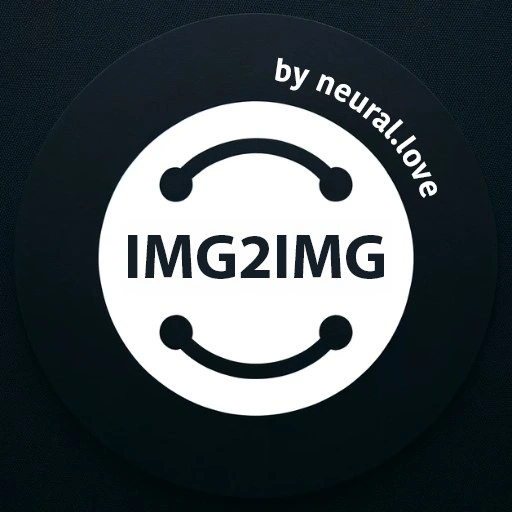
The visible image is a dark circular badge with a white smiley-like center. The main text reads:

IMG2IMG

and the curved text at the top says:

by neural.love

On the surface, it looks like a clean product logo. The developer humor comes from what IMG2IMG implies: take an existing image, feed it into a generative model, and receive a new image that is “similar,” “edited,” “merged,” or “improved,” depending on how optimistic the prompt is feeling today. The post message describes modes like img2img, txt2edit, and Image Merge, which sounds like a tidy menu of features. Anyone who has worked with AI image tools knows the tidy menu is where the chaos politely waits.

In image-to-image generation, the input image is not merely copied. It becomes conditioning data: a guide for structure, composition, colors, shapes, or semantic intent. The model then produces a new sample that tries to satisfy both the image input and the text prompt. That creates the central tension of AI tooling and computer graphics here: the user thinks they are asking for a deterministic edit, but the system is often performing controlled regeneration. “Make this logo cleaner” may mean preserve the logo, mutate the font, invent a symbol, and confidently move a circle three pixels into uncanny territory.

The smiley badge makes the joke sharper because it presents the workflow as friendly and simple. Behind that smile are questions developers immediately start asking: How strong is the image conditioning? Does the model preserve identity? What happens to text? Are multiple source images averaged, blended semantically, or just mashed into a latent-space compromise? How do you evaluate correctness when the output can be plausible, pretty, and wrong at the same time? That is the distinctive pain of generative models: the failure mode is not always an error message. Sometimes the failure mode is a beautiful image that quietly disobeys the requirement.

The post’s boast about reaching a prompt limit also fits the culture. AI builders often respond to unreliable model behavior by adding more instructions, more mode switches, more examples, more guardrails, and more carefully worded “do not” clauses. Eventually the prompt becomes a tiny operating manual duct-taped to a probability machine. The badge says IMG2IMG; the engineering reality says “ETL for pixels, except the transform step may decide the customer needed extra fingers.”

Description

A square logo-style image shows a dark circular badge on a nearly black textured background. In the center is a white circle with a simple black smiley-face mark and large bold text reading "IMG2IMG"; curved white text near the top-right edge reads "by neural.love". The visual refers to image-to-image generative AI tooling, where an existing image becomes the conditioning input for a generated or transformed output. Its meme value is mild and product-like, but the technical context is recognizable to developers familiar with diffusion workflows and AI image-generation pipelines.

Comments

1
Anonymous ★ Top Pick IMG2IMG is just ETL for pixels, except the transform step occasionally invents extra fingers.
  1. Anonymous ★ Top Pick

    IMG2IMG is just ETL for pixels, except the transform step occasionally invents extra fingers.

Use J and K for navigation