JetBrains periodic table parody pokes fun at developer tool obsession
Why is this IDEs Editors meme funny?
Level 1: Homemade Periodic Table
Imagine you ask your mom for a big poster of the periodic table of elements (you know, the chart with all the tiny chemical symbols like H, O, N for a science class). But your mom is really into programming, not chemistry. So instead of a chemistry poster, she gives you a poster covered with all the logos of her favorite coding programs arranged in a grid. It’s as if she thought her programming tools were just as good as the real elements! You look at it and see a bunch of little squares with letters – not the science you asked for, but a bunch of computer stuff. It’s funny because your mom completely missed the point and gave you a home-made “periodic table” that reflects her obsession with coding tools. In other words, you wanted something scientific, but got something geeky from mom’s world – a silly replacement that makes us laugh because it’s so unexpected.
Level 2: The IDE Elements
This meme uses a well-known internet joke format. Typically, a child asks for something (“Can we get X?”) and the parent replies, “We have X at home,” implying they don’t need to buy it. The twist is that the “X at home” is usually an inferior or funny version. Here, the child asks for a periodic table (the chart of chemical elements), but the “periodic table at home” turns out to be a grid of JetBrains product logos. The humor comes from the mismatch – instead of a science poster, it’s a bunch of software icons. It’s poking fun at how a developer (the mom in the joke) might think their software tools are just as fundamental as real chemistry elements!
JetBrains is a company that makes popular programming tools called IDEs (Integrated Development Environments). An IDE is a software application that provides a programmer with many features to write and test code (like a code editor, debugger, etc.) all in one place. JetBrains has a whole family of IDEs and developer tools, each usually focused on a specific programming language or task. Developers often talk about JetBrains IDEs because they’re powerful and can greatly enhance developer experience by catching errors early, auto-completing code, and so on. There’s a bit of a running joke that JetBrains has an IDE for “everything,” and in fact they offer a JetBrains Toolbox subscription that gives you access to all of their tools. So if someone is a big fan, they might have lots of these installed.
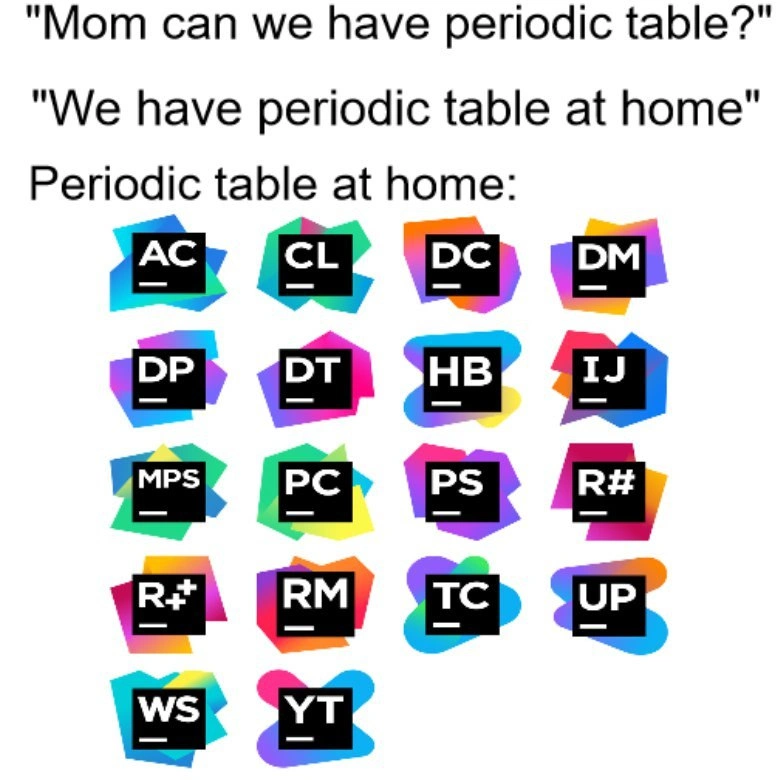
In the meme image, those little two-letter symbols like AC, CL, IJ, etc., are actually the logos for various JetBrains products. They deliberately look like element symbols (white letters on a black square, with a colorful splash behind). For example:
- IJ stands for IntelliJ IDEA, the flagship JetBrains IDE for Java and many other languages. It’s like the “carbon” of their toolset – very common and foundational.
- WS is WebStorm, an IDE for web development (JavaScript, HTML, CSS – all the stuff to build websites).
- PC is PyCharm, used for Python programming (very popular among Python devs for its smart assistance).
- CL means CLion, which is an IDE for C and C++ development (the name hints at C-Lion 🦁).
- RM is RubyMine, for Ruby and Ruby on Rails coding (notice many names have a playful theme).
- R# is ReSharper, a famous plugin for Microsoft’s Visual Studio (the
#hints at C# language; it helps .NET developers refactor and improve code). - TC stands for TeamCity, which isn’t an editor at all but a continuous integration (CI) server – it automatically builds and tests code for you and your team.
- YT is YouTrack, an issue tracker for managing bugs and tasks.
And so on – there are 18 icons shown, representing different tools. Each one has that trademark JetBrains look with two-letter abbreviations (like chemical element abbreviations). So essentially, the meme imagines a “Periodic Table of JetBrains Tools.” It’s a parody: instead of earth, air, water, fire (or rather hydrogen, helium, lithium...), a developer’s basic elements are things like IntelliJ, WebStorm, and PyCharm. If you’re new to programming, just know that JetBrains tools are very popular in the developer community, and many coders swear by them for a good coding experience.
The meme resonates with developers because it’s relatable. Many of us have had that phase of installing a bunch of JetBrains IDEs or plugins for every language we dabble in. It becomes a collection, almost like collecting action figures or trading cards, but they’re software tools. The phrase “we have X at home” is used jokingly here: the mom (a developer type) substitutes the requested item with something from her world. She didn’t give the kid the actual periodic table poster, she gave a homemade version filled with what she finds essential – her JetBrains toolbox. The underlying joke is about perspective: programmers sometimes put their tools on a pedestal. It’s highlighting developer humor where tech memes compare coding life to everyday life in a silly way. Even if you don’t recognize all the icons, you can understand that it’s a bunch of programming tools presented as if they are chemical elements, which is a fun way to show how important these tools feel to a coder.
Level 3: Toolchain Reaction
At first glance, this meme mashes up a classic meme format with a nerdy developer twist. The familiar dialogue goes:
Kid: “Mom, can we have the periodic table?”
Mom: “We have periodic table at home.”
Periodic table at home: [a grid of JetBrains logos].
For an experienced developer, the punchline lands because the “at home” version is a periodic table of JetBrains IDEs. It’s a tongue-in-cheek reference to the way programmers obsess over their tools. Instead of the elemental chart of chemistry, we get a chart of coding tools — implying that for some devs, JetBrains products are just as fundamental as oxygen or hydrogen! The humor is in the substitution: a real periodic table is a scientific foundation, while the JetBrains grid is a foundation of a coder’s workspace. It pokes fun at our developer tool obsession by suggesting that a true geek parent will proudly offer software icons in place of science charts.
This hits home for senior engineers because JetBrains makes an IDE for practically every niche: there’s an IDE for Java, for Python, for C++, for web, for database, for .NET — the list goes on. Many of us have so many JetBrains apps installed that our desktops already look like this meme. If you have the JetBrains All Products Pack or use the JetBrains Toolbox app, you’ll literally see a menu of all these acronyms. The meme arranges them like a scientific table, riffing on how IDEs and developer tools are the “elements” of a programmer’s daily life. Each JetBrains product icon is a little black square with a two-letter symbol (like IJ or WS) on a splash of color, exactly the way chemical elements are shown as symbol blocks. That visual parallel is deliberate and hilarious to anyone who recognizes those logos. (In fact, some coders realize they can identify IJ (IntelliJ) or WS (WebStorm) faster than actual element symbols like Au or Ne!)
On a deeper level, it satirizes how developer experience (DX) can revolve around having the perfect tool for every task. In theory, a periodic table organizes fundamental matter; in this parody, it organizes the JetBrains IDE family. It’s saying: these IDEs are so numerous and essential that they form a universe of their own. Seasoned devs also know an inside fact that adds a wink — many of these JetBrains “elements” share the same base. IntelliJ IDEA is like the carbon of this table: the fundamental element. Products like PyCharm or RubyMine are basically IntelliJ configured for Python or Ruby, meaning under the hood they have the same DNA (or should we say the same atomic number?). So while the meme shows a bunch of distinct symbols, a savvy programmer knows they’re all variants of a common platform (like isotopes of IntelliJ 😄). That makes the parody even richer: it’s simultaneously a JetBrains in-joke and a commentary on how we categorize our tools.
Crucially, the meme format “We have X at home” usually implies the at-home version is a knockoff or disappointing substitute. Here it’s playful because the parent’s “periodic table at home” is just a totally different thing altogether — it’s not even a periodic table of elements, it’s a baker’s dozen of JetBrains icons. The joke lands because devs notoriously get excited about JetBrains tooling; it suggests the parent (probably a coder) figures this is what the kid really needs. It’s absurd and relatable. We’ve all seen scenarios where someone’s solution to every problem is a particular tool or technology. This meme captures that senior-dev quirk: Why learn actual chemistry when you can learn the periodic table of IDEs! It’s exaggeration, of course, but it reflects how entwined our identities can be with our favorite tools. It’s the type of developer humor that makes you chuckle and maybe cringe a little — because yeah, memorizing keyboard shortcuts in IntelliJ sometimes did feel as critical as memorizing the periodic table in school.
Description
The meme is a white background with black text that reads: "Mom can we have periodic table?" followed by the reply, "We have periodic table at home" and a final line, "Periodic table at home:". Beneath the text, eighteen JetBrains product logos are arranged in a grid like chemical elements: AC, CL, DC, DM on the first row; DP, DT, HB, IJ on the second; MPS, PC, PS, R# on the third; R+, RM, TC, UP on the fourth; and WS, YT on the last. Each icon has the trademark JetBrains style - black square with white two-character abbreviation and a small underscore, set against a multicolored polygonal splash. Visually it mimics a simplified periodic table, replacing atomic symbols with IDE abbreviations to joke that a developer’s “elements” are all JetBrains tools. Technically, it riffs on the common “Mom, can we have X? We have X at home” meme while highlighting the breadth of JetBrains IDEs and how developers often treat their toolchain like a fundamental scientific reference

Comments
11Comment deleted
JetBrains’ periodic table proves a new law of developer thermodynamics: each additional IDE increases the base RAM constant by 512 MB - collect the full set and your laptop hits critical GC mass before the first test run
When you've spent so much on JetBrains licenses that your periodic table of elements is just a visualization of your monthly subscription costs, each icon representing another $20/month you'll never admit to accounting
When your development environment has more elements than Mendeleev's table, and each one requires its own 8GB of RAM. The JetBrains suite: where 'lightweight editor' is a foreign concept, but intelligent code completion makes you feel like a wizard. At least you'll never have to worry about which IDE to use - just install all 18 and let them fight for supremacy in your system tray while your laptop fan achieves liftoff velocity
JetBrains' periodic table: because one general-purpose IDE would violate the CAP theorem of dev tools
JetBrains periodic table: whichever element you pick, the chemistry’s identical - JVM spins up, indexing pegs the fans, caches have an EAP half-life, and the only stable isotope is the subscription
In our org, these aren’t elements - they’re isotopes of vendor lock-in; the build only stabilizes when TeamCity bonds with a reachable license server
What's R++? Did Rust and C++ have a child or what Comment deleted
resharper for c++ I guess Comment deleted
Well rust don't have its own yet... Although it's supported as plugin (and also directly in clion) Comment deleted
Isn't goland also belong here? Comment deleted
Where is the DataGrip WTF ? Comment deleted