Skip to content
DevMeme
396 of 7435
A Moth's Primal Urge for a Classic Web Stack
WebDev Post #461, on Jun 19, 2019 in TG

A Moth's Primal Urge for a Classic Web Stack

Why is this WebDev meme funny?

Level 1: Moth Loves Lamp

Imagine a moth flying around in a dark room — all it wants is a bright lamp to feel drawn to. In this picture, the moth with the big glowing eyes is desperately saying, “Brother, give me the lamp,” because moths love light so much they can’t think of anything else. Now, instead of a real lamp, the joke shows a LAMP stack logo (which is actually a bunch of tech tools for running websites). It’s funny because the moth doesn’t know the difference – it sees the word “LAMP” and gets super excited, just like a kid who sees a bright night-light they really like. The meme makes us laugh by mixing something very ordinary and simple (a moth loving a lamp’s light) with something very techy (the LAMP stack that developers use). In a way, it’s saying some developers love their favorite old technology as much as a moth loves a lamp. The feeling it gives is warm and familiar: just like how a night lamp makes a moth happy and comfortable, the classic LAMP stack makes some people who build websites feel happy and comfortable too.

Level 2: Stacking the Basics

So what exactly is the LAMP stack, and why would a developer-moth be so excited about it? LAMP is an acronym that stands for Linux, Apache, MySQL, and PHP (with that "P" sometimes meaning Perl or Python). It’s called a stack because these technologies sit in layers to make a fully functional web server environment:

  • Linux: An open-source operating system that forms the foundation. It’s like the ground floor of a building where everything else runs. In a LAMP setup, the server’s OS is Linux (for example Ubuntu or CentOS), known for its stability and security in BackendDevelopment.
  • Apache: Short for Apache HTTP Server (often just called Apache_httpd, where httpd means HTTP daemon). This is the web server software. Apache listens for incoming web requests (like someone visiting your website) and serves up pages in response. It’s the web server layer — analogous to a restaurant waiter taking your order and bringing your food (the webpage) from the kitchen. Apache was for a long time the most popular web server software in the world, symbolized by that feather logo (though here we see an orange flame on the LAMP graphic, hinting at a "lamp").
  • MySQL: The database layer. MySQL is a relational database management system (RDBMS) where the website can store its data – things like user accounts, posts, or product info. It uses SQL (Structured Query Language) to insert and retrieve data. In our restaurant analogy, MySQL is like the kitchen pantry and recipe book – it holds the ingredients (data) and knows how to organize and retrieve them when asked. For many years, MySQL (or similar databases like MariaDB) was the default choice for storing website data in a LAMP stack.
  • PHP (or Perl/Python): The application layer – the actual code that generates dynamic content. PHP is a scripting language that runs on the server to build web pages on the fly. When you go to a page (say index.php), the server runs the PHP code which might query MySQL for some data and then weave that into HTML that Apache sends back to your browser. PHP was hugely popular for things like WordPress, forums, and many early web applications. In the acronym, sometimes people say "P is for PHP" because that was the most common language used. But it can also stand for Perl or Python, which were other scripting languages you might find in similar Linux/Apache setups. Essentially, this layer is the brain constructing the content to be served — the cook in the kitchen using the recipes and ingredients (data) to prepare the meal (the HTML page).

Together, these four components form a full stack that can host a dynamic website. LAMP_stack became popular because each part is free, open-source, and well-proven. For a junior developer or a student setting up their first server, installing the LAMP stack is almost a rite of passage. In fact, software bundles like XAMPP or WAMP were created to make it super easy to get a LAMP-like environment on Windows or other platforms (XAMPP stands for X-os, Apache, MySQL, PHP, and WAMP is Windows, Apache, MySQL, PHP). The reason the meme calls it “classic” is that in the late 90s through mid 2000s, this was the classic way to deploy web apps. If you learned web development back then, you inevitably learned how to set up Apache conf files, how to create a MySQL database, and write some PHP to connect it all. It was the lamp that lit up millions of personal and commercial websites on the early internet.

By 2019, newer technologies emerged – for example, JavaScript-based stacks like MEAN (MongoDB, Express, Angular, Node.js) or cloud platforms – but LAMP is still around and kicking. Many TechMemes joke about it because it’s simple enough to explain and instantly recognizable. The moth meme format is a bit of absurdist internet humor: a moth character obsessively wants a lamp. In this context, the lamp it wants is the LAMP stack. If you’re newer to programming, picture a stack as a burger: Linux is the bottom bun, Apache the meat patty, MySQL the cheese, and PHP the top bun – together making a full sandwich you can actually enjoy (serve to users!). The moth in the meme doesn’t see acronyms or software, it just sees a big shiny “LAMP” word, so it’s comically demanding it. And for developers, the LAMP logo at the bottom panel — complete with that flame on the P — immediately signals the joke is about old-school web infrastructure.

Overall, the meme’s terms break down to a fun homage to these building blocks:

  • BackendDevelopment and Databases: referring to the server-side guts (like MySQL, and the code that runs behind the scenes).
  • WebDevelopment: the broader context, where LAMP was a go-to solution for creating websites that do more than just show static pages.
  • Linux and Apache_httpd: foundational technologies every web developer encountered in the LAMP era.
  • And even Perl and Python get a nod in the fine print — noting that PHP isn’t the only language one might find on the P slot, but they all iterate on the same idea: server-side scripting to generate web content.

Knowing these basics, it’s easier to see why the LAMP stack is affectionately considered “classic”. It’s like the old reliable car that still runs perfectly – it might not be as shiny as a new sports car (modern frameworks or microservices), but you know exactly how to drive it. And in this meme, that old car is being treated like the most desirable thing on earth by the moth character, which is funny and oddly heartwarming for those of us who started on LAMP.

Level 3: Illuminating Nostalgia

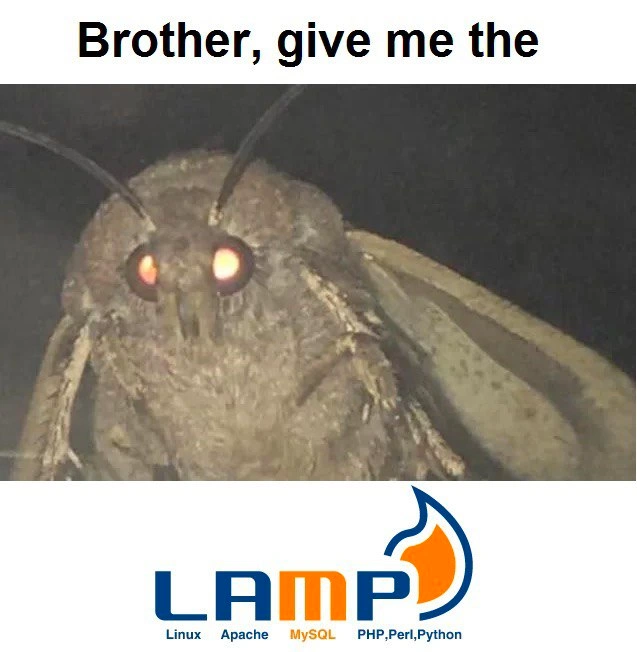
At first glance, this meme fuses a viral moth meme with classic WebDev tech, creating a hearty dose of tech nostalgia. The top text "Brother, give me the..." mimics a famous internet joke where a moth begs for a lamp’s light. Here the punchline is the bright blue-orange LAMP logo – not an actual lamp, but the venerable LAMP stack of web development. For seasoned developers, this lands as a clever pun: the moth’s obsession with a literal lamp becomes a developer’s ironic craving for the Linux + Apache + MySQL + PHP/Perl/Python stack. It’s a playful twist of tech humor where a mainstream meme about a bug loving light is repurposed into a niche joke about backend architecture. The phrase "to illuminate your server room" in the title adds an extra layer: a server room is usually a place of blinking LEDs and terminal glow, so the moth (with glowing red eyes, no less) demanding the LAMP stack suggests that this classic tech combo is as comforting and enlightening to a developer as a 60-watt bulb is to a moth.

Beyond the wordplay, the humor taps into real backend culture and history. The LAMP stack was once the guiding light of WebDevelopment – a simple, reliable way to host dynamic websites. In the early 2000s, deploying a site often meant spinning up a Linux server, installing Apache to handle HTTP requests, setting up a MySQL database, and writing server logic in PHP (or occasionally Perl/Python). This stack was everywhere, from personal blogs to early startup sites – truly the legacy_web_stack that lit the path for countless projects. By 2019 when this meme was posted, many developers had moved on to trendy new flames (like Node.js with NoSQL databases, or containerized microservices orchestrated by Kubernetes). Yet, seeing the moth passionately demand the classic LAMP stack strikes a chord. It’s as if some grizzled sysadmin or nostalgic dev inside us – the moth in all of us – still longs for the warm glow of that tried-and-true architecture. After wrestling with the complexities of modern cloud deployments, who wouldn’t feel a bit of BackendHumor in the idea of retreating to a simpler light?

The meme also winks at the endless stack_acronyms and tech stack wars. We’ve seen the rise of MEAN (MongoDB, Express, Angular, Node), MERN, JAM, and more. But LAMP is the elder acronym, practically TechHistorian material at this point. By visually summoning the LAMP logo, the meme reminds senior devs of a time when your stack’s name literally spelled out LAMP – a beacon of simplicity. It’s legacy yet legendary. The moth’s glowing eyes convey an almost religious fervor, as if the LAMP stack is a sacred light. This satirizes how older tech sometimes has die-hard fans: just like that moth that refuses to love any light but a lamp, an old-school dev might insist nothing beats a classic Linux server running Apache_httpd with a trusty MySQL backend and some PHP scripts. There’s a hint of sarcasm here too: modern infrastructure can feel like chasing ever-more complicated neon lights (containers, serverless, microservices), while this moth just wants the one humble lamp it knows and loves.

In essence, at the senior developer level, the meme is commenting on how far web dev has evolved – yet how we still fondly remember (and sometimes prefer) the straightforwardness of that foundational stack. It’s an inside joke acknowledging both the absurdity and the comfort in clinging to older technology. Just as a moth’s simple brain is irrevocably drawn to a flame, tech folks can be irresistibly drawn to solutions that simply work. The LAMP stack might be old-school, but like a porch light that’s always on, it reliably illuminated our first adventures in backend development. TechHumor like this gets a knowing chuckle because it connects a goofy insect meme to real feelings about tech choices and the passage of time in our industry. It’s the light-hearted (pun intended) recognition that sometimes the classic tools still feel like home – and we’re all a little moth-like in our affection for them.

Description

This is a tech-themed adaptation of the popular "Moth Lamp" meme. The top half features text that reads, "Brother, give me the", followed by a close-up image of a large, fuzzy moth with glowing orange eyes, characteristic of the original meme format. The bottom half of the image displays the logo for the LAMP stack, which includes the text "LAMP" in large blue and orange letters, with the full stack components listed underneath: "Linux Apache MySQL PHP,Perl,Python". The joke is a pun, substituting the moth's obsessive desire for a literal "lamp" with the acronym for the foundational LAMP web development stack. It's a niche joke for web developers who recognize both the internet meme and the classic, somewhat legacy, technology stack

Comments

7
Anonymous ★ Top Pick The moth isn't just attracted to the light; it's drawn to the warm, comforting glow of a stable, monolithic architecture and the sweet, sweet smell of a connection_status.php file
  1. Anonymous ★ Top Pick

    The moth isn't just attracted to the light; it's drawn to the warm, comforting glow of a stable, monolithic architecture and the sweet, sweet smell of a connection_status.php file

  2. Anonymous

    Legacy moth to the cloud-native intern: “Keep your thousand-pod Helm chart; this dusty LAMP has been printing revenue and 99.95% uptime since Subversion r1.”

  3. Anonymous

    Twenty years later, we're still maintaining that LAMP stack because the moth that built it is now the CTO and swears it scales better than your Kubernetes cluster

  4. Anonymous

    The LAMP stack: proof that moths had better architectural instincts than most startups in 2024. While everyone's chasing the latest JavaScript framework that'll be deprecated by Tuesday, this moth knows that sometimes the old reliable stack that's been running half the internet since 2001 is exactly what you need. No Kubernetes, no microservices, no serverless - just a moth, a server, and the comforting glow of Apache logs scrolling by at 3 AM

  5. Anonymous

    LAMP: the porch light of every org - flip it off and the legacy moths (and half the revenue) vanish

  6. Anonymous

    This moth gets it: scalability? Who needs it when PHP can handle 10 concurrent users just fine

  7. Anonymous

    Funny how after a year of microservices and a service mesh, prod still whispers 'give me the LAMP' - one VM, Apache+PHP-FPM, and a MySQL binlog restore that actually works

Use J and K for navigation