Skip to content
DevMeme
1681 of 7435
Bro, Did You Test This?
Testing Post #1877, on Aug 6, 2020 in TG

Bro, Did You Test This?

Why is this Testing meme funny?

Level 1: Did You Try It?

This is like building a paper airplane, handing it to a friend, and watching them ask, "Did you throw this even once?" The funny part is that the problem seems so obvious that the reviewer cannot believe it got this far. The meme captures that small, painful moment when someone else checks your work and immediately finds the thing you forgot to try.

Level 2: Click It Once

Testing means checking that software behaves the way it should. A unit test checks a small piece of code, an integration test checks that parts work together, and manual QA checks the product like a real user would. Code review is when teammates inspect the change before it is merged.

The meme is about a reviewer finding something so obviously broken that they wonder whether the developer tried the change even once. Maybe a button does nothing, a page crashes, a form accepts bad data, or a fix works only for the exact example used during development. The line Bro, did you test this? is blunt because the bug looks too basic to have survived a real check.

For junior developers, this is a common rite of passage. You make a change, verify the narrow thing you were focused on, and miss the surrounding behavior. A useful habit is to test like someone who does not know your code: start from the UI, try the normal path, try one bad input, and rerun the automated tests before asking other people to review it.

Level 3: Review as QA

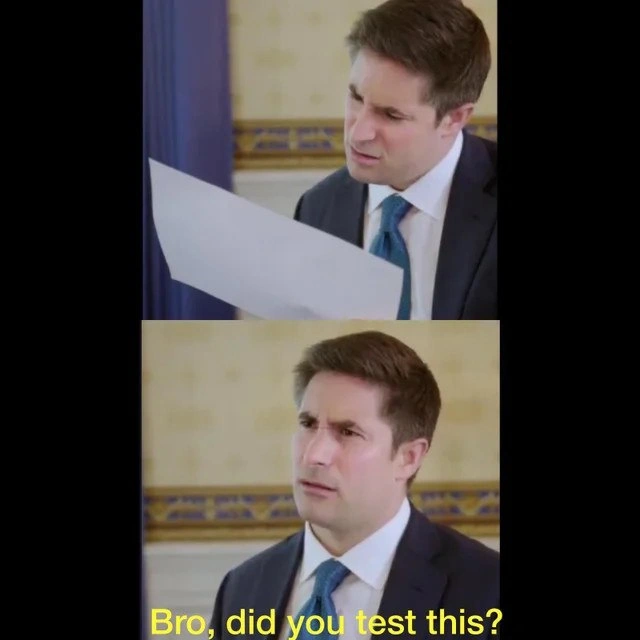
The caption at the bottom asks:

Bro, did you test this?

That question is funny because it is not a sophisticated review comment. It is the moment before sophistication, when the reviewer is still trying to determine whether the author ran the code at all. The two-panel reaction matters: first the reviewer reads the paper, then looks up with disbelief. In software terms, that is the exact transition from "interesting diff" to "this button crashes on click."

The meme lives in the awkward overlap between code review, quality assurance, and testing culture. Reviews are supposed to catch design issues, maintainability problems, missing edge cases, and risky assumptions. They are not supposed to be the first time anyone discovers that the happy path does not work. Yet every team eventually sees a pull request where the implementation compiles, the explanation sounds confident, and the reviewer breaks it in under thirty seconds by doing the most normal user action imaginable.

The painful part is that "did you test this?" can mean many different things. Did you run the unit tests? Did you manually click through the affected flow? Did you test the empty state, the disabled state, the permissions boundary, the migration path, the mobile layout, the failed network call, and the user who enters a surname longer than a database column? The author may honestly believe the answer is yes, because they tested the one path their mental model included. Production, as usual, prefers the paths no one pictured.

Good engineering teams try to avoid this by turning repeated embarrassment into process. They add automated tests for fixed bugs, tighten acceptance criteria, improve PR templates, and make CI run the boring checks humans forget. Bad teams turn the meme into a ritual: ship first, ask "did you test this?" later, then schedule a meeting to discuss quality while the same flaky branch limps toward release.

Description

The meme uses two stacked reaction shots of a suited interviewer first reading a sheet of paper and then looking up with a confused, skeptical expression. At the bottom, large yellow text reads, "Bro, did you test this?" The image has black side bars and no other significant visible text. The technical context is the moment in review or QA when an obvious broken path suggests the author relied on optimism instead of a test run.

Comments

1
Anonymous ★ Top Pick The most expensive test suite is still the reviewer clicking the one path the author never opened.
  1. Anonymous ★ Top Pick

    The most expensive test suite is still the reviewer clicking the one path the author never opened.

Use J and K for navigation