Skip to content
DevMeme
Patch notes fix a spacebar - overheating bug, frustrated power-user demands it back
Bugs Post #64, on Feb 7, 2019 in TG

Patch notes fix a spacebar - overheating bug, frustrated power-user demands it back

Why is this Bugs meme funny?

Level 1: The Squeaky Door

Imagine a house with a squeaky door. The landlord finally oils it — a clear improvement! But one tenant is furious: she relied on the squeak to know when her cat snuck out. "Put the squeak back," she demands. The landlord stares in disbelief, because who uses a broken door as a cat alarm? But for her, the squeak wasn't a problem — it was a feature she built her whole routine around. That's the joke: no matter what you fix, somebody somewhere was secretly using the broken part, and they will absolutely leave a comment about it.

Level 2: Bugs, Contracts, and Changelogs

Key vocabulary the comic runs on:

  • Changelog — the list of what changed in a new version (the "CHANGES IN VERSION 10.17" panel). Users read it mostly to find out what to be angry about.
  • Bug fix vs. breaking change — a bug fix corrects unintended behavior; a breaking change alters behavior someone relies on. The comic's punchline: these can be the same change. Whether something is a bug or a feature is decided by the user who depends on it, not by the developer who wrote it.
  • Backwards compatibility — the promise that new versions won't break existing users. Maintainers of libraries, operating systems, and APIs spend enormous effort honoring this, which is why ancient quirks survive in modern systems like flies in amber.
  • Emacs — a text editor so extensible that users script every aspect of it; the comic picks it because "I configured Emacs to do X" is plausible for nearly any X, including reading CPU temperature.

The early-career version of this lesson: you fix a "bug" in an internal tool, and a teammate's script — which parsed the buggy output — explodes. You learn that anything users can observe, they will eventually depend on: error message wording, JSON key order, timing, even crashes.

Level 3: Observable Behavior Is the Real API

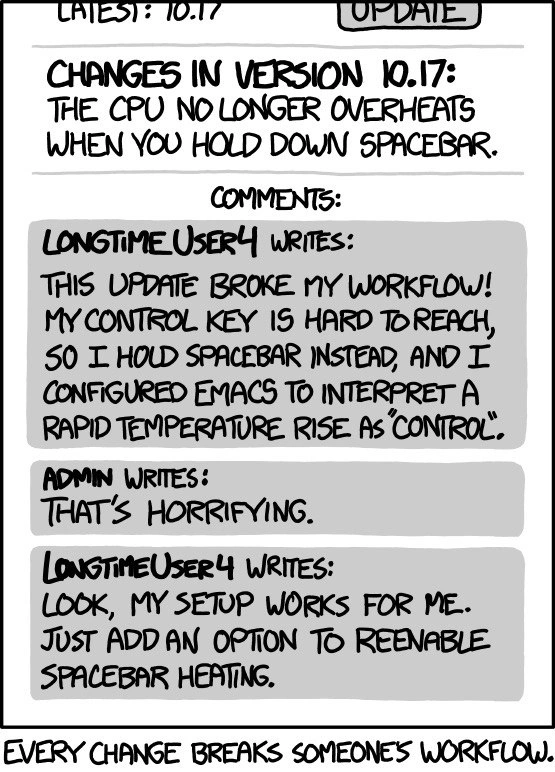
This is xkcd's "Workflow" — arguably the most-cited comic in software maintenance, because it gave engineering culture its perfect parable for Hyrum's Law: with a sufficient number of users of an API, it does not matter what you promise in the contract; all observable behaviors of your system will be depended on by somebody. The comic weaponizes this by choosing the most absurd observable behavior imaginable. The changelog for version 10.17 proudly announces:

THE CPU NO LONGER OVERHEATS WHEN YOU HOLD DOWN SPACEBAR.

A pure bug fix. Objectively good. Then LongtimeUser4 arrives in the comments: "This update broke my workflow! My control key is hard to reach, so I hold spacebar instead, and I configured Emacs to interpret a rapid temperature rise as 'control'." The admin's reply — "That's horrifying." — is the entire profession speaking with one voice. And the user's rebuttal is the genre-defining line: "Look, my setup works for me. Just add an option to reenable spacebar heating."

What elevates this past a gag is how precisely it maps to real maintainer trauma. The user isn't wrong that the change broke them; the maintainer isn't wrong that the dependency is deranged. Both are locked in the structural tragedy of platform stewardship: every bug that survives one release becomes behavior, every behavior becomes a contract, and every contract acquires constituents. This is why Windows famously ships compatibility shims for decades-old applications that relied on memory-allocator quirks, why Linux's kernel rule is "we do not break userspace," and why deprecating anything on a popular API spawns a thread of LongtimeUser4s, each with a setup that "works for me." The Emacs detail is the chef's kiss — the editor whose configurability is so total that binding thermal throttling to a modifier key reads as only mildly exaggerated. The choice of "option to reenable" also nails the maintainer's no-win endgame: every escape-hatch flag you add is a behavior fork you now support forever, which is how config files metastasize into archaeology.

The bottom caption — "EVERY CHANGE BREAKS SOMEONE'S WORKFLOW." — isn't hyperbole; it's a conservation law. The only software with no breaking changes is software with no users.

Description

Black-and-white webcomic panel styled like a software update dialog. Text at top: "LATEST: 10.17 UPDATE". Bold heading: "CHANGES IN VERSION 10.17: The CPU no longer overheats when you hold down spacebar." Below, a comments section in grey bubbles. 1) "LONGTIMEUSER4 writes: THIS UPDATE BROKE MY WORKFLOW! My control key is hard to reach, so I hold spacebar instead, and I configured Emacs to interpret a rapid temperature rise as 'Control'." 2) "ADMIN writes: THAT'S HORRIFYING." 3) "LONGTIMEUSER4 writes: Look, my setup works for me. Just add an option to reenable spacebar heating." Footer caption: "EVERY CHANGE BREAKS SOMEONE'S WORKFLOW." The humor targets developers: a bug (CPU overheating on spacebar hold) is patched, but a niche Emacs power-user relied on the hardware malfunction as a custom control key signal, illustrating how seemingly obvious fixes become breaking changes for edge-case workflows, release-note anxiety, and backwards-compatibility headaches

Comments

7
Anonymous ★ Top Pick We closed “spacebar heats CPU to 95 °C,” reopened as sev-0 when a veteran dev’s Emacs macro - watching /sys/class/thermal/zone0/temp>90 °C for Ctrl - stopped working; Hyrum’s Law, now featuring the flag --enable-scorched-earth-compat
  1. Anonymous ★ Top Pick

    We closed “spacebar heats CPU to 95 °C,” reopened as sev-0 when a veteran dev’s Emacs macro - watching /sys/class/thermal/zone0/temp>90 °C for Ctrl - stopped working; Hyrum’s Law, now featuring the flag --enable-scorched-earth-compat

  2. Anonymous

    Somewhere there's a principal engineer who just discovered their entire distributed tracing system depends on a deprecated jQuery method that only works when the browser thinks it's Internet Explorer 6

  3. Anonymous

    With a sufficient number of users, there's no such thing as a private bug - somewhere, spacebar heating is a load-bearing dependency with an SLA

  4. Anonymous

    This perfectly captures the nightmare of maintaining production systems: you finally fix that CPU thermal issue from users hammering the spacebar, only to discover someone's been running their entire Emacs workflow on temperature-based control signals for years. It's the software equivalent of finding out your 'temporary' fix from 2015 is now load-bearing infrastructure. The real horror isn't the bug - it's that somewhere, right now, there's a senior engineer who genuinely sympathizes with LongtimeUser4's position because they've seen worse in production

  5. Anonymous

    Emacs power users: remapping spacebar to Ctrl since RSI was just 'commitment to the craft' - now nerfed by mere sanity

  6. Anonymous

    Backward compatibility shouldn’t extend to side‑channel input devices; if your Emacs config relies on Tjmax, file the change request with Facilities, not Engineering

  7. Anonymous

    When your input layer relies on thermal throttling, the fix becomes a breaking change - fine, we’ll ship a feature flag called enable_spacebar_meltdown and call it ‘backward compatibility.’

Use J and K for navigation