Skip to content
DevMeme
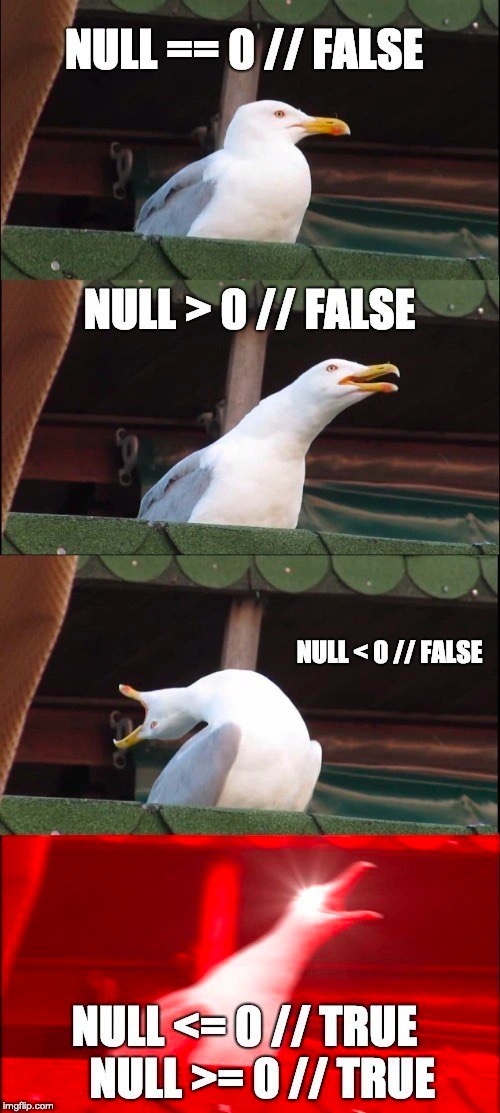
Seagull discovers JavaScript’s null comparison paradox and loses its mind
Languages Post #65, on Feb 7, 2019 in TG

Seagull discovers JavaScript’s null comparison paradox and loses its mind

Why is this Languages meme funny?

Level 1: The Riddle That Cheats

Imagine asking a friend: "Is nothing the same as zero?" — "No." "Is nothing more than zero?" — "No." "Less than zero?" — "No." "So... is nothing at most zero?" — "Yes! And also at least zero!" You'd stare at them exactly like this seagull stares at the sky, because those answers can't all be true at once — it's like a riddle where the rules change between questions. The bird's growing scream is every programmer realizing the language they use every day answered the riddle that way on purpose, wrote it down in the official rulebook, and will never change it.

Level 2: Coercion, or Why JavaScript Guesses

Some definitions to defuse the seagull:

  • null — JavaScript's value for "intentionally nothing." Not zero, not empty string: the deliberate absence of a value.
  • Type coercion — JavaScript's habit of automatically converting values between types so an operation can proceed. Compare null with a number, and the language quietly turns null into 0 first — without telling you.
  • == (loose equality) — compares after coercion, with special handwritten rules; null == 0 is false because the rulebook says null only equals undefined.
  • === (strict equality) — compares value and type, no conversions. This is why every mentor and linter tells juniors: use three equals signs until you can explain this meme from memory.

The classic early-career encounter: a form field or API response yields null, your >= 0 validation waves it through, and you spend an afternoon discovering that JavaScript considered "nothing" to be a perfectly fine quantity. That afternoon is this meme.

Level 3: The WAT Genre, Peer-Reviewed

The four-panel escalation — captions reading NULL == 0 // FALSE, NULL > 0 // FALSE, NULL < 0 // FALSE, then the red-tinted shriek of NULL <= 0 // TRUE, NULL >= 0 // TRUE — is the Inhaling Seagull template doing exactly what it was born for: three beats of mounting comprehension, one beat of cosmic protest. It belongs to the proud lineage of the "WAT" genre of JavaScript humor, where the joke is simply reading the language's actual behavior aloud.

Why does this land so hard with working developers? Because null handling is not trivia — it's a production bug generator. Any comparison like if (value >= 0) silently passes when value is null, because null coerces to zero in relational contexts. Pair that with an API that returns null for "missing" and you've got a discount calculation treating absent prices as free, or a pagination offset accepting nothingness as page zero. The standard defenses became industry liturgy: always use strict equality (===), which never coerces; lint rules like eqeqeq that ban == outright; and eventually TypeScript, whose strict null checking exists in large part because of exactly this family of landmines. There's also a deeper irony seniors appreciate: == treating null as equal only to undefined was a deliberate convenience feature — the one blessed use of loose equality (value == null checks both nulls at once) — and it's precisely that special case that makes the operator inconsistent with <=. The fix for one footgun is the ammunition for another. The language never had a chance: ten days of design, thirty years of memes.

Level 4: Trichotomy Dies in the Spec

The seagull is screaming about a genuine violation of mathematical order theory. For real numbers, the law of trichotomy guarantees exactly one of a < b, a = b, a > b holds — and from it, a <= b is provably equivalent to (a < b) ∨ (a = b). JavaScript's panels assert: not equal, not greater, not less... yet both <= and >=. The bird's spine arches accordingly.

The trick is that ECMAScript implements equality and relational comparison with two unrelated algorithms:

  • null == 0 runs Abstract Equality Comparison. The spec special-cases null: it's loosely equal only to undefined and itself. No numeric conversion ever happens, so the result is false by enumerated fiat.
  • null > 0, null < 0, null <= 0 run Abstract Relational Comparison, which knows nothing of those special cases. It applies ToPrimitive then ToNumber, and ToNumber(null) is +0. So the engine actually evaluates 0 < 0false and 0 > 0false.
  • Here's the punchline mechanism: the spec defines a <= b not as "less or equal" but as !(b < a). Since 0 < 0 is false, null <= 0 is !falsetrue. Same negation trick yields null >= 0.

So <= is not the disjunction of < and == — it's the negation of the reversed <, computed under a different coercion regime than == uses. Two algorithms, two philosophies, one operand, zero consistency. This is the formal-semantics flavor of humor: every individual spec step is locally defensible, and their composition violates an axiom most programmers absorbed in grade school. Brendan Eich built the language in ten days in 1995; the web then froze these behaviors into permanent backward-compatible amber, which is why TC39 can add BigInt and pattern matching but can never, ever fix this.

Description

Four-panel seagull-scream meme. Panel 1: calm seagull, white text reads “NULL == 0 // FALSE”. Panel 2: seagull opens beak slightly, caption “NULL > 0 // FALSE”. Panel 3: seagull leans forward, caption “NULL < 0 // FALSE”. Panel 4: zoomed-in, glowing red, screaming seagull; two bold lines state “NULL <= 0 // TRUE” and “NULL >= 0 // TRUE”. The gag highlights ECMAScript’s counter-intuitive type-coercion rules: equality treats null as only equal to undefined, while relational operators coerce null to numeric 0, yielding the apparently contradictory outcomes that every senior frontend dev has debugged at 2 a.m

Comments

7
Anonymous ★ Top Pick The moment someone ships code that relies on `null >= 0`, the on-call rotation instantly gains infinite squawk retries
  1. Anonymous ★ Top Pick

    The moment someone ships code that relies on `null >= 0`, the on-call rotation instantly gains infinite squawk retries

  2. Anonymous

    After 20 years in this industry, I've accepted that NULL isn't the absence of value - it's the presence of every possible quantum state of wrong, simultaneously

  3. Anonymous

    null isn't equal to, greater than, or less than 0 - but it's both <= and >= 0. JavaScript: violating trichotomy since 1995, and we still shipped the entire web on it

  4. Anonymous

    This meme perfectly captures the moment every senior engineer realizes they need to add 'null !== undefined && value != null' to their linting rules after the third production incident this quarter. The real kicker? In JavaScript, null is simultaneously less-than-or-equal-to AND greater-than-or-equal-to zero because ToNumber(null) returns 0 for relational comparisons but not for equality - a design decision that makes perfect sense if you've never had to debug a payment processing system at 3 AM where someone's account balance is null instead of zero

  5. Anonymous

    Only JavaScript makes a value neither > 0 nor < 0 yet both <= and >= 0 - two specs, two truths, one null

  6. Anonymous

    NULL: neither > nor < zero, yet humbly <= and arrogantly >= - the relational anarchist every architect dreads

  7. Anonymous

    JavaScript: where a value can be neither <, >, nor == 0, yet still satisfy both range checks - enable eqeqeq and strictNullChecks before your validation turns into metaphysics

Use J and K for navigation