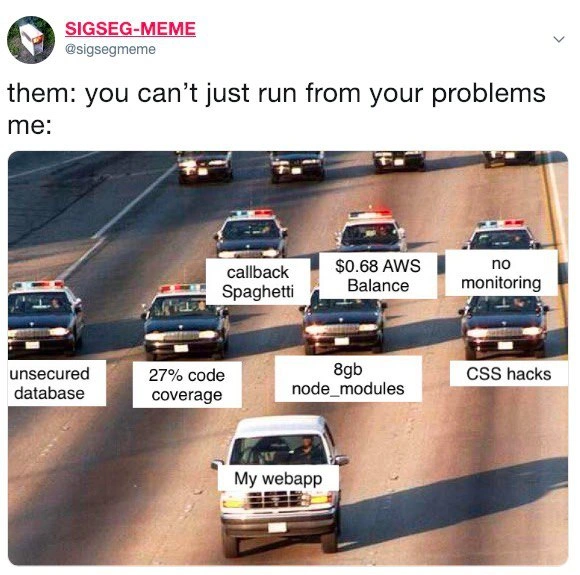
When your webapp goes full Bronco on accumulated tech debt
Why is this TechDebt meme funny?
Level 1: Driving Away From Your Chores
Imagine your messy room could chase you. Not fast — just always there behind you: the unmade bed, the homework you didn't do, the goldfish you forgot to feed, all rolling along in a slow parade while you pedal your bike ahead of them. You're not escaping, exactly. You're just staying slightly in front, waving, pretending this is fine. That's what this developer is doing with their website: every shortcut they ever took is following them down the highway, and instead of stopping to clean up, they've decided the real solution is to simply never stop driving.
Level 2: Meet Your Pursuers
Each police car is a real, common shortcut in web development:
- Unsecured database — a database exposed to the internet with no password or default credentials. Automated scanners find these constantly; it's the #1 way side projects leak user data.
- 27% code coverage — coverage measures what percentage of your code is executed by automated tests. 27% means roughly three-quarters of the app has never been verified by anything but hope.
- Callback spaghetti — deeply nested asynchronous JavaScript callbacks (
callback hell), the tangled control flow style thatPromiseandasync/awaitwere invented to escape. - 8gb node_modules — the
node_modulesfolder holds your project's dependencies. Eight gigabytes means dependencies-of-dependencies have metastasized; the heaviest object in the universe, as the older joke goes. - $0.68 AWS Balance — nearly out of cloud-hosting money. When it hits zero, the chase ends for everyone.
- No monitoring — no error tracking, no uptime checks, no logs anyone reads. The app may be down right now. Who would know?
- CSS hacks — layout held together with
!important, magic negative margins, andz-index: 99999.
The rite of passage this meme commemorates: realizing your first real project accumulated all seven of these, and that "I'll fix it later" is a load-bearing architectural decision.
Level 3: Low-Speed Chase, High-Interest Debt
The template choice is doing heavy lifting here. The 1994 O.J. Simpson Bronco pursuit was famously a slow chase — a white Bronco cruising down an emptied Los Angeles freeway, trailed at polite distance by a phalanx of police cars, while the entire nation watched on live TV. That's exactly the physics of technical debt: nothing is actually catching you right now. The webapp runs. Users click things. But the pursuers are always in the mirror, in formation, patient:
unsecured database · 27% code coverage · callback Spaghetti · $0.68 AWS Balance · 8gb node_modules · no monitoring · CSS hacks
What makes this list great satire is its accuracy as a portfolio of debt types. The unsecured database is the time bomb — the open MongoDB era taught us these get found by scanners within hours, not by hackers in hoodies but by scripts. 27% code coverage is the honesty metric: high enough to claim "we have tests," low enough that every refactor is a prayer. callback Spaghetti dates the codebase to pre-async/await Node, where business logic descended six indentation levels into the pyramid of doom. no monitoring is the load-bearing item — it's what allows the chase to continue, because you can't be alarmed by alerts you never configured. And $0.68 AWS Balance reframes the whole pursuit: this app isn't fleeing toward salvation, it's fleeing until the credit card declines.
The caption — "them: you can't just run from your problems / me:" — captures the actual senior-engineer truth the meme winks at: yes you can, and the industry does, constantly. Rewrites get funded; remediation doesn't. Incentive structures reward the next feature, not raising the coverage number, so the rational individual move is to keep driving. The fleet never accelerates... until the day it does, all at once, usually starting with the unsecured database and a polite email from a security researcher. Or an impolite one from a ransomware bot.
Description
Tweet-style meme from the account “SIGSEG-MEME @sigsegmeme”. The text reads: “them: you can’t just run from your problems me:”. Below, the famous white-Ford-Bronco freeway photo is shown. The lone front vehicle is over-laid with the label “My webapp”, while a fleet of police cars behind it each carries a white caption box naming a lurking issue: “unsecured database”, “27% code coverage”, “8gb node_modules”, “CSS hacks”, “callback Spaghetti”, “$0.68 AWS Balance”, and “no monitoring”. Visually, flashing red-blue lights underscore urgency as the cars barrel down a multi-lane highway. Technically, the meme lampoons every senior engineer’s nightmare: a production service sprinting into traffic while security gaps, brittle CSS, bloated dependencies, near-zero cloud budget, spaghetti callbacks, minimal test coverage, and total lack of observability race to catch up. It’s a darkly comic snapshot of what happens when tech debt, poor code quality, and neglected ops finally chase a hastily shipped webapp
Comments
7Comment deleted
Sure, you can ghost your incident backlog - right up until the PagerDuty sirens overtake your Bronco and AWS starts billing for the mileage
The beauty of microservices is that now your $0.68 AWS balance can fail independently across seventeen different availability zones
The chase ends the way they all do: not with the police catching up, but with the $0.68 AWS balance hitting zero and the whole pursuit getting terminated by the billing alarm you actually did configure
Every senior engineer knows that '$0.68 AWS Balance' isn't just a number - it's the exact moment between 'we're fine' and 'why is the CTO calling me at 2 AM?' The real tragedy here isn't the callback spaghetti or the 8GB node_modules; it's that 27% code coverage, which means someone actually *tried* to write tests but gave up after the happy path. And let's be honest: we've all shipped that webapp being chased by these exact cops, telling ourselves 'we'll circle back to monitoring after launch' - a promise as empty as that AWS account balance
Current architecture: we treat 8GB node_modules and 27% coverage as eventual consistency; when the AWS balance hits $0.68, we autoscale observability to zero and call it cost optimization
The webapp's HA strategy: High-velocity Avoidance, until node_modules' event loop catches the license plate
You can outrun callback spaghetti for a sprint, but the SLO police inevitably catch you when “no monitoring” meets an unsecured database and your AWS tank reads $0.68