Born just in time to abuse AI with truly cursed image prompts
Why is this AI ML meme funny?
Level 1: Super Tech, Silly Fun
Imagine you have a super-powerful computer that can draw anything you tell it to. It’s like a magical art machine. Now, logically, you might think people would use this magic machine to do really important things – like painting awesome new landscapes or designing helpful inventions. But what do we actually do? We ask it to make funny, ridiculous pictures just to see what happens! 😂
This meme jokes about how people always find a way to turn even the most amazing technology into a toy for laughs. Think of it this way: long ago, people could explore new lands on Earth or maybe in the future they’ll explore distant planets in space. But you and I were born in a time where something different is happening – we have AI, a kind of super smart computer program. And what timing for us! Instead of sailing the seas or flying rocket ships, we get to play with this AI and make it do crazy stuff. It’s as if someone gave us a genius robot helper, and our first request was, “Hey robot, draw something really silly that no one’s ever seen, like a picture of a movie star kissing a goofy alien from a film.” Totally not saving the world – just goofing around.
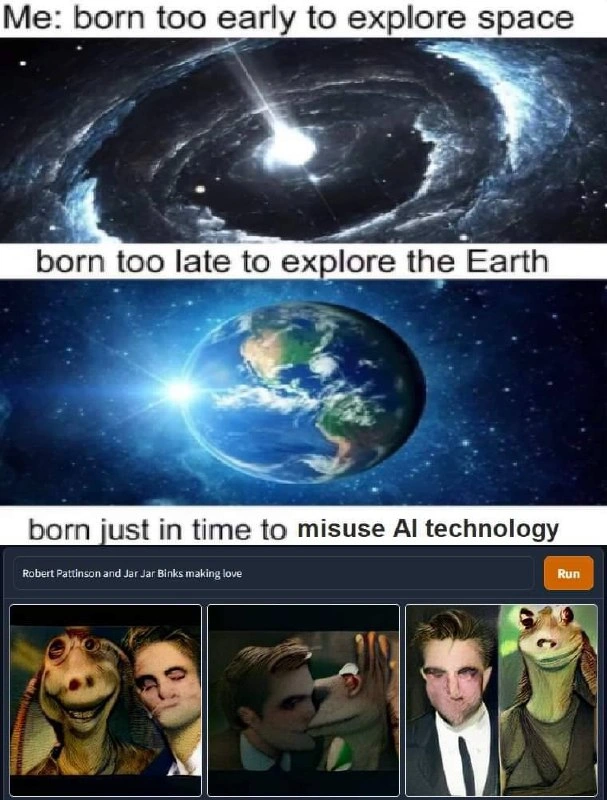
The meme shows this in three steps. First, it says some people were born too early to go explore space. That’s like saying “aww, we can’t be astronauts visiting other galaxies because we were born at the wrong time.” Then it says some of us were born too late to explore the Earth, meaning “shoot, all the cool discovering of new lands and islands already happened before we were around.” Those two statements make you think, “man, did we miss all the great adventures?” But then comes the funny twist: we were born just in time to misuse AI technology. In plain words, that means we arrived exactly when we could mess around with awesome AI tools in ways they probably aren’t meant to be used.
And the example given is super silly: it shows a computer screen where someone typed in “Robert Pattinson and Jar Jar Binks making love” into an AI image generator and hit run. In kid terms, that’s like telling a very smart art robot, “draw something naughty with this real person and a cartoon alien, hehe.” The result (those blurry pictures) is the robot’s attempt to do it – and it’s likely both funny and weird-looking. The meme is funny because it highlights how humans can turn any powerful new thing into a source of entertainment. It’s like having a spaceship and using it to go buy ice cream; sure, it’s not what the spaceship was made for, but it’s kind of hilarious that you could do that.
So the big feeling behind this is: We might not be heroes of land or space, but boy, do we get to have some quirky fun with the technology of our time! It’s poking fun at us, saying “Yep, this is our legacy – great advancements and we make goofy art with it.” And honestly, that contrast – between serious potential and silly usage – is what makes it so humorous and light-hearted. It reminds us that at the end of the day, people love to play and have a laugh, no matter how advanced our toys have become.
Level 2: Cursed Prompt Playground
Let’s break down what’s happening in this meme in more straightforward terms. The meme uses a classic three-part formula:
“Born too early to explore space.” – This text is placed over an image of a beautiful spiral galaxy. It means the person (the “Me” in the caption) feels they were born too soon in history, probably before humanity has the technology for starships to travel the galaxy. It’s a humorous way to say, “Darn, I wish I could hop on the Millennium Falcon or join Starfleet, but I live now, not in some sci-fi future.” Many science enthusiasts have this feeling because real interstellar travel is still a distant dream. The galaxy visual really drives home “space” and “the final frontier” kind of vibe.
“Born too late to explore the Earth.” – This caption goes with an image of Earth from space. It conveys that the person also missed the great ages of earthly exploration. Think about people like Columbus, Magellan, or Amelia Earhart – in the past, there were still unmapped corners of the Earth to discover or first journeys to achieve. Nowadays, pretty much every island and mountain is known, mapped by satellites (hence the image of Earth itself, as seen from a satellite or the ISS). The meme is humorously saying, “If only I had been around a few hundred years earlier, I could have been an explorer with a ship or something. But alas, Google Maps and airplanes beat me to it.” So these first two panels set up a feeling of having missed out on grand adventures both future and past. This “born too early/late” setup is a known meme format where people fill in the blanks with various laments.
“Born just in time to misuse AI technology.” – This is the twist, the part that makes this meme unique and funny. Instead of another majestic image, we see a screenshot of an AI image generator interface. It’s a dark-themed application window. There’s a text box (labeled “prompt” or similar) that contains the user’s input: “Robert Pattinson and Jar Jar Binks making love”. Next to it is an orange “Run” button, which presumably the user clicks to generate images. Below that, we see four little image previews (thumbnails). They are blurred out, but given the prompt, they likely show some attempt at the scenario described – probably a very weird and maybe creepy set of images of that actor and that Star Wars character in romantic poses. The caption “born just in time to misuse AI technology” is the meme’s way of saying: “Alright, maybe I can’t trek the stars or discover new lands… but hey, I can play with these crazy new AI tools in ways no one in the past ever could!” It’s using the word “misuse” playfully. Misuse here means using something in a way it wasn’t really intended for, often a silly or wrong way. The meme implies that firing off a prompt like that into an AI is definitely not the serious intended use of such advanced tech – it’s more like a prank or a curiosity-driven stunt.
This panel is packed with AI references. Let’s clarify a few terms and ideas:
- AI image-generator UI: This stands for an Artificial Intelligence image generator User Interface. There are apps and websites that let you type a description (the prompt) and then the AI creates an image based on it. By 2022, names like DALL·E, MidJourney, and Stable Diffusion were becoming famous for doing exactly this. The interface typically has a text box where you enter whatever wild idea you have, and a run/generate button to tell the AI “go ahead, make it!”. After some processing time, you get one or several images as output. In the meme’s image, the UI is dark (perhaps a nod to developers’ love for dark mode) and shows four outputs, which is common – many such tools return multiple results so you can pick the best or see variations.
- Prompt: The prompt is just the text you give to the AI describing what you want. Here the prompt is explicitly shown:
"Robert Pattinson and Jar Jar Binks making love". It’s quite the prominent example of a prompt because it’s combining two known characters in a scenario that is unusual (to put it mildly). Robert Pattinson is a real-life actor (famous for movies like Twilight where he played a vampire, and later he portrayed Batman). Jar Jar Binks is a fictional alien character from Star Wars (often remembered for being goofy and clumsy). Normally, these two have nothing to do with each other – they belong to completely separate universes! And “making love” puts them in a very intimate, R-rated context. So this prompt is likely chosen to be as ridiculous and provocative as possible, just to see if the AI will actually try to fulfill it. - Cursed image/art: Internet slang alert! When we say an image is “cursed,” we mean it’s strangely disturbing or gross, yet fascinating – the kind of picture that might make you laugh uncomfortably or go “oh no, why does that exist?”. A cursed AI art prompt, therefore, is one that’s almost guaranteed to produce something deeply weird or nightmarish. People often do this for amusement. This meme’s prompt definitely qualifies as cursed. If you imagine what the AI might output: maybe a semi-realistic rendering of Jar Jar’s amphibian face leaning in to kiss Robert Pattinson… It’s the kind of visual you can’t un-see, equal parts funny and horrifying. The meme understands that readers will imagine how cursed those blurred thumbnails likely are, which adds to the humor.
- AIHypeCycle / AI hype: The meme is also tongue-in-cheek commentary on how hyped AI technology was (and is). “Hype” means lots of excitement and talk, often exaggerating how revolutionary something will be. The hype cycle is a concept in the tech industry describing how a new technology goes from being overhyped and idealized, then through a phase of disillusionment, and eventually to practical, productive use. By mid-2022, generative AI was at a peak hype phase – every news outlet was proclaiming AI would change art, work, maybe the whole world. So here we have that super-hyped tech… being used to ship goofy images. It’s a funny reality-check.
- Generative image prompt and AI misuse commentary: Essentially, the meme is a commentary on how people (especially we techies) tend to use new tools. “Generative” means the AI creates something new (like images from scratch). And indeed, in 2022, a huge trend was AIGeneratedContent – people loved making AI create art, poetry, code, you name it. The meme calls it “misuse” because, officially, such AI might be intended for creative professionals to prototype ideas, or for positive applications like generating illustrations or solving design problems. But the actual popular use-case became, well, doing bonkers stuff like this prompt. This is very much an AI humor inside joke: we acknowledge we’re kinda abusing a serious tool for silliness.
Imagine you’re a junior developer or someone new to AI:
- You might have heard all the big terms like machine learning, neural networks, etc., but what you see in practice is people on your Twitter timeline posting AI-made pictures of superheroes combined with chickens or whatever. It’s both impressive and absurd.
- The meme is easy to get if you’ve even casually followed tech trends: first panel (space travel) = big ambitious dream, second panel (earth exploration) = old-timey adventure, third panel (AI shenanigans) = what we get to do instead. It’s basically saying: our generation’s exciting adventure is of a very different kind. Not physically dangerous or heroic… more like digitally hilarious and weird.
Also, note that this is a multi-image meme. The born_too_late_meme_format is the template being used – it usually always has those first two lines about space and Earth, and then a third line that changes depending on what joke the meme maker wants. In this case, the joke is targeting AI usage. By saying “born just in time to misuse AI technology,” the meme creator is highlighting that this exact moment (early 2020s) is when these AI tools have become accessible. It’s true – a few years earlier, this kind of on-the-fly image generation was not something the average person could do. And who knows, maybe a few decades later, it’ll be so regulated or advanced that it’s not such a novelty. So we really are “just in time” to witness and play with this phenomenon in its somewhat wild west phase.
One more aspect: the presence of real names (Robert Pattinson) and trademarked characters (Jar Jar Binks from Lucasfilm/Disney) is itself part of the humor. Normally, creating or distributing explicit images of a real person or someone’s IP can be legally and ethically problematic (think deepfakes controversies). The meme isn’t endorsing it, but by choosing that example, it’s like the meme is cheekily saying, “Look at what kind of borderline stuff people are doing haha”. It’s a form of shock humor – picking a scenario that’s so over-the-top that it shocks you into laughing (or cringing).
In summary, the meme is a playful observation about the current state of technology culture. If you’re new to this: yes, people really do use advanced AI to generate silly or disturbing pictures. We have tools today that feel like science fiction, and our first instinct is often to meme with them. It’s our generation’s version of exploring – not outer space or uncharted lands, but the boundaries of computational creativity and maybe our own sense of humor. In this playground of prompts, even the most cursed ideas can come to life on screen. And that’s equal parts amazing, amusing, and absurd.
Level 3: The Final Meme Frontier
The meme taps into a shared nerdy lament and then gives it a tech-hype twist. The first two panels reference a popular sentiment: “Born too early to explore space, born too late to explore the Earth.” This phrase has been an internet meme format for years, capturing the feeling that our generation missed out on the grand Age of Discovery on Earth and is also a bit too early for starship adventures across the galaxy. It’s the wistful complaint of many a science geek or explorer at heart. However, this meme subverts the melancholy by adding a third, very contemporary panel: “born just in time to misuse AI technology.” 🚀🎨
That punchline hits home for anyone watching the rapid rise of AI tools around 2021-2022. We’re in an era where AI/ML breakthroughs are the new frontier. Instead of galleons or space shuttles, we have powerful generative models and machine learning algorithms as our vessels of exploration. And how are we exploring this frontier? Apparently, by creating some of the weirdest, most cursed AI art imaginable! The contrast is hilarious and a bit satirical. It suggests that while past generations had noble explorations (discovering continents, walking on the Moon), our generation’s big adventure is playing with algorithms in often trivial or twisted ways. The phrase “misuse AI technology” is key – it implies we have this incredibly advanced tool (the product of serious research and IndustryTrends_Hype around AI), and rather than using it purely for lofty goals, we’re gleefully abusing it for laughs and memes.
For developers and tech enthusiasts, this strikes a chord because it’s so true to life. The moment the first public AI image generators became available (think of the beta of DALL·E, or open-source tools like Stable Diffusion emerging in 2022), what did the internet collectively do? We tried the most absurd prompts we could think of. Twitter, Reddit, and Discord communities were flooded with AI-generated images of improbable mash-ups: from “Shrek as an Iron Man-style mech” to “Elderly Harry Potter skateboarding in Tokyo” – and, yes, even outright cursed combos like fictional characters in R-rated scenarios. It was a mix of fascination and mischievous glee. This meme’s example, Robert Pattinson making love with Jar Jar Binks, is exactly the sort of outlandish idea someone would test because they can. It’s practically a challenge: “I have this mind-blowing AI, let’s see how far I can push it into the bizarre.” The outputs often turn out distorted or unintentionally funny, which only adds to the entertainment.
From a senior developer perspective, there’s an undercurrent of commentary on the AI hype cycle. We’ve all heard grand promises about AI revolutionizing industries, solving climate change, diagnosing diseases, etc. Billions of dollars and decades of research have been poured into machine learning. So there’s rich irony in the fact that one of the most viral uses of this tech is making ridiculous meme fodder. It’s a classic pattern: humans invent a technology with serious intent, and then promptly use it for silliness (remember how the early Internet, envisioned as an information superhighway, quickly became a place for cat videos and trollish forums?). Tech humor often highlights this disconnect between idealistic goals and real-world usage. Here, the meme is essentially saying, “Forget exploring unknown lands or distant planets – we’re exploring the outer limits of absurdity with AI!” It pokes fun at our priorities and how every new frontier gets domesticated into pop culture play.
There’s also a gentle nod to ethical questions and the novelty bias in AI development. The text explicitly says “misuse” of AI. Words matter: misuse suggests that making something like Jar Jar Binks erotica is not exactly what the creators of these models intended. There have been numerous debates in AI ethics about misuse – deepfakes, fake news images, copyright issues, and yes, creating possibly offensive or inappropriate content. Using a real actor’s likeness (Robert Pattinson) in a compromising scene with a fictional character raises red flags about consent and copyright. If you think about it, it’s a cocktail of what keeps AI ethics folks up at night: sexual content, a celebrity’s image, a franchise character (Disney’s, no less), all mashed by an AI that blurs reality and fiction. However, the meme treats it lightly – it’s humor, not a serious violation. This reflects how a lot of developers feel: we’re aware that these tools have serious implications, but we can’t resist the temptation to experiment and push their buttons. It’s like being given the keys to a shiny new sports car and immediately doing doughnuts in a parking lot. Sure, it’s not best practice, but it is fun and almost a rite of passage in the tech community when confronted with breakthrough tech.
In the broader context, this meme format itself (“born too early/late… just in time for X”) has become a way to comment on the current state of affairs. By filling in that X with “misuse AI technology,” the meme creator is making a statement about our moment in history. Future and past generations might have had different kinds of adventures, but we’re uniquely positioned at the dawn of widespread AI. It’s both self-deprecating and celebratory. On one hand, we’re mocking ourselves for not doing something more profound with AI’s potential. On the other hand, there’s a cheeky pride: hey, at least we get to witness and toy with this crazy new power. It resonates with developers who have seen waves of tech come and go – some who lived through earlier AI hype (like the neural network craze of the 2010s, or even the AI winters of the 80s/90s) and now see this wave turning into a cultural phenomenon of its own.
The visual elements in the meme drive the joke home expertly:
- The galaxy image (Panel 1) evokes the grandiosity of space exploration – something that requires rocket science and huge rockets. It’s labeled “born too early to explore space,” implying the person wishes they lived in a Star Trek future.
- The Earth photo (Panel 2) represents global exploration, reminding us of historical adventures like discovering new continents or reaching the poles. “Born too late to explore the Earth” nods to how, by now, Google Earth has photographed every corner and there’s no terra incognita left for us.
- Then Panel 3 flips the tone: instead of a majestic photo, we see a very mundane computer interface – an AI image generation dashboard with a prompt box and a bright “Run” button. It’s the kind of interface a developer or AI enthusiast would recognize (the design looks like tools such as Midjourney’s early UI or an open-source front-end for image models). This grounds the meme in the present day. The prompt text itself is the punchline: “Robert Pattinson and Jar Jar Binks making love.” It’s so specific, so absurd, and yes, a bit obscene in a comical way. The fact that the UI shows four generated thumbnails (albeit blurred) implies the AI actually attempted this request four different ways – and presumably, none are sane (the blur adds to the comedic effect, letting our imagination run wild on how messed up they probably look).
For someone in the developer or AI community, every piece of this is relatable and loaded with meaning. The generic-ness of the UI (dark theme, orange Run button, text field) looks like countless web apps or prototypes we’ve seen in hackathons and research demos. It screams “this is cutting-edge tech being casually used”. The prompt is the kind of thing that circulates as a screenshot on social media with captions like “look what I got the AI to do 😂” – pure AIHumor. And summing it up with “born just in time to misuse AI technology” ties back to that familiar meme phrase structure, delivering a satisfying comedic contrast.
So, why is it funny? Because it’s painfully accurate and ironic. We love to romanticize past and future adventures, but in reality, many of us spend our time doing delightfully pointless things with extremely advanced tools. There’s a communal knowing chuckle in that. Developers reading this meme might recall their own late-night “I can’t believe the AI actually drew that” moment. It’s a humor born from the collision of epic possibility and trivial pursuit. And it’s practically the definition of TechHumor: only in our modern developer world could “AI misuse” be considered a timely joke. The meme winks at the fact that, yes, this is what we do now for fun – generation of improbable AIGeneratedContent – and isn’t that a wild sign of the times?
Level 4: Adventures in Latent Space
At the cutting edge of AI research, we’ve developed massive text-to-image networks capable of conjuring virtually any scene from a simple line of text. Behind that dark-themed UI in the meme lies a model possibly akin to DALL·E 2 or Stable Diffusion, armed with billions of parameters. These models operate in a latent space – an abstract high-dimensional representation where concepts like “Robert Pattinson”, “Jar Jar Binks”, and “making love” are encoded as numerical vectors. When you enter a truly cursed prompt like “Robert Pattinson and Jar Jar Binks making love”, the model doesn’t flinch – it treats it as just another query in this latent multiverse.
Under the hood, there’s some heavy science turning that bizarre request into images. The model’s neural network has essentially learned to map language to images by ingesting millions of captioned pictures from the internet. Words in the prompt are converted into embeddings (fancy term for mathematical representations) that capture their meaning and visual attributes. For example, it has an embedding for Jar Jar Binks (the clumsy Gungan from Star Wars) and one for Robert Pattinson (the actor from Twilight and The Batman), learned from countless images and references during training. The phrase “making love” adds context about intimate pose and interaction. The generative model’s job is to synthesize a new image that combines all these concepts coherently – a task that would have sounded like sci-fi just a decade ago.
Most likely, a diffusion model is at work here. Diffusion models start with pure noise and then iteratively refine the pixels, guided by the prompt’s embeddings, until recognizable features emerge. Through dozens of steps, the model denoises the image, gradually transforming random static into something that matches the requested mash-up. It’s an algorithmic magic trick: the code is effectively performing an advanced optimization in the latent space, trying to satisfy multiple constraints at once (“Jar Jar’s face here, Pattinson’s face there, they’re close together in a romantic way, realistic lighting...”). The final result is those four thumbnail outputs – likely the model’s best attempts at this absurd scenario. They look uncanny and blurred (as the meme shows), revealing the limits of the AI’s understanding. The network can paint a scene somewhat resembling the prompt, but it struggles with fine details (human faces, alien anatomy) because such a bizarre crossover probably stretches its training distribution to the limit.
What’s remarkable is the generality of these models. They’re often called foundation models in AI research because one giant network underpins many tasks. The same system that might generate a professional concept art or help design a product can just as easily produce goofy fan-fiction imagery. In purely technical terms, there’s no difference – it’s all just data in and data out. The AI doesn’t “know” that this request is a misuse of cutting-edge tech; it has no concept of taste or propriety. It treats a prompt about a Hollywood actor and a hapless alien in love just as it would treat “two astronauts on Mars” or “a cat wearing a top hat.” This value-neutral creativity is both the power and the peril of such AI.
In fact, the meme hints at ongoing ethics debates in AI. By mid-2022, when generative models hit the mainstream, people realized these tools could just as readily produce masterpieces monstrosities. AI companies rushed to implement content filters and moderation. Certain prompts (especially sexual or violent ones) might be blocked or heavily influenced by a safety model. For instance, a phrase like “making love” could trigger a safe-guard to avoid explicit pornographic output, causing the results to be blurry or tame. Yet as we see, it’s hard to draw clear lines – the prompt isn’t outright vulgar, but it’s definitely borderline and bizarre. The AI might slip it through with awkward PG-13 visuals. This showcases a technical challenge: how do we constrain a general-purpose generator that can spew AIGeneratedContent of basically anything? It’s a classic AI alignment problem, now playing out in millions of home offices where people are testing naughty or nutty prompts.
So, this meme’s punchline operates on that deep realization: we have world-changing algorithms at our fingertips, grounded in complex linear algebra and decades of machine learning research, and we’re using them to smash together unrelated pop culture icons into cursed digital art. It’s a tongue-in-cheek nod to the incredible versatility of modern AI – and to our human tendency to immediately exploit new tools for laughs and mischief. In a way, it’s the ultimate triumph of technology: when even our hype-cycle inventions become everyday toys for humor, you know the tech has arrived (though perhaps not exactly in the glorious way the researchers envisioned).
Description
The meme is split into three horizontal panels. Panel 1 shows a swirling galaxy with the caption, “Me: born too early to explore space.” Panel 2 shows a photo-realistic globe against a star field with the text, “born too late to explore the Earth.” Panel 3 reads, “born just in time to misuse AI technology” and displays a dark-themed AI image-generator UI: a prompt box containing the text “Robert Pattinson and Jar Jar Binks making love,” a bright orange “Run” button, and four thumbnail outputs - blurred but clearly depicting the requested bizarre crossover. The punchline highlights how generative models let modern users waste cutting-edge tech on improbable mash-ups, poking fun at AI hype, ethics debates, and developer fascination with novel tooling
Comments
12Comment deleted
15 years bullet-proofing distributed systems so marketing can burn 500 GPU-hours generating 4K renders of a Gungan snogging a glitter vampire - glad my five-nines are finally enabling real business value
We spent decades building neural networks to solve humanity's greatest challenges, only to discover their killer app is generating nightmare fuel that makes our code reviews look like therapy sessions
We've reached the point where the most advanced neural networks humanity has ever created - trained on billions of images, requiring megawatts of power and millions in compute costs - are primarily being used to generate increasingly cursed celebrity-character mashups. The model weights may be open source, but the psychological damage from these prompts is proprietary and permanent. This is the diffusion model future our ML researchers warned us about, just not in the way they expected
Jar Jar Pattinson: the only crossover more cursed than a monorepo merge conflict across diffusion model latents
We gave the internet a diffusion model and a textbox - then tried to moderate it with a 400-line denylist and a prayer
Born too late to explore Earth or space, just in time to write guardrails for a billion‑parameter image model where “Milky Way” trips the NSFW filter but celebrity mashups sail through - apparently our alignment strategy is paging me
*ML Comment deleted
ML is a part of AI Comment deleted
AI is not part of ML Comment deleted
you cannot abuse AI if it does not exist Comment deleted
What the name of this AI? Comment deleted
10q Comment deleted