Skip to content
DevMeme
4185 of 7435
Linux Distros as Street Fashion
OperatingSystems Post #4569, on Jun 24, 2022 in TG

Linux Distros as Street Fashion

Why is this OperatingSystems meme funny?

Level 1: Computer Outfits

This is like saying different computer systems dress in different clothes. One looks serious, one looks practical, one looks flashy, and one looks like it built the whole outfit by hand. The joke is that people can treat their favorite Linux version like a personal style, not just a tool.

Level 2: Distro Personalities

A Linux distribution, or distro, is a packaged version of Linux plus tools, defaults, software repositories, installers, update policies, and often a preferred desktop experience. Different distros can run many of the same applications, but they feel different because they make different choices for the user.

That is why people develop loyalty to them. A developer who likes maximum control may enjoy a distro that expects manual setup. Someone who values stability may prefer slower, more conservative updates. Someone switching from another operating system may prefer a friendlier desktop. Those are real technical preferences, but communities turn them into jokes, identities, and stereotypes.

The meme uses clothing as a visual metaphor for LinuxCustomization. Just as clothes can say "formal," "practical," "eccentric," or "casual," distro choices can signal "I want control," "I want stability," "I want polish," or "I want things to mostly work." The funny part is that Linux users know these labels are exaggerated, but they also recognize the type instantly.

Level 3: Package Manager Couture

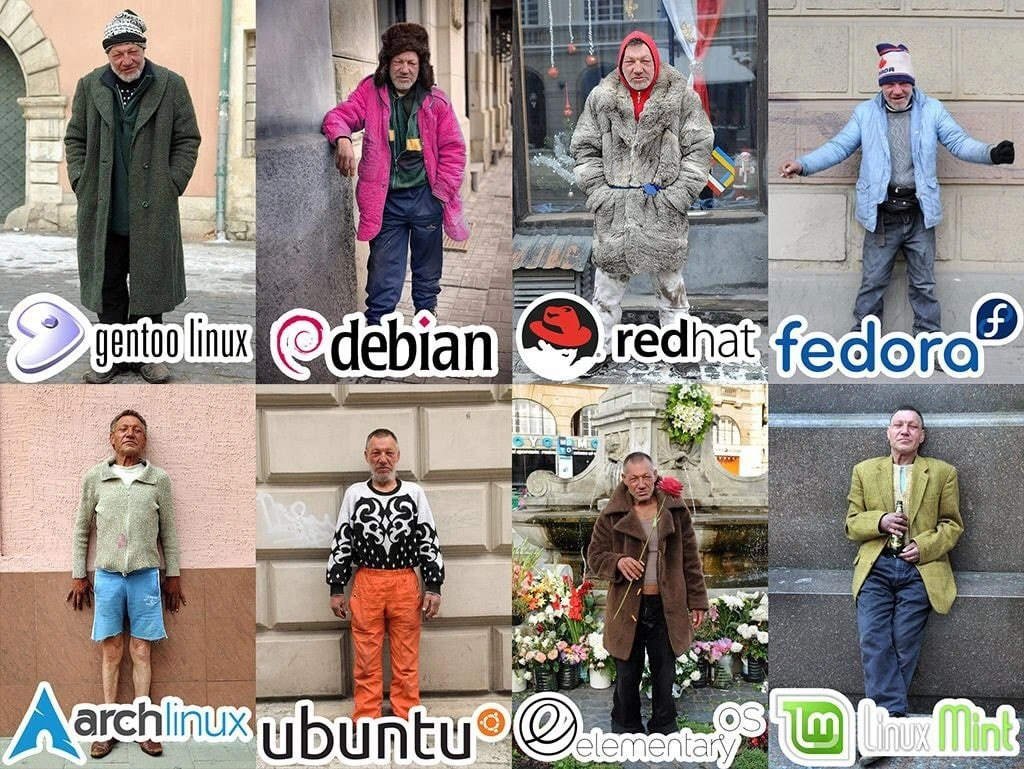
The collage labels eight different outfits with Linux distribution logos and names: gentoo linux, debian, red hat, fedora, arch linux, ubuntu, elementary OS, and Linux Mint. The joke is not that these specific people use those systems. The joke is that LinuxDistributions have such strong community identities that a distro choice can be caricatured as a complete wardrobe, posture, and life philosophy.

That is the heart of OpenSourceCulture tribalism. In theory, Linux distributions are practical packaging decisions: which kernel version, which init system defaults, which package manager, which release cadence, which desktop environment, which support model, and how much configuration the user is expected to do. In practice, those choices become social signals. Your package manager is apparently your personality test, your bootloader is your horoscope, and your dotfiles are admissible evidence.

The labels line up with familiar stereotypes. gentoo linux often signals patient, source-building control. debian suggests old-school reliability and a tolerance for doing things the proven way. red hat carries enterprise weight: certifications, support contracts, and the smell of a server room with a change-control board. fedora is adjacent but more experimental, often treated as the stylish upstream cousin. arch linux is the minimalist do-it-yourself identity, forever one forum thread away from enlightenment or a broken display manager. ubuntu is mainstream and accessible, which in Linux circles somehow becomes both an advantage and an accusation. elementary OS emphasizes desktop polish and visual coherence. Linux Mint reads as practical, comfortable, and aimed at people who want the desktop to behave without turning every Saturday into a boot repair clinic.

The visual humor comes from translating those reputations into street fashion. The top row and bottom row do not explain anything technically; they let the community fill in the blanks. That is why it works as a developer meme. Linux users already know the arguments: rolling release versus stable, source versus binary packages, system defaults versus customization, elegance versus control, beginner friendliness versus purity. The image compresses all of that into a lineup where each distro looks like it dressed itself from its own wiki page.

The post message says "Have a great weekend!", which fits the low-stakes vibe. This is not an outage, not a flamewar thread, and not a benchmark. It is the kind of CommunityInJokes material people share after a week of pretending distro choice is purely rational while quietly judging someone's desktop environment.

Description

A two-row collage maps different Linux distributions to photos of older men wearing distinctive street outfits. The visible distro labels and logos are "gentoo linux", "debian", "red hat", "fedora", "arch linux", "ubuntu", "elementary OS", and "Linux Mint". Each person is posed differently and dressed in a way that implies a stereotype for that distro, from austere and utilitarian to eccentric, fashionable, or casually mismatched. The humor depends on Linux community tribalism: distro choice becomes a personality, wardrobe, and social identity signal.

Comments

15
Anonymous ★ Top Pick The package manager is the personality test; the outfit is just the post-install script.
  1. Anonymous ★ Top Pick

    The package manager is the personality test; the outfit is just the post-install script.

  2. @maksym_x 4y

    Slavik, the homeless man

  3. @karim_mahyari 4y

    All hail Linux Mint (never used it, gonna give it a try sometime)

  4. @Iplay2hours 4y

    Astra Linux?

  5. dev_meme 4y

    we in Iraq, Sunday is not holiday, its very crowded day

  6. dev_meme 4y

    ("

  7. @a_desant 4y

    What about Kyiv безхатько (homeless man)

  8. @andriikosaniak 4y

    Damn, that's a local famous homeless guy from my city (Lviv).

    1. @a_desant 4y

      I thought he's from Kyiv

      1. @andriikosaniak 4y

        https://tsn.ua/exclusive/modni-obrazi-lvivskogo-bezhatka-slavika-skopiyuvav-francuzkiy-brend-odyagu-1837933.html

        1. @a_desant 4y

          Oopsey, sorry, you're right

    2. @romanovich_dev 4y

      Not only Yours. Me also in city

  9. @gorqmorq 4y

    Show me Kali

  10. Deleted Account 4y

    how about Red Star OS

  11. @RiedleroD 4y

    not sure what this meme even means

Use J and K for navigation