Skip to content
DevMeme
5607 of 7435
When Elon realizes Bootstrap came from Twitter: a dev’s dark premonition
Frameworks Post #6151, on Aug 11, 2024 in TG

When Elon realizes Bootstrap came from Twitter: a dev’s dark premonition

Why is this Frameworks meme funny?

Level 1: Our Playground, His Rules

Imagine you and your friends all love playing in a really cool treehouse at the edge of your neighborhood. A nice person from down the street built that treehouse years ago and said, “Anyone can play here!” So it kind of became everyone’s favorite hangout – a free clubhouse where all the kids gather after school. Now suppose that nice neighbor moved away and sold his house to a new guy – let’s call him Mr. Elon. Mr. Elon is famous in town for doing things his own way. He’s the kind of guy who might paint the swing set neon green one day just because he felt like it. Now, the treehouse is technically on Mr. Elon’s new property. You and your friends joke nervously, “He doesn’t seem to know about our treehouse yet... it’d be a shame if he finds out he owns it.” Why do you say that? Because you’re a little scared he might suddenly decide to lock it up, charge money to use it, or turn it into something else entirely.

In this story, the treehouse is like Bootstrap – a fun, useful thing everyone enjoys that originally came from someone (Twitter) who gave it to the community. Mr. Elon represents Elon Musk, the new owner of that someone (since he bought Twitter). The kids’ worried joke, “be a shame if he discovers he owns it,” is just like the meme’s punchline. It’s a simple way of saying: “We really hope the new boss doesn’t mess up this good thing we all use.” It’s funny in a cheeky way, because usually a treehouse or a coding framework is open for all, and the idea of one big boss suddenly taking special control of it feels both silly and a bit scary. Just as you’d laugh and cross your fingers about your playground, developers laugh and cross their fingers that Bootstrap stays safe and fun, no matter who’s in charge of the original house it came from.

Level 2: Bootstrap Bootcamp

Let’s break down the key references so newer developers and tech enthusiasts can appreciate the joke. Bootstrap is a widely-used CSS framework – basically a collection of pre-written CSS (and some JavaScript) that makes it easier to design good-looking, responsive websites. Instead of writing all your button styles, grid layouts, and navbars from scratch, you include the Bootstrap library and apply its ready-made classes (like btn btn-primary or row col-6) to get a clean, uniform look. It’s like a toolkit of Lego blocks for web design. Front-end developers love it because it speeds up development and ensures consistency across different browsers and devices. Now, here’s the kicker: when Bootstrap was first created in 2011, it was called Twitter Bootstrap because it was developed by engineers Mark Otto and Jacob Thornton at Twitter. They built it to maintain design consistency across Twitter’s internal tools, then generously open-sourced it for anyone to use. Over time, it dropped “Twitter” from the name and just became Bootstrap, maintained by the open-source community. But that origin story remains: Bootstrap literally came from Twitter’s halls.

Fast forward to today: Twitter was acquired by Elon Musk (the famous CEO of Tesla and SpaceX) in late 2022. Elon is an influential but unpredictable figure in tech. He’s known for bold moves and controversial changes – for example, after buying Twitter, he almost immediately started transforming it (firing top executives, changing features, and eventually rebranding Twitter as “X”). If you’ve been following tech news, you might also know he changed a lot about how developers interact with Twitter. Famously, he restricted or ended free access to Twitter’s API (the tools that let other apps and researchers pull Twitter data), which upset many developers who used it for cool projects. This context helps explain why developers joke about Elon in a somewhat uneasy way.

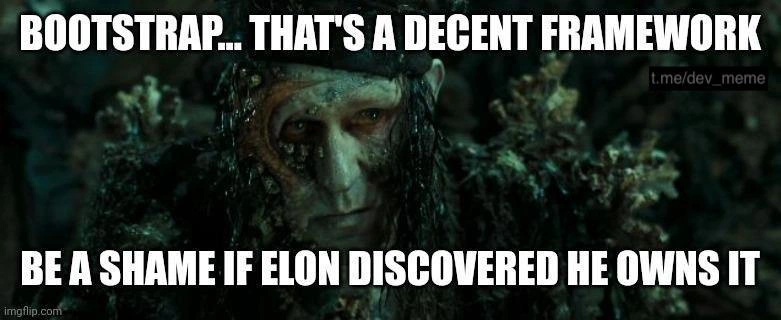
Now, the meme text: “Bootstrap… that’s a decent framework. Be a shame if Elon discovered he owns it.” The first line is praising Bootstrap as a “decent framework,” which many devs agree with – it’s a solid piece of tech and practically a household name in web development. The second line is a twist: “shame if Elon discovered he owns it.” This is referencing a common meme template where someone says “nice ___ you got there, shame if something happened to it.” It usually implies a threat, as if a bully or gangster is eyeing something valuable and hinting at ruining it. In our meme, Elon Musk is being cast in that villainous role, potentially threatening Bootstrap just by realizing his company (Twitter, now X) originally created it. It’s a playful exaggeration – Elon isn’t literally a pirate or mobster – but it taps into developers’ real worry that Musk might unknowingly mess with things they love.

Why would devs think Elon “owns” Bootstrap? Well, since Twitter made Bootstrap, and Elon owns Twitter, one could say Elon indirectly “owns” the origin of Bootstrap. Of course, open-source software doesn’t have an owner in the traditional sense. Bootstrap is under the MIT License, which means anyone can use, modify, and distribute it freely. Twitter (and by extension Elon) can’t suddenly take Bootstrap away from us or start charging money for it because the code is out in the world with a permissive license. However, the meme jabs at a more psychological idea: Elon might not realize Bootstrap was a Twitter-born project, and if one day he does, who knows what wild idea he’d tweet about? Maybe he’d demand credit, or decide that the next version of Bootstrap should have an “X theme” by default, or worse (in jest, people imagine extremes).

The image used is a scene from Pirates of the Caribbean, showing a scary-looking barnacled pirate (from Davy Jones’s cursed crew). In meme culture, pirates or mafia images are often paired with the phrase “be a shame if something happened.” Here it gives off a dark, sea-green vibe, matching the ominous tone of the joke. The top text and bottom text are in that bold white Impact font typical of meme captions, making it instantly recognizable as meme humor. The watermark t.me/dev_meme suggests this image came from a developer meme channel on Telegram, indicating it’s a joke aimed at programmers. Categories like Frameworks, Frontend, and Industry Trends flagged with this meme mean it’s referencing a software framework (Bootstrap), front-end development, and a current industry topic (Elon Musk’s ownership of Twitter and its broader impacts). The tags like bootstrap_css, elon_musk, twitter_acquisition, and corporate_ownership all signal what’s going on: this is humor at the intersection of coding and tech business news.

For a junior dev or someone new to the field, the meme is basically saying: “Hey, you know that UI library Bootstrap you use to make websites look nice? Funny thing, it was made at Twitter. Now Elon Musk owns Twitter, so imagine if he realized he kind of 'owns' Bootstrap too and decided to meddle with it. Wouldn’t that be scary (and ironically funny)?” It’s a form of tech humor that plays on our knowledge of how big personalities can influence technology. The reason it’s funny is the absurdity and dread mix: nobody actually expects Bootstrap to suddenly change because of Elon, but given his recent track record with Twitter itself, developers joke about “what if?” scenarios. It’s like a inside joke among developers about not jinxing a good thing: Bootstrap works great and is free – let’s hope it stays that way, knock on wood. Elon discovering he “owns” Bootstrap is that comedic bad omen that makes this meme both funny and a tad nerve-wracking for those in the know.

Level 3: Open-Source Omen

The meme’s punchline lands squarely in the gut of seasoned developers who have survived corporate takeovers and the unintended collateral damage they can inflict on beloved tools. Here we have Bootstrap, a massively popular CSS framework famously born as “Twitter Bootstrap,” now ominously tied to Elon Musk’s empire. The top caption sets the stage with a seemingly innocent observation: “Bootstrap… that’s a decent framework.” Any experienced dev can practically hear the foreshadowing music. The bottom caption twists the knife: “Be a shame if Elon discovered he owns it.” This is a direct play on the classic mobster meme format “nice thing ya got there... shame if something happened to it,” implying a threat to ruin something good. In this context, Elon Musk is the wildcard threat – known for his unpredictable decisions with acquired companies – and Bootstrap is the unsuspecting treasure that might get caught in a corporate crossfire.

This dark humor resonates because it satirizes a real industry anxiety: the idea that open-source projects can become pawns in corporate power plays. Developers recall how Twitter’s open API went from a thriving ecosystem to severely restricted after Musk’s takeover – so the joke that he might suddenly meddle with Bootstrap doesn’t feel entirely far-fetched (in a nightmare scenario, at least). The meme leverages that shared PTSD: “We’ve got a nice stable framework here, it would be a shame if a billionaire with a flair for chaos took an interest in it.” The senior engineer brain immediately sparks with examples of big acquisitions gone awry. Think of Oracle’s stewardship of Java and MySQL: when Oracle bought Sun Microsystems, Java developers joked nervously about what might break. Or recall how IBM acquired Red Hat – plenty of open-source folks raised an eyebrow even with IBM’s open-source friendly history. The humor here is that Bootstap’s origin at Twitter is a forgotten footnote that suddenly feels like a ticking time bomb under new ownership.

The meme’s imagery choice – a barnacle-encrusted pirate from Pirates of the Caribbean – adds a layer of dark, nautical menace. This isn’t a happy SpongeBob pirate; it’s a cursed crewman delivering a threat. It mirrors how devs view the situation: Bootstrap is the treasure chest, and Elon (by virtue of owning Twitter, the original creator) could become the pirate captain claiming that treasure. The phrase “owns it” is doing heavy lifting here. Legally, Bootstrap is MIT-licensed open-source, so no, Elon can’t lock it away – but the meme isn’t about legal reality, it’s about emotional reality in tech culture. We’ve witnessed tech moguls rebrand products on a whim (R.I.P. Twitter blue bird, hello enigmatic “X”). So, we chuckle nervously imagining Musk waking up one day, realizing “Hey, didn’t my company invent Bootstrap? Shouldn’t I be monetizing that?!”. Cue the collective groan of developers worldwide.

It’s funny because it taps into that cynicism every developer eventually earns: no technology is safe from management’s bizarre ideas. We all know how it goes – one quarterly meeting Elon might declare, “Bootstrap needs to become Xstrap with subscription-only components!” It’s absurd, yes, but absurdity is Musk’s brand these days. The meme is a senior-level inside joke: it name-drops a ubiquitous framework (Bootstrap) and a tech titan (Elon) in a scenario that’s both ridiculous and perversely plausible. It underscores a core truth in software engineering: even our open-source “commons” can feel precariously tied to the whims of their original corporate benefactors. Seasoned devs laugh, but it’s the kind of laugh that comes with a sigh, knowing how often “industry trends” and hype cycles get driven by big personalities rather than purely by technical merit. The meme’s dark premonition is that one man’s ego (or mere realization) could ripple out to millions of codebases, and that’s both hilarious and horrifying to contemplate. In the end, “Open-Source Omen” captures this perfectly: it’s an omen of what could go wrong in the absurd crossover episode of Frontend Frameworks and IndustryTrends_Hype. The joke cuts deep because every experienced developer has a little voice whispering, “please, for the love of clean UI, don’t let it happen.”

Description

Dark, sea-green still from a Pirates-of-the-Caribbean scene forms the background. White impact-font caption at the top reads: “BOOTSTRAP… THAT’S A DECENT FRAMEWORK”. A smaller watermark in the upper-right says “t.me/dev_meme”. Bottom caption in the same bold font states: “BE A SHAME IF ELON DISCOVERED HE OWNS IT”. The center of the frame shows a barnacle-encrusted character (blurred here) delivering the ominous line, evoking the popular “nice X, shame if something happened to it” meme template. The joke plays on the fact that Bootstrap, a widely used CSS UI framework, was originally developed at Twitter - now owned by Elon Musk - hinting that corporate acquisition angst could spill over into open-source tooling. Visually, the meme is high-contrast with teal and dark hues; technically it references frontend frameworks, open-source provenance, and industry takeover culture, making it relatable to seasoned web engineers
Comments

15
Anonymous ★ Top Pick Just waiting for the pull-request that swaps Bootstrap’s MIT license for: “.container now available for $8/month - includes verified padding.”
  1. Anonymous ★ Top Pick

    Just waiting for the pull-request that swaps Bootstrap’s MIT license for: “.container now available for $8/month - includes verified padding.”

  2. Anonymous

    After watching Elon 'improve' Twitter's codebase by firing half the team and breaking features that worked for a decade, the thought of him discovering Bootstrap exists is genuinely terrifying - imagine mandatory rounded corners becoming hexagons because 'first principles thinking' or having to pay $8/month for responsive grid layouts

  3. Anonymous

    The real horror isn't Davy Jones emerging from the depths - it's imagining a world where your entire UI component library gets rebranded to 'X Framework' overnight, half the documentation gets paywalled behind a blue checkmark subscription, and the CDN starts rate-limiting based on your social credit score. At least with Bootstrap, the only breaking changes we fear are in major version releases, not quarterly earnings calls

  4. Anonymous

    Open source doesn’t come with a cap table - if a new owner tries to rename .container to .x-container, that’s a sed -i patch and a spicy release note, not a transfer of rights

  5. Anonymous

    If Elon bought Bootstrap, .container-fluid would rate‑limit itself, the grid would be rebranded XGrid, and every primary color would resolve to #000000

  6. Anonymous

    Bootstrap's grids have outlasted Twitter's pivots; Elon's 'hardcore' mode would mandate Dogecoin payments per media query

  7. @IvanKononenk0 1y

    huh

  8. @Johnny_bit 1y

    is this MDS-fuelled meme? It sure looks like one.

  9. @misesOnWheels 1y

    'why ?

    1. @f0cu53d 1y

      Cuz

  10. @elonmasc_official 1y

    Which Elon? How is he connected to bootstrap? What is MDS? Da fack is so difficult to understand

    1. D Y 1y

      Twiter made bootstrap. Elon owns twitter.

  11. @elonmasc_official 1y

    But why is gonna be the shame for Elon to discover it?

  12. @DmitryArkh 1y

    Apparently Elon also owns Tailwind

  13. Deleted Account 1y

    Bootstrap a decent framework ? 💀💀💀💀💀💀💀💀

Use J and K for navigation