Skip to content
DevMeme
5606 of 7435
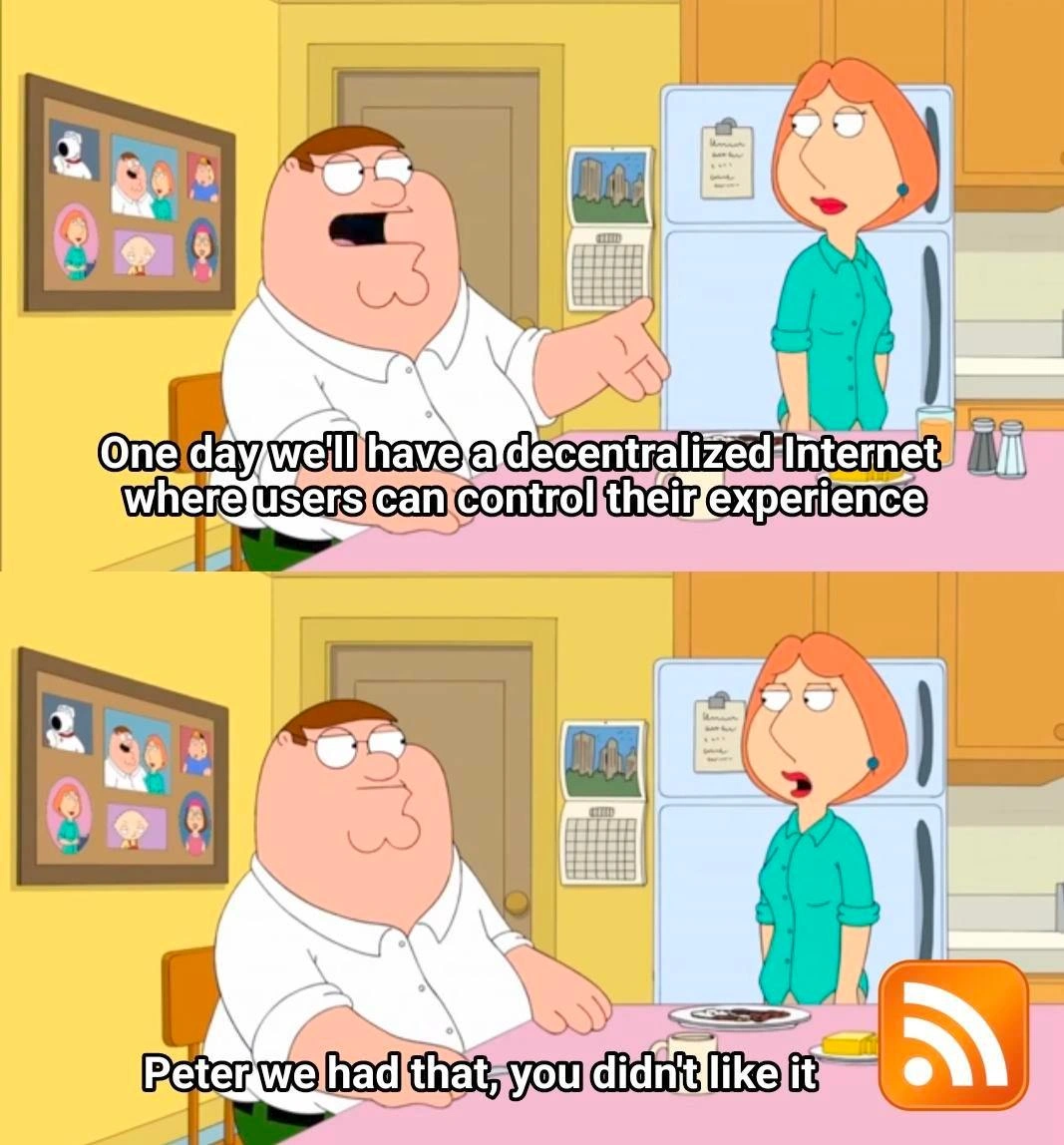
When devs rediscover decentralization and forget RSS existed all along
Blockchain Post #6150, on Aug 11, 2024 in TG

When devs rediscover decentralization and forget RSS existed all along

Why is this Blockchain meme funny?

Level 1: Old Toy, New Box

Imagine you once had a big toy box filled with all your favorite toys, and you could play with any of them whenever you wanted. You were in charge of that toy box – nobody could take toys out or decide which ones you played with. That’s like the Internet when you use tools that let you pick what you see (like following your favorite blogs or comic strips directly). Now, say one day you got bored of your toy box and instead started using a fancy new toy machine that gives you toys. This machine is really flashy and knows what you might like, but it also chooses a lot of the toys for you. After a while, you realize you miss being in control of your old toy box. So you say, “One day, I wish I could have a place where I choose all my toys to play with!” Your mom overhears you and says, “Sweetie, you had that already – it was your old toy box – but you stopped using it.”

In this meme, Peter is like the kid dreaming of that new “decentralized internet” (a special internet where users are in control, kind of like being in charge of your toy box again). Lois, the mom, is pointing out that we had an old way to do just that – represented by the little orange RSS icon (that was like an old toy box for the internet content). The joke is funny because Peter forgot about the good thing he already had. It’s like wanting a new invention, forgetting that the old version was sitting in the attic all along. In simple words, the meme is saying: sometimes tech folks get excited about a brand new idea, not realizing it’s actually something we had before – and maybe we didn’t appreciate it enough back then.

Level 2: RSS – The OG Decentralized Feed

Let’s break down the key terms and imagery for those newer to the tech scene. RSS, which stands for Really Simple Syndication, is a technology from the early 2000s (the Web 2.0 era) that allowed websites to publish updates in a standard format (usually XML). Think of an RSS feed as a news ticker or a Twitter timeline, but one that’s controlled by you. Websites (like blogs, news outlets, forums) would produce feeds of their latest posts, and you’d use a feed_reader app or service (for example, the late great Google Reader, or modern ones like Feedly) to subscribe to those feeds. This way, you’d see all the new articles or posts from all your chosen sources in one place, organized chronologically. No single company decided what articles you should see; you decided by picking the sources. This is what we mean by a user_controlled_content experience. It’s decentralized in the sense that every website is its own publisher – there’s no central authority like a Facebook or Twitter controlling the distribution. The orange icon in the meme’s corner is the universal symbol for an RSS feed (that dot with two curves symbolizing a radio signal or broadcast).

Now, Peter’s line about a “decentralized Internet where users can control their experience” is referencing the promise of Web3Concepts and BlockchainHype. Web3 is a buzzword you might have heard – it often describes an internet powered by blockchain or other distributed technologies, where instead of big companies (like social media giants or YouTube) owning the platforms and data, the users or the community do. It’s all about decentralizationConcepts: removing single points of control. For instance, instead of Facebook holding all your social data, a Web3 social network might let you own your data and move it around, or instead of YouTube controlling video monetization, a decentralized video platform might use tokens to let viewers and creators interact directly. It’s a cool idea, but also a very hyped trend in recent years, and it tends to involve complicated tech like blockchains (which are basically special databases that many computers build and verify together, so no one completely owns it – kind of like a shared Google Sheet that nobody can cheat on because everyone’s watching each other).

The joke is, we already had something that gave the user-controlled experience for content: RSS feeds! Lois, in the second panel, represents the voice of someone who remembers tech history (or just a no-nonsense reality check). When she says, “Peter we had that, you didn’t like it,” she’s pointing out that the dream Peter has is not new. In fact, technologies like RSS (and also things like email newsletters, independent blogs, even feed_readers and forums) offered a way for users to curate what they see online, outside the control of any one corporation. But many people (Peter in this scenario) stopped using those open, decentralized tools. Why? A mix of reasons: newer platforms (like social media apps) were more convenient or flashy, and not as nerdy to set up. RSS, while beloved by many developers and journalists, never became a mainstream daily tool for everyone – it stayed a bit “techie.” Also, big companies didn’t have a direct way to make money if everyone was just using open feeds and an ad-free reader app. So, over time, fewer casual users followed RSS feeds, and more people just got their news from algorithm-driven feeds on Twitter, Facebook, or Reddit.

Fast forward to today: there’s a lot of chatter about “decentralizing the web” again. People talk about things like the “fediverse” (federated social networks like Mastodon, which is sort of Twitter-like but decentralized) or using blockchains to create social networks and content platforms where users have more control or ownership (sometimes called Web3 social media). It’s in vogue to say the next iteration of the internet will give power back to users and not be controlled by Big Tech. Peter’s quote captures that starry-eyed optimism. But Lois’s retort – with that RSS icon as a visual cue – reminds us: we already had an Internet like that, built on legacy_open_standards (like RSS for reading content, or protocols like SMTP for email, which is inherently decentralized too). And the kicker: when we had it, many folks (maybe including the same developers now hyping Web3) ignored it or let it die. Google Reader (the most popular RSS reader) was killed off, and there was some outcry, but mostly the world moved on to getting content from centralized feeds run by algorithms.

In simpler terms, the meme is like a conversation:

  • Peter (excited dev): “Wouldn’t it be great if we could build a new system where nobody owns everything and each person can pick what they see online? That would be so innovative!”
  • Lois (long-time user/dev): “Umm… we literally did that already with RSS and open web tools. But you guys stopped using them because something shinier came along.”

It’s a bit of a lighthearted smackdown. The categories like Blockchain and IndustryTrends_Hype are touched on because this is poking at the current trend of using blockchain for everything (BlockchainHype), and the notion of decentralization is a big buzzword. The IndustryIrony or satire here is that the tech industry sometimes has a short memory: it’s cycling back to old ideas but acting like they’re new. And using a family_guy_meme format – a popular setup in InternetCulture for humor – makes the message clear and accessible: even if you don’t know all the details, you see that Peter’s wishful idea was something Lois says we had before. The RSS icon clue might prompt some to think, “Oh right, RSS feeds… we kind of forgot about those.” If you’re a junior dev or a student, the lesson lurking behind the joke is: always check if someone in the past already built the thing you’re excited about. You might find that the high-tech solution of today has a Web2_vs_Web3 ancestor from yesterday.

Level 3: The Hype Cycle Redux

From a senior developer’s perspective, this meme nails a classic TechHypeCycle pattern: the industry rediscovers an old idea, gives it a shiny new coat of paint (and often a token or blockchain), and proclaims it the future. Peter’s enthusiastic claim about a “decentralized Internet where users control their experience” echoes countless BlockchainHype pitches about Web3: from decentralized social networks and content platforms to user-owned data marketplaces. The punchline, delivered by Lois with an exasperated “we had that, you didn’t like it”, alludes to RSS feeds and other legacy_open_standards that offered exactly those ideals years ago. Remember the era of personal blogs and feed_readers (like Google Reader, which was basically every dev’s morning newspaper until its shutdown in 2013)? Back then, you could decentralize your content diet by subscribing to any site’s RSS or Atom feed. No black-box algorithms decided what you saw – you did. It was a golden age of user_controlled_content on the WebDev front: you’d stitch together your own timeline from diverse sources, effectively controlling your online experience without a central platform’s permission. But what happened? The InternetCulture shifted toward centralized social media platforms and walled-garden apps (Facebook, Twitter, YouTube) because they were slick, easy, and came with dopamine-inducing feeds. Many users (Peter, we’re looking at you) abandoned those decentralized RSS habits in favor of Big Tech’s curated timelines. The irony (and IndustryIrony tag come to life) is that now, after years of ceding control to algorithms and ad-driven platforms, the tech world longs for “decentralization” again. Only this time, it’s wrapped in blockchain buzzwords and Web3Concepts. The meme humorously calls out how IndustryTrends_Hype can blind us: we get excited about a revolutionary new solution (decentralize everything with blockchain!) while forgetting that simpler, proven solutions (open protocols like RSS, email, XMPP) already solved many aspects of the problem. It’s a bit of a facepalm for veteran engineers – we’ve been here before. In the Family Guy format, Peter’s starry-eyed naiveté represents hype-driven devs or thought leaders romanticizing the next big thing, and Lois is the voice of the grizzled CynicalVeteran or TechHistorian reminding them, “Hey genius, we already built this and you all shrugged it off.” The inclusion of the bright orange rss_feed_icon in the corner of the meme is the mic drop moment – a visual reminder of the RSS era. It subtly underscores the joke: while Web3 evangelists brag about “decentralization” via complex blockchain networks, there’s an almost retro solution that’s been quietly doing decentralization all along, sans tokens, fancy cryptography, or billion-dollar valuations. For seasoned developers, the meme hits on a painful truth: we often chase new technology not because the old tech failed, but because the new tech is shiny (and perhaps VC-fundable). It’s a little satire of our industry’s tendency to develop amnesia about past tools. After all, DecentralizationConcepts aren’t new – they’re just resurfacing in a new form. And nothing elicits a knowing, slightly bitter laugh in a senior dev more than “rediscovering” an old wheel and calling it innovation. Peter’s utopian claim and Lois’s realist retort capture this dynamic perfectly, making the meme a spicy bit of TechIndustrySatire that says, “We had freedom and control on the web once; we gave it up… and now we act like we’ve found a magical solution, conveniently forgetting our own history.”

Level 4: Syndication vs Consensus

At the deepest technical level, this meme pits two distributed content models against each other: the old-school RSS syndication and the newfangled blockchain-powered Web3 approach. RSS (Really Simple Syndication) is an open legacy standard from the early Web that enables decentralized_internet content distribution without any central authority. Each content publisher (like a blog or news site) generates an XML feed of updates, and users aggregate those feeds in their own readers. This is a federated* model – every feed is autonomous, and users control their content experience by choosing which feeds to subscribe to. There’s no need for a global agreement on the “state” of all feeds; each RSS feed exists independently. In contrast, the Web3Concepts of decentralization often imply a trustless network where all nodes must reach consensus on shared data (as in blockchain-based systems). Blockchains solve a hard distributed computing puzzle – the Byzantine Generals Problem – using heavy tools like Proof-of-Work or Proof-of-Stake. These ensure no single node can forge the truth, at the cost of significant complexity and resource usage. In pure technical terms, RSS and blockchain tackle decentralization on different layers: RSS operates at the application layer (content sharing) leveraging simple open protocols (HTTP + XML) and assumes a level of trust in each content source, whereas blockchain operates at the data/ledger layer ensuring cryptographic trust among untrusted parties. The humor here is that developers are hyping a futuristic, cryptographically-enforced decentralized_internet (where every client might run a full node, verify content via consensus, etc.), seemingly oblivious to the fact that a much simpler, legacy_open_standard (RSS) has for decades allowed users to self-curate and control their content feeds without any fancy consensus algorithms. It’s a playful jab at how we sometimes reach for extremely complex distributed systems solutions (global ledgers, smart contracts, content addressed storage) to reinvent a wheel we already had rolling smoothly with a straightforward syndication format. The meme’s wink is that, theoretically, if you strip away the cryptographic trustless requirement, an open RSS-like architecture already delivers a decentralized user experience with far less overhead – a notion that might make a TechHistorian raise an eyebrow at the BlockchainHype.

Description

Two-panel Family Guy meme set in the Griffin kitchen. Panel 1: Peter, seated at the table, enthusiastically points and says in bold white subtitle text, “One day we’ll have a decentralized Internet where users can control their experience.” Panel 2: Lois, standing by the refrigerator, replies in subtitle text, “Peter we had that, you didn’t like it.” An orange square in the lower-right corner shows the classic white RSS broadcast icon. The joke contrasts current Web3/blockchain hype about a user-controlled, decentralized web with the long-standing, open RSS standard that let people self-curate content feeds, highlighting how the industry often chases shiny new buzzwords while ignoring existing solutions

Comments

17
Anonymous ★ Top Pick Let the blockchain squad raise a Series B for “self-sovereign content feeds” while I quietly relabel RSS as a “Distributed Event Stream” and send them the consulting invoice
  1. Anonymous ★ Top Pick

    Let the blockchain squad raise a Series B for “self-sovereign content feeds” while I quietly relabel RSS as a “Distributed Event Stream” and send them the consulting invoice

  2. Anonymous

    The real decentralized web was the RSS feeds we killed along the way - right after Google Reader shut down and we all decided algorithmic timelines were somehow better than chronological feeds we actually controlled

  3. Anonymous

    Ah yes, the eternal cycle: engineers build decentralized protocols that require users to manage their own infrastructure, users choose centralized platforms for convenience, engineers complain about centralization, engineers build new decentralized protocols. We literally had RSS - a beautifully simple, open standard where you controlled your feed reader, chose your sources, and owned your subscription list. But then we collectively decided that was too much work and handed everything to Facebook's algorithm. Now we're trying to solve centralization with blockchain, NFTs, and crypto wallets, because apparently managing private keys and gas fees is *totally* more user-friendly than subscribing to an RSS feed. The real decentralization was the RSS feeds we abandoned along the way

  4. Anonymous

    We shipped decentralized, user-controlled feeds in 2005 called RSS; then OKRs demanded 'engagement', and walled gardens got promoted to architecture

  5. Anonymous

    Web3 pitch: user-owned feeds on a decentralized network - 2005 me called it RSS on a $5 VPS, no tokenomics, just OPML

  6. Anonymous

    RSS: user-controlled feeds we ditched because who needs sovereignty when algorithms serve ragebait on a platter?

  7. @noi01 1y

    Explain

    1. @trainzman 1y

      RSS

      1. @noi01 1y

        I remember seeing that icon, espesially on an older websites, thanks for the source

    2. @AmindaEU 1y

      https://en.wikipedia.org/wiki/RSS

      1. @AmindaEU 1y

        https://indieweb.org/RSS might be a better link in this context though

  8. @heito_r 1y

    Truer words were never spoken.

  9. @beton_kruglosu_totchno 1y

    what a stupid thing to say

  10. @romanthekat 1y

    still use rss from time to time ^_^

    1. @erizpl 1y

      daily, thankfully it's still alive and quite useful

  11. @mira_the_cat 1y

    is torrent only one which is still alive?

  12. @tema3210 1y

    That's for a different purpose

Use J and K for navigation