Skip to content
DevMeme
5608 of 7435
Open Source Game Pivots to Gen Alpha Brain Rot
OpenSource Post #6152, on Aug 13, 2024 in TG

Open Source Game Pivots to Gen Alpha Brain Rot

Why is this OpenSource meme funny?

Level 1: Playground Becomes Arcade

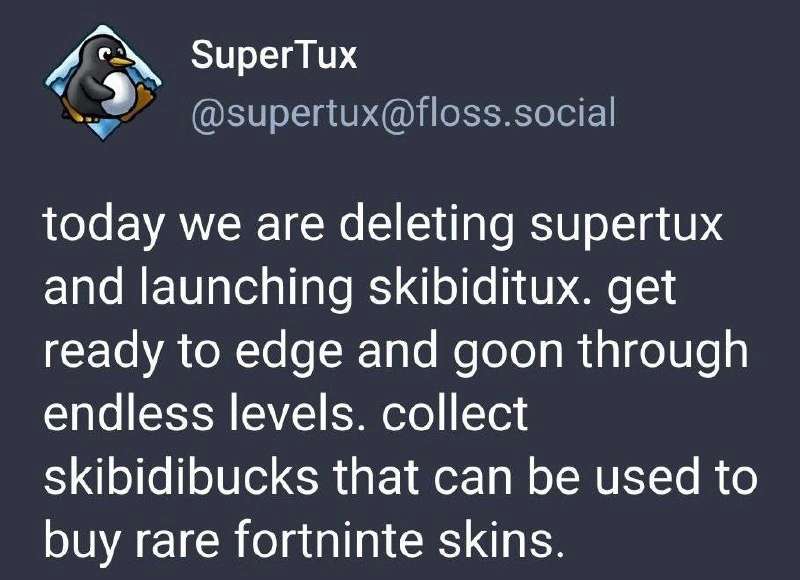
Imagine you have a favorite public playground in your neighborhood. It’s a simple, happy place run by kind volunteers, where you can play for free anytime. There’s a friendly penguin theme to it, and it’s been around forever – everyone loves it because it’s fun and doesn’t cost a thing. Now picture one day the folks in charge announce: “We’re tearing down the old playground and rebranding it as the Skibidi Playground!” They say it’s going to be based on the latest wacky dance craze all the kids are doing online (something totally unrelated to the usual penguin theme you knew). Not only that, but this new playground will have endless games and levels, almost like a carnival that never closes. Sounds exciting, maybe? But here’s the catch: to play on the new super-fun equipment, you won’t just be playing freely anymore – you’ll need to collect special tokens, let’s call them Skibidibucks. You can earn a few by playing, but realistically you might have to buy more with real money. And what do you use these tokens for? To get cool costumes of famous characters from another hugely popular game (imagine being able to dress up as a Fortnite character on the playground).

This scenario is pretty wild, right? Your sweet free playground is suddenly turning into a flashy arcade or theme park that’s capitalizing on the latest fad and even charging money for extra goodies. It feels over-the-top and a bit wrong: something that was once just about simple fun and community is now about cash and trends. That mismatch is exactly why the original post is funny. It’s taking a lovable old thing (a penguin game that’s like the playground) and joking that it will become this crazy new thing (SkibidiTux, like a glitzy arcade) where you have to use funny money (Skibidibucks tokens) to get fancy outfits (Fortnite skins). The idea is so exaggerated and silly that you can’t help but laugh at it – it’s like a prank announcement saying “We’re turning your nice sandbox into a wild game store because that’s what’s hip now!” Even if you don’t know the specific game names, the humor is in that feeling of a beloved simple thing suddenly chasing a trend and asking for money. It’s both ridiculous and a little bit making fun of how some companies actually behave. In the end, we laugh because we know the penguin playground would never really do this – it’s a joke showing what it would look like if it did.

Level 2: Meme-Driven Makeover

Let’s break this down in simpler terms and explain the buzzwords. SuperTux is the name of a real open-source game. Open-source means the game’s code is freely available for anyone to see, change, and share – usually these projects are maintained by volunteers for the fun and passion of it (not to make money). SuperTux in particular is a cute 2D platformer (like the old Super Mario games) featuring Tux the penguin (Tux is the mascot of Linux, so he’s a familiar character in DevCommunities). It’s a game with a lot of nostalgia and a free spirit: no cost to play, no in-game purchases, just straightforward fun.

Now, the post says they are “deleting supertux and launching skibiditux.” This implies a rebranding – essentially throwing away the old name/identity and starting fresh with a new one. Why SkibidiTux? This is referencing a viral meme known as “Skibidi” (likely the Skibidi Toilet videos or a TikTok trend where characters dance to a catchy tune saying “Skibidi”). It’s a silly internet phenomenon that has nothing to do with SuperTux’s original theme. By choosing that name, the post mimics how companies sometimes chase viral trends to seem relevant. It's a meme-driven makeover: changing a project just to ride the wave of what's popular online. This is commonly seen in the tech world – for example, when every app suddenly added a feature related to a hot trend (like when all games wanted a battle royale mode after Fortnite became a hit, or when apps jumped on the blockchain bandwagon during the crypto hype). In the context of IndustryTrends_Hype, “SkibidiTux” suggests that even our innocent penguin game is jumping on the latest bandwagon. The phrase “deleting SuperTux” is hyperbole – indicating a total replacement of the old project – which itself is a joking nod to how sudden and drastic these pivots can feel.

Next part: “get ready to edge and goon through endless levels.” This is phrased in a deliberately exaggerated, somewhat goofy way. “Endless levels” hints that the game is now going to have infinite content or a never-ending mode. Many modern games (especially mobile or free-to-play games) use endless or very long progression to keep players engaged for as long as possible. It’s part of what we call player engagement strategy – basically, design tricks to make you play longer and maybe spend more money over time. The words “edge” and “goon” are slang that here mean something like “stay excited and crazed.” They’re not standard gaming terms; they come off as GamingCulture jargon mixed with internet slang, thrown in for shock humor. The effect is to make the announcement sound overhyped and a bit unhinged, as if the game is trying very hard to excite (or overstimulate) you. It parodies the tone of some game marketing that promises extreme, never-ending thrills. For a newcomer: imagine a game ad saying “Prepare to be on the edge of your seat, going wild through infinite challenges!” – it’s that kind of over-excited tone, just using even sillier wording.

Now the juicy satire: “collect skibidibucks that can be used to buy rare fortnite skins.” Here we have multiple layers:

  • Skibidibucks: The suffix “bucks” clues us in that this is a fake currency. In many popular games, especially free ones, there’s a virtual currency you earn or buy. For example, in Fortnite (one of the world’s most popular online games), the currency is called V-Bucks. You usually purchase V-Bucks with real money, then spend them in-game.
  • By naming it Skibidibucks, the post is parodying this concept, tying it to the Skibidi meme theme. It implies that in “SkibidiTux”, players would collect or purchase these Skibidi-coins.
  • Fortnite skins: A “skin” in gaming is just a cosmetic outfit or appearance change for your character or items – it doesn’t affect gameplay, just how things look. Fortnite is famous for its skins; players often buy skins to make their character look like popular movie characters, superheroes, or wear cool costumes. Skins have become a huge part of gaming culture, sometimes even a status symbol among players.
  • Saying that Skibidibucks can buy “rare Fortnite skins” is purposefully ridiculous. Fortnite is a completely separate, closed source game owned by a big corporation (Epic Games). The idea that an open-source penguin game would let you buy Fortnite’s proprietary skins is absurd – it would be an intellectual property nightmare in reality! But as a joke, it accentuates how far this hypothetical rebranding is willing to go to copy mainstream monetization. It’s like they’re bolting on the entire monetization strategy of a big commercial game.
  • This is clearly a microtransactions_parody. Microtransactions are those small purchases in games (like buying currency, skins, extra levels, loot boxes, etc.). Fortnite skins are a prime example: you spend a few dollars here and there for cosmetic items. It’s a huge revenue model in modern gaming, but typically not something you see in a free software project like SuperTux. Open-source games generally don’t have microtransactions; they’re often free downloads with maybe an option to donate to the developers, but not an in-game economy designed to make money.

By combining all this, the post is humorously illustrating trend_chasing in the worst (funniest) way possible: “We had a nice free game, but forget that – we’re now a trendy meme game with endless grind and in-game money for skins!” For a junior dev or someone new to these ideas, the humor lands when you understand how each element clashes with the original spirit of SuperTux:

  • SuperTux = simple, community-made classic game.
  • SkibidiTux = bandwagon-hopping meme game name (Skibidi is a random viral trend unrelated to the game).
  • Skibidibucks = fake money (satirizing games that make you collect/buy funny money).
  • Rare Fortnite skins = cross-over to a famous commercial game’s monetization gimmick (something a small open-source project would never actually do).

It’s an inside joke in tech and gaming circles. People who love open-source (like those on a Mastodon instance floss.social – FLoSS stands for Free/Libre Open Source Software) would find it laughably outrageous that a beloved FOSS game might “sell out” like this. The post format itself mimics a social media announcement, which adds to the joke – it’s pretending to be an official statement from the SuperTux maintainer, delivered in a deadpan way. That contrast (serious announcement tone vs. ridiculous content) is classic parody. So, in simpler summary: the meme humorously imagines an open-source game abandoning its old identity to chase a silly internet fad and adopt the money-making schemes of big commercial games. If you know how opposed the open-source community usually is to those hype-driven, money-grabbing tactics, you’ll get why this is both funny and pointed commentary.

Level 3: Hype-Driven Game Dev

At this level, we dive deep into why this post is hilarious (and a bit horrifying) to seasoned developers. SuperTux is a classic open-source platformer game starring the Linux penguin Tux – think of it as a free software love letter to Super Mario. It embodies the ideals of the OpenSource community: collaborative development, no cost to play, and certainly no shady monetization. Now this social post claims “we are deleting supertux and launching skibiditux.” That one sentence alone is dripping with tech humor and irony. Why? Because it lampoons the very real trend of projects abruptly rebranding or pivoting to chase whatever viral phenomenon is hot right now – the ultimate TechHypeCycle maneuver. In real software terms, it’s like suddenly refactoring a stable project to use a completely new, unproven framework just because it’s trending on Hacker News. Here, the imaginary framework is “Skibidi,” referencing the absurdly viral Skibidi Toilet meme/videos. Seasoned devs have seen this hype-chasing before: one year every game must add a battle royale mode (thanks, Fortnite), the next year everything needs blockchain or NFTs, and so on. This post cranks that to 11 by suggesting an open-source game would throw away its identity (literally deleting SuperTux) to become SkibidiTux, a cringe-inducing mashup with a current meme. It’s a parody of trend_chasing in game development and IndustryTrends_Hype cycles – truly a “what if FOSS hopped on the hype train” scenario.

Now, about “get ready to edge and goon through endless levels.” This phrasing sounds intentionally over-the-top and frankly bizarre. In gaming slang (and some…other contexts) “edging” and “gooning” imply being teased and over-stimulated for a long time. Here it's used ironically: the project is promising an endless, addictive grind. This is poking fun at how modern Games-as-a-Service are designed to be endless levels of repetitive content meant to keep players hooked (and spending). It’s as if our gentle penguin platformer suddenly adopted the dark arts of player retention and engagement metrics that big gaming studios obsess over. The enthusiastic educator in me imagines the veteran devs reading that line and chuckling (or cringing): we’ve gone from a wholesome Super Mario clone to something that sounds like a seedy arcade’s marketing pitch. This highlights a pain point known in DevCommunities – the clash between pure, creative game development and the cold, calculated tricks to maximize player “engagement” (i.e., get players addicted).

The kicker is the currency bit: “collect skibidibucks that can be used to buy rare fortnite skins.” Here, Skibidibucks parody the idea of custom in-game currencies (like Fortnite’s famous V-Bucks) that free-to-play games use to facilitate microtransactions. In a real AAA game, you buy V-Bucks with real money, then spend them on skins (cosmetic outfits or character looks, purely for flex and fun). Seeing Fortnite skins referenced in an open_source_games context is peak absurdity: Fortnite is a closed-source, massively profitable enterprise, basically the opposite of a community-driven FOSS project. The meme is painting a scenario where an earnest free game adopts the most commercial monetization strategy out there, essentially betraying its free software ethos. It’s satire aimed at how even open-source or indie projects might be tempted (or pressured) to adopt mainstream monetization when a hype wave hits. It resonates deeply with developers familiar with free software ideals: the idea of bolting on microtransactions to a libre game is sacrilege – and thus darkly funny.

Importantly, this meme isn’t just random absurdity; it’s an inside joke targeting the intersection of GamingCulture and open-source DevCommunities. For context, SuperTux is beloved in Linux circles, a symbol of community-driven game dev. The notion that it would suddenly chase a meme (“Skibidi”) and introduce a fake currency is a deliberate exaggeration to mock industry trends. It mirrors how big gaming companies market their products: endless content, edgy phrasing, hype rebrands, and virtual currencies for monetization. Seasoned developers have seen so many projects fall prey to the “let’s pivot to whatever kids are into this week” mentality that this extreme parody hits home. We laugh (maybe with a groan) because we recognize the pattern – it’s taking the TechHypeCycle to a ridiculously ill-fitting conclusion. It’s like seeing your favorite little indie tool suddenly announce it’s now an AI-powered crypto metaverse platform – the mismatch is the joke. In short, the humor comes from the collision of FOSS purity with Fortnite-style profiteering, highlighting the absurd lengths projects go to ride hype waves. The meme cleverly compresses several industry sore spots – rebranding for hype, endless engagement loops, and microtransaction cash-grabs – into one fake announcement. Experienced devs find it both funny and painfully true, a parody that underscores just how common (and cringe-inducing) trend_chasing has become in the tech and gaming world.

Description

A screenshot of a social media post from the official account for 'SuperTux' (@[email protected]), a well-known open-source video game. The profile picture is the game's penguin mascot, Tux. The post is a satirical announcement stating: 'today we are deleting supertux and launching skibiditux. get ready to edge and goon through endless levels. collect skibidibucks that can be used to buy rare fortninte skins.' The humor is derived from the extreme and absurd culture clash between the wholesome, community-driven, FOSS (Free and Open Source Software) world of SuperTux and the chaotic, monetized, and often bizarre world of modern internet trends popular with a younger audience (Gen Alpha/Gen Z). It combines references to the 'Skibidi Toilet' meme series, sexual slang ('edging' and 'gooning'), and the microtransaction model of mainstream games like Fortnite, creating a nightmare scenario for any FOSS purist

Comments

10
Anonymous ★ Top Pick The SuperTux dev team finally implemented a feature monetization strategy, but the pull request is just a link to a TikTok dance and a demand for 'skibidibucks'. It's the final boss of selling out
  1. Anonymous ★ Top Pick

    The SuperTux dev team finally implemented a feature monetization strategy, but the pull request is just a link to a TikTok dance and a demand for 'skibidibucks'. It's the final boss of selling out

  2. Anonymous

    SuperTux pivoting to SkibidiTux with SkibidiBucks is peak 2023: “free as in freedom” just morphed into “freemium as in Fortnite” - stay tuned for the $4.99 DLC that lets you git clone

  3. Anonymous

    After 20 years of maintaining an open-source game, the real boss battle isn't Bowser - it's explaining to your board why you haven't pivoted to blockchain-powered battle passes with AI-generated NFT penguins that mine cryptocurrency while players 'edge through levels.'

  4. Anonymous

    When your beloved FLOSS project's roadmap suddenly includes 'tokenomics' and 'rare cosmetic NFTs,' you know someone's been to too many VC pitch meetings. SuperTux going from GPL to 'goon through endless levels' is the kind of pivot that makes you wonder if the maintainers accidentally merged a parody PR into main - or if this is just what happens when you let product managers near your open-source game engine after they discover Web3 Twitter

  5. Anonymous

    Open-source pivot: delete SuperTux, relaunch as SkibidiTux with skibidibucks - engineering plan: sed -i 's/SuperTux/SkibidiTux/g' and a wallets table; community plan: fork by Friday

  6. Anonymous

    SuperTux maintainers finally nailed monetization: delete the repo, add skibidibucks for Fortnite skins - legacy code meets Web3 vibes

  7. Anonymous

    Peak open source pivot: archive the repo, rebrand for SEO, and introduce a virtual currency - because nothing boosts DAU like turning a tarball into a battle pass

  8. @yoyatayo 1y

    chat chat is this real? Cant find this tweet

    1. @AmindaEU 1y

      Try Mastodon

  9. @azizhakberdiev 1y

    can't even turn on pc in ohio

Use J and K for navigation